Showing posts with label un-desa. Show all posts

Wednesday, 8 August 2012

China Daily: - - China's best play a part on international stage (These are the Chinese players)

China's best play a part on international stage

Click here to read this at China Daily: http://www.chinadaily.com.cn/cndy/2012-08/08/content_15651073.htm


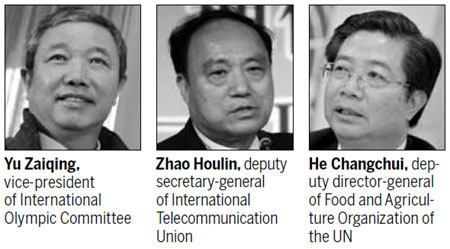
More Chinese than ever are holding key positions in international organizations in recent years, broadening developing countries' influence on the world stage.

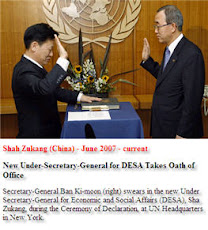
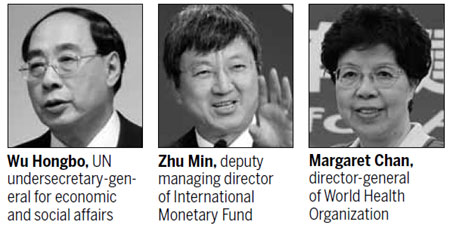
The latest example is Wu Hongbo, former Chinese ambassador to Germany, who was appointed in late May as undersecretary-general for economics and social affairs in the United Nations, replacing Sha Zukang, another Chinese official. Sha had held the position since February 2007.

Before Wu and Sha, Chen Jian was undersecretary-general for General Assembly Affairs and Conference Service of the UN from 2001 to 2007.

Undersecretary-general is the highest position in the UN that can be held by a Chinese citizen, as there is a rule that the UN secretary-general cannot come from the five permanent members of the UN Security Council.

The changes in their areas of responsibility reflect the rise of China's national strength and international influence, said Zhang Yi, deputy director of the Secretariat of the United Nations Association of China.

Chinese officials bring to the table their experience in economic development and addressing the needs of a developing country, adding to the variety and efficiency of international organizations, Zhang said.

In recent years, more Chinese officials have held key positions at international organizations.
In 2011, Zhu Min became the first Chinese to hold the position of deputy managing director of the International Monetary Fund, and Justin Yifu Lin just concluded a four-year term as World Bank chief economist and senior vice-president in June.

Statistics from the UN show that in 2011 China contributed $74.9 million to the organization's annual budget - the eighth most among the 193 UN members.

China currently has less than 500 staff at the UN Secretariat, which is the fewest among the five permanent members of the UN Security Council and fewer than UN members such as Pakistan and Japan, Zhang told China Daily.

The number of UN staff allowed for each member country is determined using a formula that includes demographics and GDP, with budget contributions being a decisive factor.
Holding key positions at international organizations "increases China's voice on the world stage and helps China win more rights in international organizations", said Jin Canrong, deputy dean of the School of International Studies at Renmin University of China.

With the exception of Margaret Chan, director-general of the World Health Organization from Hong Kong, and Wu Jianmin, who was elected president of the International Exhibitions Bureau in 2003, Jin noted that the total number of Chinese officials in decision-making positions at international organizations still lags behind other countries such as India and Japan.

"The increase in the number of high-level Chinese officials in international organizations cannot match the growth of China's national strength, which is likely to harm China's national interests in future, as China contributes an increasing amount of money to these international organizations but still lacks power in decision making," Jin said.

"A country's international position is not only reflected by its own national strength, but also the degree of acceptance by the world," Jin said. "One of the indicators is its participation in international organizations."

The largest difficulty for Chinese citizens working in international organizations is cultural differences, Zhang said. Chinese are used to keeping a low profile and are more concerned with the collective honor of a group, while their Western counterparts are aggressive and highlight personal values, Zhang said. Zhang and Jin said most Chinese staff at international organizations are placed in low-level positions.

The inability to master multiple languages also keeps most Chinese from standing out in the competition to become an international civil servant, Jin said. "Some government departments, which have talents fit for the requirements of international organizations, should let them go instead of hanging on to them," Jin said.

China urgently needs to train more qualified professionals as reserve forces to work in international organizations, Zhang said.

In 2011, the United Nations Association of China and the department of international cooperation at the Ministry of Human Resources and Social Security began co-hosting a training program for international civil servants.

Sponsored by China Ocean Shipping Company, the program has had more than 200 participants in the last two years, mostly university students.

The eight-day program includes an introduction to the UN system, major international issues and lectures by professors and diplomats.

Zhao Liang, 21, participated in the program in 2011. She received an internship with the United Nations Development Programme in China from February to June.

"I hope I can work for the UN in the future, after working at other places and accumulating enough experience to meet the high standards required by the UN," she told China Daily.

Zhao said she will represent China's views and positions when working for an international organization, even though international civil servants are not designated according to a person's home country.

Zhao, who graduated from Renmin University of China this summer, will soon go to the United States to continue her studies in politics.

"I hope this training program will become the starting point of your dreams and a cradle of backup talents for international civil servants from China," Chen, who is president of the UN Association of China, wrote in a foreword for the training program's 2011 student brochure. "It is also expected to help enhance China's capacity in participating in global governance and increase the interest and level of study in international organizations in China," Chen wrote.
chengguangjin@chinadaily.com.cn

Click here to read this at China Daily: http://www.chinadaily.com.cn/cndy/2012-08/08/content_15651073.htm

Tuesday, 31 July 2012

New Assistant Secretary-General for Economic Development takes office

Shamshad Akhtar


photo of desa's asg Shamshad Akhtar

Shamshad Akhtar was appointed by the Secretary-General as Assistant Secretary-General for Economic Development at DESA and took office on 9 July 2012.
Ms. Akhtar has previously served as Governor of the Central Bank of Pakistan and recently also as Vice President of the Middle East and North Africa Region of the World Bank. In her capacity as Governor, Ms. Akhtar served as the Chairperson of the Central Bank Board and its affiliates and as Governor of the IMF. During her term, she was recognized for the conduct of the bank, which was restructured significantly, the introduction of an analytical framework for monetary policy, and the development of a ten-year-vision for the finance industry with a vibrant structure for the banking sector. For these accomplishments, she won two consecutive awards as Asia's Best Central Bank Governor from Emerging Markets and the Banker’s Trust. In 2008, The Asian Wall Street Journal also recognized her as one of the top ten professional women of Asia.
Ms. Akhtar has had a long standing career with the Multilateral Development Banks (MDBs). In her assignment for the World Bank she spearheaded the Bank’s response to the Arab Spring and the Arab regional integration strategy and its implementation. She has served the Asian Development Bank (ADB) for almost 15 years, rising from the ranks as Senior Economist, to attaining the highest professional positions including as Special Senior Advisor to the President of ADB and as the bank’s Director General of the East Asia region. During the Asian Financial crisis she also served as the ADB’s Coordinator to the APEC Finance Minister providing analytical support in a number of economic and social areas for crisis prevention and mitigation, while also leading the engagement with the Bank for International Settlement, and other standard setting bodies.
Ms. Akhtar has worked in several regions/countries dealing with fiscal and taxation policy, decentralization, poverty and inequality, financial and monetary policy, industrial and infrastructure policies and governance development. In the past few months she further served as a member of the Pakistan Economic Advisory Committee and of the Governing Council of Pakistan Statistics Bureau. In addition, Ms. Akhtar advised development agencies on the operationalization of Pakistan’s New Economic Growth Framework and worked on PPP policy frameworks and governance issues.
Ms. Akhtar has earned her post doctorate degree as a US Fullbright Fellow at the University of Harvard and prior, she obtained her PhD in Economics at the Scotland's Paisley College of Technology and a Master in Development Economics at the University of Sussex in the UK. She also has an MSc in Economics from Quaid-e-Azam University in Islamabad.

Thursday, 12 July 2012

How professional and ethical are the Human Resources of UN-DESA?

This month is the 10th anniversary of John Mary Kauzya' appointment as Chief of Governance and Public Administration Branch of DPADM.

Let's compare the career and rise of Haiyan Qian (Chinese) and John Mary Kauzya (African) in the last 10 years:

2002

John Mary Kauzya      => appointed D1
Haiyan Qian               => was a P3

2003

John Mary Kauzya      => is D1
Haiyan Qian               => appointed P4

2004 (end)

John Mary Kauzya      => is D1
Haiyan Qian               => appointed P5

2006

John Mary Kauzya      => is D1
Haiyan Qian               => is P5

2007

John Mary Kauzya      => is D1
Haiyan Qian               => appointed D1

2009

John Mary Kauzya      => is D1
Haiyan Qian               => appointed D2 (replaces Guido Bertucci)

2012

John Mary Kauzya      => still D1
Haiyan Qian               => still D2

So to recapitulate the above, in 10 years:

John Mary Kauzya      => stays without any further promotion at D1

Haiyan Qian               => moves 4 level ( and countless steps) to D2

Click on the above names to see their CVs and judge for yourself.

We're sure that at the end you'll blame your parents for not being a ...Chinese !


Monday, 9 April 2012

As predicted since 20th Sept 2011 - the plan to remove Roberto Villareal and replace him with Elia Yi Armstrong (South Korean) - was a successful one


Elia Yi Armstrong
(South Korean)

appointed:

Chief of Branch
Socio-Economic Development Branch
Division for Public Administration & Development Management
UN-DESA

The pianist, Elia Yi Armstrong, (see her CV) has finally worked out the plan to fire Roberto Villareal and position herself as the newest D1 at DPADM.

Yes, despite her current term at UNDP as Ethics Officer will end at the end of June 2012 (as per contract) Haiyan Qian, has selected thru a competitive process (check here to see process) Elia Yi Armstrong, who has a BA in Piano and a Master of 9 months from London Schools of Economics (despite her CV shows she was working in Chicago at the time she was supposedly studying for her full-time Master in London).

Well...good luck to Roberto Villareal, who was "demoted" for lack of managerial skills and removed from his job, in a well coordinated plan - which started already 12 months ago.


Friday, 13 January 2012

How to guide for dummies: Ousting your boss at the United Nations (the sure way)

OUSTED
All United Nations staffers UNITE !

Does your boss abuse his authority and treats you like a piece of SH*T ?
Does your boss abuse his/her Dept funds by hiring personal friends as consultants without proper selection process?
Does your boss have no consideration of you, unless you become his/her tool and or servant as if it was 1800'?
Does your boss think he/she is a king/queen of the Dept, anyone else is "peasant"?

If all or any of the above applies to you, you can have your boss expelled from the United Nations, very easy:

1. Start a signatory complain campaign - where at least 50% + of staffers of that Dept/Branch should sign in;

2. Deposit your claims/complain with Ethics and Ombudsman, let is seats there for 30 days (chances are you wont hear from them) ;

3. After 30 days, bring your claim to the office of OHRM/BoM the desk responsible for your Dept (Secretariat only);

4. Wait for another 30 days, meanwhile initiate individual complains to the highest hierarchical authority in your Dept (Director, Chief or ASG/USG). This will serve the purpose of filling up the file that will be used against your boss later on;

5. After 90 days mark, start sending complains to the Executive Office of USG of your Dept (Make sure you mark your communication - URGENT);

6. In mean time copy all your boss's files, communications and all financial transactions he/she signed off, which you think were against the UN rules and regulations, including the list of all individual consultants he/she hired without proper selection process, it will be handy when you fight the battle later on;

7. Call for staff meeting and demand from management that your boss be expelled from UN (on above grounds) and just use the phrase: "we are afraid to return to work under him/her leadership", "there is fear of retaliation", etc. United Nations can go against 1 or 2 but cannot afford to go against a larger number of staffers thus the easier way is to get your boss out of the way "FAST".

GOOD LUCK !

Wednesday, 5 January 2011

UN-DESA's Capacity Development Office spends $1.294 Million in Meetings to "save forests"

THIS IS THE TRANSPARENCY
UN-DESA
PROMISES TO UN MEMBER STATES AND DONORS

AND

THIS IS THE REPORTING
THE OBAMA ADMINISTRATION
WILL HAVE TO PROVIDE TO A REPUBLICAN PARLIAMENT
TO JUSTIFY $500,000 OF U.S. TAX PAYERS MONEY FOR MEETINGS TO SAVE FORESTS

IS THIS ACCEPTABLE REPORTING ?

As shown in a recent document from UN-DESA's Capacity Development Office, in its reporting to the ninth session of the UN's Forum on Forests, about $1.294 Million dollars were spent in meetings for an "ad-hoc expert group" on forestry and and for few other workshops.


What interesting is that almost half of the funds, about $500,000 (half a million) came from United States of America. But DESA's Capacity Development Office does not even try to comply with agreed format of programme or project reporting, and instead of providing full transparency of funds used by budget line, choses to report to the member states and to the Obama Administration with this budget:

Wednesday, 1 December 2010

HuffingtonPost: Funding Our Enemies

CLICK HERE TO VIEW THIS ON HUFFINGTON POST

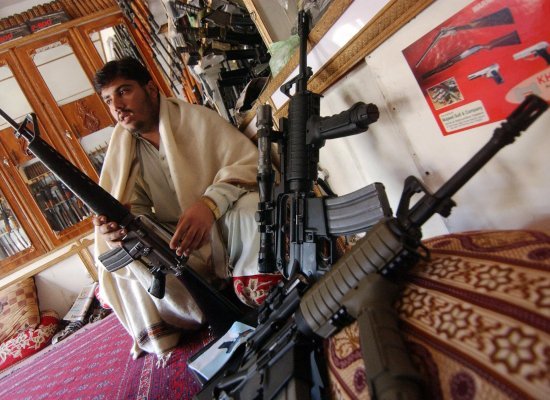
"Money is ammunition; don't put it in the wrong hands," Gen. David Petraeus famously said in an August guidance to NATO troops in Afghanistan. “And remember, we are who we fund.”

By that definition, however, we are our own worst enemies.

An October report from the Senate Armed Services Committee came to the startling conclusion that the military’s hired guns are fueling the very insurgency the military is there to fight:

The Committee's inquiry uncovered evidence of private security contractors funneling U.S. taxpayers dollars to Afghan warlords and strongmen linked to murder, kidnapping, bribery as well as Taliban and other anti-Coalition activities. It revealed squandered resources and dangerous failures in contractor performance, including untrained guards, insufficient and unserviceable weapons, unmanned posts, and other shortcomings that directly affect the safety of U.S. Military personnel.


The report highlighted two cases in particular, in which security contracting firms ArmorGroup and EOD Technology relied on personnel linked to the Taliban.

Among the report’s major conclusions:


• The proliferation of private security personnel in
Afghanistan is inconsistent with the counterinsurgency strategy

• Afghan warlords and strongmen operating as force providers to
private security contractors have acted against U.S. and Afghan
government interests

• U.S. government contracts for private security services are
undermining the Afghan government's ability to retain members of the
Afghan National Security Forces by recruiting men with Afghan National
Army and Afghan National Police experience and by offering higher pay

• Failures to adequately vet, train, and supervise armed security
personnel have been widespread among Department of Defense private
security contractors, posing grave risks to U.S. and coalition troops
as well as to Afghan civilians.