Showing posts with label South Korea. Show all posts

Monday, 9 April 2012

As predicted since 20th Sept 2011 - the plan to remove Roberto Villareal and replace him with Elia Yi Armstrong (South Korean) - was a successful one


Elia Yi Armstrong
(South Korean)

appointed:

Chief of Branch
Socio-Economic Development Branch
Division for Public Administration & Development Management
UN-DESA

The pianist, Elia Yi Armstrong, (see her CV) has finally worked out the plan to fire Roberto Villareal and position herself as the newest D1 at DPADM.

Yes, despite her current term at UNDP as Ethics Officer will end at the end of June 2012 (as per contract) Haiyan Qian, has selected thru a competitive process (check here to see process) Elia Yi Armstrong, who has a BA in Piano and a Master of 9 months from London Schools of Economics (despite her CV shows she was working in Chicago at the time she was supposedly studying for her full-time Master in London).

Well...good luck to Roberto Villareal, who was "demoted" for lack of managerial skills and removed from his job, in a well coordinated plan - which started already 12 months ago.


Sunday, 23 October 2011

New UN facility on sustainable development opens in Republic of Korea

Story on UN-DPI

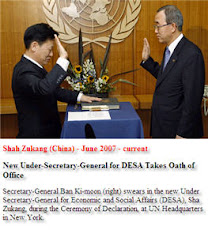
Sha Zukang, Under-Secretary- General for Economic and Social Affairs

19 October 2011 –
A new United Nations research and training facility designed to help poorer countries pursue sustainable development to accelerate economic growth while improving the quality of life and protecting the environment was inauguratedtoday in the Republic of Korea.

The UN Office for Sustainable Development, a joint effort of the UN, the Republic of Korea’s environment ministry, the city of Incheon and Yonsei University, was opened at a ceremony in Seoul, the country’s capital. It is based at the university in Incheon.

“The establishment of the UN Office for Sustainable Development 20 years after the United Nations Conference on Environment and Development underscores the fact that the world’s commitment for sustainable development is as strong as ever,” said Sha Zukang, the Secretary-General of the UN Conference on Sustainable Development (Rio+20), to be held in Brazil in June next year.

[The new office] will contribute to advancing the implementation of the outcomes of the Rio+20 Conference.

The Office will be managed by the UN Department of Economic and Social Affairs (DESA) and will serve as a training and research institution, and a centre for pooling sustainable development knowledge and making it usable and accessible through a knowledge portal that will integrate the three pillars of sustainable development – economic growth, improving the quality of life, and protecting the environment.

Mr. Sha said that in the short term, the new office will support developing countries and major groups in their preparations for the Rio+20 Conference, while in the longer term, “it will contribute to advancing the implementation of the outcomes of the Rio+20 Conference.”

The centre will also organize training programmes for national representatives and major groups from developing countries to advance the sustainable development agenda. In addition, it will undertake policy research and seek synergies through mobilizing sustainable development research institutions and universities.

News Tracker: past stories on this issue

UN agency joins campaign to boost sustainable development for world of 7 billion

Friday, 3 December 2010

China's U.N. influence rising, West should be careful: institute

Reutersclick here to view this on Reuters

A People's Liberation Army (PLA) officer is reflected in the window of a make-shift hut at a new training centre for the army's peacekeeping troops in the town of Huairou, located on the outskirts of Beijing November 19, 2009. REUTERS/David Gray

SYDNEY | Thu Dec 2, 2010 8:26pm EST

(Reuters) - China's engagement with the United Nations is on the rise as its economic power grows, but the West should be cautious with calls for it to act as a responsible world leader, as Beijing's goals may not be the same as the West's, said a new report on Friday.

Beijing is wielding greater influence at the United Nations, especially in the Security Council, but its pluralist foreign policy means its remains defensive, continues to protect pariah states Iran and North Korea, and defines its interests narrowly.

"China is sending higher-caliber diplomats to New York and providing increasingly robust support to U.N. peacekeeping operations," said author Michael Fullilove, Director Global Issues at the Lowy Institute for International Policy in Sydney.

"China is increasingly willing to take the lead on issues and behave more like a normal great power," said Fullilove, but adds: "On the Security Council, China's new confidence sits along strains of caution and defensiveness."

The report said the world climate talks in Copenhagen in 2009 reflected China's desire to balance its self-interests with its aspirations as a world player.

China, which accounts for 24 percent of global CO2 emissions, opposed a commitment for rich nations to cut emissions by 80 percent by 2050 from 1990 levels and for Copenhagen to be a stage toward a legally binding treaty.

"The Chinese leadership remains overwhelmingly focused on domestic issues. One Chinese interviewee told the author: 'Beijing is not psychologically ready to be an active global player," wrote Fullilove.

But China's foreign policy is changing, even toward its historic support for pariah states.

"Concerned at the fragility of some of the regimes it supports and conscious of its international reputation, China has begun to condition its support in some cases," said Fullilove.

China is being pushed by Washington to bring North Korea to heel after last week's artillery attack on the South, but Beijing refuses to blame Pyongyang for the shelling which destroyed dozens of houses and killed four people, or for the sinking of a South Korean naval vessel in March.

Beijing's frustration with Pyongyang has resulted in a reported public debate in Beijing, with traditionalist favoring support and strategists arguing growing economic ties with South Koreawarrants support for Seoul, said the report.

"Beijing needs to strike a new balance between its traditional economic and security concerns and the broader imperatives it must now satisfy, including stable great-power relations, non-proliferation and the development of international prestige," said Fullilove.

"On the other hand, the West needs to be careful what it wishes for. Washington and Canberra want Beijing to be more responsible and active, but they don't like it when Beijing is more assertive. China's version of stepping up is not necessarily the same as the West's."

(Reporting by Michael Perry; Editing by Sanjeev Miglani)

Saturday, 24 January 2009

DESA's Seoul Center plunged into scandals

During a recent visit of Ban Ki-Moon in Seoul, South Korea (July 3, 2008) he stated that his purpose of visit to Korea was to encourage Korean government to contribute more to international community, and underlined importance of further active roles of UN Family in Korea will get essential. 

At the end of his meeting in Seoul, little Ban would know that he was about to take a happy family photo with a rather disturbing and scandal embroiled branch of his own organization - called : United Nations Governance Centre (UNGC - http://www.ungc.org/)

Click in the picture for larger image

To be fair to Ban Ki-moon, UNGC was established on June 23, 2006, almost six months before Ban Ki-moon was appointed Secretary General. Eventhough the timing and selection of Seoul as the center of good governance for Asia would have left many in the region skeptical and think that it was just a move of South Korean government to strengthen their "candidacy" for the post of Secretary General (Ban Ki-moon was running for SG job at time of announcement).

In the agreement reached between DESA and GoSK (Government of South Korea), the goal of the United Nations Governance Centre (UNGC) is to act as an international and regional focal point for research, training and advocacy in government reinvention, and its functions will be oriented towards addressing information requirements of public officials, civil society, and the private sector. In the initial stages, UNGC would focus on e-government, government innovation, citizen participation, and public ethics in terms of research, capacity development, consulting and support activities.

on the opening day

All the above looked "very promising" if DESA ought to entrust the centre to anyone else other than Guido Bertucci, John Mary Kauzya and Elia Armstrong, who as usual would corrupt anything they would touch and manage on their way.

A very recent secret report from DESA's Executive Office details a massive abuse of power, UN immunities - including abuse with tax-deduction and other UN perks for SK Government officials as well as corrupt procurement practices and commitment of funds without any procedural approval from HQs.

While many at 23rd floor are "committed to secrecy on Seoul center" due to "sensitivity" it bears from Ban Ki-Moon being a south korean, the scandal has now become a heavy one, that even ASG Jomo has admitted that the center should be "shut down, or if it should continue it should not under DESA's flag".

With UNGC being the second scandal of DESA's centers in the world (UNTC - Thessaloniki Centre was the first one) now we wonder what would be the status of other centers of DESA ?