Showing posts with label FAO. Show all posts

Wednesday, 8 August 2012

China Daily: - - China's best play a part on international stage (These are the Chinese players)

China's best play a part on international stage

Click here to read this at China Daily: http://www.chinadaily.com.cn/cndy/2012-08/08/content_15651073.htm

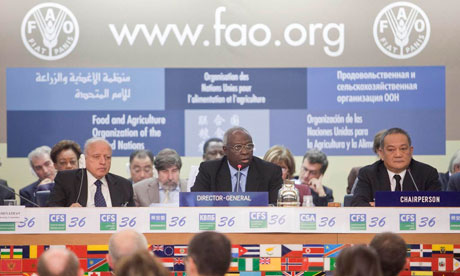
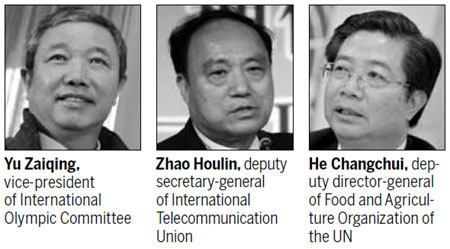
More Chinese than ever are holding key positions in international organizations in recent years, broadening developing countries' influence on the world stage.

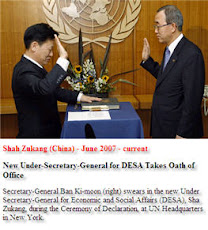
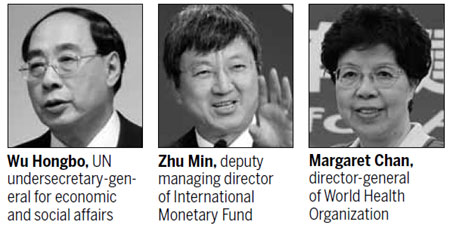
The latest example is Wu Hongbo, former Chinese ambassador to Germany, who was appointed in late May as undersecretary-general for economics and social affairs in the United Nations, replacing Sha Zukang, another Chinese official. Sha had held the position since February 2007.

Before Wu and Sha, Chen Jian was undersecretary-general for General Assembly Affairs and Conference Service of the UN from 2001 to 2007.

Undersecretary-general is the highest position in the UN that can be held by a Chinese citizen, as there is a rule that the UN secretary-general cannot come from the five permanent members of the UN Security Council.

The changes in their areas of responsibility reflect the rise of China's national strength and international influence, said Zhang Yi, deputy director of the Secretariat of the United Nations Association of China.

Chinese officials bring to the table their experience in economic development and addressing the needs of a developing country, adding to the variety and efficiency of international organizations, Zhang said.

In recent years, more Chinese officials have held key positions at international organizations.
In 2011, Zhu Min became the first Chinese to hold the position of deputy managing director of the International Monetary Fund, and Justin Yifu Lin just concluded a four-year term as World Bank chief economist and senior vice-president in June.

Statistics from the UN show that in 2011 China contributed $74.9 million to the organization's annual budget - the eighth most among the 193 UN members.

China currently has less than 500 staff at the UN Secretariat, which is the fewest among the five permanent members of the UN Security Council and fewer than UN members such as Pakistan and Japan, Zhang told China Daily.

The number of UN staff allowed for each member country is determined using a formula that includes demographics and GDP, with budget contributions being a decisive factor.
Holding key positions at international organizations "increases China's voice on the world stage and helps China win more rights in international organizations", said Jin Canrong, deputy dean of the School of International Studies at Renmin University of China.

With the exception of Margaret Chan, director-general of the World Health Organization from Hong Kong, and Wu Jianmin, who was elected president of the International Exhibitions Bureau in 2003, Jin noted that the total number of Chinese officials in decision-making positions at international organizations still lags behind other countries such as India and Japan.

"The increase in the number of high-level Chinese officials in international organizations cannot match the growth of China's national strength, which is likely to harm China's national interests in future, as China contributes an increasing amount of money to these international organizations but still lacks power in decision making," Jin said.

"A country's international position is not only reflected by its own national strength, but also the degree of acceptance by the world," Jin said. "One of the indicators is its participation in international organizations."

The largest difficulty for Chinese citizens working in international organizations is cultural differences, Zhang said. Chinese are used to keeping a low profile and are more concerned with the collective honor of a group, while their Western counterparts are aggressive and highlight personal values, Zhang said. Zhang and Jin said most Chinese staff at international organizations are placed in low-level positions.

The inability to master multiple languages also keeps most Chinese from standing out in the competition to become an international civil servant, Jin said. "Some government departments, which have talents fit for the requirements of international organizations, should let them go instead of hanging on to them," Jin said.

China urgently needs to train more qualified professionals as reserve forces to work in international organizations, Zhang said.

In 2011, the United Nations Association of China and the department of international cooperation at the Ministry of Human Resources and Social Security began co-hosting a training program for international civil servants.

Sponsored by China Ocean Shipping Company, the program has had more than 200 participants in the last two years, mostly university students.

The eight-day program includes an introduction to the UN system, major international issues and lectures by professors and diplomats.

Zhao Liang, 21, participated in the program in 2011. She received an internship with the United Nations Development Programme in China from February to June.

"I hope I can work for the UN in the future, after working at other places and accumulating enough experience to meet the high standards required by the UN," she told China Daily.

Zhao said she will represent China's views and positions when working for an international organization, even though international civil servants are not designated according to a person's home country.

Zhao, who graduated from Renmin University of China this summer, will soon go to the United States to continue her studies in politics.

"I hope this training program will become the starting point of your dreams and a cradle of backup talents for international civil servants from China," Chen, who is president of the UN Association of China, wrote in a foreword for the training program's 2011 student brochure. "It is also expected to help enhance China's capacity in participating in global governance and increase the interest and level of study in international organizations in China," Chen wrote.
chengguangjin@chinadaily.com.cn

Click here to read this at China Daily: http://www.chinadaily.com.cn/cndy/2012-08/08/content_15651073.htm

Wednesday, 16 February 2011

The UN needs to be open about leadership selection


The FAO's director general will be elected in four months, but we won't be told the selection process for this important position

MDG: FAO : Committee on World Food Security
How does the FAO select its leaders? Photograph: Giulio Napolitano/FAO

Last week, the UN's Food and Agriculture Organisation (FAO) quietly announced its shortlist of six candidates for the role of director general. Quite how these six (all men) were selected, who knows? And, on what basis will the UN member countries vote for their preferred candidate? We, the public, shall never know; we'll just be told in four months' time. (The vote takes place at the FAO conference in Rome, which starts on 25 June.) In this age of turbo-charged people power, that is simply not good enough.

In a world where the food system is highly fragile, where food prices are increasingly volatile, and with new stressors from a changing climate, it is the hungriest who would bear the heaviest burden of a botched appointment.

One person does not make an organisation, but few organisations are effective with an ineffective leader. The FAO is just one part in a very complex food system, but it is the only part that has a mandate to make that overall system work better for the hungry and malnourished. However, the FAO is not the most highly rated of UN agencies. In fact, one person who wrote to me recently said that it does not matter who the next director general is because the FAO is irrelevant. But I believe that the FAO provides vital global public goods: things like information, standards, innovation and coordination. To provide these effectively it needs strong leadership with imagination.

The next FAO leader needs to be:

• relentless in not letting anyone forget about hunger and malnutrition. The FAO will need to find new ways to support global and national civil society, helping to develop new tools, such as responsive hunger surveillance maps, indexes that measure commitments of public and private groups to reduce hunger, and new tools to prioritise action against hunger and malnutrition in different contexts

• brave in taking on vested interests to prevent hunger and malnutrition by leading efforts to set standards around large, international land purchases, the production of biofuels and the deployment of ready-to-use foods for infants

• creative in supporting innovation to make science, technology and institutions focus more on the needs of those who still cannot afford diets that reduce malnutrition

• genuinely inclusive and non-territorial, forging strong relationships to deliver the best possible cooperation between the FAO and the other Rome-based UN food agencies (the World Food Programme and theInternational Fund for Agricultural Development).

If the voting process is not to descend into Eurovision Song contest-type balloting, we need answers from the candidates to questions such as: How do they see the external environment changing? What needs to be done? What should the FAO's role be? How would they transform the FAO to deliver that role?

And I have been collecting more questions from my cyber-correspondents, which I shall put in an open letter to each of the candidates. If any of the six reply, I shall publish their responses here. If we know the answers to these kinds of questions we can give our opinions to member states about who they should pick.

The six candidates, each nominated by his government, are: Franz Fischler (Austria), José Graziano da Silva (Brazil), Indroyono Soesilo (Indonesia), Mohammad Saeid Noori Naeini (Iran), Abdul Latif Rashid (Iraq) and Miguel Ángel Moratinos Cuyaubé (Spain).

We all have a stake in the vision and effectiveness of the FAO's next director general. We should all have a say in the appointment. The openness of the selection process must be more like the Egypt of 12 February than the Egypt of 11 February.

Sunday, 6 February 2011

In UN Forest Week, Maathai Dodges on UNDP, Sri Lanka Dispute

By Matthew Russell Lee

UNITED NATIONS, February 2 -- Alongside UN inaction on Egypt, and lack of follow through on Darfur and Cote d'Ivoire, it's forest week at the UN. Wednesday the UN Food & Agriculture Organization's forestry expert Eduardo Rojas-Briales told the Press that, as a region, Asia is doing well. He named as Asian countries going the wrong way on forests Myanmar, Sri Lanka and Timor Leste.

When Inner City Press asked him for details, he tied the forest backsliding to conflict, in Myanmar and Sri Lanka. There he said the conflict came to an end, but only recently.

Later on Wednesday, however, Sri Lanka's Ambassador to the UN Palitha Kohona took issue with the FAO report. He said that because on the conflict, forests “just grew” and “no one could go hunting.” Then he cut away to speak to President of the General Assembly Joseph Deiss.

The venue was a reception by Croatia presenting photos and even a video of its forests. The country's deputy prime minister, speaking in Croatian, said people should come not only for Zagreb and the coastline, but the trees. He handed out hearts carved of wood and painted red and green.

Speaking for the UN was China's Sha Zukang. Afterwards Inner City Press asked him about China's role in logging in the Congo, where huge trees are ripped out for cheap furniture. “Some trees have to come down,” he said, described massive replanting in China.


Wangari Maathai planted tree at UN: where is it now? REDD+ not shown

Sha Zukang's staffer disputed that the Amazon rainforest is shrinking. Inner City Press asked her about EarthFirst, putting metal spikes in trees that face the chainsaw. People who only say no, she replied, are stuck in the 1950s.

Above her the ceiling of this UN General Assembly entrance hall was peeling. There were salmon sandwiches, red and white white, the forestry ministers of Turkey and other countries. The 13 year old boy famous for his photos of “Stop Talking, Start Planting," Felix Finkbeiner, was there.

Earlier on Wednesday, Wangari Maathai of Kenya spoke. Inner City Press asked her about criticism of the REDD and REDD+ programs. She said that indigenous people were being taken into account.

When an enterprising reporter asking about a UNDP study saying the green jobs are not being achieved -- a position echoed by former UN climate envoy Yvo de Boer -- the UN moderator cut the question off, saying that of course Ms. Maathai couldn't answer for UNDP. Why not let a Nobel Peace Prize winner speak for herself? But the UN protects itself. as some forests are ravaged. Watch this site.