Showing posts with label ban ki who. Show all posts

Sunday, 6 February 2011

In UN Forest Week, Maathai Dodges on UNDP, Sri Lanka Dispute

By Matthew Russell Lee

UNITED NATIONS, February 2 -- Alongside UN inaction on Egypt, and lack of follow through on Darfur and Cote d'Ivoire, it's forest week at the UN. Wednesday the UN Food & Agriculture Organization's forestry expert Eduardo Rojas-Briales told the Press that, as a region, Asia is doing well. He named as Asian countries going the wrong way on forests Myanmar, Sri Lanka and Timor Leste.

When Inner City Press asked him for details, he tied the forest backsliding to conflict, in Myanmar and Sri Lanka. There he said the conflict came to an end, but only recently.

Later on Wednesday, however, Sri Lanka's Ambassador to the UN Palitha Kohona took issue with the FAO report. He said that because on the conflict, forests “just grew” and “no one could go hunting.” Then he cut away to speak to President of the General Assembly Joseph Deiss.

The venue was a reception by Croatia presenting photos and even a video of its forests. The country's deputy prime minister, speaking in Croatian, said people should come not only for Zagreb and the coastline, but the trees. He handed out hearts carved of wood and painted red and green.

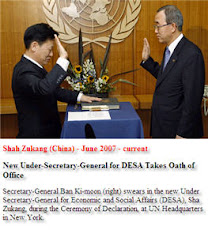
Speaking for the UN was China's Sha Zukang. Afterwards Inner City Press asked him about China's role in logging in the Congo, where huge trees are ripped out for cheap furniture. “Some trees have to come down,” he said, described massive replanting in China.


Wangari Maathai planted tree at UN: where is it now? REDD+ not shown

Sha Zukang's staffer disputed that the Amazon rainforest is shrinking. Inner City Press asked her about EarthFirst, putting metal spikes in trees that face the chainsaw. People who only say no, she replied, are stuck in the 1950s.

Above her the ceiling of this UN General Assembly entrance hall was peeling. There were salmon sandwiches, red and white white, the forestry ministers of Turkey and other countries. The 13 year old boy famous for his photos of “Stop Talking, Start Planting," Felix Finkbeiner, was there.

Earlier on Wednesday, Wangari Maathai of Kenya spoke. Inner City Press asked her about criticism of the REDD and REDD+ programs. She said that indigenous people were being taken into account.

When an enterprising reporter asking about a UNDP study saying the green jobs are not being achieved -- a position echoed by former UN climate envoy Yvo de Boer -- the UN moderator cut the question off, saying that of course Ms. Maathai couldn't answer for UNDP. Why not let a Nobel Peace Prize winner speak for herself? But the UN protects itself. as some forests are ravaged. Watch this site.

Thursday, 3 February 2011

You CUT - a project of economic recovery (Cutting UN budget is only the beginning)

Welcome to YouCut
YouCut – a first-of-its-kind project - is designed to defeat the permissive culture of runaway spending in Congress. It allows you to vote, both online and on your cell phone, on spending cuts that you want to see the House enact. Each week that the House is in session, we will take the winning item and offer it to the full House for an up-or-down vote, so that you can see where your representative stands on your priorities. Vote on this page today for your priorities and together we can begin to change Washington's culture of spending into a culture of savings.

Vote
Vote
Obtain Refund of Funds Owed to the U.S. by the U.N. Tax Equalization Fund
Approximate $180 million in one time savings
As of December 31, 2009, the United Nations reported that it was holding almost $180 million that the U.S. had overpaid into the U.N.’s Tax Equalization Fund (TEF). It appears that the U.N. is still holding the U.S. funds because the Administration has not instructed the U.N. on how it wishes to dispose of them. By instructing the U.N. to return those funds to the U.S. we can generate savings for American taxpayers. In addition, the Administration should also demand that the process for Tax Equalization Fund withholdings be revised to prevent (or at least reduce) future discrepancies leading to such large surpluses.
Vote
Vote
Obtain Refund of Unspent Contributions to International Peacekeeping Activities
Approximately $86 million in one-time savings
The United Nations has been holding approximately between $210 and $240 million in cash reserves from closed peacekeeping operations. These funds have been accumulating since the early 1990s. Successive U.N. Secretaries-General have requested authority to maintain these unspent funds in a Peacekeeping Reserve Fund, which allows them to cover shortfalls in peacekeeping and, at times, the general budget. However, U.N. regulations require that unspent funds from liquidated missions be returned to Member States within 12 months (with a potential extension to four years in order to meet receipts submitted by troop contributing countries). The U.S.-share of these unspent funds currently totals approximately $86 million. The U.S. should act to demand the reimbursement of these unspent funds.
Vote
Vote
Prohibit Economic Assistance to Countries Who Hold More Than $50 Billion in U.S. Debt
Savings of potentially $46 million over ten years
Of America's $14 trillion national debt, approximately $4.3 trillion is held by foreign countries. Over the past year, foreign holding of U.S. debt has increased by over $650 billion. Ironically, we actually provide economic assistance in the form of foreign aid to some of our largest creditors. For example, in 2010 U.S. taxpayers provided approximately $4.7 million in economic assistance for countries, including China, that hold in excess of $50 billion in U.S. government debt (this excludes funds for environmental programs). In short, Congress is borrowing money from foreign countries and turning around using some of that money to provide them with economic grants. This proposal would prohibit any economic foreign aid to a country that holds $50 billion or more in U.S. debt.
Then, Submit Your Ideas for Spending Cuts

YouCut is designed to defeat the permissive culture of spending in Congress. After you vote on this week's choices, we need your help in identifying which program and spending cuts should be featured on this website each week. Click the button below to submit your ideas!

Vote

Wednesday, 2 February 2011

Cote d'Ivoire: "Secretary General Ban Ki Moon and the United Nations are currently distributing weapons for the rebels"

France Attempts Coup in Cote d’Ivoire – Foreign Minister

Click here to view this on NewBusinessEthiopia

BY NEW BUSINESS ETHIOPIA REPORTER

The current political crises in the West African country, Cote d’Ivoire, is masterminded by France, who was behind the 2002 coup d'état attempt in Cote d’Ivoire, said Foreign Minister of President Gbagbo’s government.

Briefing local and international media today (February 1, 2011) at the Cote d’Ivoire embassy here in Addis Ababa, Ivorian Minister in charge of foreign affairs, Alcide Djedje not that France is responsible for all the current crises, which followed the late national election of Cote d’Ivoire.

“What we see in Cote d’Ivoire today is clearly a coup d'état started by France in 2002 and being realized using the 2010 election. The whole issue is just a continuation of France’s strategy of giving power to Ouattara at any cost,” he said.

Since 2003, France has got control of the issue of Cote d’Ivoire through UN from New York, according to the minister. France is using the United Nations as a weapon to realize its dream of deciding the political issues of Cote d’Ivoire, according to the minister.

“France is using Secretary General Ban Ki Moon and the United Nations who are currently distributing weapons for the rebels. It is France that used the international media to announce that Mr. Alassane Ouattara has won the election,” he said.

According the minister, what was announced by the election commission president at after the election was just a provisional result, which is not the final and announced contrary to the constitution of the country.

Commenting on the current activity of the UN forces in Cote d’Ivoire, the minister said: “Ban Ki Moon is not working for peace. He is responsible for the current situation in the country. Despite the fact that we told them to leave our sovereign land, the UN is distributing weapons worsening the crises caused by France.”

Speaking about the panel of Heads of African States, which is established yesterday (January 31, 2011) by the African Union comprising different sub-regions of the continent, he noted that as long as they (the panel) are willing to look into the issue in detail respecting Cote d’Ivoire constitution, Gbagbo’s government will support their activity in the country.

The minister has mentioned names of several African countries that are currently supporting the stand of Gbagbo’s government on the issues. Countries such as Gabon, Gambia South Africa, Algeria, Sudan, Libya, Zambia and Ethiopia, among other are on Gbagbo’s government side officially and unofficially and denounce foreign interference in a sovereign country’s internal politics, according to the minister.

Before the establishment of the Panel of African Heads of States, it is recalled that the AU and the UN have accepted that Mr. Alassane Ouattara is the President of Cote d’Ivoire.

The panel is expected to solve the issue within a month working along with the UN experts as suggested by Ban KI Moon. “If Ouattara is the President, then why will the Pannel come to Cote d’Ivoire,” questions the Foreign Minister.

Currently Mr. Alassane Ouattara, who is claiming the presidency, is in a hotel in Cote d’Ivoire guarded by the UN troops.

Accordin to media infomation, Mr. Alassane Ouattara, who is claiming the presidency, is in a hotel at the moment in Cote d’Ivoire guarded by the UN troops.

Tuesday, 1 February 2011

UN Falling Apart Under ‘Ban Ki-Who’

CLICK HERE TO VIEW THIS STORY ON IPSNEWS.NET

By Ida Karlsson


STOCKHOLM, Jan 31, 2011 (IPS) - United Nations chief Ban Ki-moon is under fire again. Inga-Britt Ahlenius - until recently one of the highest-ranking officials at the U.N. - explains to IPS her blistering attacks on Ban’s leadership.


"How could this man be appointed to the world’s most important job? He is definitely not up to the mark," Ahlenius, who was the head of the U.N.’s investigating arm, the Office of Internal Oversight Services (OIOS), until July last year, told IPS.

Her critique of Ban’s leadership is dealt with in-depth in a book recently released in Swedish. It has not yet been decided if the book ‘Mr. Chance’ will be translated into English. Asked for his comments, U.N. Spokesman Martin Nesirky said Monday: "We are aware of the book. We have dealt with the matter extensively last year. We do not have any further comments to make".

Ahlenius, former auditor-general of Sweden, was in 1999 one of the experts exposing corruption within the European Union when a succession of scandals led to the fall of the European Commission of Jacques Santer.

Called "Ms. Fearless" by former colleagues in the U.N. Secretariat, Ahlenius accuses Ban of being more interested in walking red carpets and giving speeches others have written rather than assuming the role as the chief administrative officer.

At meetings with U.N. senior advisors, Ban when returning from his travels, often speaks more about receptions and dinners he has been invited to or media coverage during events - rather than addressing political issues and follow up, according to Ahlenius.

"As the head of the Secretariat he is a catastrophe. He is uninterested and uncommitted," Ahlenius said.

Ahlenius also accuses the secretary-general of lacking transparency in management and of striving to control internal oversight. As an example she mentions that Ban - against established rules - blocked her from appointing a former U.S. attorney as head of the OIOS investigations unit. Ban has said that he acted in accordance with U.N. procedures.

When Ban took office he dismissed the managerial staff of former Secretary- General Kofi Annan. "There was no institutional memory left on senior level or in his own Executive Offices," Ahlenius said.

She was the only undersecretary-general not removed at that time as she had been appointed by the U.N. General Assembly and not by the secretary- general himself.

In her end-of assignment report in July last year Ahlenius sharply criticised Ban for causing the U.N. to fall apart. The report was filed as she stepped down from her post as the U.N.’s chief investigator. IPS was the only news organisation which had access to the entire 50-page report published exclusively on our website.
"I was the only one who was in a position to write such a report since I was not under the authority of the secretary-general and had a non-renewable contract. I did not have to bow and scrape for anybody," Ahlenius explained.

Her report was written over a period of five months. "I consulted five persons in central positions in the Secretariat who independently of each other reviewed the drafts for facts and for tone. They all agreed that the report gives a fair description of the state of affairs," she said.

At a press conference at U.N. Headquarters in New York last week Ban stressed that Ahlenius’s criticisms were based on unfounded allegations. Vijay Nambiar - the U.N.’s chief of staff - has also accused Ahlenius of distortion of facts.

"It is just a way to avoid a discussion. They will not find any inaccuracies in the report because there are none. They have not come back to substantiate such allegations," Ahlenius said.

At first her report was publicly commended by Ban Ki-moon as important, she explains. "But then I got an aggressive letter in return from Nambiar. I also received phone calls where I was warned that the circles around Ban Ki-moon would spare no effort to hit and hurt me in retaliation for my report. That is a sign of a depraved culture - to try to kill the messenger."

In December 2010 Ahlenius was informed that former colleagues at the U.N. had been invited to participate in a smear campaign against her.

But Ahlenius’s criticism of the secretary-general does not stand alone. The Norwegian Ambassador to the U.N. Mona Juul wrote a damning internal memo on Ban in 2009, deeming him weak, spineless, ineffective and lacking in charisma.

Juul also mentioned a whole range of crises where, according to her, Ban failed to make any impact - Myanmar, Sri Lanka, Democratic Republic of the Congo, Darfur, Somalia, Pakistan and Zimbabwe. She said she was not seeing him defending human rights, nor working for disarmament.

In November 2009 Ban was described as "The Master of Missteps" in the German news magazine Der Spiegel - he had recently spoken out positively on the death penalty (something his own organisation formally stands against), praised former U.S. President George W. Bush’s war in Iraq, and travelled to meet the leaders of Myanmar and Sudan but returned without tangible success.

Ban, a South Korean diplomat, has served as the U.N. secretary-general since 2007 and has not yet announced if he will run for re-election in 2011. Critics say he was appointed as the secretary-general because the super powers wanted an inoffensive leader.

"It would be pretty embarrassing if he was re-elected - ‘Ban Ki-Who’ or ‘Nowhere Man’ as he has been called by the media," Ahlenius told IPS.

(END)