Showing posts with label WHO. Show all posts

Wednesday, 8 August 2012

China Daily: - - China's best play a part on international stage (These are the Chinese players)

China's best play a part on international stage

Click here to read this at China Daily: http://www.chinadaily.com.cn/cndy/2012-08/08/content_15651073.htm

More Chinese than ever are holding key positions in international organizations in recent years, broadening developing countries' influence on the world stage.

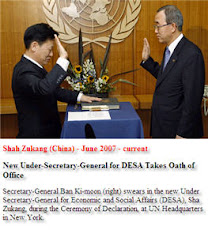
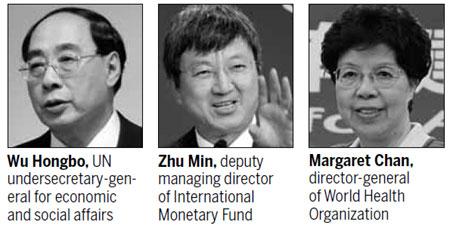
The latest example is Wu Hongbo, former Chinese ambassador to Germany, who was appointed in late May as undersecretary-general for economics and social affairs in the United Nations, replacing Sha Zukang, another Chinese official. Sha had held the position since February 2007.

Before Wu and Sha, Chen Jian was undersecretary-general for General Assembly Affairs and Conference Service of the UN from 2001 to 2007.

Undersecretary-general is the highest position in the UN that can be held by a Chinese citizen, as there is a rule that the UN secretary-general cannot come from the five permanent members of the UN Security Council.

The changes in their areas of responsibility reflect the rise of China's national strength and international influence, said Zhang Yi, deputy director of the Secretariat of the United Nations Association of China.

Chinese officials bring to the table their experience in economic development and addressing the needs of a developing country, adding to the variety and efficiency of international organizations, Zhang said.

In recent years, more Chinese officials have held key positions at international organizations.
In 2011, Zhu Min became the first Chinese to hold the position of deputy managing director of the International Monetary Fund, and Justin Yifu Lin just concluded a four-year term as World Bank chief economist and senior vice-president in June.

Statistics from the UN show that in 2011 China contributed $74.9 million to the organization's annual budget - the eighth most among the 193 UN members.

China currently has less than 500 staff at the UN Secretariat, which is the fewest among the five permanent members of the UN Security Council and fewer than UN members such as Pakistan and Japan, Zhang told China Daily.

The number of UN staff allowed for each member country is determined using a formula that includes demographics and GDP, with budget contributions being a decisive factor.
Holding key positions at international organizations "increases China's voice on the world stage and helps China win more rights in international organizations", said Jin Canrong, deputy dean of the School of International Studies at Renmin University of China.

With the exception of Margaret Chan, director-general of the World Health Organization from Hong Kong, and Wu Jianmin, who was elected president of the International Exhibitions Bureau in 2003, Jin noted that the total number of Chinese officials in decision-making positions at international organizations still lags behind other countries such as India and Japan.

"The increase in the number of high-level Chinese officials in international organizations cannot match the growth of China's national strength, which is likely to harm China's national interests in future, as China contributes an increasing amount of money to these international organizations but still lacks power in decision making," Jin said.

"A country's international position is not only reflected by its own national strength, but also the degree of acceptance by the world," Jin said. "One of the indicators is its participation in international organizations."

The largest difficulty for Chinese citizens working in international organizations is cultural differences, Zhang said. Chinese are used to keeping a low profile and are more concerned with the collective honor of a group, while their Western counterparts are aggressive and highlight personal values, Zhang said. Zhang and Jin said most Chinese staff at international organizations are placed in low-level positions.

The inability to master multiple languages also keeps most Chinese from standing out in the competition to become an international civil servant, Jin said. "Some government departments, which have talents fit for the requirements of international organizations, should let them go instead of hanging on to them," Jin said.

China urgently needs to train more qualified professionals as reserve forces to work in international organizations, Zhang said.

In 2011, the United Nations Association of China and the department of international cooperation at the Ministry of Human Resources and Social Security began co-hosting a training program for international civil servants.

Sponsored by China Ocean Shipping Company, the program has had more than 200 participants in the last two years, mostly university students.

The eight-day program includes an introduction to the UN system, major international issues and lectures by professors and diplomats.

Zhao Liang, 21, participated in the program in 2011. She received an internship with the United Nations Development Programme in China from February to June.

"I hope I can work for the UN in the future, after working at other places and accumulating enough experience to meet the high standards required by the UN," she told China Daily.

Zhao said she will represent China's views and positions when working for an international organization, even though international civil servants are not designated according to a person's home country.

Zhao, who graduated from Renmin University of China this summer, will soon go to the United States to continue her studies in politics.

"I hope this training program will become the starting point of your dreams and a cradle of backup talents for international civil servants from China," Chen, who is president of the UN Association of China, wrote in a foreword for the training program's 2011 student brochure. "It is also expected to help enhance China's capacity in participating in global governance and increase the interest and level of study in international organizations in China," Chen wrote.
chengguangjin@chinadaily.com.cn

Click here to read this at China Daily: http://www.chinadaily.com.cn/cndy/2012-08/08/content_15651073.htm

Monday, 10 May 2010

World Health Organization Moving Ahead on Billions in Internet and Other Taxes

FOX News.com

The World Health Organization is moving full speed ahead with a controversial plan to impose billions of dollars in global consumer taxes on such things as Internet activity and everyday financial transactions like paying bills online — while its spending soars and its own financial house is in disarray.

The World Health Organization (WHO), the United Nations' public health arm, is moving full speed ahead with a controversial plan to impose global consumer taxes on such things as Internet activity and everyday financial transactions like paying bills online — while its spending soars and its own financial house is in disarray.

The aim of its taxing plans is to raise "tens of billions" of dollars for WHO that would be used to radically reorganize the research, development, production and distribution of medicines around the world, with greater emphasis on drugs for communicable diseases in poor countries.

The irony is that the WHO push to take a huge bite out of global consumers comes as the organization is having a management crisis of its own, juggling finances, failing to use its current resources efficiently, or keep its costs under control — and it doesn't expect to show positive results in managing those challenges until a year from now, at the earliest.

Fox News initially reported last January on the "suite of proposals" for "new and innovative sources of funding," prepared by a 25-member panel of medical experts, academics and health care bureaucrats, when it was presented of a meeting of WHO's 34-member Executive Board in Geneva.

Now the proposals are headed for the four-day annual meeting of the 193-member World Health Assembly, WHO's chief legislative organ, which begins in Geneva on May 17.

The Health Assembly, a medical version of the United Nations General Assembly, will be invited to "take note" of the experts' report. It will then head back with that passive endorsement to another Executive Board meeting, which begins May 22, for further action. It is the Executive Board that will "give effect" to the Assembly's decisions.

What it all means is that a major lobbying effort could soon be underway to convince rich governments in particular to begin taxing citizens or industries to finance a drastic restructuring of medical research and development on behalf of poorer ones.

The scheme would leave WHO in the middle, helping to manage a "global health research and innovation coordination and funding mechanism," as the experts' report calls it.

In effect, the plan amounts to a pharmaceutical version of the U.N.-sponsored climate-change deal that failed to win global approval at Copenhagen last December. If implemented as the experts suggest, it could easily involve the same kind of wealth transfers as the failed Copenhagen summit, which will send $30 billion a year to poor nations, starting this year.

The WHO strategy involves a wide variety of actions to transfer "pharmaceutical-related technology," and its production, along with intellectual property rights, to developing countries, according to a condensed "global strategy and plan of action" also being presented to the World Health Assembly.

Regional "networks for innovation" would be cultivated across the developing world, and some regions, such as Africa, would be encouraged to develop technology to exploit "traditional medicines."

According to the condensed plan of action being presented to the Assembly, a number of those initiatives are already well under way.

Click here to read the plan of action.

The rationale for the drastic restructuring of medical R and D, as outlined in the group of experts' report, is the skewed nature of medical research in the developed world, which concentrates largely on non-communicable diseases, notably cancer, and scants research on malaria, tuberculosis and other communicable scourges of poor countries. It cites a 1986 study that claimed that only 5 percent of global health research and development was applied to the health problems of developing countries.

(In dissecting contemporary medical R and D, however, the expert report glosses over the historical fact that many drugs for fighting communicable diseases in developing countries are already discovered; the issue in many cases is the abysmal living and hygienic conditions that make them easily transmitted killers.)

What truly concerns the experts, however, is how to get the wealth transfers that will make the R and D transfers possible — on a permanent basis. The panel offers up a specific number of possibilities.

Chief among them:
• a "digital" or "bit" tax on Internet activity, which could raise "tens of billions of U.S. dollars";
• a 10 percent tax on international arms deals, "worth about $5 billion per annum";
• a financial transaction tax, citing a Brazilian levy that was raising some $20 billion per year until it was canceled (for unspecified reasons);
• an airline tax that already exists in 13 countries and has raised some $1 billion.

Almost casually, the panel's report notes that the fundraising effort would involve global changes in legal structures — and policing. As the report puts it: "Introducing a new tax or expanding an existing tax may require legal changes, nationally and internationally and ongoing regulation to ensure compliance."

As a backup, the panel offers some less costly, voluntary alternatives, including "solidarity contributions" via mobile telephone usage, or set-asides on income taxes.

Yet another alternative: new health care contributions from countries such as China, India or Venezuela, or higher contributions from rich countries — neither idea looking likely in the current climate of international financial crisis. In the report's words: "channeling these resources in this way can only be achieved if there is political will to do so and a convincing case is made."

Click here to read the financing report.

As follow-up, the experts suggest that WHO promote each and every suggested approach for new financing, along with "regulatory harmonization and integration" in the developing world, "research and development platforms in the developing world," and new "product development partnerships" to kick-start the global medicines program.

Just as big an issue for WHO, however, may be whether it can adequately manage the money it is already getting — or trying to get — for its current planned needs.

Other budget documents intended for the World Health Assembly, and obtained by Fox News, paint a picture of an organization where:

• spiraling financial demands are beginning to outstrip the ability of member-nations to pay;
• outsized headquarters budgets, in contrast to the regional and country networks where WHO's public health work is largely done, are rising even faster than the overall budget; and
• efforts to control onerous staff costs are just getting underway.

Those challenges are laid out in WHO's proposed biennial budget for 2010-2011, which calls for a combination of mandatory and voluntary contributions from the world's nations — meaning, overwhelmingly, the three dozen richest ones — of $5.4 billion — a whopping 27 percent increase over the same initial draft figure for 2008-2009.

But that increase, large as it is, will likely be far less than WHO needs before the latest biennium ends. In 2008-2009, the initial $4.23 billion draft budget was "revised" to a final $4.95 billion during the two-year period, a 17 percent increase.

Using the same inflationary measure, WHO's spending could well climb to $6.3 billion before the end of 2011.

Click here for the draft 2010-2011 budget.

One of the biggest jumps would come in the spending centered on WHO's headquarters in pricey Geneva — a 44 percent climb in its share of program budgets, from $1.18 billion to $1.7 billion, even before any future "revisions."

WHO planners point to the shrinking value of the U.S. dollar, its budgeted currency, against the Swiss franc as a major factor, which they say has increased costs by 15 percent. But other factors include more meetings for WHO's governing bodies and salary provisions for the top officers of the WHO Secretariat.

According to documents presented to the program, budget and administration committee of WHO's Executive Board, headquarters costs for the organization have remained proportionately steady for years at almost 38 percent of WHO's spending, however much that spending has grown. The ratio is striking, since WHO devotes most of its efforts to improving health care conditions in the developing world.

The organization's stated goal is to spend only 30 percent of its program funding in Geneva, but the same planners think it is "unrealistic" to think WHO will reach that objective, even by 2013.

In foggy bureaucratic language, they declare that "a change that is too swift and radical will be disruptive to the entire function of the Organization or fail because of an insurmountable accumulation of practical problems of execution."

Translation: the WHO bureaucracy won't easily cooperate.

In a bid to get the head-to-tail ratio under better control, WHO's top managers have set ceilings for headquarters hiring, but these only went into effect this year. The hiring limits will not cut the Geneva head-count but limit its further growth — "an acknowledgement," the document says, "that staff numbers are the main driver of WHO's expenditures."

That combination of WHO's sharp hikes in costs and a grim economic climate have led to another major management problem: "continued disparities between the approved budgets and the available resources."

In other words, WHO's member states and donors are not paying up as fast as the organization is spending the money across its many and varied priorities, leading to budgetary juggling and behind the scenes efforts to get major donor countries to ante up future contributions in advance, and cough up more voluntary funds in the future.

In its planning committee documents, the WHO bureaucracy promises to get a better grip on its finances in the near future.

Among the cost management efforts will be higher levies on voluntary donations to cover WHO staff costs — higher administrative fees, in short — along with more voluntary and "fully flexible" donations that can be used at the management's discretion, rather than being earmarked for specific programs.

Click here for the resource management report.

It will be another year, however, before WHO's overseers will be able to see if its management juggling will bear adequate fruit.

All in all, that is not a confidence-building credential for an organization that is simultaneously trying to reorganize the world's medical research, development, production and distribution system — and make the world's consumers and taxpayers pick up most of the multibillion-dollar tab.

George Russell is executive editor of Fox News.

Friday, 15 January 2010

U.N.'s World Health Organization Eyeing Global Tax on Banking, Internet Activity

Friday , January 15, 2010

By George Russell

FC1


The World Health Organization (WHO) is considering a plan to ask governments to impose a global consumer tax on such things as Internet activity or everyday financial transactions like paying bills online.

Such a scheme could raise "tens of billions of dollars" on behalf of the United Nations' public health arm from a broad base of consumers, which would then be used to transfer drug-making research, development and manufacturing capabilities, among other things, to the developing world.

The multibillion-dollar "indirect consumer tax" is only one of a "suite of proposals" for financing the rapid transformation of the global medical industry that will go before WHO's 34-member supervisory Executive Board at its biannual meeting in Geneva.

The idea is the most lucrative — and probably the most controversial — of a number of schemes proposed by a 25-member panel of medical experts, academics and health care bureaucrats who have been working for the past 14 months at WHO's behest on "new and innovative sources of funding" to accomplish major shifts in the production of medical R&D.

WHO's so-called Expert Working Group has also suggested asking rich countries to set aside fixed portions of their gross domestic product to finance the shift in worldwide research and development, as well as asking cash-rich developing nations like China, India or Venezuela to pony up more of the money.

These would also add billions in additional funds to international health care for the future — as much as $7.4 billion yearly from rich countries, and as much as $12.1 billion from low- and middle-income nations.

But the taxation ideas draw the most interest. The expert panel cites a number of possible examples. Among them:

—a 10 per cent tax on the international arms trade, "which might net about $5 billion per annum";

—a "digital tax or 'hit' tax." The report says the levy "could yield tens of billions of U.S. dollars from a broad base of users";

—a financial transaction tax. The report approvingly cites a levy in Brazil that charged 0.38 percent on bills paid online and on unspecified "major withdrawals." The report says the Brazilian tax was raising an estimated $20 billion per year until it was cancelled for unspecified reasons.

The panel concludes that "taxes would provide greater certainty once in place than voluntary contributions," even as the report urges WHO's executive board to promote all of the alternatives, and more, to support creation of a "global health research and innovation coordination and funding mechanism" for the planned revolution in medical research, development and distribution.

Click here to read the executive summary of the report.

The WHO scheme to transfer impressive amounts of money, technology, patents and manufacturing ability to the developing world in a global battle to conquer disease looks similar in many respects to the calls for huge transfers of wealth and technology that were at the heart of the just-failed U.N.-sponsored conference on lowering greenhouse gas emissions at Copenhagen.

Indeed, the volume of revenues that the experts foresee from their global indirect tax — if it should ever be approved by enough national governments — might well come close to the $30 billion annual wealth transfer that rich nations approved at Copenhagen to hand over to poor countries until 2012.

But a global health tax would go one big step further. And, as the experts point out, one trail-blazing version of their global consumer tax for medical research already exists: a germinating program known as UNITAID, which aims to battle against HIV/AIDS, malaria and tuberculosis.

UNITAID, which began in 2006 and is also hosted by WHO, is financed in part by a "solidarity contribution" levy of anywhere from $1.20 to $58 on airline tickets among a group of nations led by France, Brazil, Chile, Norway and Britain. According to the WHO experts report, it has raised around $1 billion since its inception, with 13 countries having already passed the airline tax legislation and "several" others in the process of doing so.

The idea, as with the "indirect" taxes that WHO is about to consider, is that a relatively small consumer levy, once implemented, is a low-profile and relatively painless way to create a global health-care tax system.

UNITAID's board chairman, Philippe Douste-Blazy, a former French Cabinet Minister and currently special advisor to U.N. Secretary General Ban Ki-moon on "innovative financing for development," is also a member of the WHO expert working group.

The global financial mechanism that the experts have been exploring is the keystone to WHO's entire program for the transformation of the world's health industry, which was endorsed as a "global strategy and plan of action" by the health organization's World Assembly in May 2008.

The plan includes more than 100 specific actions across the areas of research and development, technology transfer and intellectual property rights, among others, according to an update that will also be presented to the executive board next week.

Click here for the update.

New regional and national networks for medical innovation and development are being planned in Asia, Latin America and Africa — where, for example, there will be "African-led product research and development innovation," including delivery of drugs based on traditional medicines.

Another major effort is the transfer of technology to poorer countries to produce vaccines. One example: H1N1 flu vaccine, which is being manufactured in China, India and Thailand under licensing arrangements created under WHO auspices.

After WHO issued repeated warnings of a serious H1N1 influenza pandemic over the past two years, countries such as Britain and France ordered hundreds of millions of dollars worth of vaccine, only to decide that they were unnecessary, leading to mass cancellations of orders. WHO is reviewing how it handled the crisis.

According to the WHO update, the U.N. organization is already promoting transfers of new medical products for vaccines against rabies, even though that disease is now something of a rarity in the West.

A significant aim of the WHO effort is expanding production and distribution of remedies for what it calls "neglected diseases," mainly meaning those that are more common in poor, underdeveloped countries than in richer ones. These include a variety of parasitic ailments, including trypanosomiasis, or sleeping sickness.

Behind all of the effort is the "persistent and growing concern," as the expert's paper puts it, that "the benefits of the advances in health technology are not reaching the poor," which the paper calls "one of the more egregious manifestations of inequity."

As with "climate change" at Copenhagen, the WHO's experts see that health inequity as a malady that innovative and permanent forms of global taxation are just the right thing to help cure.

George Russell is executive editor of Fox News.