Showing posts with label US Government. Show all posts

Wednesday, 16 February 2011

Clientitis at the U.S. Mission to the United Nations?

The Heritage Foundation Leadership for America

by Brett Schaefer

Ambassador Susan Rice, the U.S. Ambassador to the United Nations, gave the first of a series of scheduled speeches last week in Portland, Oregon. The focus of the speeches is “Why America Needs the UN” and wasinspired, apparently, by congressional efforts to include U.S. payments to the U.N. among efforts to cut the U.S. budget deficit.

Her speech was dominated by unstinting praise for the U.N. and arguments intended to instill that viewpoint in her audience. Describing it as hagiographic would be going too far, perhaps, but not by much. Rice acknowledged some of the problems of the U.N., including its poor management, its anti-Israel bias, and its inability to punish peacekeepers who commit rape or other criminal acts. She argued that the U.S. is tirelessly trying to address these problems and provided a few tepid examples of the Administration’s successes. But throughout the speech was an unambiguous message that the U.N.’s foibles were an acceptable cost in exchange for the good done by the organization:

Main Street America needs the United Nations, and so do you and I, especially in these tough economic times. America can’t police every conflict, end every crisis, and shelter every refugee. The UN provides a real return on our tax dollars by bringing 192 countries together to share the cost of providing stability, vital aid, and hope in the world’s most broken places. Because of the UN, the world doesn’t look to America to solve every problem alone. And the UN offers our troops in places like Afghanistan the international legitimacy and support that comes only from a Security Council mandate—which, in turn, is a force multiplier for our soldiers on the frontlines.

It is all too easy to find cases where the UN could be more efficient and effective. I spend plenty of time pointing them out and trying to fix them—and not always diplomatically. But judging the UN solely by isolated cases of mismanagement or corruption misses the forest for the trees. We’re far better off working to strengthen the UN than trying to starve it—and then having to choose between filling the void ourselves or leaving real threats untended.

This line of defense is bizarre. Few people judge the U.N. solely by its foibles, but even fewer would seriously argue that the good works done by the U.N. should shield it from legitimate criticism or inoculate it from congressional efforts to use its power of the purse to leverage support for specific reforms to “strengthen” the U.N.

Nor is starving the U.N. on the table. In fact, the budgetary proposals put forward by the House involve small cuts to U.S. contributions to the U.N. For fiscal year (FY) 2011, the House majority is essentially proposing to reduce U.S. contributions to the two main accounts for U.S. contributions to the U.N. and other international programs (Contributions to International Organizations and International Organizations and Programs) back to the level they were at in FY 2008. How much money does the crash diet come to? About $120 million or about 6 percent less than the President’s FY 2011 request.

According to the Office of Management and Budget, total U.S. contributions to the U.N. system were more than $6.347 billion in FY 2009 (the latest figure for which we have data). So, when compared to all U.S. contributions to the U.N. system, the current cuts proposed in the House work out to about a 2 percent reduction.

By comparison, President Obama’s own National Commission on Fiscal Responsibility and Reformrecommended reducing U.S. voluntary contributions to the U.N. and other international organizations by 10 percent, or about $350 million.

So let me get this straight: Ambassador Rice is seriously suggesting that cutting U.S. contributions to the U.N. by 6 percent is tantamount to starving the U.N. of funds? Was the U.N. starving in 2008? Is there no fat to by cut from the U.N. budget that would allow key activities to be funded despite reduced funding by the U.S.? Of course not. The Ambassador apparently likes knocking down straw men.

The speech took a nasty turn toward the end:

[T]hose who push to curtail U.S. support to the United Nations owe it to U.S. soldiers to explain why they should perform missions now handled by United Nations peacekeepers, and they owe it to parents around the world to explain why their children should suffer without the medicine, food, and shelter that only the United Nations provides.

True, many Members of Congress would like to further cut U.S. contributions to the U.N., and more proposals to withhold money from U.S. contributions to the U.N. are likely to be proposed. But in nearly every case, those withholdings are tied to specific reforms that would enhance U.N. oversight, accountability, management, or fiscal discipline. The point of these efforts is to improve the U.N. and make it more accountable, not to destroy it. Nor is the effort based on a desire to cause suffering or shirk our responsibilities. Ambassador Rice does a disservice to Congress by suggesting otherwise.

The fact of the matter is that the U.N. budget is “utterly opaque, untransparent and completely in the shadow,”in the words of former U.N. Deputy Secretary-General Mark Malloch Brown. Tens of millions of U.N. dollars, perhaps hundreds of millions, are wasted, mismanaged, and stolen outright. How many lives are lost due to this mismanagement, opacity, and unaccountability? Should Congress ignore these problems because the U.N. has noble aims?

Perhaps Congress would feel less need to use financial leverage to press for U.N. reform if Ambassador Rice had been more successful in actually advancing the stalled U.N. reform agenda over the past few years. But that would entail actually attending meetings in Turtle Bay and would preclude Ambassador Rice’s whistle stop tour to enlighten America.

Which raises a final point: Why, when the U.N. has its own Department of Public Information funded to the tune of $43 million courtesy of the U.S. taxpayer, is Ambassador Rice barnstorming the U.S. to defend the U.N. from congressional cuts? Her job is to convince the U.N. to adopt America’s agenda, not convince Americans to adopt the U.N.’s agenda.

As noted by former U.N. Ambassador John Bolton in his book Surrender Is Not an Option, the State Department bureaucrats can fall victim to a “clientitis” problem. They begin—consciously or unconsciously—to see the countries, regions or organizations under their diplomatic tent as clients whose interests they feel compelled to defend inside the State Department or to the U.S. in general. Instead of scheduling a speaking tour to defend the U.N., Ambassador Rice might have been better served to arrange a listening tour of her real clients—the American taxpayers.

Friday, 21 January 2011

UN's Ban to Combat U.S. Republican Critics as Funding Questioned

click here to view this on Bloomberg

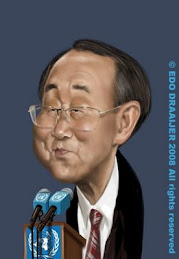
United Nations Secretary-General Ban Ki-moon said he will try to blunt a threat by Republican leaders in the U.S. House of Representatives to withhold financial support for the world body by meeting with them to defend his record.

Republican Representative Ileana Ros-Lehtinen of Florida, new head of the House Foreign Affairs Committee, last July called the UN a “stew of corruption, mismanagement and negligence.”

Ros-Lehtinen is holding a hearing featuring UN critics on Jan. 25. She plans legislation to increase congressional scrutiny and to make the U.S. financial commitment voluntary, rather than an annual amount stipulated by a formula based on national economic output.

“I am sure I will be able to talk with Republicans in Congress and try to explain my priorities,” Ban said in an interview yesterday at Bloomberg’s headquarters in New York. “I think their priorities and my priorities are the same. The only complaint they may have is the lack of much faster progress than they might have expected.”

Ban, 66, is seeking to make the case for his efforts to improve UN management and provide protection of civilians in conflict-ridden countries as he enters the final year of his five-year term in office. He declined to declare that he is seeking a second term.

UN Image

The former South Korean foreign minister said he is struggling to overcome what he called a “fixed, framed image” of the UN as ineffective and mismanaged over the course of its six decades of existence.

“I am also sometimes frustrated by a lack of progress, but if you look at my four years as secretary-general, we have made quite significant progress in terms of transparent work, accountability, more efficiency and mobility,” Ban said. “It was me who for the first time in UN history had all senior advisers disclose their financial assets.”

Ros-Lehtinen was elevated to chairman of the House Foreign Affairs Committee following the election of a Republican majority in the House last November. Ban has had good relations with President Barack Obama’s Democratic administration, which moved in June 2009 to erase all U.S. debts to the UN for the first time since 1999.

“I’ve met with Secretary Ban in the past and I look forward to meeting with him again to discuss what I believe is a critical need to bring sweeping reform to the UN,” Ros-Lehtinen said in an e-mailed statement yesterday. “Not nearly enough has been done to address the across-the-board lack of transparency, accountability, and resistance to reform that is seen throughout the sprawling UN apparatus.”

Ban said he has met Ros-Lehtinen many times, knows her “very well” and will travel toWashington soon to meet with congressional leaders of both parties.

Punishing the UN

Asked about the threat to withhold U.S. funding, Ban said that “rather than try to punish by cutting the budget, continuing with robust and proper financial support will be better for the long-term interests of the U.S.”

The U.S. last year contributed $517 million to the UN’s operating budget of $2.17 billion and $2.68 billion of the $9.67 billion peacekeeping budget, the most of any nation.

Republican control of the House will “create difficulty for the UN in a way that Ban has been spared,” Jeff Laurenti, a UN analyst at the New York-based Century Foundation research group, said in an interview.

Republican President George W. Bush “became a little more reliant on the UN as he was bogged down in Iraq, Obama got the arrears paid off and Ban has had two years of a free ride,” Laurenti said. “Now there is the question of whether Ban is capable of defending the UN in the U.S. public debate when its enemies have power to wield against it.”

UN Reform Act

The first significant push for improvements in UN management came during the administration of President Bill Clinton, who signed the Helms-Biden United Nations Reform Act of 1999. It tied U.S. payments to specified steps to improve management. Republican Representative Henry Hyde of Illinois, a former Foreign Affairs chairman, tried unsuccessfully in 2006 to pass legislation tying payments to UN management changes.

U.S. debts, erased in 1999, began to build up again through late payments and underfunding during the Bush administration.

“Ban is continuing modest incremental steps on transparency and accountability, but nothing substantial,” Mark Lagon, a former aide to Republican Senator Jesse Helms of North Carolinaand now an adjunct senior fellow at the Council on Foreign Relations in Washington, said in an interview. “There is sincere concern on the part of Congress and the consistent position that voluntary funding works with agencies such as the World Food Program.”

UN Accomplishments

Ban and senior advisers who attended the interview cited such UN accomplishments as efforts to save lives in Myanmar following the 2008 cyclone there, success in Sudan in deploying a joint UN and African Union peacekeeping mission in the nation’s Darfur region, and assisting with the recent peaceful referendum on Southern Sudan’s independence. Ban also noted work helping Haiti recover from natural disasters and Iraq from the civil war that followed the 2003 U.S. invasion.

“There should be some fair appreciation and understanding of what the UN is doing and has been doing,” Ban said. “The UN is an organization of 192 member states. The U.S. makes the largest financial contribution, but there are many other member states who have different views who have made the work of the UN sometimes very slow.”

Human Rights Council

Referring to Ros-Lehtinen’s criticism of the UN’s Geneva- based Human Rights Council for allowing the membership of China, Cuba, Saudi Arabia and Libya, all accused of human rights abuses, he said this was an issue of the governments that chose them rather than his responsibility.

“The United States has worked very constructively and productively with this secretary-general,” U.S. Ambassador Susan Rice said this week. “We have been grateful for his leadership on a number of important issues, and we continue to talk about the ways we can work together to strengthen this institution, to make it more efficient, more cost effective, and to improve its performance.”

To contact the reporter on this story: Bill Varner at the United Nations atwvarner@bloomberg.net

To contact the editor responsible for this story: Mark Silva in Washington atmsilva34@bloomberg.net

Thursday, 16 December 2010

US-UN Relations, Foreign Aid to Come Under Fire in New Congress

click here for this story

Barbara CrossetteWed Dec 15, 12:17 pm ET

The Nation -- While President Obama was just beginning to make headway against the often cynical approach to human rights at the United Nations, and had begun to repair US-UN relations and the image of the United States globally, Republicans were warming up for another chance to bully the world. With a shift in power, arrogant and often ignorant resurgent cold warriors and neo-isolationists could make 2011 a risky year for the UN, where the US is still the dominant voice.

The Republican right, now fortified by a dose of Tea Party patriotism, has a list of targets: international agreements that might dare to constrain the US, money spent on some UN development programs, foreign aid generally and soft diplomacy. The enemies are foreigners who criticize American policies and power. Ileana Ros-Lehtinen, the Republican from Miami who will chair the House Foreign Affairs Committee, says she’s ready to play “hardball.”

"I plan on using U.S. contributions to international organizations as leverage to press for real reform of those organizations, such as the United Nations,” Ros-Lehtinen, a relentless foe of her native Cuba, among other nations, said in a statement when she was chosen committee chair on December 8. She added that she will “not hesitate to call for withdrawal of U.S. funds to failed entities like the discredited Human Rights Council if improvements are not made.”

She also promised to cut the “fat” from foreign aid. A recent WorldPublicOpinion.org poll from the University of Maryland showed that Americans still wildly overestimate the percentage of the federal budget spent on international assistance. Respondents to the poll said that they thought, on average, that aid accounted for about a quarter of the budget; in reality it is barely 1 percent.

In the Senate, a narrower Democratic majority could make it even more difficult to round up the votes necessary for action on foreign policy steps Republicans oppose.

Threats to the UN, or even American membership in it, are all too familiar in Washington, but no less disturbing, given the recent history of Republican-inspired assaults. Some actions were farcical, others more damaging.

In the 1990s, Congress outlawed the naming of Unesco World Heritage Sites in the US without its approval on the absurd theory that Unesco threatened national sovereignty. In 2001, American contributions to the UN Population Fund were eliminated by a campaign originating in the House that falsely accused the fund of abetting forced abortions in China. At least 200 million women are now thought to be seeking but not finding contraception as world population rises to 7 billion next year—almost all the growth in the poorest countries where maternal deaths rates are high. American contributions were restored by Obama, but another campaign by anti-abortion activists against the Population Fund and progressive, secular nongovernmental agencies supported by USAID cannot be ruled out.

UN officials are often targeted by critics before the facts are in. In 2004, then Senator Norm Coleman of Minnesota called in the Wall Street Journal for the resignation of Secretary-General Kofi Annan because of his handling of corruption surrounding the oil-for-food program in Iraq during a period of UN sanctions. The campaign to oust Annan took a physical toll on him, little mitigated when an investigation led by Paul Volcker found that the billions Saddam Hussein reaped from illegal deals were largely bribes from private corporations (some American) or government trading agencies such as the Australian Wheat Board. A former French ambassador to the UN and India’s foreign minister were implicated as recipients of Iraqi financial favors, but not Annan. The US, as a Security Council member with the power to stop the undercover deals, had been turning a blind eye to much of what was going on in order to keep its Iraq sanctions policy in place.

As for the Human Rights Council, a favorite target on Capitol Hill, even the mainstream media has difficulty understanding how it works. The council is a UN body only in the same way the Security Council is—a group of nations making its own rules completely out of the control of the secretary-general or any other UN official. Its rights monitors are independent, pro-bono experts who not infrequently criticize the US or give a pass to nations with far worse records. The Obama team was beginning to demonstrate that the only way to influence this body is to get inside, blow whistles, demand show-your-face votes and reject weasel consensuses. An impatient Congress would argue for the opposite course—just get out, and stay out. That was George W. Bush’s policy.

Certainly doomed next year and beyond will be any action on two generally harmless (to national sovereignty) international conventions on the rights of children (important to those battling global child trafficking and child prostitution) and on the elimination of discrimination against women. Senators, who are responsible for ratifying treaties, are lining up to block the Convention on the Rights of the Child, although the US is virtually alone among UN member nations in refusing to ratify it. The Convention on the Elimination of all Forms of Discrimination Against Women, generally known as CEDAW, had a half-chance of ratification this year until Republicans seized and complicated the agenda of the lame duck Congressional session.

Also likely to be out of the picture for the foreseeable future are a ratification of US membership in the International Criminal Court, which tries the masterminds of genocide, war crimes and crimes against humanity, and probably the Comprehensive Test Ban Treaty, which went down to defeat in the Senate in the late 1990s under a similarly anti-international sentiment on the Hill. And what about the climate change deniers? Will they have the power to keep the US from joining global agreements?

Whether the Republican distaste for the UN, which not a few representatives and senators threaten to quit entirely if it balks at being run by Congress, will create problems for another secretary general is another question. Boutros Boutros-Ghali was denied a second term in the era of Newt Gingrich and Jesse Helms. In an interview later he said that one of his sins—apart from being foreign—was that he was critical of Israeli incursions in Lebanon. Annan opposed the war in Iraq and was hounded ever after.

The incumbent, Ban Ki-moon, whose relations with Washington are correct and amiable but not especially warm, has spoken out against Israeli tactics in Gaza. He has also recently warned that the departure of US troops from Iraq will make it difficult for the UN to operate there without a large infusion of money. The US and the UN are not always on the same page in Afghanistan, particularly over the effects on civilians of NATO military tactics.

Curtailing the spread of nuclear weapons, stopping terrorism, managing global migrations, reducing trafficking and other cross-border crimes, managing world resources, developing poor societies, stopping pandemic diseases and advancing human rights—nearly a fifth of UN member nations criminalize homosexuality, and women’s rights are widely abused or nonexistent—all require international cooperation and compromise. Rising powers are challenging American and European assumptions of dominance as never before. In this new world, hardball won’t work, and weakening the UN in the name of “reform” can only be counterproductive. Obama and Hillary Clinton say repeatedly that they understand this and assign an important role to the UN. But atmospherics matter. If the administration of Bill Clinton is any guide, Democrats are willing to throw internationalism overboard if it gets in the way of domestic politics.

Wednesday, 1 December 2010

HuffingtonPost: Countless Dollars Literally Taking Flight

CLICK HERE TO VIEW THIS ON HUFFINGTON POST
The Wall Street Journal reported in June that more than $3 billion in cash has been openly flown out of Kabul International Airport in the past three years -- “packed into suitcases, piled onto pallets and loaded into airplanes.” Only so much of that could be drug money. The bulk, presumably, was skimmed from U.S. aid and logistics spending.

And that’s just what people are declaring. The Journal calculated the $3 billion figure based on Afghan customs records, noting: “More declared cash flies out of Kabul each year than the Afghan government collects in tax and customs revenue nationwide.”

The actual amount of money flown out of the country is, of course, higher. As the Journal noted: “One courier alone carried $2.3 billion between the second half of 2008 and the end of 2009, said a senior U.S. official, citing other documents that are in the possession of investigators.”

The New York Times reported in August 2010:

The flow of capital out of Afghanistan is so large that it makes up a substantial portion of Afghanistan’s gross domestic product. In an interview, a United Arab Emirates customs official said it received about $1 billion from Afghanistan in 2009. But the American official said the amount might be closer to $2.5 billion.

Thursday, 25 February 2010

Advancing communist agenda of social integration - China using DESA as trampoline for ECOSOC and Commission for Social Development

The Commission for Social Development concluded its forty-eighth session today by approving a draft resolution on the social dimensions of the New Partnership for Africa’s Development ( NEPAD ).

By the terms of that text, introduced as orally revised by the representative of Yemen, the Commission would have the Economic and Social Council encourage African countries to step up efforts to implement NEPAD by developing and strengthening governance institutions in order to create an environment conducive to foreign direct investment for the region’s development.

Further by the text, the Council would urge those States that had not done so to join and strengthen the African Peer Review Mechanism, as well as urge continuous support for poverty eradication and sustainable development measures in Africa, with a particular emphasis on the Millennium Development Goals. Furthermore, the Council would ask the Secretary-General to submit a report on the social dimensions of NEPAD, to be tabled in collaboration with the Office of the Special Adviser on Africa, during the Commission’s forty-ninth session.

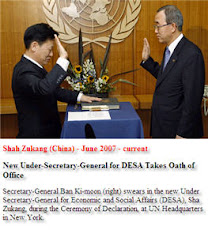
Also during the meeting, Sha Zukang, Under-Secretary-General for Economic and Social Affairs, hailed the Commission on its first ever approval of a text on social integration and on showing the will and commitment to tackle daunting remaining challenges to the achievement of such broad social development goals as social integration, poverty eradication, and full employment and decent work for all, as set forth in the Copenhagen Declaration of the World Social Summit.

In other business, the Commission adopted the report of its forty-eighth session and the provisional agenda and documentation for its forty-ninth session. It then adjourned the forty-eighth and opened the forty-ninth.

The Committee then elected by acclamation Jorge Valero ( Venezuela ) as its new Chairperson. Andi Xhoi ( Albania ); Katja Wiesbrock Donovan ( Germany ), Jimmy Blas ( Philippines ) and Najla Abdelrahman ( Sudan ) were elected Vice Chairs.

Sunday, 7 February 2010

U.N. Remains Uninterested in Oversight and Accountability

by Brett D. Schaefer

This Associated Press story does a wonderful job of revealing just how uninterested theUnited Nations is in combating U.N.-related mismanagement, fraud, and corruption. As I detailed in a 2009 Heritage Foundation paper, the U.N. has a well-earned reputation for mismanagement and vulnerability to corruption and fraud. The United States tried for years to get the U.N. to take steps to address this problem, with little success. But when the extend of fraud and mismanagement under the Iraqi Oil-for-Food program became clear, the Bush administration was able to get the U.N. to create the United Nations Procurement Task Force (PTF) as an ad hoc group within the U.N.’s quasi–inspector general, the Office of Internal Oversight Services (OIOS), to investigate and pursue allegations of fraud and mismanagement.


The PTF began work in January 2006 and over the next three years uncovered fraud, waste, and mismanagement in U.N. procurement and other activities involving contracts valued at more than $630 million. The evidence unearthed by the PTF led to misconduct findings against 17 U.N. officials and the conviction of a senior U.N. procurement official. Unfortunately, the PTF did its job too well. As punishment for pursuing cases against Singaporean and Russian nationals, those countries led a successful effort to eliminate the PTF in December 2008.

My prediction that the decision to eliminate the PTF would undermine accountability and oversight at the U.N. is, unfortunately, proving true. As detailed in the AP story, U.N. investigations into fraud, corruption, and mismanagement have ground to a halt since the elimination of the PTF:

Since [the elimination of the PTF at the end of 2008], the number of cases opened, pursued or completed has dropped dramatically and the [OIOS's permanent investigation division] division has let go most former task force investigators, the AP found in an examination of U.N. documents, audits and e-mails, along with dozens of interviews with current and former U.N. officials and diplomats.

Over the past year, not a single significant fraud or corruption case has been completed, compared with an average 150 cases a year investigated by the task force. The permanent investigation division decided not to even pursue about 95 cases left over when the task force ceased operation, while another 80 unfinished cases have languished.

It also stopped probes into contractors and cut qualified staff and other resources — and halted five major corruption investigations documented by the task force in the final days of 2008.

Moreover, the U.N. management under Secretary General Ban Ki-moon seems determined to prevent efforts to bolster investigatory capabilities in the existing U.N. Office of Internal Oversight Services (OIOS), which was supposed to pick up the slack following the demise of the PTF. For instance, Ban’s office reportedly twice blocked the appointment of the head of the OIOS permanent investigation division for more than two years because the most qualified candidate — as determined by an independent panel — was an American.

Meanwhile, the acting head of the division, Michael Dudley, has severely curtailed new investigations by barring new inquiries into anyone outside of the U.N. In other words, any U.N. employee can escape investigation or prosecution simply by quitting.

The story reports that, according to U.S. Ambassador to the U.N. Susan Rice, the loss of the PTF and the lack of an OIOS permanent investigation director are each “a source of concern to the United States.” But apparently the concern was not strong enough to lead the U.S. mission to demand reinstatement of the PTF in return for U.S. support of the U.N. budget this past December. The U.S. did not even bother to call for a vote on the budget.

Since the U.S. pays for 22 percent of the U.N. regular budget and 27 percent of the U.N. peacekeeping budget, you would think that the probability of U.S. tax dollars being misused at the U.N. would be more alarming to the person in charge of U.S. relations with the U.N.

— Brett D. Schaefer is Jay Kingham Fellow in International Regulatory Affairs in the Margaret Thatcher Center for Freedom, a division of the Kathryn and Shelby Cullom Davis Institute for International Studies, at the Heritage Foundation and editor ofConUNdrum: The Limits of the U.N. and the Search for Alternatives.


Goofy at the UN?

by Claudia Rosett @ PajamasMedia.com

“Indispensable, if imperfect,” is how President Obama’s envoy to the United Nations, Susan Rice, has described the UN. If you accept the “indispensable” part of that phrase (and after years of watching the UN in action, I don’t), that still leaves the question of just how “imperfect” the UN has become. Since the advent of Obama’s presidency, the U.S. has been ever more willing to tolerate the imperfections. Oversight by the U.S. Mission appears to have pretty much dried up, U.S. security interests get no real traction at the UN Security Council, U.S. tax dollars keep gushing in, and America keeps trying to place at the center of its foreign policy an institution where the majority would rather spend time and U.S. tax dollars on projects such as outlawing free speech and enlisting quack science to control the world economy in the name of fine-tuning the weather to the second decimal point.

Could it be that one of the imperfections aggravating this process is the performance of Ambassador Rice herself?

So argues Richard Grenell, a former spokesman of the U.S. Mission to the UN, who served under four ambassadors during the Bush administration. Grenell makes a compelling case — which caught my eye thanks to a post on NRO’sCorner by Brett Schaefer of the Heritage Foundation. Schaefer highlights some of Grenell’s arguments, and concludes that “it appears that not even Ambassador Rice takes the U.N. seriously enough to try to make it work.” In Grenell’s article itself, worth reading in full — “Where Has Susan Rice, Our UN Ambassador, Been This Past Year?” – we get quite a tour of the lapses, failings and sheer irresponsibility of current U.S. administration dealings with the UN. He notes there is no more effort to control the UN’s sky-rocketing budget (which dips into U.S. wallets for roughly one-quarter of its funding), and no evident follow-up to matters symbolized by such items as $200,000 spent by a UN agency on renovating a guest house. He also points out that the old red-white-and-blue colors of the web site for the U.S. Mission to the UN have been transformed under Rice to UN blue, with a big UN logo (and a little American flag).

But the main thrust of Grenell’s piece is that Rice herself, despite all her talk about the importance of the UN, has been largely awol from Turtle Bay. She commutes between her penthouse in New York’s Waldorf-Astoria Hotel and Washington, D.C. — where Grenell says she has the largest office and staff of any U.S. ambassador in UN history. She has been missing at many Security Council meetings on important issues, including some on Iran, as well as the recent vote to add more UN peacekeepers in Haiti. But she finds time to go “regularly” to White House social functions, including holiday parties and the White House Halloween Party, for which she dressed up in a Walt Disney“Goofy” costume.

I’m sure the Goofy costume was all in good fun, and Grenell says Rice is the life of the party. But his article might just leave you wondering if Americans would be better off with Goofy himself representing America at the UN.