Monday, 13 August 2012

Beyonce's U.N. Earrings Are Distractingly Large (PHOTOS)


... To her credit, Beyonce wisely kept her outfit subdued and professional to offset the heavy-duty bling around her face. But we're curious what Ban Ki Moon thought of her ensemble. Maybe he's actually a big jewelry kind of guy?
 
See the pic and watch Beyonce's "I Was Here" campaign video below...
 

From Poverty to Power How Good Governance Made Brazil a Model Nation


Western democracies consider themselves to be efficient, farsighted and just -- in other words, prime examples of "good governance." But in recent years, the euro and debt crises, along with wars in Iraq and Afghanistan, have shattered faith in the reliability of Western institutions. Disconcerted Europeans are casting a worried eye at newly industrialized nations like China and Brazil. Can the West learn something from countries that for so long sought its advice? In the first of a four-part series, SPIEGEL takes a look at how Brazil is governed today.
 

Fareed Zakaria Is Bitten by His Own Tale: How He Helped Create the System That Bit Him Back


... Most of the top-paid people in the media are "writers" whom the public are deceived to believe do all the researching and writing of "their" material. The actual writers (usually called "research assistants," or sometimes just "interns"), unlike these bosses, lack the connections to be able to succeed "on their own," and are therefore obscure workers for these aristocrats -- the writing-stars who make the big incomes. If one of these workers bows down sufficiently to his boss so as to be plucked by him to become a star "on his own," then that lucky acolyte will almost certainly share the existing hierarchical values of his boss, and so may become a new aristocrat in the full sense, and go on to produce his own reputation, and perhaps even dynasty. But the others will never win the connections and thus the money...
 

India’s place in a ‘post-superpower age’ An engaging guide to the issues on which India, as it takes the global stage, will have to pick sides


Review by James Crabtree
 
Pax Indica: India and the World of the 21st Century, by Shashi Tharoor, Penguin India/Allen Lane, RRPRs799/£19.99
 
He writes beautifully too, and these gifts of style are best employed when he probes the weaknesses of India’s diplomatic establishment, which he characterises as small and disorganised. India has only 900 foreign service officers to staff its 120 missions around the world: “a diplomatic corps roughly equally to Singapore”, and a fraction the size of most countries of comparable economic weight. Tharoor thinks this apparatus must be completely revamped, if his country is to prosper on its newly enlarged global stage. Yet while Pax Indica is admirably frank on these bureaucratic weakness, it is sadly less so on the policies that these institutions produce....
 

Ready for Primetime? The $100 Billion Climate Fund


After delays and political bickering, a late August date was announced last week to hold the first meeting of the Green Climate Fund (GCF)—the ambitious multilateral funding instrument to help developing countries tackle climate change. We should expect more snags in the coming years as the GCF is pieced together before it is fully operational.
 
The GCF, proposed at the 2009 UN Framework Convention on Climate Change (UNFCCC) meeting in Copenhagen, is envisioned to amass up to $100 billion a year after 2020 of additional and sustainable funds.  Through grants and concessional loans for climate projects, the fund is expected to finance mitigation and adaptation efforts in poor countries at an unprecedented scale. To put it in perspective, the largest climate fund today—the Climate Investment Funds under the umbrella of the World Bank—has $6.5 billion pledged for the period 2009-2012. The World Bank in total funds some $43 billion in development projects per year.  The GCF could double that.
 

Ban Ki-Moon’s Moment of Truth


By Ruth Wedgwood
 
... The residents of the 38th floor have often blamed operational disasters on U.N. member states. After the debacles in Rwanda and Srebrenica, there were long investigations of how to prevent another such mistake. But going to Tehran is a political calamity that will be blamed only on the secretary general himself.
 
— Ruth Wedgwood is a law professor and member of the Hoover Institution Task Force on Law and National Security. She served for eight years as the U.S. member of the United Nations Human Rights Committee in Geneva and New York, and directed the Council on Foreign Relations’ Diplomatic Roundtable on the United Nations.
 

Mad Libs: The United Nations


As the U.N. General Assembly prepares to meet next month, FP asked experts and insiders what role the body -- lately taking heat for its response to crises in Syria and Iran -- should play on the world stage today.
 
THE U.N.'s BIGGEST MISTAKE IN THE PAST 10 YEARS HAS BEEN...
 

UN, Israel & Anti-Semitism


... Although Secretary-General Kofi Annan has made important pronouncements against anti-Semitism, and even -- before a Jerusalem audience -- against some aspects of the UN's anti-Israel bias, his regular statements on the Arab-Israeli conflict are disproportionately critical of Israel. Senior aide Lakhdar Brahimi publicly described Israel as a country whose policy constitutes "the great poison in the region."...
 

Obama administration demands UN reform -- but won't threaten to withhold funding


George Russell is executive editor of Fox News
 
With presidential elections looming, the Obama administration has launched a high-profile campaign in favor of belt-tightening at the United Nations -- but without the threat of withholding U.S. funding for the sprawling world organization.
 

Life after Rio+20: A Commentary by Mark Halle, IISD


... And since we do not seem ready to do that, we must put a stop to the massive waste of money represented by events like the Rio conference. If our governments are not prepared to move towards sustainability, it is better that our voting populations know this. Calling a failure a success – even a guarded success – is to paper over the ever-widening cracks in the system...
 

UN launches sustainable development network to help find solutions to global problems


United Nations Secretary-General Ban Ki-moon today launched a new independent global network of research centres, universities and technical institutions to help find solutions for some of the world’s most pressing environmental, social and economic problems.
 
The Sustainable Development Solutions Network (SDSN) will work with stakeholders including business, civil society, UN agencies and other international organizations to identify and share the best pathways to achieve sustainable development, according to a UN news release.
 
This initiative is part of the work undertaken in response to the mandate on post-2015 and the outcome of UN Conference on Sustainable Development (Rio+20), which took place in Rio De Janeiro, Brazil, in June.
 
The Solutions Network will be directed by Professor Jeffrey D. Sachs, director of the Earth Institute at Columbia University and Special Advisor to Secretary-General Ban on the global anti-poverty targets known as the Millennium Development Goals (MDGs). It will operate in close coordination with the High-level Panel of Eminent Persons on the Post-2015 Development Agenda. ...
 

Wednesday, 8 August 2012

China Daily: - - China's best play a part on international stage (These are the Chinese players)

China's best play a part on international stage

Click here to read this at China Daily: http://www.chinadaily.com.cn/cndy/2012-08/08/content_15651073.htm
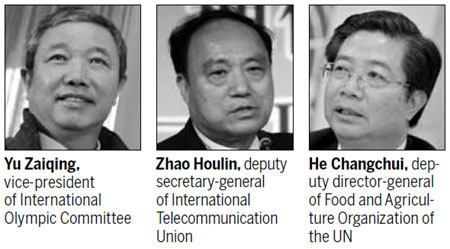
More Chinese than ever are holding key positions in international organizations in recent years, broadening developing countries' influence on the world stage.

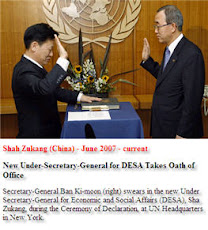
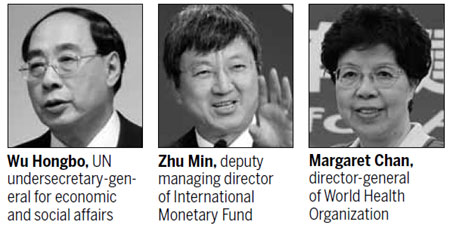
The latest example is Wu Hongbo, former Chinese ambassador to Germany, who was appointed in late May as undersecretary-general for economics and social affairs in the United Nations, replacing Sha Zukang, another Chinese official. Sha had held the position since February 2007.

Before Wu and Sha, Chen Jian was undersecretary-general for General Assembly Affairs and Conference Service of the UN from 2001 to 2007.

Undersecretary-general is the highest position in the UN that can be held by a Chinese citizen, as there is a rule that the UN secretary-general cannot come from the five permanent members of the UN Security Council.

The changes in their areas of responsibility reflect the rise of China's national strength and international influence, said Zhang Yi, deputy director of the Secretariat of the United Nations Association of China.

Chinese officials bring to the table their experience in economic development and addressing the needs of a developing country, adding to the variety and efficiency of international organizations, Zhang said.

In recent years, more Chinese officials have held key positions at international organizations.
In 2011, Zhu Min became the first Chinese to hold the position of deputy managing director of the International Monetary Fund, and Justin Yifu Lin just concluded a four-year term as World Bank chief economist and senior vice-president in June.

Statistics from the UN show that in 2011 China contributed $74.9 million to the organization's annual budget - the eighth most among the 193 UN members.

China currently has less than 500 staff at the UN Secretariat, which is the fewest among the five permanent members of the UN Security Council and fewer than UN members such as Pakistan and Japan, Zhang told China Daily.

The number of UN staff allowed for each member country is determined using a formula that includes demographics and GDP, with budget contributions being a decisive factor.
Holding key positions at international organizations "increases China's voice on the world stage and helps China win more rights in international organizations", said Jin Canrong, deputy dean of the School of International Studies at Renmin University of China.

With the exception of Margaret Chan, director-general of the World Health Organization from Hong Kong, and Wu Jianmin, who was elected president of the International Exhibitions Bureau in 2003, Jin noted that the total number of Chinese officials in decision-making positions at international organizations still lags behind other countries such as India and Japan.

"The increase in the number of high-level Chinese officials in international organizations cannot match the growth of China's national strength, which is likely to harm China's national interests in future, as China contributes an increasing amount of money to these international organizations but still lacks power in decision making," Jin said.

"A country's international position is not only reflected by its own national strength, but also the degree of acceptance by the world," Jin said. "One of the indicators is its participation in international organizations."

The largest difficulty for Chinese citizens working in international organizations is cultural differences, Zhang said. Chinese are used to keeping a low profile and are more concerned with the collective honor of a group, while their Western counterparts are aggressive and highlight personal values, Zhang said. Zhang and Jin said most Chinese staff at international organizations are placed in low-level positions.

The inability to master multiple languages also keeps most Chinese from standing out in the competition to become an international civil servant, Jin said. "Some government departments, which have talents fit for the requirements of international organizations, should let them go instead of hanging on to them," Jin said.

China urgently needs to train more qualified professionals as reserve forces to work in international organizations, Zhang said.

In 2011, the United Nations Association of China and the department of international cooperation at the Ministry of Human Resources and Social Security began co-hosting a training program for international civil servants.

Sponsored by China Ocean Shipping Company, the program has had more than 200 participants in the last two years, mostly university students.

The eight-day program includes an introduction to the UN system, major international issues and lectures by professors and diplomats.

Zhao Liang, 21, participated in the program in 2011. She received an internship with the United Nations Development Programme in China from February to June.

"I hope I can work for the UN in the future, after working at other places and accumulating enough experience to meet the high standards required by the UN," she told China Daily.

Zhao said she will represent China's views and positions when working for an international organization, even though international civil servants are not designated according to a person's home country.

Zhao, who graduated from Renmin University of China this summer, will soon go to the United States to continue her studies in politics.

"I hope this training program will become the starting point of your dreams and a cradle of backup talents for international civil servants from China," Chen, who is president of the UN Association of China, wrote in a foreword for the training program's 2011 student brochure. "It is also expected to help enhance China's capacity in participating in global governance and increase the interest and level of study in international organizations in China," Chen wrote.
chengguangjin@chinadaily.com.cn

Click here to read this at China Daily: http://www.chinadaily.com.cn/cndy/2012-08/08/content_15651073.htm

A New Documentary Exposes the U.N.'s DNA


... But one of the most disturbing segments of U.N.Me is entitled "1,000 people every 20 minutes." That was the number of innocent people killed in the genocide that took place in Rwanda in 1994 due to the failure of Kofi Annan, then U.N. head of peacekeeping missions, to authorize intervention despite having a mission in place ready and willing to act. The film does a superb job of walking the viewer through the background leading up to the extermination of the Rwandan people and the callousness and disregard for human life that occurred under the U.N. watch...
 

Tuesday, 31 July 2012

DESA by numbers:


  • On the research and analytical front, DESA’s top priority is to maximize the impact of its flagship publications and major intergovernmental reports on national and international policy-making. Every year, we prepare some 300 documents and 300 publications that analyze a wide range of development issues, which are distributed in print and electronic format around the world.
  • DESA has supported more than 35 major summits and conferences since 1990 on issues ranging from sustainable development and the advancement of women to the global economic crisis, financing for development and the ageing of the global population.
  • The Development Account, a fund established by the General Assembly and co-managed by DESA, has implemented more than 150 development projects around the world since 1997.
  • In the year 2000, United Nations Member states agreed to 8 Millennium Development Goals to be achieved by 2015, with the global progress monitored by DESA in its annual Millennium Development Goals Report, as well as the Report of the MDG Gap Task Force.

UN-DESA on Facebook

DESA’s monthly newsletter

DESA’s monthly newsletter

Targeting efforts to meet MDG expectations Featured in this issue:
More news stories on topics including: Global dialogue on development; Trends and analysis; Capacity Development

New Assistant Secretary-General for Economic Development takes office

Shamshad Akhtar


photo of desa's asg Shamshad Akhtar

Shamshad Akhtar was appointed by the Secretary-General as Assistant Secretary-General for Economic Development at DESA and took office on 9 July 2012.
Ms. Akhtar has previously served as Governor of the Central Bank of Pakistan and recently also as Vice President of the Middle East and North Africa Region of the World Bank. In her capacity as Governor, Ms. Akhtar served as the Chairperson of the Central Bank Board and its affiliates and as Governor of the IMF. During her term, she was recognized for the conduct of the bank, which was restructured significantly, the introduction of an analytical framework for monetary policy, and the development of a ten-year-vision for the finance industry with a vibrant structure for the banking sector. For these accomplishments, she won two consecutive awards as Asia's Best Central Bank Governor from Emerging Markets and the Banker’s Trust. In 2008, The Asian Wall Street Journal also recognized her as one of the top ten professional women of Asia.
Ms. Akhtar has had a long standing career with the Multilateral Development Banks (MDBs). In her assignment for the World Bank she spearheaded the Bank’s response to the Arab Spring and the Arab regional integration strategy and its implementation. She has served the Asian Development Bank (ADB) for almost 15 years, rising from the ranks as Senior Economist, to attaining the highest professional positions including as Special Senior Advisor to the President of ADB and as the bank’s Director General of the East Asia region. During the Asian Financial crisis she also served as the ADB’s Coordinator to the APEC Finance Minister providing analytical support in a number of economic and social areas for crisis prevention and mitigation, while also leading the engagement with the Bank for International Settlement, and other standard setting bodies.
Ms. Akhtar has worked in several regions/countries dealing with fiscal and taxation policy, decentralization, poverty and inequality, financial and monetary policy, industrial and infrastructure policies and governance development. In the past few months she further served as a member of the Pakistan Economic Advisory Committee and of the Governing Council of Pakistan Statistics Bureau. In addition, Ms. Akhtar advised development agencies on the operationalization of Pakistan’s New Economic Growth Framework and worked on PPP policy frameworks and governance issues.
Ms. Akhtar has earned her post doctorate degree as a US Fullbright Fellow at the University of Harvard and prior, she obtained her PhD in Economics at the Scotland's Paisley College of Technology and a Master in Development Economics at the University of Sussex in the UK. She also has an MSc in Economics from Quaid-e-Azam University in Islamabad.

Friday, 27 July 2012

Thursday, 19 July 2012

UNESCO Funds King Saud University Desalination Chair in Riyadh


UNESCO funded a water desalination research chair that will be based at King Saud University in the desert kingdom of Saudi Arabia.
 
The United Nations Educational, Scientific and Cultural Organization funding of the chair in Riyadh will help officials assess “long-term decisions involving capital necessary to avert any shortage of water supply and resources,” the university said in a statement.
 
Saudi Arabia, whose oilfields hold a fifth of the world’s reserves, aims to use solar energy to desalinate seawater and build nuclear reactors as it seeks to cut the amount of crude it burns in generators for power and to increase water supplies.
 
Saudi Arabia has almost 30 desalination plants in which salt and minerals are extracted from seawater and transported through 2,500 miles of pipelines, according to Ziad Aldress, Saudi’s ambassador to UNESCO, who said the new chair will help boost the desalination industry
 

Dictator funds 'shameful' Unesco prize; Lawyers believe sponsorship money was embezzled United Nations

 
The Times
 
18 July 2012
 
Adam Sage
 
 
Human rights groups expressed outrage yesterday as the United Nations awarded a scientific prize financed by an African ruler suspected of corruption on a massive scale.
 
Lawyers said that the prize money itself may have been embezzled by Teodoro Obiang Nguema Mbasogo, 70, who has been president of Equatorial Guinea for the past 33 years.
 
The award to three academics for their contribution to life sciences was made by Unesco, the UN's educational, scientific and cultural organisation, despite the protests.
 
"It is shameful and utterly irresponsible for Unesco to award this prize," a statement signed by seven human rights groups, including Human Rights Watch, declared. In a sign of Unesco's embarrassment over the row, there was no mention of the winners' names on its website as the award ceremony got under way in Paris.
 
The controversy comes a week after French judges issued an international arrest warrant for Mr Obiang's son, Teodoro Nguema Obiang Mangue, who, like his father, is under investigation for corruption in France.
 
Mr Obiang Jr, 43, is suspected of embezzling tens of millions of dollars to pay for purchases including 14 sports cars, an array of luxury watches and 14,000 DVDs. When French police raided the 101-room mansion used by him in Paris, they discovered furniture, works of art and wine worth more than €1 million. The Obiangs both deny any wrongdoing.
 
At a press conference, William Bourdon, a human rights lawyer who is the chairman of Sherpa, an anti-corruption campaign group, claimed that the prize was a ploy by Mr Obiang to gain international respectability.
 
The Equatorial Guinea president claims to have put up the money himself, but Mr Bourdon said that it had probably come from the public purse.
 
Mr Obiang proposed the prize in 2008 for work on diseases such as Aids, tuberculosis and malaria. He said that he would make $3 million available over five years, half for the winners, the rest to finance the administrative costs. Equatorial Guinea is an oil-rich former Spanish colony with a population below 700,000, but 76 per cent of its people live below the poverty line.
 
A Unesco spokeswoman said that the three winners were Dr Maged al-Sherbiny, chairman of the Egyptian Academy of Scientific Research, Dr Felix Dakora, professor of agro-chemical research at Tshwane University of Technology in South Africa, and Dr Rossana Arroyo, professor of research and advanced studies at Mexico's National Polytechnic Institute.
 
They received $300,000 to share between them, along with a diploma and a statuette by the Equatorial Guinean artist Leandro Mbomio Nsue, a former government minister.
 

Saturday, 14 July 2012

CNSNews.com: U.N. Salary-Setters Meet in New York, Amid U.S. Complaints of Excessive Pay

Click here to read full article on CNSNews.com 

(CNSNews.com) – A year after the body that sets United Nations pay scales came under fire for approving an effective three percent salary increase to thousands of U.N. staffers, it is meeting again in New York for a session that may reveal how successful the Obama administration has been in urging belt-tightening at the world body.

The International Civil Service Commission (ICSC), a body of 15 independent experts appointed by the U.N. General Assembly for four-year terms, is holding a low-profile, twice-yearly meeting from July 9-20.

In posts on his Twitter account, Joseph Torsella, U.S. deputy ambassador for U.N. management and reform, called the ICSC “the most important U.N. body you’ve never heard of.” He noted that it sets salaries and benefits for all U.N. staff and pointed out that personnel costs account for 75 percent of the budgets of most U.N. agencies.

Last summer, the ICSC awarded a cost of living or “post adjustment” increase, which the U.S. said amounted to a three percent salary raise for some 4,800 staffers based in New York.

The hike came just four months after U.N. Secretary-General Ban Ki-moon announced he had given instructions for the U.N.’s 2012-13 operating budget to be reduced by three percent, noting that “even the wealthiest nations are tightening their belts and cutting budgets.”

Responding to the decision, Torsella wrote to ICSC chairman Kingston Rhodes, objecting “strongly” to the increase and urging the commission to reverse it.

“Such a raise is inappropriate at this time of global fiscal austerity, when Member State governments everywhere are implementing drastic austerity measures such as layoffs, service reductions, revenue increases, and reductions in pay and benefits for civil servants,” he wrote.

“While we have the highest regard for the many dedicated professionals in the U.N. system, in these difficult times we must – at a minimum – forgo salary increases. Failure to do so could well lead to more draconian approaches to budget-balancing in the future.”

Torsella pointed out that the U.S. federal civil service is currently subject to a pay freeze.
U.S. taxpayers account for 22 percent of the U.N.’s operating budget and 27 percent of the peacekeeping budget, along with billions of additional dollars in “voluntary” contributions to various U.N. agencies. The total U.S. contribution in fiscal year 2010 was $7.69 billion.

Republican lawmakers are pushing legislation that would change the way the U.N. is funded, allowing the U.S. and other member states to fund only those activities and agencies they deem to be well-run and in the national interest.

The Obama administration, which strongly opposes the GOP measure, has made engagement at the U.N. a top foreign policy priority. Officials regularly give speeches and issue statements touting how its approach has led to improvements and reforms.

In a fact sheet last January, the U.S. mission to the U.N. said the administration has “[i]ntroducing the concept of administrative pay freezes in the U.N. system by tasking the International Civil Service Commission with finding ways to reflect the freezes on pay for U.S. federal employees, including the statutory pay freeze in effect through next year, within the U.N. salary system for professional staff system-wide.”

In a speech at the Council on Foreign Relations, also in January, Torsella said too little effort had been made at the U.N. to manage personnel costs.

“The results have been predictable: in the past decade, for example, the number of regular budget positions has increased modestly while the average total compensation per employee has increased dramatically.”

While U.N. staffers deserved to be properly compensated, he said, “with average U.N. professional pay now at nearly 130 percent of average U.S. federal civil-service pay in Washington – the system is becoming seriously distorted.”

“So we’re calling for a comprehensive study comparing U.N. salaries and benefits to U.S. civil-service scales. We’re pressing for a pay freeze for U.N. employees to fix the anachronisms in the International Civil Service System [sic].”

According to an ICSC publication, it was set up in 1974 to regulate the conditions of service of more than 80,000 U.N. staff members at over 650 locations.

It sets salaries “by comparing the net salaries of United Nations staff with the after-tax salaries of comparable staff employed by selected employers in the locality.”

The ICSC also takes into account the views of member states, organizations and staff.

“The Commission is composed of 15 members appointed by the General Assembly in their personal capacity,” it says. “Members are selected from among individuals with substantial experience of executive responsibility in public administration or related functions, due regard being paid to considerations of geographical distribution.”

The current chairman, Rhodes, is from Sierra Leone, and the other 14 members come from the United States, France, Germany, Italy, Poland, Russia, Japan, China, Bangladesh, Mexico, Jamaica, Ghana, Algeria and Morocco.

Click here to read full article on CNSNews.com

Hindustan times: UN’s comedy of errors

Click here to read full story on Hindustan times

The UN has more important issues to tackle. For instance, its High Commissioner for Human Rights, Navi Pillay, is fuming at human rights violations in the Canadian province of Quebec, where the government imposed a mild order to prevent disruptive assembly by student protestors. Pillay was possibly perturbed that Quebec wasn’t dealing with protestors in the manner sanctioned by Syria, or Iran.

It’s somewhat surprising that the UN’s human rights apparatus is actually going beyond its focus on castigating Israel, to countries like Canada, the US, or even India.

Though it doesn’t quite extend to matters like gay rights, as that offends many member nations of the HRC. When the Council’s president attempted to introduce that matter, a swift rebuke came from Zamir Akram, Pakistan’s Permanent Representative in Geneva: “We are even more disturbed at the attempt to focus on certain persons on the grounds of their abnormal sexual behaviour.”

Meanwhile, the world busybody is causing other problems for countries that actually recognise the normal meaning of human rights. Another human rights champion, Cuba, sponsored a resolution to “right to peace”, which winks at terrorists’ activities against “foreign occupation”. India abstained at the vote, possibly because of the implications for Kashmir. Co-sponsors of that declaration included well-known human rights stalwarts like China, Iran, North Korea, Venezuela, Sudan and Syria.
Of course, as far as these UN luminaries can see, there are no terrorists. In fact, despite decades of effort, they still can’t define a terrorist. It’s probably a task that’s deemed more difficult than the positive identification of the Higgs boson particle.

Click here to read full story on Hindustan times

Fox News: Time to get out of the United Nations?

AMERICANS STANDS UP  

Read more: http://www.foxnews.com/on-air/war-stories/2012/07/13/time-get-out-united-nations#ixzz20bCMC0rE

Written by Oliver North
 
Georgetown, S.C. -- Here in the Carolina Lowcountry, there are few things lower in the esteem of American citizens than the United Nations. While filling the tank of my SUV this morning, I noted the following about the pickup truck at the pump ahead of me: a South Carolina license plate; a USMC decal; an NRA decal; a gun rack in the rear window; a sticker reading "Armed Infidel" and another that said "Get US Out of the UN" on it. The owner, it turned out, was a medical doctor on his way to visit a patient. Apparently, down here, doctors still make house calls. Our brief conversation went something like this:

Doctor: "You're Colonel North, aren't you?

Me: "I better be. I'm using his credit card."

Doctor: "That's a pretty Boykin spaniel you have there. Do you hunt her?"

Me: "Every chance I get."

Doctor: "You're on the NRA board, aren't you?"

Me: "Yes. I see you're a member. Were you in the Marines?"

Doctor: "No, my son is. He just got back from Afghanistan. I'm really proud of him, but I want him to get out and finish college before Obama sells us out to the U.N. They're out to take away our Second Amendment rights. This isn't about 'gun rights.' Guns don't have rights. We do. 'We the People' have rights – and one of 'em is the right to keep and bear arms. That's why I belong to the NRA and why we ought to get out of the U.N."

We parted so he could get to his patient. In the car, I turned on the radio to hear the mellifluous voice of former U.N. Secretary-General Kofi Annan – now the U.N.'s "special emissary" – announcing in Geneva yet another "peace plan" for Syria. He claims to have had "productive discussions" in Damascus with Syrian dictator Bashar Assad on a "transition plan" and says that the U.N. Security Council must now "send a message to all that there will be consequences for noncompliance."

Annan's announcement prompted a scurry of diplomats and "experts" rushing to microphones in New York, Washington, London, Paris and Moscow – all expounding on this "new initiative." Meanwhile, the killing in Syria continues. Opposition groups and human rights organizations now estimate that more than 17,000 have been killed in the 15-month uprising against the Assad regime.

The continuing catastrophe for the people of Syria isn't likely to end any time soon. At the instigation of Annan's "working group," two separate Syrian opposition delegations went to Moscow this week, seeking concessions from the Kremlin on Russia's backing for Assad. After meeting with Russian Foreign Minister Sergey Lavrov, they left empty-handed.

Russian President Vladimir Putin is committed to retaining Russia's naval base at Tartus, Syria. Moscow's toehold in the Mediterranean Sea depends on Assad's remaining in power. That's why Russia will continue to use its veto power as a permanent member of the U.N. Security Council to block any serious sanctions against the Assad regime.

The Syrian civil war is increasingly deadly – and a vivid reminder of what happens when the fate of a nation is placed in the hands of dithering diplomats at the United Nations. Everyone ought to know by now that U.N. bluster about serious "consequences for noncompliance" and utopian talk about a "transitional government in Damascus" are futile. And that's in keeping with the U.N. track record on everything from stopping Iran from acquiring nuclear weapons and the means of delivering them to the disaster in Somalia.

These failures go beyond the intransigence of Beijing and Moscow. They also point to the naïveté, incompetence and corruption in the "world body," as the U.N. bills itself.

It was Kofi Annan who promised to "clean up" the U.N. after FOX News exposed rampant fraud and bribery in the so-called oil-for-food program, which helped prop up Saddam Hussein's brutal regime in Baghdad. Apparently, he missed some. Two months ago, FOX News reported that the United Nations World Intellectual Property Organization (WIPO) shipped sophisticated computer technology to North Korea in violation of U.N.-imposed sanctions. Now it's apparent that more high-tech computers were shipped by WIPO to Iran. Adding insult to injury, the banned shipments were financed by the United Nations Development Programme – which gets most of its support from U.S. taxpayers.

Last year, the U.S. forked over more than $8 billion to the U.N. – about 25 percent of the organization's budget. Apparently, that's not enough. This week, the U.N. told its 193 member countries that "donor nations" will have to increase their "contributions," and it has suggested "voluntary taxes" on carbon emissions, billionaires and currency transactions.

No wonder the doctor who admired my dog wants us to get out of the U.N. Maybe we should start by moving the U.N. out of the U.S. How about Mogadishu?

Oliver North is a nationally syndicated columnist, the host of War Stories on the Fox News Channel, the author of the American Heroes book series and the co-founder of Freedom Alliance, an organization that provides college scholarships to the children of U.S. military personnel killed or permanently disabled in the line of duty.

Thursday, 12 July 2012

How professional and ethical are the Human Resources of UN-DESA?

This month is the 10th anniversary of John Mary Kauzya' appointment as Chief of Governance and Public Administration Branch of DPADM.

Let's compare the career and rise of Haiyan Qian (Chinese) and John Mary Kauzya (African) in the last 10 years:

2002

John Mary Kauzya      => appointed D1
Haiyan Qian               => was a P3

2003

John Mary Kauzya      => is D1
Haiyan Qian               => appointed P4

2004 (end)

John Mary Kauzya      => is D1
Haiyan Qian               => appointed P5

2006

John Mary Kauzya      => is D1
Haiyan Qian               => is P5

2007

John Mary Kauzya      => is D1
Haiyan Qian               => appointed D1

2009

John Mary Kauzya      => is D1
Haiyan Qian               => appointed D2 (replaces Guido Bertucci)

2012

John Mary Kauzya      => still D1
Haiyan Qian               => still D2

So to recapitulate the above, in 10 years:

John Mary Kauzya      => stays without any further promotion at D1

Haiyan Qian               => moves 4 level ( and countless steps) to D2

Click on the above names to see their CVs and judge for yourself.

We're sure that at the end you'll blame your parents for not being a ...Chinese !


Wednesday, 11 July 2012

Your UN: Tax Proliferators for the Planet


...No such luck. I went looking for the original UN report, and here it is, from the UN Secretariat’s Department of Economic and Social Affairs, the World Economic and Social Survey 2012, titled “In Search of New Development Finance.”  Just scroll down to Section 1, pages 4-5 for the handy chart, listing proposals for everything from a global tax on billionaires (which the UN estimates might generate $40-$50 billion), to taxes on carbon, financial transactions, currency exchange, etc...
 

Ban Ki-moon says: "30 percent of aid lost to corruption" (How much of it is from UN's corruption?)


How many times have we heard of corruption undermining development?
 
At the 2012 Economic and Social Council high-level panel on accountability and transparency, which concluded Monday (July 9), U.N. Secretary-General Ban Ki-moon again reiterated the importance of combating corruption. Peace, development nor human rights “can flourish in an atmosphere of corruption,” he said.
 

CAN Indigenous Peoples Council Demands International Climate and Environment Court


22 June 2012: In a formal declaration sent to the UN Conference on Sustainable Development (UNCSD, or Rio+20) in Rio de Janeiro, Brazil, the Consultative Council of Indigenous Peoples of the Andean Community (CCPICAN) demanded the creation of an International Court of Climate and Environmental Justice.
 
The Council, which represents indigenous peoples of Bolivia, Colombia, Ecuador and Peru, sent two "special declarations" adopted on 10 June 2012, to Rio+20. One on some of the themes of the Conference, the other focused on climate change.
 
The Special Declaration to Rio+20 calls for the new Court to be empowered to "prevent, adjudge and sanction" States, enterprises and persons for acts or omissions that provoke climate change "or strong and irreparable damage to nature." The Declaration also calls for, inter alia: the rejection of green economy, geoengineering, transgenic organisms and nanotechnology; the creation of a world tax on international financial transactions, with the revenue earmarked to combating climate change and restoring and preserving Mother Earth; and the approval of a Universal Declaration of the Rights of Mother Earth.
 
The Special Declaration on Climate Change rejects the Cancun Agreements and "the false solutions of carbon markets," condemns and rejects REDD, REDD+ and REDD++, and demands that developed countries reduce their greenhouse gas (GHG) emissions 50% by 2017 and 100% by 2040. The Declaration reiterates the call for a global tax on international financial transactions, and commits themselves to push for a Latin American Referendum on climate change that would require LAC governments to take their demands to "global leadership." [CAN Press Release (in Spanish)] [Declaración Especial a la Conferencia Mundial sobre Desarrollo Sostenible (Rio+20) & Declaracion Especial sobre Cambio Climatico]