Friday, 13 January 2012

How to guide for dummies: Ousting your boss at the United Nations (the sure way)

OUSTED
All United Nations staffers UNITE !

Does your boss abuse his authority and treats you like a piece of SH*T ?
Does your boss abuse his/her Dept funds by hiring personal friends as consultants without proper selection process?
Does your boss have no consideration of you, unless you become his/her tool and or servant as if it was 1800'?
Does your boss think he/she is a king/queen of the Dept, anyone else is "peasant"?

If all or any of the above applies to you, you can have your boss expelled from the United Nations, very easy:

1. Start a signatory complain campaign - where at least 50% + of staffers of that Dept/Branch should sign in;

2. Deposit your claims/complain with Ethics and Ombudsman, let is seats there for 30 days (chances are you wont hear from them) ;

3. After 30 days, bring your claim to the office of OHRM/BoM the desk responsible for your Dept (Secretariat only);

4. Wait for another 30 days, meanwhile initiate individual complains to the highest hierarchical authority in your Dept (Director, Chief or ASG/USG). This will serve the purpose of filling up the file that will be used against your boss later on;

5. After 90 days mark, start sending complains to the Executive Office of USG of your Dept (Make sure you mark your communication - URGENT);

6. In mean time copy all your boss's files, communications and all financial transactions he/she signed off, which you think were against the UN rules and regulations, including the list of all individual consultants he/she hired without proper selection process, it will be handy when you fight the battle later on;

7. Call for staff meeting and demand from management that your boss be expelled from UN (on above grounds) and just use the phrase: "we are afraid to return to work under him/her leadership", "there is fear of retaliation", etc. United Nations can go against 1 or 2 but cannot afford to go against a larger number of staffers thus the easier way is to get your boss out of the way "FAST".

GOOD LUCK !

Wednesday, 11 January 2012

United Nations: Abuse of Authority at work place (DESA/DPADM/DMB)

Following the meetings at UN-DESA's flagship division of DPADM, there seem to be a clear case of abuse of authority happening at DMB.

But as usual with Haiyan Qian traveling to China to celebrate Chinese new year, and many at Executive office of Sha Zukang totally disengaged on the matter, it seems that the Mexican (Roberto Villareal) might have a real chance of getting over this with a Note-to-File. The question is what about those staffers who signed the petition, will there be any retaliation against them? Some now say that they are afraid to even continue to work under him since he "is known for being vindictive". So the question is will Haiyan Qian take action before she departs or will all this matter turn into those usual "clan battles" inside DESA, where abuse of authority becomes part of the "managerial charm"?

This is what UN's rules say about abuse of authority at work place:

Abuse of authority is the improper use of a position of influence, power or authority against another person. This is particularly serious when a person uses his or her influence, power or authority to improperly influence the career or employment conditions of another, including, but not limited to, appointment, assignment, contract renewal, performance evaluation or promotion. Abuse of authority may also include conduct that creates a hostile or offensive work environment which includes, but is not limited to, the use of intimidation, threats, blackmail or coercion. (ST/SGB/2008/5)

CV of Villareal:

Mr. Roberto VillarealMr. Roberto Villareal joined the Division for Public Administration & Development Management as the new Chief of the Socio-Economic Development Branch (which will now be known as Development Management Branch) on 22 April. His most recent assignment was with the Division of the Regional Competitiveness and Governance of the Organization of Economic Cooperation and Development (OECD), where he served as its head.

Mr. Villareal has served the Federal Government of Mexico for over 20 years, assuming the responsibilities of high level posts in different ministries and in diverse fields of socio-economic development. He previously served as the Undersecretary for Regional and Urban Development and Head Unit Social and Regional Policy, for the Federal Government of Mexico. He holds a Ph.D. in economics from the Massachusetts Institute of Technology.

Monday, 9 January 2012

Is Elia Yi Armstrong cleaning up the place at DPADM so she can have a D1 served on a silver-plate?

On 20th September 2011 we predicted that Elia Yi Armstrong (on her way out from UNDP) would stir-up the waters and get either John-Mary Kauzya or Roberto Villareal out of their jobs.

Since Sept 2011, we confirmed the fact that Roberto Villareal was having major interpersonal problems with the staff at his Development Management Branch (DMB) of DPADM/DESA.

Well...less than 4 months later, our predictions are coming true, in a major investigation involving UN Ombudsman, Office of USG Sha Zukang and DESA's OHRM, there seem to be more than "issues" between staffers at DMB/DPADM.

Some say this is just an "Italian Job" to get the Mexican (Villareal) out, and plain the way to return of Elia Yi Armstrong (who seem to be more friendly with "the Italians"), others say that this is a failure of Haiyan Qian and DESA's management in first place to detect well in advance that Villareal, even at his previous job in Paris had similar inter-staff "issues", thus his appointment at the helm of DMB/DPADM (without a proper selection process) made things worst at DPADM. Another groups say that Villareal is a hardworking guy who detest "lazy employees who seat and do nothing all day", and thus he expresses his frustration with anger towards those who fail to deliver.

Whatever the option or situation might be, Villareal seem to be headed for a major confrontation.

Let's see what will happen.

ONLY AT UN-DESA !
UNDER SHA ZUKANG' MANAGEMENT !

Tuesday, 13 December 2011

Corruption at the Inter-American Development Bank: The Fox-In-The-Henhouse Syndrome

by Bea Edwards on December 12, 2011 ( The Whistleblogger / 2010 )

It seems that the Inter-American Development Bank (IDB) is holding an accountability gala (invitation here) this week called "Leveraging Transparency and Integrity as a Condition to Sustainable Development." There will be a transparency carnival conducted by The Institutional Capacity and Finance Sector, and a special star turn by IDB Bank President Luis Alberto Moreno.

The Bank has been working hard on transparency and integrity because it needs a bailout from the US Congress, which has been asking intrusive questions about the IDB's appalling record on aid effectiveness and anti-corruption. Specific Congressional offices have even been prying into the IDB's habit of retaliating against whistleblowers and using internal "oversight" offices to do it. As Representative Charles Dent (R-Pa) put it during a hearing this past spring (minutes 29 – 31):

As you know, these banks need reforms in many areas, but specifically in their internal judicial systems, which are not always as impartial when investigating charges of fraud, corruption and waste by various whistleblowers, and there was an example at the Inter-American Development Bank that, according to the press, immediately dismissed a contract officer in Haiti when that person raised the issue of fraud in the IDB's Haiti reconstruction contracts.

The "integrity" record at the IDB took another turn for the worse this past summer when the Administrative Tribunal handed down an embarrassing ruling in the Fernando Fernandez case. Those industrious enough to skim through the text discovered that Mr. Fernandez helped to award a series of contracts to chapters of PriceWaterhouseCoopers in exchange for a job for his son. In the published ruling, the identity of PwC is concealed, and the favored firm is referred to as XYZ, but trust me – it's PwC.

...[T]he Complainant (Fernandez) was issued a Notice of Investigation by the Ethics Officer alleging that he unduly influenced the Bank's award of a contract in favor of the XYZ, in exchange for a personal favor to the Complainant, the employment by XYZ of the Complainant's son.

If you read further, you'll find that Mr. Fernandez did, in fact, attempt to exchange favored treatment of PwC in IDB contract competitions for his son's new job there.

The Tribunal does conclude that there was misconduct by virtue of the fact that the Complainant took advantage of his post and position of trust as Senior Advisor to the Vice-President for Finance and Administration to procure a job for his son.

The whole situation is even more remarkable when the Complainant's position at the IDB is taken into account. Mr. Fernandez was:

[A] high official and former Deputy Auditor with responsibility for investigating ethics violations.

A remarkably Orwellian feature of the IDB is that a lack of transparency, flagrant misconduct and unethical practices often begin and end with the very departments created to promote accountability and integrity.

As pointed out, in the Fernandez case, Mr. Fernandez himself was a Deputy in the Office of the Executive Auditor.

Similarly, in a case brought to the Administrative Tribunal two years ago, an unnamed Complainant argued that an investigator in the Bank's unfortunately named Office of Institutional Integrity (OII) was biased and incompetent. The Tribunal agreed, and so, with great presence of mind, his superiors transferred him to the Ethics Office! And there he remains.

As it turns out, it's a good thing they have a little extra help over there, because the Ethics Officer in place at the time resigned abruptly after the conclusion of an investigation into her own professional conduct earlier this year.

Meanwhile, as an auditor, Mr. Fernandez was able to contest the Bank's sanctioning of his "wrongdoing," because the practices employed by the investigator in his case, acting on behalf of the Ethics Officer, were so outrageous.

In the end, the Tribunal ordered Mr. Fernandez reinstated, after three years of suspension without pay. Unaddressed in this conflict between this Deputy Auditor and the Bank, however, was the role of PwC itself. As those in the anti-corruption business should be aware, in the United States, under the Foreign Corrupt Practices Act, it is illegal (if such a term is applicable to anything the IDB does) to either offer or to accept a bribe. In this case, PwC clearly offered Mr. Fernandez a bribe, yet apparently escaped the fallout of the entire caper.

This is not surprising. According to its breathless description of itself, PwC is a model corporate citizen:

At PwC, leadership is at the core of our corporate responsibility strategy. Our programs are guided by one common commitment: to do what is right for our clients, our people, our communities and the environment. We deliver our services as a trusted business advisor by developing our people to be responsible leaders who demonstrate our leadership as good corporate citizens. Whether we're driving a discussion about corporate responsibility in the marketplace or donating our time and skills to local communities, we're continuing our long history of doing business responsibly.

And so, in the aftermath of the Fernandez debacle, PwC simply "reached out" to the IDB to mend fences, so to speak. In an agreement signed by the Bank and PwC, the Argentine affiliate of PwC was barred from applying for Bank contracts for a period of about a month after the Fernandez ruling and PwC US was barred for about a year.

Curiously, given the IDB's commitment to transparency, the agreement debarring PwC was strictly confidential between the parties. In a letter to five high level Bank officials, Executive VP Julie Katzman wrote:

Under the Agreement, the parties thereto, including the Bank, shall not disclose(i) the Agreement (including any terms thereof), (ii) information concerning the discussions that preceded the Agreement, or (iii) other related information concerning PwC US and PwC AE SRL...

So, we asked, what was the agreement between the bribe (the IDB) and the briber (PwC)? In its own transparent way, the IDB released this statement on August 15, 2011:

The Inter-American Development Bank (IDB) today announces that PricewaterhouseCoopers LLP (PwC) has agreed to contribute US$2 million to establish an IDB-managed fund to support integrity, governance and institution building in Latin America and the IDB. PwC has taken measures to address a past issue of concern. Among such measures include PwC's implementation of a focused internal compliance training program for PwC employees on IDB engagements, and PwC acknowledges its responsibility for ensuring compliance.

Note the delicate phrasing; "a past issue of concern." This particular "issue" involves a bribe, which would be, if it occurred in a jurisdiction where the rule of law applied, a crime.

So what exactly were the terms of the Agreement not to be disclosed, and what transpired in the discussions preceding the signatures on that particular piece of paper? Here's a suggestion: in return for a $2 million fund to support "integrity" and "governance," the IDB's Office of Institutional Integrity would not refer PwC to the US or the Argentine Justice Departments for investigation and possible prosecution.

It's just a guess, but in the absence of transparency, it's a good one. Such a superbly cynical move is completely in character: the IDB will use the funds dubiously extorted from PwC's corrupt actors to train Latin American and Caribbean officials in integrity.

Bea Edwards is Executive Director and International Director for the Government Accountability Project, the nation's leading whistleblower protection and advocacy organization.

Friday, 9 December 2011

H.E. Sha Zukang, Head of the Rio+20 Conference on Sustainable Development, to address Eye on Earth Summit

The United Nations Under-Secretary-General for Economic and Social Affairs, who is also the Secretary-General of the 2012 UN Conference on Sustainable Development ("Rio+20") will address the Eye on Earth Summit on 13 December and speak about "The road to Rio: The importance of information networking."

Abu Dhabi, December 8, 2011: His Excellency Sha Zukang, United Nations Under-Secretary-General for Economic and Social Affairs and the Secretary-General of the 2012 UN Conference on Sustainable Development, will share his vision regarding "The road to Rio: The importance of information networking" at the Eye on Earth Abu Dhabi 2011 Summit.

"As the world seeks to eradicate poverty, it faces two huge and interlinked challenges: how to reduce the stress the global economy puts on nature and how to put in place solid institutions to shepherd global sustainable development," H.E. Mr. Sha said. A key question will be how to ensure that people and decision-makers everywhere have access to the data and information they will need to chart a sustainable course in the years ahead.

"I am particularly pleased to attend the Eye on Earth Summit, primarily because I consider it the launch of a historic initiative to bring together the public and private networks of experts working to advance environmental and societal information infrastructure as a new foundation for sustainable development."

The Summit will convene world experts to facilitate greater access to environmental and societal information, especially for emerging economies.

To be held December 12-15 under the patronage of His Highness Sheikh Khalifa Bin Zayed Al Nahyan, President of the UAE, the Summit is hosted by Environment Agency - Abu Dhabi (EAD), facilitated by Abu Dhabi Global Environmental Data Initiative (AGEDI) and held in partnership with the United Nations Environment Programme (UNEP).

The Eye on Earth Abu Dhabi 2011 Summit will convene world leaders and experts in environmental and societal information networking to reach consensus on solutions to greater data accessibility and to encourage stakeholders to collaborate to either strengthen existing data access initiatives or launch new ones. A key goal of the Summit is the environmental and societal data community's adoption of the Eye on Earth Abu Dhabi 2011 Summit Declaration - a document that will provide input to the United Nations Conference on Sustainable Development to be held in June 2012 under the leadership of H.E. Mr. Sha.

H.E. Razan Khalifa Al Mubarak, Secretary General of Environment Agency - Abu Dhabi and Eye on Earth Co-Chair, said: "H.E. Mr. Sha's participation in the Eye on Earth Abu Dhabi Summit illustrates the importance the work of the international data and information community has for the sustainability of global development and the alleviation of poverty. Coming twenty years after the first global conference devoted to sustainable development, the decisions that will be taken at the Rio+20 conference guided by H.E. Mr. Sha will be crucial to our common future."

This will be H.E. Sha Zukang's first visit to Abu Dhabi.

Confirmed attendees of the Eye on Earth Abu Dhabi 2011 Summit include UAE leadership, President Bill Clinton, Achim Steiner, UNEP Executive Director and Under-Secretary-General of the United Nations, Dame Jane Morris Goodall, Philippe Costeau, Jr. and Lelei Lelaulu, Chairman, Foundation for the Peoples of the South Pacific International (FSPI).

An Eye on Earth Exhibition will showcase the latest developments in environmental information and technology.

For more information and speaker biographies, please visit www.eyeonearthsummit.org

-Ends-

About Mr. Sha Zukang
Mr. Sha Zukang is the United Nations Under-Secretary-General heading the Department of Economic and Social Affairs (DESA), which is responsible for the follow-up to the major United Nations Summits and Conferences, and services the Second and Third Committees of the General Assembly, the Economic and Social Council as well as the vast majority of its functional commissions and expert bodies. He also convenes inter-agency coordinating mechanisms such as the Executive Committee on Economic and Social Affairs.

Mr. Sha also serves as the Secretary-General of the United Nations Conference on Sustainable Development, to be convened in Brazil in 2012.

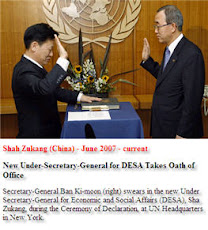
Before joining the United Nations in July 2007, Mr. Sha held a number of posts in the diplomatic service of the People's Republic of China. He has varied experience with multilateral organizations and international conferences. He was Chairman of the Preparatory Committee and Chairman of the Committee of the Whole, United Nations Conference on Trade and Development (UNCTAD) 11th session from 2003 to 2004, President of the Trade and Development Board, 50th Session of UNCTAD, Chairperson of the Government group of the Governing Body of the International Labour Organization from 2002 to 2003, and member of the UN Secretary-General's Advisory Board on Disarmament matters from 1994 to 1999. In addition, he has served as president, vice-president, chairperson, coordinator and expert in many international conferences in the field of arms control, trade, intellectual property, social affairs, and telecommunications, among others.

Mr. Sha is a graduate of Nanjing University, China. He is a native of Jiangsu Province and is married, with one son.

About Environment Agency - Abu Dhabi (EAD)
The Environment Agency - Abu Dhabi (EAD) was established in 1996 to preserve Abu Dhabi's natural heritage, protect our future, and raise awareness about environmental issues. EAD is Abu Dhabi's environmental regulator and advises the government on environmental policy. It works to create sustainable communities, and protect and conserve wildlife and natural resources. EAD also works to ensure integrated and sustainable water resources management, to ensure clean air and minimise climate change and its impacts. For more information, visit www.ead.ae

About Abu Dhabi Global Environmental Data Initiative (AGEDI)
Conceived by the Environment Agency - Abu Dhabi and launched by the Abu Dhabi Government in 2002, under the guidance and patronage of His Highness Sheikh Khalifa bin Zayed Al Nahyan, AGEDI provides user-friendly access to high-quality environmental information, through a variety of information products. While EAD champions AGEDI locally, the United Nations Environment Programme (UNEP) champions it regionally and globally. AGEDI's objectives include; to enhance environmental data collection and assessment, to increase data capacities for local, national, regional, and global environmental decision making, to ensure sustainable development planning is based on quality, timely, useable, and updated data and information, to provide accessibility of data and information to all stakeholders, to enhance national and international mechanisms of information processing and exchange and to enhance national capacities in information handling and communications. For more information, visit www.agedi.ae

About United Nations Department of Economic and Social Affairs (DESA)
The United Nations Department of Economic and Social Affairs (DESA) and its predecessors have helped countries around the world meet their economic, social and environmental challenges for more than 50 years. DESA's mission - to promote development for all - reflects a fundamental concern for equity and equality in countries large and small, developed and developing. DESA works on issues ranging from poverty reduction, population, gender equality and indigenous rights to macroeconomic policy, development finance, public sector innovation, forest policy, climate change and sustainable development. The Department also supports the effort to achieve the Millennium Development Goals, a set of time-bound targets, which put the eradication of poverty at the centre of the global partnership for development.

For media enquiries, please contact: Environment Agency-Abu Dhabi (EAD), Sobhia Al Masry, Media Specialist, EAD Press Office, Tel: +9712 6934-637, Mobile: +97150 442-5096, Email: pressoffice@ead.ae

Or United Nations Environment Programme, Contact: Mia Turner, UNEP Newsdesk on Tel. +254 20 7625211, Mobile +254 710620495 or E-mail: Mia.Turner@unep.org or unepnewsdesk@unep.org

Or Eye on Earth Summit, Contact: Mustafa Alrawi, M: Communications on Mobile: +97150 657-5945 or E-mail: eyeonearth@mcomgroup.com

© Press Release 2011 from Environment Agency - Abu Dhabi

How many Iranian Government Officials were trained by UN/UNDP (and other UN Agencies) & Saudi Arabia Says ‘Will Never’ Contribute to $100 Billion UN G

How many Iranian Government Officials were trained by UN/UNDP (and other UN Agencies) out of Iran, where and who are they?
3,053
Government Officials were trained by UNDP in various disciplines in the last 10 years outside of Iran (since 2002).
But in Iran, UN (or any specialized agency: ie. UNDP, UNOPS) never had a say in selecting the candidates who were trained. All their nomination came from the Iranian Ministry of Foreign affairs after a scrutinized process of validation and how trustful these officials were for the Iranian regime.
Having no way to verify their credentials, UN/UNDP had to take Iranian Government word and include all the "selected" into the list of officials sent abroad to attend international conferences, regional round-tables, or short-medium term training and exchanges in various countries (in the West but also Region).
Today the United Nations, and its operation arm in Iran (UNDP), are very reluctant to make public the names of all Iranian Officials it trained thru out the past 10 years with the World Tax-payers money. Why?
UNDP's Helen Clark brags about the transparency and accountability of UNDP's programmes, how difficult could be to have the following data published:
Individual Name:
Affiliated State Institution:
Purpose of trip:
Country of Destination:
Duration of trip:
This is the UNDP Iran Website. You can all visit and witness the transparency of data UNDP makes available to outsiders on how it conducts business in Iran.

Saudi Arabia Says ‘Will Never’ Contribute to $100 Billion UN Green Fund
Saudi Arabia “will never contribute” to the United Nations’ $100 billion Green Climate Fund, which should be financed by the governments of developed nations, according to the kingdom’s chief climate negotiator.
“Saudi Arabia and other developing countries will never contribute to this Fund as some developed countries are suggesting,” Mohammad al-Sabban said today in an e-mailed response to questions. “It is not acceptable to ask developing countries to contribute to the fund, because and as stated in the Climate Convention, it is the responsibility of the developed countries,” he said referring to the United Nations Framework Convention on Climate Change or UNFCCC. “We are very strong on this point along with other developing countries.”
The Green Climate Fund, which was central to agreements reached last year by UN treaty negotiators in Cancun, Mexico, is being discussed at climate talks in Durban, South Africa that began this week. The world’s richest countries pledged to channel $100 billion annually by 2020, part of it through the fund, to help poorer nations reduce greenhouse-gas emissions from energy production and adapt to effects of global warming such as rising sea levels.
Oil Income Loss
Saudi Arabia should be compensated from the fund as climate policies may lead to a loss in oil income to the kingdom, the world’s largest crude exporter, al-Sabban said.
“Those developing countries who are going to be adversely impacted as a result of climate policies should be assisted by the Fund to adapt to such impacts including helping us in achieving economic diversification and reduce our dependency on the exportation of crude oil,” he wrote.
There should be funding to support carbon capture and storage projects in developing countries, in particular fossil fuel exporters such as Saudi Arabia and the UNFCCC should have full authority over the Green Fund rather than the World Bank, al-Sabban said.
“We are fully aware of the economic crisis that the EU and other Organization for Economic Cooperation & Development countries are facing, but that should not lead us to change their commitments,” he said.


Deadlock in Durban
Jagdish Bhagwati
... Indeed, the extravagance of these conferences seems to grow, rather than shrink, as their dismal results become more apparent. COP-15 in Copenhagen lasted 12 days, and is estimated to have attracted 15,000 delegates and 5,000 journalists. The carbon emissions created by so many people flying to Denmark was real, while the emissions targets that the conference sought remained beyond reach. That will be true in Durban as well – and on an even greater scale...
Jagdish Bhagwati is Professor of Economics and Law at Columbia University and Senior Fellow in International Economics at the Council on Foreign Relations.

Bloated UNIDO alienates friends: Agency's donors head for the door. & Students Uncover China Nuke Tunnels – Video

“Sesame Street” went on the air in Afghanistan. How can they have "Sesame Street" in a country that doesn't have streets?
Let this be a warning to nations around the world, engage in a war with us and we will invade your country and provide you with quality children's programming. - Jimmy Kimmel Live!
Students Uncover China Nuke Tunnels – Video
UN activates Index Number 19653: Aung San Suu Kyi demands expansion of UNDP Programmes in Myanmar – Photo
Tooting our own horn: GenevaLunch editor wins “Unsung hero” award
GENEVA, SWITZERLAND – GenevaLunch editor Ellen Wallace was named “Unsung hero” by the British-Swiss Chamber of Commerce at its first Business Awards Wednesday 30 November in Geneva for her work in developing an online news source in English for the Lake Geneva region and Switzerland. GenevaLunch, staffed by volunteers, will soon hit the 3 million pages viewed mark, with 1 million of those in 2011.
Anglo-German Pullout Casts Shadow Over UNIDO
... The 30-year old organisation's relevance to the present day world, changing priorities and a financial crisis were cited as reasons three weeks ago when Germany said it intend to pull out.
Arguing for a German pull out, Carl-Dieter Spranger, the minister for economic cooperation and development, said UNIDO has no longer any role to play as governments are reducing their own roles in industrial development and allowing the private sector to play to take the lead.
Besides, he also questioned the organisation's willingness to introduce reforms. Spranger said Germany, the second largest donor after Japan at present, would like to withdraw end of next year...
U.N. Agency That Deals With ‘Green Energy’ and ‘Green Industry’ Loses Another Major Funder
(CNSNews.com) – A Vienna-based United Nations agency is pondering how to get by without one of its biggest donors, following a recent British government decision to withdraw from an organization which it said was ineffective and poorly run.
Bloated UNIDO alienates friends: Agency's donors head for the door.
While member states mull how to streamline and prioritize the work of the United Nations, individual countries have forced at least one harshly criticized U.N. agency to undergo a radical reform, possibly putting it out of business.
Syrian Minister of Industry: Sanctions against Syria Will Negatively Affect Syrian Citizens
VIENNA, (SANA) – The Syrian Minister of Industry, Adnan Slakho, on Wednesday said that the sanctions against Syria will negatively affect the interests and the living conditions of the majority of the Syrian workers and citizens.
Speaking at the 14th session of the General Conference of the United Nations Industrial Development Organization (UNIDO) in the Austrian capital, Vienna, Slakho said that the Syrian people will foil the conspiracy against their country thanks to their determination, national unity and rallying around President Bashar al-Assad despite all misleading media campaigns and some countries' support of terrorism and armed groups against Syria.
The Minister reviewed the standing cooperation between the UNIDO and Syria, hoping that the next stage will contribute to implementing the economic reform program and developing industry in Syria.
The use and effects of payment of allowances when attending meetings, seminars etc.
This has come into focus in recent years, but there is reason to believe that the documentation is limited. It might be interesting to look into this in more detail, deciding whether it is a problem and if so, how big an issue it is. This can be done by mapping the available documentation in the form of a synthesis study, and then possibly conducting a couple of country-specific studies. Chr. Michelsens Institute (CMI) will execute the study.

Timeplan: Final report November 2011
Responsible: Eirik G. jansen
* (170 KB)
How India squanders British aid: We give £1.4bn to a country that has its own space programme. In this damning investigation, the Mail reveals how it's scandalously wasted
... I visited a small maternity clinic in busy Bhopal. It has five beds, although it caters for 250,000 people. The operating theatre on the first floor has a new anaesthesia machine which is still in its plastic cover, the instructions in an unopened manual. The theatre bed is unused. Not one child has been delivered here since it was opened a few years ago...
Fiat Money in Crisis
The printing press has become politicians' last tool to project the mirage of sustainability and solvency.
mod=googlenews_wsj
Is Modern Capitalism Sustainable?
Kenneth Rogoff
... Will capitalism be a victim of its own success in producing massive wealth? For now, as fashionable as the topic of capitalism’s demise might be, the possibility seems remote. Nevertheless, as pollution, financial instability, health problems, and inequality continue to grow, and as political systems remain paralyzed, capitalism’s future might not seem so secure in a few decades as it seems now.
Kenneth Rogoff is Professor of Economics and Public Policy at Harvard University, and was formerly chief economist at the IMF..
Workers of the Western world
... Milanovic, a World Bank economist who earned his doctorate in his native Yugoslavia, has an intuitively international frame of reference. Both qualities are in evidence in “Global Inequality: From Class to Location, From Proletarians to Migrants,” a working paper released this autumn by the World Bank Development Research Group...
Do giant oil field discoveries fuel internal armed conflicts?
Do natural resource windfalls, such as those arising from the discovery of giant oil fields, increase the risk of internal armed conflict? This column argues that giant oil field discoveries, which are largely down to chance, significantly increase the incidence of conflict. This is especially so in countries with recent histories of political violence, where locals may have little to gain from such discoveries.