DESA has become a den of corruption and cronyism. Thanks to the Greek project, the bad apple started to smell with Bertucci. But Bertucci has been nothing more than a dandy dealer in a corrupt network. The real goons are Peluso, Oveissi etc. They thrive by nurturing corruption.
Whether it involves facilitating recruitment of incompetent Bastet, or Bertucci's niece and nephew, or promotion of clueless Hian Qian as Division Director, it is these two opportunists who keep on buttering the right side of the bread so that their own hold on the Department continues unabated.
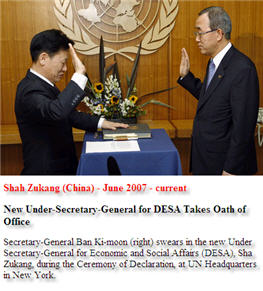
Lot were expected of M. Sha Zhukang. But not only the gentleman has proven himself to be an outright humbug, in league with these two master schemers of the Department he himself has also indulged in the most wanton act of nepotism and favouritism - promotion of clueless Haiyan Qian, a fellow chinese and the daughter of his former colleague, to the position of Director of DPADM, over the heads of many extremely highly competent candidates is a good example of abusive use of his authority. It has been reported that to accomodate Haiyan, Mr. Sha draically changd the original TOR of the position.
It is about time that OIOS takes note of these dubious activiies and do something to clean up the Department.
DESA's reputation both in substantive as well as in administrative terms, is at lowest ever.
Showing posts with label marie oveissi. Show all posts
Showing posts with label marie oveissi. Show all posts
Saturday, 29 August 2009

Friday, 29 May 2009
A silent tsunami on the way against Filipino staff at UN Secretariat and DESA
In a flagrant discriminatory targeted campaign, the cupola of MAFIA in DESA, the Executive Office and Marie Oveissi's TCMS (we like the old name) has been targeting the "Filipino" Staff as "the problem" with the capacity development in DESA.
It appears that Pelluso and Oveissi have no shame at all. By targeting the Filipino staff, and by singling out a nationality and determining that "they are the problem", this is nothing but an old communist and leftist way to shift the attention of the ongoing OIOS/OHRM investigation into the real DESA's illegal activities and mismanagement of funds.
OIOS - instead of focusing in Filipino staff, who are the most devoted and hard working employees at the UN - should focus on the corruption, nepotism and illegal hiring of hundreds of Italians and other developed countries "so-called VIP consultants".
The corruption in DESA has never been generated from General Service, who has been humiliated, abused and harassed for years, while our "Professionals" enjoy all the perks, including the ability to hire, fire and deploy financial resources wherever and whenever they like.
ENOUGH IS ENOUGH
ALL TOGETHER SHOULD SAY NO TO MAFIA IN UN-DESA
JOIN US AND SAY NO MORE!!
Wednesday, 1 April 2009
Claudio Aponte - the career of a Trust Slaughter into a International Public Administration Advisor
well is not fiction -> Is the truth.
While Haiyan Qian, Guido Bertucci, Marie Oveissi, Furio De Tomassi, Jose Manuel Sucre-Ciffoni - have hired in the past 9 1/2 years this gentleman as a :


- Representative of Mexican Government at DPADM's CEPA;
- Representative of Universitad Autonoma de Mexico;
- Representative of DPADM/DESA in Mexico;
Now the confirmation is here. Mr. Claudio Aponte is not a :

But Mr. Claudio Aponte is instead the FIDEICOMISO CENTRAL DE ABASTO DE LA CIUDAD DE MÉXICO (for those whose spanish is not their mother tongue = CENTRAL TRUST OF SLAUGHTER OF MEXICO CITY)
FIDEICOMISO CENTRAL DE ABASTO DE LA CIUDAD DE MÉXICO
CENTRAL TRUST OF SLAUGHTER OF MEXICO CITY

You can see better what Mr Claudio Aponte's role in this prestigious agency is.

So the questions for Mr. Sha Zukang and its ignorant, incompetent and totally corrupt staff are:
1. How can a Director of Finance of a Slaughter Center of Mexico City qualifies for the most prestigious body of the United Nations on Public administration?2. How can a man who's career is Slaughter Center, provide top-class advice to Presidents, Prime Ministers, Ministers and law-makers around the world on public administration?3. How much money did Guido Bertucci, Jose Manuel Sucre-Ciffoni, Marie Oveissi and Furio De Tomassi throw to this FAKE Public Administration Advisor?
WHAT DOES THE WORD ENOUGH MEANS TO YOU Mr. SHA ZUKANG ?
足够的 / 足够 /
Thursday, 26 March 2009
SCANDAL: - Claudio Aponte returns to CEPA 2009 as University Observer

OIOS investigated DESA and found that Mr. Claudio Aponte was hired from Guido Bertucci and TCMS illegally against all established rules and regulations. Moreover, MR. Aponte had not produced nor filed any end-of-mission reports for his alleged work, despite hundreds of thousands of dollars paid to him on fees and expensive transatlantic travel costs.
As we already provided proof of the miss-representation of Claudio Aponte of both DESA and Mexico Government, the miss-management in DPADM seem to have no limits.
Haiyan Qian, who owns her job to Guido Bertucci, is now paying Claudio Aponte's travel and DSA to allow him to attend CEPA 2009 (click here for list of observers) - but this time as Observer of the Autonomous University of Mexico......UAUUUUUUUUUUUUU
But wasn't last year that Mr. Aponte represented Mexico Government at CEPA, and the year before(08)....and the year before(07)??
So please Ms QIAN -
TELL US WHO REALLY IS CLAUDIO APONTE ?
Friday, 23 January 2009
Furio De Tomassi illegally shortlisted and selected Adriana Alberti as Italian Associate Expert
Adriana Alberti, a New Jersey born, was illegally selected and hired as Italian Associate Expert from Furio De Tomassi.
Is outrageous to even think that a person with such a controversial CV (click here for our story) that has paid no taxes in Italy during her entire life be selected and deprive a real italian from being selected for this job. But it seem that for Mr. De Tomassi and Catherine Pelluso rules do not apply. This fake italian made it to New York, as an "Italian Associate Expert".
Only to find out that 18 months later she had to resign and be expelled from the DESA's Associate Experts Programme for not declaring and paying US Taxes. The scandal at that time was again kept under the radar of everyone, thanks to Catherine Pelluso and Marie Oveisi who bent over to Bertucci and De Tomassi and arranged with the UN Tax Unit that Alberti pay all accumulated taxes. Today all the above has been doctored from the file of Alberti at Oveissi's office.
But Alberti was made to work for her uncle, and therefore only few months passed from the above scandal until her return - this time from the "window" when De Tomassi again, hired her as a Consultant under a Regional Italian Project at DPADM/DESA. She would never undergo any selection or proper HR scrutiny.
Today Alberti is a "respected" Senior Advisor in DESA's Governance Division. There is a problem though. This fake ITALIAN continue to be in the system as ITALIAN. She declares and receives International benefits, even-though she is a US citizen and finally pays US taxes (not even a dime in Italian taxes).
Furio De Tommassi and Catherine Pelluso are the direct responsible for allowing this US citizen to collect $189,000 US Dollars in International Benefits (so far) when she should have been hired as a local consultant and/or expert.
Mr. Sha Zukang should call the UN Tax Unit and take the files of Alberti of her years as Associate Expert where she was obliged to pay all accumulated taxes and was expelled for lying to UN and not disclosing her being a US citizen.
Mr. Sha Zukang should initiate an investigation into the hiring and retaining of the services of Adriana Alberti and other so-called Italian Associate Experts who currently work for DESA/DPADM and the way they made it thru the system.
Mr. Sha Zukang should make public the finding of his investigation and held responsible those managers who acted against the rules and regulations of the UN system.
The staff of UNDESA deserve to know what is going on.
Sunday, 11 January 2009
UN-DESA fails to implement mobility, while 70% of its Managerial force is expected to retire - there is a total lack of succession planning
Our dear leader Ban Ki-moon in his address to General Assembly on September 23, 2008, said:
But at United Nations Department of Economic and Social Affairs (DESA), our management composed by:
All these three gentlemen have been on the job at minimum one year (Stelzer - Feb 08). They need to initiate immediately an assessment of the age structure of the staff across in DESA, to assess the overall dimensions of the average ageing of staff and its impact on human resources management policies, including succession planning, and its financial implications, with a special emphasis on the Professional staff.
All the reports that come from Catherine Pelluso's office provide only general statistics on gender, geographical distribution and the basic demographic profile of staff. Most reports do not pay sufficient attention to age-related issues, lack analytical details about the consequences of the existing age structure, and do not call the attention of Senior Management in DESA and OHRM at Secretariat to the likely impact of the age structure. Often these reports are submitted either for the purposes of "information" or "taking note of" and rarely contain proposals to address age-related issues which are about to engulf Department of Economic and Social Affairs (DESA).
Both Catherine Pelluso and TCMS's Marie Oveissi are totally ignorant of what a Succession planning tool mean and how that affect the work of the department. For Pelluso and the entire Executive Office at DESA, "succession planning" is done as part of vacancy management, and in most cases it does not go beyond filling vacancies. Instead Sha Zukang should invest in a professional Human Resource Specialist within Executive Office - who should follow professionally the HR strategies and age structure of DESA against the particular mandate and objectives to be accomplished our Department.
Good and fresh example is that of Director of DPADM - instead of being prepared for Guido Bertucci's retirement (and failing to collect the $34,000 as established by OIOS Investigation and requested by Ban Ki-moon), DESA's EO failed to have in place a succession plan and thus being ready to replace both Bertucci (D2) and Khan(D1) right after their departure in July 2008. The lack of such detailed planning led to a leadership gap and a total chaos for the work of the division for the past nine months.
Lack of a coherent HR planning in DESA leads to major implications for a real succession and in endless process of replacing those who retire. While many now believe that such practices are "man maid" - whereby corrupt managers make "deals" with Executive Office (EO) in order to either remain in their positions post-retirement date, or micro-manage the vacancy and replacement process to ensure "continuity".
We will continue to talk about these problems..........
In closing, let me briefly return to the theme of my address to you last year – a stronger UN for a better world. The foundation of all our work is accountability. The UN Secretariat, including myself, is accountable to you, the Member States. And that is why I push so hard, so strongly for UN reform.
We need to change the UN culture. We need to become faster, more flexible and more effective and more modern. In the coming weeks, I will ask you, the Member States, to support my proposals for a new human resources framework. We need to replace our current system of contracts and conditions of service. It is dysfunctional. It is demoralizing. It discourages mobility between UN departments and the field. It promotes stagnation, rather than creativity. It undercuts our most precious resource – the global, dedicated corps of international civil servants that is the backbone of the United Nations.
But at United Nations Department of Economic and Social Affairs (DESA), our management composed by:
- USG- Sha Zukang - Arm Expert;
- ASG- Jomo Kwame Sundaram - the only Economist;
- ASG- Thomas Stelzer - former President of Klangforum Wien, a leading ensemble for contemporary classical music;
All these three gentlemen have been on the job at minimum one year (Stelzer - Feb 08). They need to initiate immediately an assessment of the age structure of the staff across in DESA, to assess the overall dimensions of the average ageing of staff and its impact on human resources management policies, including succession planning, and its financial implications, with a special emphasis on the Professional staff.
All the reports that come from Catherine Pelluso's office provide only general statistics on gender, geographical distribution and the basic demographic profile of staff. Most reports do not pay sufficient attention to age-related issues, lack analytical details about the consequences of the existing age structure, and do not call the attention of Senior Management in DESA and OHRM at Secretariat to the likely impact of the age structure. Often these reports are submitted either for the purposes of "information" or "taking note of" and rarely contain proposals to address age-related issues which are about to engulf Department of Economic and Social Affairs (DESA).
Both Catherine Pelluso and TCMS's Marie Oveissi are totally ignorant of what a Succession planning tool mean and how that affect the work of the department. For Pelluso and the entire Executive Office at DESA, "succession planning" is done as part of vacancy management, and in most cases it does not go beyond filling vacancies. Instead Sha Zukang should invest in a professional Human Resource Specialist within Executive Office - who should follow professionally the HR strategies and age structure of DESA against the particular mandate and objectives to be accomplished our Department.
Good and fresh example is that of Director of DPADM - instead of being prepared for Guido Bertucci's retirement (and failing to collect the $34,000 as established by OIOS Investigation and requested by Ban Ki-moon), DESA's EO failed to have in place a succession plan and thus being ready to replace both Bertucci (D2) and Khan(D1) right after their departure in July 2008. The lack of such detailed planning led to a leadership gap and a total chaos for the work of the division for the past nine months.
Lack of a coherent HR planning in DESA leads to major implications for a real succession and in endless process of replacing those who retire. While many now believe that such practices are "man maid" - whereby corrupt managers make "deals" with Executive Office (EO) in order to either remain in their positions post-retirement date, or micro-manage the vacancy and replacement process to ensure "continuity".
We will continue to talk about these problems..........
Tuesday, 18 November 2008
Bernard Kliksberg's Beautiful Life !

Today we will discuss the story of another corrupt case in DESA (Department Economic and Social Affairs) of the United Nations.
His name is Bernard Kligsberg. A so-called leading Argentinean economist, who has made his career in "advising" multiple International institutions at same time. There is nothing wrong with that, as long as you do it in the private sector. But if you work for the UN and you sign the contracts - you have to bide by them and dedicate full time to your work for the respective UN unit who hires you.
His career at UN-DESA and his personal relation to Guido Bertucci is extremely important because while employed for years as indefinite CONSULTANT at DPADM located at DC-2 - 17 floor, this gentleman was also employed as full time personal advisor to Rebeca Grynspan, Assistant Secretary General of United Nations for Latin America Bureau of UNDP - DC-1, making an astonishing US$429,341 Thousand Dollars a year, respectively from:
1. Full Time Employee of UN Department of Economic and Social Affairs (DESA/DPADM);All the above is TAX-FREE, and since this well-known economist is in US with a G4 Visa - thanks to Bertucci and Furio De Tomassi, why not make some extra money aside working for various private and/or semi-private banks in Washington DC.
2. Full Time Employee of UN Development Programme (UNDP/RBLAC);
3. Full Time Employee of InterAmerican Development Bank in Washington DC (BID);
4. Consultant of UN Development Programme Office in Argentina;
Here are all the payment Mr. Kilksberg made at UNDP - at the same very period he was under contract and being paid from Bertucci/De Tomassi with full support of Catherine Pelluso and under "extremely vigilant eyes" of Marie Oveissi.
Another important element of Mr. Kliksberg's career is that while he was employed as CONSULTANT of DPADM/DESA he was also for the past 7 years member of the Committee of Experts in Public Administration, the body who was supposed to exercise oversight functions over DPADM/Bertucci.
LIFE IS BEAUTIFUL for Mr. Kliksberg - isn't it?
Payments from UNDP Office in ARGENTINA

Payments made by UNDP HQs - Latin America Bureau (RBLAC)

Payments made by UNDP for Travel - While DESA paid for his travel as well

We really wonder at this point if Mr. Sha Zukang or anyother manager of UN-DESA would take any actions to really remove once and for all the corruption which eating-up DESA/DPADM and TCMS like a cancer.
Friday, 31 October 2008
COMMENT: Sha Zukang's October Surprise
If indeed it is true that Mr. Sha is embarking on early retirement of a large number of Senior but incompetent staff, then this is a clear sign that he has made up his mind to tackle the most difficult of all tasks - cleaning of DESA of human garbage, the main impediment to change!
It is well known within DESA that many of the non-performing but self-seeking staff who other than promoting their own personal agenda have had little or no intetrest in advancing the cause of DESA, have been at the centre of the mess that the organization has currently plunged itself into.
Mr. Sha ought to be congratulated for this bold step. At the same time, I only hope that he and his colleagues who have embarked on this most difficult challenges of all do it astutely and strategically and most importantly, take the member states into confidence, especially the group of 77. In the past, unbeknown to the Group of the real reasons, many non-performing and scheming staff of DESA when faced with job threats or other initiatives that appear to risk curtailing their personal agenda, made it a habit of manupulating G77either to protect them from an impending job loss or curtailment of an activity that mey affect their personal interest. Therefore, it is absolutely key that Mr. Sha and his advisers brief fully the member states before the axe starts to fall.
Mr. Sha also needs to be equally astute in filling up the forthcoming vacant posts with the very best - here also he needs the blessings of the member states, especially those of the developed countries. In the past in more than one occassions, lobbying from developed countries seemed to have caused distortions to quality recruitment in DESA.
Furthermore, filling up of vacant posts will have to go hand in hand and be relevant to what DESA will ultimately be reformed into, as a substantive organization. It is the new subtantive portfolio of DESA that should determine who its staff would be.
In the area of technical cooperation, an important DESA activity, not only that the content of technical cooperation products will need to be redefined, preferably through a survey of developing countries (presently, technical cooperation in DESA has become by and large a condiut for holding, with some exceptions, useless meetings and workshops, thus providing free tickets for DESA staff to travel and opportunities of patronage distribution through recruitment of friends as consultants), but also its method of delivery.
I wish Mr. Sha and his reforming colleagues of DESA the very best in their reforming endeavour and look forward to seeing DESA emerge as a world class organization devoted to providing, through their normative, analytical and technical cooperation works, helpful guidance in tackling the most difficult of challenges - economic, social and governance related- that the world is facing these days, both in developing as well as in developed countries. After all, DESA is the only apex organization in UN that has the mandate to do so. Given the right people and structure, I have no doubt that DESA will rise and prove its worth.
It is well known within DESA that many of the non-performing but self-seeking staff who other than promoting their own personal agenda have had little or no intetrest in advancing the cause of DESA, have been at the centre of the mess that the organization has currently plunged itself into.
Mr. Sha ought to be congratulated for this bold step. At the same time, I only hope that he and his colleagues who have embarked on this most difficult challenges of all do it astutely and strategically and most importantly, take the member states into confidence, especially the group of 77. In the past, unbeknown to the Group of the real reasons, many non-performing and scheming staff of DESA when faced with job threats or other initiatives that appear to risk curtailing their personal agenda, made it a habit of manupulating G77either to protect them from an impending job loss or curtailment of an activity that mey affect their personal interest. Therefore, it is absolutely key that Mr. Sha and his advisers brief fully the member states before the axe starts to fall.
Mr. Sha also needs to be equally astute in filling up the forthcoming vacant posts with the very best - here also he needs the blessings of the member states, especially those of the developed countries. In the past in more than one occassions, lobbying from developed countries seemed to have caused distortions to quality recruitment in DESA.
Furthermore, filling up of vacant posts will have to go hand in hand and be relevant to what DESA will ultimately be reformed into, as a substantive organization. It is the new subtantive portfolio of DESA that should determine who its staff would be.
In the area of technical cooperation, an important DESA activity, not only that the content of technical cooperation products will need to be redefined, preferably through a survey of developing countries (presently, technical cooperation in DESA has become by and large a condiut for holding, with some exceptions, useless meetings and workshops, thus providing free tickets for DESA staff to travel and opportunities of patronage distribution through recruitment of friends as consultants), but also its method of delivery.
I wish Mr. Sha and his reforming colleagues of DESA the very best in their reforming endeavour and look forward to seeing DESA emerge as a world class organization devoted to providing, through their normative, analytical and technical cooperation works, helpful guidance in tackling the most difficult of challenges - economic, social and governance related- that the world is facing these days, both in developing as well as in developed countries. After all, DESA is the only apex organization in UN that has the mandate to do so. Given the right people and structure, I have no doubt that DESA will rise and prove its worth.
Wednesday, 29 October 2008
Staff Reaction: Real face of Technical Cooperation and Management Support (TCMS)
In support of qualification of deficits of TCMS, the following may also be added:
These anomalies of TCMS and machinations perpetuated by Ms. Oveissi and De Tomassi were brought to the attention of the previous USGs on numerous occassions. In case of Mr. Sha, all it can be said that clever manupulations by Ms. Oveissi and her group and other colleagues of the Executive Office have kept him away from knowing the real truth. Hopefully, submissions made through Reform UNDESA blog will draw his attention and bring to bear some serious and all encompassing reform. However, truth of the matter is that very little can be done and will be done as long as those who contribute to malfuncting of DESA continue to remain in their current position.
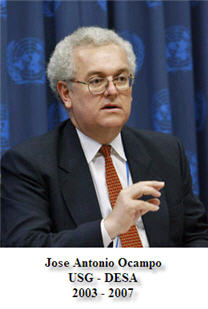
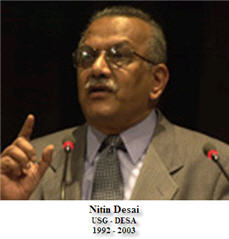
If any one can change DESA, it is Mr. Sha who can do it. Of all the previous DESA USGs he is the only one without any specialised interest ( for example, Desai's interst was environment and thus he spent most of his time pursuing his personal substantive intereset at the neglect of DESA organizational matters; same with Ocampo - true to his substantive interest he spent all his time on global fiscal issues and left the business of organization and management of DESA to Executive Office and TCMS head - result is today's accumulated mess)
- Ms. Marie Oveissi, the OIC of TCMS is a book keeper by training. She has neither the educational qualifications nor the country experience (the latter is crucial to successful delivery of technical cooperation products at the country level)to deserve this post. Her promotion to this post is a direct outcome of machinations of axis of DESA patronage distribution.
- Her management style is authoritative, secretive and abusive.
- Although, TCMS has been established to function as a support services organization to the substantive divisions of DESA (the designated implementors of DESA Technical Cooperation projects)for the effecient delivery of technical cooperation products, Ms. Oveissi through clever manipulations has taken over execution responsibilities within her own fold - this is totally contrary to the mandate of the TCMS, a service organization cannot become an implementing agency. But that is exactly what TCMS has increasingly bcome over the years. It is also a highly staff heavy organization, but on casual scruntiny this is not easily detectable - many of its staff are hideen under the cover various bogus posts.
These anomalies of TCMS and machinations perpetuated by Ms. Oveissi and De Tomassi were brought to the attention of the previous USGs on numerous occassions. In case of Mr. Sha, all it can be said that clever manupulations by Ms. Oveissi and her group and other colleagues of the Executive Office have kept him away from knowing the real truth. Hopefully, submissions made through Reform UNDESA blog will draw his attention and bring to bear some serious and all encompassing reform. However, truth of the matter is that very little can be done and will be done as long as those who contribute to malfuncting of DESA continue to remain in their current position.
If any one can change DESA, it is Mr. Sha who can do it. Of all the previous DESA USGs he is the only one without any specialised interest ( for example, Desai's interst was environment and thus he spent most of his time pursuing his personal substantive intereset at the neglect of DESA organizational matters; same with Ocampo - true to his substantive interest he spent all his time on global fiscal issues and left the business of organization and management of DESA to Executive Office and TCMS head - result is today's accumulated mess)
Monday, 27 October 2008
Board of Auditors and ACABQ slam DESA for hiring hundreds of non-compliant consultants with BA and/or less education
During the biennium 2006-2007, The office of Technical Cooperation of UN-DESA, caired by Marie Oveissi and Furio De Tomassi, hired the following consultants:


2006: (Education/Nr#)
PhD / 86 consultants
MA / 94 consultants
BA / 42 consultants
Less BA / 124 consultants
Total of Consultants hired in 2006: 403 (out of which 48% with less than required education)

2007: (Education/Nr#)
PhD / 155 consultants
MA / 164 consultants
BA / 103 consultants
Less BA / 108 consultants
Total of Consultants hired in 2007: 530 (out of which 49.1% with less than required education)

This is a direct result of management failure, when allowing individuals at DESA/Technical Cooperation (TCMS) work as specialized HR officers. None of those employed at TCMS have any qualification or appropriate degrees in Human Resource Management.
DESA Staff call upon USG - Mr. Sha Zukang to immediately impose a freeze in hiring further useless consultants and initiate a radical and substantial change of TCMS and ensure that those involved in Human Resource policy and implementation have appropriate education and training.
Thursday, 23 October 2008
Even left-wing and pro-UN media couldn't pass on damning report that mentions DESA corruption

UNITED NATIONS — A task force established to ferret out corruption in United Nations purchasing practices will report the details of five new cases involving some $20 million in contracts to the General Assembly on Thursday, as well as preliminary details of eight other inquiries.
The report, covering July 2007 to July 2008, includes several allegations of United Nations employees’ steering contracts to close relatives or to vendors involved in kickback schemes.
The report from the Procurement Task Force, leaving out some details of individuals still under investigation, was released several weeks ago, just three months before the group’s mandate from the General Assembly was scheduled to run out at the end of December.
The task force is investigating some 50 cases involving fraud or corruption, which will be transferred to the investigations division in the internal oversight office of the United Nations.
The task force has been viewed with suspicion by some United Nations members since it was formed in January 2006, after the oil-for-food scandal involving kickbacks in the program under which Iraq was allowed to sell oil and to buy humanitarian goods.
The task force report said that 22 vendors had been sanctioned by the United Nations during its years in operation and that it had identified more than 20 fraud and corruption schemes involved in some $630 million in contracts.
But the report and two responses from the United Nations underscore the tension between the Secretariat building and the task force, which is run by Robert Appleton, a former assistant United States attorney in Connecticut, and has 19 investigators of diverse nationalities.
The task force says the United Nations has not done enough to screen vendors and has allowed corrupt individuals to continue getting contracts after changing companies’ names. It also criticizes the organization for not pursuing millions of dollars in lost revenue with any zeal.
“It is a matter of concern that the task force’s recommendations for recovery actions — supported by documentary evidence of fraud, corruption and misappropriation of funds resulting in losses and damages — have not been vigorously pursued,” the report says.
Senior United Nations officials responded that often the task force did not provide the detail needed to pursue the individuals.
In its official response to the report, the Secretariat said the task force overstepped its authority in recommending whom and what to pursue. The response, issued by the office of Ban Ki-moon, the secretary general, said “a recommendation or finding of severe performance failings does not necessarily constitute misconduct or bind the discretion of the secretary general.”
A clash of cultures is also evident, with the task force calling any fraud a poor reflection on the United Nations. But a review by the United Nations Board of Auditors suggested that the damage done was unclear because the task force “was only able to identify clear losses of $25 million.”
The main task force report and the secretary general’s response were first reported in The Washington Post on Tuesday. The reports were released without fanfare more than two weeks ago, quietly placed on public display racks among a blizzard of the organization’s documents.
In one case in Kenya investigated by the task force, an operations assistant involved in buying supplies via the United Nations Office for Project Services steered contracts to various companies, including one called Depasse Logistics, owned by her husband, according to the full investigation report posted on the American Embassy Web site.
The value of the contracts awarded amounted to $800,000. The woman and another employee were dismissed, and 12 companies were banned from doing business with the United Nations.
Saturday, 18 October 2008
Comment on REFORM UN-DESA: we're in dire need of reform
First of all I would like to congratulate your initiative to expose and fight internal corruption and miss-management that is eating and consuming UN-DESA alive.
As a staff member of UN-DESA for more than 15 years, I have witness with great concern the increasing attack by critics in the United States and other countries towards our department. The truth at the heart of our department's mounting problems is an almost total lack of accountability, which gives rise to suspicions of wholesale corruption. With the latest publication from your BLOG and reputable MEDIA on Guido Bertucci's, EO's and TCMS's practices, indicates that corruption and mismanagement go beyond the routine fraud, waste, and abuse of resources.
UN-DESA's budgets are shrouded in secrecy, and the actual performance is translucent, if not opaque. There is no reliable way to determine whether the various and often competing Divisions and/or Branches are doing their jobs, and many DESA activities, even if they are of some value, can be carried out better and more efficiently by other groups (NGOs or even UN Funds and Programmes). Other activities should not be undertaken at all.
The latest available evidence from OIOS investigations coupled with DESA's management unwillingness to undergo a thorough audit raise serious questions about our mission and the means used to carry it out. Secretary General Ban Ki-Moon's rationale that the UN is accountable to all its 185 member-states is meaningless. Such an amorphous standard of accountability is akin to saying no one is responsible.
Today UN-DESA, our/my Department, is in dire need of reform, starting with a comprehensive, independent audit of all our activities and programmes.
Even if a complete audit were performed inside DESA today, however, with the current leadership and management - there is no guarantee anything would be done about the problems identified. And radical change may not be possible, no matter how obvious the need. Given all the earlier, failed attempts to put things right, even on a limited basis, staff optimism about meaningful reform may be an exercise in wishful thinking.
Its 18 months since Mr. Sha Zukang came at DESA, and nothing has changed so far. While I remain skeptical about CHANGE, I hope that your BLOG will open the eyes of the outsiders and media and pressure our managers to do the right thing for once.
Best Regards,
a DESA employee
(name withhold for fear of retaliation)
As a staff member of UN-DESA for more than 15 years, I have witness with great concern the increasing attack by critics in the United States and other countries towards our department. The truth at the heart of our department's mounting problems is an almost total lack of accountability, which gives rise to suspicions of wholesale corruption. With the latest publication from your BLOG and reputable MEDIA on Guido Bertucci's, EO's and TCMS's practices, indicates that corruption and mismanagement go beyond the routine fraud, waste, and abuse of resources.
UN-DESA's budgets are shrouded in secrecy, and the actual performance is translucent, if not opaque. There is no reliable way to determine whether the various and often competing Divisions and/or Branches are doing their jobs, and many DESA activities, even if they are of some value, can be carried out better and more efficiently by other groups (NGOs or even UN Funds and Programmes). Other activities should not be undertaken at all.
The latest available evidence from OIOS investigations coupled with DESA's management unwillingness to undergo a thorough audit raise serious questions about our mission and the means used to carry it out. Secretary General Ban Ki-Moon's rationale that the UN is accountable to all its 185 member-states is meaningless. Such an amorphous standard of accountability is akin to saying no one is responsible.
Today UN-DESA, our/my Department, is in dire need of reform, starting with a comprehensive, independent audit of all our activities and programmes.
Even if a complete audit were performed inside DESA today, however, with the current leadership and management - there is no guarantee anything would be done about the problems identified. And radical change may not be possible, no matter how obvious the need. Given all the earlier, failed attempts to put things right, even on a limited basis, staff optimism about meaningful reform may be an exercise in wishful thinking.
Its 18 months since Mr. Sha Zukang came at DESA, and nothing has changed so far. While I remain skeptical about CHANGE, I hope that your BLOG will open the eyes of the outsiders and media and pressure our managers to do the right thing for once.
Best Regards,
a DESA employee
(name withhold for fear of retaliation)
Friday, 17 October 2008
Staff' Call for United States to withhold contributions to UN until U.N.D.E.S.A. Cleanup
For years the US Congress has called for Turtle Bay to fix itself pronto — or lose a big chunk of the U.S. dollars that fund its operations.
Such threats should come as no surprise to anyone who has been following the United Nations and its Funds and Programmes recently. The world's premier international institution has been wracked by widespread scandal and mismanagement.
The exposure of the corrupt Public Administration Programme (DPADM) and shocking accounts of procurement and contracts by U.N DESA's Executive Office and Technical Cooperation Unit (TCMS) in far too many places would be enough to close down most organizations — but not the United Nations's DESA.
Secretary-General Ban Ki-Moon as well as USG Sha Zukang admit there are serious problems — and have promised change. But with the United States taxpayers contributing the lion's share of the U.N.'s bloated budget — $2 billion a year — promises of change aren't good enough.
Time has come to address the U.N.'s legendary bureaucratization, billions of dollars spent on multitudes of programs with meager results, and outright misappropriation and mismanagement of funds.
And there's a stick: If the UN DESA doesn't implement — and certify — the changes stipulated in many OIOS and Procurement Task Force Reports — including budget, human resources overhauling, Executive Office and Technical Cooperation cleanup — the U.S. government should withhold its U.N. dues payment.
UN Staff believes that without applying appropriate "leverage," such as withholding up to half of America's assessed dues or mandating cuts in specific U.N. programs, that reforms "will fail or be incomplete at best." Considering the U.S. pays 22 percent of the U.N. budget, a cut of that magnitude would be a painful dose of "tough love."
The only way to improve UN-DESA's effectiveness and efficiency is to cut its resources and oblige its management to rethink the way it does business, and deal with its growing cancer.
The UN Staff recognizes that U.N. reforms need to be kick-started. With Ban Ki-moon leaving his post at the end of his term in 24 months, many see him now as a lame duck, and woefully incapable of implementing any meaningful reform agenda.
As it stands now, without serious US congressional pressure and leadership, reforms are likely to languish until a new and more energetic secretary-general is in place — at best. At worst, reform will be frustrated and infinitum by the U.N.'s (DESA) entrenched bureaucracy.
It is outrageous the spending that DESA does on conferences and useless meetings. 70% of DESA's budget goes to meaningless meetings and round tables which produce nothing and does nothing to alleviate poverty and help the poor around the world.
Since the United Nations Department of Economic and Social Affairs can't—or won't — reform, US Congress will have to step in and save the world body from itself.
UN Staff call on all media to turn their attention to UN-DESA and its growing corruption and miss management. We need to scrutinize and held accountable DESA's management while inform the public of what is happening inside this UN institution.
Such threats should come as no surprise to anyone who has been following the United Nations and its Funds and Programmes recently. The world's premier international institution has been wracked by widespread scandal and mismanagement.
The exposure of the corrupt Public Administration Programme (DPADM) and shocking accounts of procurement and contracts by U.N DESA's Executive Office and Technical Cooperation Unit (TCMS) in far too many places would be enough to close down most organizations — but not the United Nations's DESA.
Secretary-General Ban Ki-Moon as well as USG Sha Zukang admit there are serious problems — and have promised change. But with the United States taxpayers contributing the lion's share of the U.N.'s bloated budget — $2 billion a year — promises of change aren't good enough.
Time has come to address the U.N.'s legendary bureaucratization, billions of dollars spent on multitudes of programs with meager results, and outright misappropriation and mismanagement of funds.
And there's a stick: If the UN DESA doesn't implement — and certify — the changes stipulated in many OIOS and Procurement Task Force Reports — including budget, human resources overhauling, Executive Office and Technical Cooperation cleanup — the U.S. government should withhold its U.N. dues payment.
UN Staff believes that without applying appropriate "leverage," such as withholding up to half of America's assessed dues or mandating cuts in specific U.N. programs, that reforms "will fail or be incomplete at best." Considering the U.S. pays 22 percent of the U.N. budget, a cut of that magnitude would be a painful dose of "tough love."
The only way to improve UN-DESA's effectiveness and efficiency is to cut its resources and oblige its management to rethink the way it does business, and deal with its growing cancer.
The UN Staff recognizes that U.N. reforms need to be kick-started. With Ban Ki-moon leaving his post at the end of his term in 24 months, many see him now as a lame duck, and woefully incapable of implementing any meaningful reform agenda.
As it stands now, without serious US congressional pressure and leadership, reforms are likely to languish until a new and more energetic secretary-general is in place — at best. At worst, reform will be frustrated and infinitum by the U.N.'s (DESA) entrenched bureaucracy.
It is outrageous the spending that DESA does on conferences and useless meetings. 70% of DESA's budget goes to meaningless meetings and round tables which produce nothing and does nothing to alleviate poverty and help the poor around the world.
Since the United Nations Department of Economic and Social Affairs can't—or won't — reform, US Congress will have to step in and save the world body from itself.
UN Staff call on all media to turn their attention to UN-DESA and its growing corruption and miss management. We need to scrutinize and held accountable DESA's management while inform the public of what is happening inside this UN institution.
Thursday, 16 October 2008
OIOS report on investigation of DESA's Executive Office and TCMS reveals major corruption
Following an investigative story on Washington Times on December 13, 2006 from Betsy Pisik, after almost two years of intensive investigations, today OIOS presented to the 63rd session of General Assembly it's report on Activities of the Office of Internal Oversight Services for the period from 1 July 2007 to 30 June 2008 (A/63/302 (PART I)).
In this report OIOS reveals how DESA's Executive Office (Catherine Peluso) and DESA's Technical Cooperation Management Services (Marie Oveissi and Furio De Tomassi) abused their power and rewarded contracts to individuals (consultants) without any criteria and/or proper bidding process.
The report shows that in the case of Peluso that she awarded out of 30 sample contracts - 10 contract to the same individual. While in the case of Oveissi and De Tomassi out of 37 sample of contracts, 34 of them were missing and destroyed.
We the DESA staff demand from Mr. Sha Zukang and our management to take immediate action and remove from DESA the above mentioned staff who, with their irresponsible actions, have brought shame and destroyed our reputation.
Here is a part of the OIOS report to General Assembly (ART.35 Page 16)
In this report OIOS reveals how DESA's Executive Office (Catherine Peluso) and DESA's Technical Cooperation Management Services (Marie Oveissi and Furio De Tomassi) abused their power and rewarded contracts to individuals (consultants) without any criteria and/or proper bidding process.
The report shows that in the case of Peluso that she awarded out of 30 sample contracts - 10 contract to the same individual. While in the case of Oveissi and De Tomassi out of 37 sample of contracts, 34 of them were missing and destroyed.
We the DESA staff demand from Mr. Sha Zukang and our management to take immediate action and remove from DESA the above mentioned staff who, with their irresponsible actions, have brought shame and destroyed our reputation.
Here is a part of the OIOS report to General Assembly (ART.35 Page 16)
35. In an audit of the use of consultants and individual contractors by the Department of Economic and Social Affairs (AN2007/540/02), OIOS found that the procedure for ensuring competitive selection was not spelled out by the Office of Human Resources Management of the Department of Management with a view to ensuring compliance by departments/offices. In addition, the Department of Economic and Social Affairs had not established internal procedures to ensure uniformly that the selection of consultants was competitive, fully documented, economical and in the best interests of the United Nations. Consequently, contracts were being awarded repeatedly to a limited number of consultants without documentation of a competitive process. For example, OIOS found that, of a sample of 37 contracts administered by the Technical Cooperation Management Services, documentation justifying the selection of candidates was not available in 34 files. In the contracts processed by the Executive Office of the Department, while 27 of 30 contracts sampled did document the names of the candidates who were considered, the same names were repeated in 10 of the contracts. The OIOS recommendations contained in the report are in the process of being implemented.

Monday, 6 October 2008
Sha Zukang admits that DESA miss-managed Greek Trust Fund: - says "Technical Cooperation at crossroad"
 Under Secretary General for UN-DESA has openly admitted thru an email to DESA's Directors that DPADM's Technical Cooperation is weak and at a crossroad.
In a document attached to his email he exposes and admits the wrong doings and miss-management of Guido Bertucci, Marie Oveissi and Furio De Tomassi, calling for a total overhaul of the Technical Cooperation.
Sha Zukang seem to be under enormous pressure from many member states who, based on Bertucci/Oveissi/De Tomassi performance, are now questioning if DESA should engage at all in Technical Cooperation.
One thing Sha Zukang should do now, he should officially transmit the OIOS report to Greek Government and return the unspent funds to its tax-payers, while pursuing thru JDC Guido Bertucci and insist that he pays back the $35,000 USD he wrongfully and intentionally misappropriated from the project.
Here is the copy of the letter.

Friday, 25 July 2008
Greek Parliament discuss U.N.-DESA's corruption and requests restituion of funds
In response to the Question (No 1333) presented by the Member of Parliament Ms. Chryssa Arapoglou on the subject of the “Operations of the Office of the United Nations in Thessaloniki by the Honourable Representative for Thessaloniki” we report the following:
---
In 1999, the Greek Government signed a Technical Cooperation Agreement1 with the United Nations with a view to the establishment of the United Nations Thessaloniki Centre for Public Service Professionalism (UNTC) and the financing of a Trust Fund.
The objectives of the Centre were as follows:
- [a] to reinforce the role, performance and professionalism, ethical values and standards in the public services of the countries of Eastern Europe and the Commonwealth of Independent States (CIS);
- [b] to strengthen institutional capacity for public service reform and to enhance professionalism in the countries of Eastern Europe and the CIS;
- [c] to strengthen the institutions, which contribute to good governance and to combat corruption in the countries of Eastern Europe and the CIS;
- [d] to promote cooperation for the improvement of the machinery of government, for good governance and social progress among the Member States of Eastern Europe and the CIS;
- [e] to provide a constant flow of information in support of the abovementioned objectives, activities and outcomes; and
- [f] to promote decentralisation on the basis of the principles of devolution of authority and support for non-governmental organisations which support public service reform.
The creation of the Centre signalled the passage of Greece from a recipient country to being a donor country in the framework of the United Nations Technical Cooperation Programme. It also sought to turn the city of Thessaloniki into the hub of a network for information-sharing on issues which relate to Public Service Reform and for dissemination of relevant Greek know how in the countries of Central, Eastern and South-Eastern Europe and the CIS. This goal has not been achieved and very few of the objectives of the Centre have been fulfilled because the Centre and the Trust Fund became victims of serious mismanagement on the part of DPADM/DESA2.
This mismanagement of monies of the Trust Fund was not detected immediately, on account of obstruction from the responsible Division (DPADM/DESA) which consistently refused to comply with provisions in the Trust Fund Agreement requiring it to account on economic matters. An intervention was needed, from Mr. Christopher B. Burnham, to set in motion the process of an internal audit and to secure replies, albeit with great delay, to some questions which the responsible Minister of IPAD had asked as early as June 2004, by letter to Mr. Ocampo and Mr. Bertucci, senior officials in charge of the management of the UNTC and the Trust Fund.
We are talking, in effect, of a process which was first initiated in 2004 and 2005, but has yet to be completed.
Analytically, we report the following:
The Greek Government, by letter of the Minister of IPAD3, Professor P. Pavlopoulos, requested the conduct of an external audit of the Programme and the Fund. This, the Minister put forward to Mr. Guido Bertucci, Director of DPADM/UNDESA. He repeated the request to Mrs. Inga-Britt Ahlenius, Under-Secretary-General for the OIOS4.
After the passage of several months, an answer was received from the UnderSecretary-General of the Department of Management Mr. Christopher B. Burnham5. Mr. Burnham expressed regret for this delayed response to the Minister’s request. He added that, after consultations with Mrs. Ahlenius, an internal audit had been launched, which was expected to reach its conclusion towards the end of July.
In the framework of this audit, two Auditors visited Greece during the third week of July. They met with the former professional staff of the UNTC, Dr. Panos Liverakos, Chief Technical Advisor, and Ms. Anne Caroline Tveoy, former Public Administration Officer and Officer-in-Charge. They also met with a member of the responsible Division (D1) of the Ministry of Foreign Affairs, Ambassador Alexandros Rallis, with the Minister of IPAD and the Secretary-General of the same Department of government. At the close of the working session, the Secretary-General gave the auditors a list of questions6 on which the Government wished to receive detailed replies.
This mismanagement and misuse, have been corroborated by the UnderSecretary-General Mr. Christopher B. Burnham in a letter which he addressed to the Minister of IPAD7. In this letter, Mr. Burnham briefly referred to the progress of the audit and also thanked the Minister for his cooperation, noting that his insistence had helped to bring to light a number of deficiencies not of the UNTC – this should be stressed - but of the UNDESA Division charged with its supervision, and headquartered in New York.
The deficiencies in question, which the Hellenic Government had repeatedly underscored and brought to the attention of the United Nations, could be summed up as follows:
- [a] Non-compliance with the terms of the Trust Fund Agreement, as ratified by Parliament on 17 July 20028; specifically:
- submission of detailed financial data on an annual basis;
- submission of progress reports on a six-monthly basis;
- provision of the requisite administrative and technical support (backstopping) to the Programme; and - [b] Lack of any consistency and transparency in the actions of the Division (DPADM) tasked with the supervision and management of the Centre.
These rendered it impossible for Centre’s professional staff to implement its Programme and to accomplish goals to which Mr. Bertucci himself had agreed in December 2004 after his consultations with the Minister of IPAD9.
The complete lack of consistency and transparency in the actions of the Division entrusted with the management of the UNTC became abundantly clear during the final months of the Centre’s operation – or to be more precise, deficient operation. Specifically, on 5 December 2005, Mr. Guido Bertucci, Director of DPADM, sent a letter10 to the Minister of IPAD, which announced his intention to close the Centre down on 31 March 2006. This intention, Mr. Bertucci repeated in a letter11 to Ambassador F. Verros, Director of the responsible Division of the Ministry of Foreign Affairs. Indeed, in this second letter, Mr. Bertucci confirmed, not only the removal of the UNTC’s Chief Technical Advisor, which had already taken place on 31 December 2005, but also his intention to inform the landlord of the building housing the Centre that he would take all measures in order to surrender the building in due form by 31 March 2006.
However, as stipulated, in a subsequent letter12 of the Secretary-General of IPAD, the Centre did not close on 31 March as stated, but continued to be open though idle for six months, at a monthly cost of US $ 16,000 approximately. The Secretary-General demanded immediate remedial action to put an end to this situation. He added that, if the Centre remained open past 15 October 2006, the corresponding expenditures would burden DPADM exclusively. In response to this ultimatum, the Director, Mr. Bertucci instructed his subordinate to go to Athens immediately and close the Centre down on 31 October 2006.
In addition to lack of transparency, accountability, consultation and cooperation on the part of DPADM (New York), the management of the Centre consistently exemplified obstruction and lack of any continuity in the pursuit of the objectives of the Centre, as well as systematic passing the blame for failures on its successive heads (Chief Technical Advisors), i.e., Mr. Tsekos (2000-2004) and Mr. Liverakos (2004-2005). In retrospect, it is manifest that obstruction was intended to maximize the funds of the Trust Fund and Centre, which would remain available for totally extraneous purposes, which only now belatedly have surfaced: payment of numerous “consultants”, who never produced any output related to the Centre; whose employment did not have either specific goals or outcomes.
The above corroborates the view that the Trust Fund became the victim of very grave mis-management. This view was clearly expressed, at a very early stage, by the Minister of IPAD in a letter13, which requested the return and restitution not merely of the remaining balance of the Trust Fund, but also
In conclusion, it is necessary to emphasise the following:
- [a] From the very early start and assumption of his duties in March 2004, the Minister of IPAD despatched repeated messages to the responsible agency requesting the submission of the mandated reports together with details on assets and expenditures of the Centre14;
- [b] The Director of DPADM, Mr. Bertucci consistently refused to account, as he was required under the terms of the Trust Fund Agreement. Indeed, he falsely claimed – in his letter of 5 December 2005 – that an audit could not be conducted. He further “threatened” closure of the Centre, by 31 March 2006. As stated, however, this closure did not take place in fact until six months later and only after despatch of an ultimatum by the Secretary-General of the Ministry of IPAD, Mr. Vassilios Andronopoulos;
- [c] The claim to restitution remains in force. It demonstrates the country’s firm commitment to recovering the amounts which correspond to funds that were embezzled for reasons unrelated to the Centre, or money paid in return for support services which the Centre did not receive;
- [d] Lastly, as might be expected for any further action, we shall await the outcomes of the audit, which the responsible Department of the United Nations is currently concluding.
Thursday, 17 July 2008

Monday, 14 July 2008
The U.N. and your money
By Betsy Pisik
THE WASHINGTON TIMES
NEW YORK -- A U.N. office charged with promoting accountability has for years been steering millions of dollars in contributions from the Italian government toward projects that enrich Italian nationals but offer little of real value, according to former and current staff members.
The contributions have been used to hire unneeded consultants and establish international programs, often in Italy, say the staffers employed in the U.N. Department of Economic and Social Affairs (DESA).
The U.S. Mission to the United Nations has asked the U.N. watchdog agency to investigate the awarding of contracts by DESA and reports of retaliation against staff members. It is also seeking to have documents seized before they can be destroyed, according to internal U.S. communications.
Some sensitive financial data disappeared from the DESA Web site last week after a reporter began making inquiries.
Several staff members say they worry that well-connected DESA officials will seek senior positions in the administration of incoming Secretary-General Ban Ki-moon, who takes office Jan. 1. Most spoke on the condition of anonymity, saying internal U.N. controls are not sufficient to root out ingrained corruption or protect whistle-blowers at the department.
Two years after a U.N. report found extensive abuse in the Iraq oil-for-food program, disbursements to DESA still are only lightly reviewed by U.N. financial oversight offices.
DESA is a sprawling U.N. department with nearly 570 employees and a 2006-07 budget of $268.2 million, 40 percent of which comes from voluntary contributions. Its divisions are charged with providing economic data and other statistics to the General Assembly, as well as advancing the role of women, creating sustainable development policy and coordinating good governance.
One of its largest divisions is the Department for Public Administration and Development Management (DPADM), which promotes transparency and accountability in public administration.
DPADM, which is based in a glass-walled New York skyscraper but has an office in Rome and smaller outposts elsewhere, advises governments on improving management, providing social services and rooting out corruption.
The Italian government is by far the largest single donor to DESA and DPADM activities, contributing some $80.2 million since 2004 to various trust funds. These are overseen by DPADM Director Guido Bertucci and the chief of the personnel services unit, Furio de Tomassi, according to DESA officials. They report to Patrizio Civili, assistant secretary-general for DESA.
All three are Italian nationals. That, say current and former U.N. officials with knowledge of the program, makes it possible for the Italian government's development office to channel its U.N. contributions to Italian nationals and pet causes, such as those focusing on the Mediterranean region.
The Italian Mission to the United Nations indirectly signs off on all disbursements from their contributions, according to U.N. officials, but Italian authorities have never requested a U.N. audit of the funds.
The Italian ambassador to the United Nations, Marcello Spatafora, declined through his spokesman to be interviewed for this article.
Checks and balances
Unlike any comparable division in the U.N. Secretariat, DESA has its own in-house human-resources department, enabling it to consolidate the hiring of consultants and independently funded "associate experts" under its own umbrella, away from the more accountable U.N. Office of Human Resources Management.
Current and former U.N. officials also say that contrary to standard procedure, the hiring, project-review and payment-authorization functions have been merged, concentrating power in the hands of Mr. Bertucci and a handful of people who work closely with him.
"It's a simple system of checks and balances to make sure that whoever is hired does the work and then is paid," said a current U.N. official who did not want to be named for fear of retaliation. Some DPADM staff members said they have been questioned by their supervisors about leaks from the department.
One area of concern is DESA's $39 million Associate Expert Program, in which young and relatively inexperienced technocrats are brought to headquarters or member capitals for one- to two-year assignments working on governance issues such as civil-service professionalism, ethics and reform, and management.
Italians are recruited through DESA offices in Rome as well as in New York, while candidates from other nationalities must send their resumes to the New York headquarters.
Marie Oveissi, officer in charge of DESA's Technical and Cooperation Management Services, said in a memo that 28 of this year's 159 associate experts are Italian, more than any other nationality. An additional 111 Italian associate experts are deployed to independent U.N. agencies, as are experts of other nationalities.
In addition, Italy -- which finances one-third to one-half of the total program each year -- also subsidized the hiring this year of one associate from the developing world.
Some observers say the associate-experts program is, effectively, a talent pool for future DESA consultants and contractors.
In an interview last week, two senior DESA officials said there was nothing amiss within their organization and rejected any suggestion that Italian government funds have been misused.
However, when reporters began making inquiries about the administration of the DPADM unit, the public Web site was briefly shut down and information relating to the funds and programs was removed.
Nicolai Zaitsev, chief of office for DESA Undersecretary-General Jose Antonio Ocampo, said last week that he had been assured by the system administrator that nothing significant had been changed or removed from the Web site.
But substantive materials relating to the use of Italian contributions have been taken down. Documents that are no longer available include memorandums of an understanding between DESA and the Italian government on the use of its funds for:
•An electronic governance center.
•The establishment of DESA's Rome office.
•The funding of associate experts.
•The establishment of several international programs to be based in Italy.
Other documents no longer available include four annual reports of DESA's Committee of Experts in Public Administration and the Web site of a Greek-financed governance center that is subject to an ongoing U.N. investigation.
Mrs. Oveissi, whose department oversees much of DPADM's work, defended the department and its management, saying that donor governments are routinely informed how their money will be used and have the opportunity to object or direct their contributions.
"I would say every donor is fully aware of the intent of the organization and how the money will be used," she said. "It is defined in specific project documents, which have been agreed to by both parties and expenditures of those projects are reported back. ... They may say, 'We want to fund this, not that.' "
Mrs. Oveissi also stressed that all of the department's trust funds are regularly monitored by internal and external auditors in accordance with U.N. regulations. She said she was aware of only one investigation, requested earlier this year by the Greek government.
Unneeded consultants
Greek officials gave the unit $5 million to establish the Thessaloniki Center for Public Service Professionalism in 1999 but said its work was undermined by a duplicative center that was established in Naples three years later. The project was to have been shut down and remaining funds and fees returned to Athens, but that has not yet happened.
Originally expected this week, the report on the center will not be concluded until mid-January, according to U.N. auditors, because DESA officials have not yet responded to their findings.
Some U.N. officials and DESA staffers say the Greek contretemps is emblematic of the secretive nature of DPADM, in which budgets and decision-making are held in near secrecy and the staff is often left with little idea of what is expected of them.
A former DESA official, who left the organization after more than a decade citing frustration with DPADM management, said one of the biggest problems was the hiring of consultants to do projects that were more suitably accomplished in-house.
"Not only was it a waste of $25,000 or $100,000, but it demoralized the staff," the official said in an interview last week. "We would organize something, and then Mr. Bertucci would tell us not to bother. He would assign it to a consultant."
The official, who asked not to be identified, described an atmosphere of uncertainty in which consultants would take up office space and then disappear, with no one knowing who they were, what projects they were working on or how they were funded.
"When organizing projects, we seldom knew what funds we could predictably spend; [Mr. Bertucci] held finances for all the branches in DPADM in some central fund, and there was no transparency or accountability in the planning and utilizing of funds," the former official said.
Mrs. Oveissi, an American who has worked in DESA for more than a decade, was unable to say how many consultants had been hired in recent years, nor could she break down the number of Italian staff members and contract holders compared with other nationalities.
However, she rejected the suggestion that hiring favored any nationality.
Biennial review
All trust funds established within the U.N. Secretariat are audited every year, according to an official in the office of Program Planning, Budget and Accounts. However, he said, the funds are looked at as a whole and rarely dissected individually.
There is also a biennial review by the U.N. External Board of Auditors. In July 2004, the board found plenty to criticize in DESA's handling of 73 active trust funds: A review of 25 percent of the funds found "eight had no work plans, 11 were without review plans, 16 did not specify performance indicators, five did not have monitoring and evaluation reports and three did not have financial and inventory reports.
"The board is concerned that the department may not be able to monitor effectively the implementation of the projects owing to the absence of project documents," it said.
Mrs. Oveissi said the poor review was the result of a slow adoption of results-based budgeting, a new and improved form of evaluation that the department had not adopted at that point.
The chief U.N. watchdog agency, the Office of Internal Oversight Services (OIOS), has not conducted a comprehensive investigation of DESA or its trust funds, according to a manager within OIOS.
"Once in a while, not every year, we audit one or two of their projects, or their divisions at headquarters," he said, speaking on the condition that he not be identified.
"There are so many trust funds even just under economic and social [affairs]. Sometimes we audit them on issues that are common to all trust funds, sometimes we audit individually."
THE WASHINGTON TIMES
NEW YORK -- A U.N. office charged with promoting accountability has for years been steering millions of dollars in contributions from the Italian government toward projects that enrich Italian nationals but offer little of real value, according to former and current staff members.
The contributions have been used to hire unneeded consultants and establish international programs, often in Italy, say the staffers employed in the U.N. Department of Economic and Social Affairs (DESA).
The U.S. Mission to the United Nations has asked the U.N. watchdog agency to investigate the awarding of contracts by DESA and reports of retaliation against staff members. It is also seeking to have documents seized before they can be destroyed, according to internal U.S. communications.
Some sensitive financial data disappeared from the DESA Web site last week after a reporter began making inquiries.
Several staff members say they worry that well-connected DESA officials will seek senior positions in the administration of incoming Secretary-General Ban Ki-moon, who takes office Jan. 1. Most spoke on the condition of anonymity, saying internal U.N. controls are not sufficient to root out ingrained corruption or protect whistle-blowers at the department.
Two years after a U.N. report found extensive abuse in the Iraq oil-for-food program, disbursements to DESA still are only lightly reviewed by U.N. financial oversight offices.
DESA is a sprawling U.N. department with nearly 570 employees and a 2006-07 budget of $268.2 million, 40 percent of which comes from voluntary contributions. Its divisions are charged with providing economic data and other statistics to the General Assembly, as well as advancing the role of women, creating sustainable development policy and coordinating good governance.
One of its largest divisions is the Department for Public Administration and Development Management (DPADM), which promotes transparency and accountability in public administration.
DPADM, which is based in a glass-walled New York skyscraper but has an office in Rome and smaller outposts elsewhere, advises governments on improving management, providing social services and rooting out corruption.
The Italian government is by far the largest single donor to DESA and DPADM activities, contributing some $80.2 million since 2004 to various trust funds. These are overseen by DPADM Director Guido Bertucci and the chief of the personnel services unit, Furio de Tomassi, according to DESA officials. They report to Patrizio Civili, assistant secretary-general for DESA.
All three are Italian nationals. That, say current and former U.N. officials with knowledge of the program, makes it possible for the Italian government's development office to channel its U.N. contributions to Italian nationals and pet causes, such as those focusing on the Mediterranean region.
The Italian Mission to the United Nations indirectly signs off on all disbursements from their contributions, according to U.N. officials, but Italian authorities have never requested a U.N. audit of the funds.
The Italian ambassador to the United Nations, Marcello Spatafora, declined through his spokesman to be interviewed for this article.
Checks and balances
Unlike any comparable division in the U.N. Secretariat, DESA has its own in-house human-resources department, enabling it to consolidate the hiring of consultants and independently funded "associate experts" under its own umbrella, away from the more accountable U.N. Office of Human Resources Management.
Current and former U.N. officials also say that contrary to standard procedure, the hiring, project-review and payment-authorization functions have been merged, concentrating power in the hands of Mr. Bertucci and a handful of people who work closely with him.
"It's a simple system of checks and balances to make sure that whoever is hired does the work and then is paid," said a current U.N. official who did not want to be named for fear of retaliation. Some DPADM staff members said they have been questioned by their supervisors about leaks from the department.
One area of concern is DESA's $39 million Associate Expert Program, in which young and relatively inexperienced technocrats are brought to headquarters or member capitals for one- to two-year assignments working on governance issues such as civil-service professionalism, ethics and reform, and management.
Italians are recruited through DESA offices in Rome as well as in New York, while candidates from other nationalities must send their resumes to the New York headquarters.
Marie Oveissi, officer in charge of DESA's Technical and Cooperation Management Services, said in a memo that 28 of this year's 159 associate experts are Italian, more than any other nationality. An additional 111 Italian associate experts are deployed to independent U.N. agencies, as are experts of other nationalities.
In addition, Italy -- which finances one-third to one-half of the total program each year -- also subsidized the hiring this year of one associate from the developing world.
Some observers say the associate-experts program is, effectively, a talent pool for future DESA consultants and contractors.
In an interview last week, two senior DESA officials said there was nothing amiss within their organization and rejected any suggestion that Italian government funds have been misused.
However, when reporters began making inquiries about the administration of the DPADM unit, the public Web site was briefly shut down and information relating to the funds and programs was removed.
Nicolai Zaitsev, chief of office for DESA Undersecretary-General Jose Antonio Ocampo, said last week that he had been assured by the system administrator that nothing significant had been changed or removed from the Web site.
But substantive materials relating to the use of Italian contributions have been taken down. Documents that are no longer available include memorandums of an understanding between DESA and the Italian government on the use of its funds for:
•An electronic governance center.
•The establishment of DESA's Rome office.
•The funding of associate experts.
•The establishment of several international programs to be based in Italy.
Other documents no longer available include four annual reports of DESA's Committee of Experts in Public Administration and the Web site of a Greek-financed governance center that is subject to an ongoing U.N. investigation.
Mrs. Oveissi, whose department oversees much of DPADM's work, defended the department and its management, saying that donor governments are routinely informed how their money will be used and have the opportunity to object or direct their contributions.
"I would say every donor is fully aware of the intent of the organization and how the money will be used," she said. "It is defined in specific project documents, which have been agreed to by both parties and expenditures of those projects are reported back. ... They may say, 'We want to fund this, not that.' "
Mrs. Oveissi also stressed that all of the department's trust funds are regularly monitored by internal and external auditors in accordance with U.N. regulations. She said she was aware of only one investigation, requested earlier this year by the Greek government.
Unneeded consultants
Greek officials gave the unit $5 million to establish the Thessaloniki Center for Public Service Professionalism in 1999 but said its work was undermined by a duplicative center that was established in Naples three years later. The project was to have been shut down and remaining funds and fees returned to Athens, but that has not yet happened.
Originally expected this week, the report on the center will not be concluded until mid-January, according to U.N. auditors, because DESA officials have not yet responded to their findings.
Some U.N. officials and DESA staffers say the Greek contretemps is emblematic of the secretive nature of DPADM, in which budgets and decision-making are held in near secrecy and the staff is often left with little idea of what is expected of them.
A former DESA official, who left the organization after more than a decade citing frustration with DPADM management, said one of the biggest problems was the hiring of consultants to do projects that were more suitably accomplished in-house.
"Not only was it a waste of $25,000 or $100,000, but it demoralized the staff," the official said in an interview last week. "We would organize something, and then Mr. Bertucci would tell us not to bother. He would assign it to a consultant."
The official, who asked not to be identified, described an atmosphere of uncertainty in which consultants would take up office space and then disappear, with no one knowing who they were, what projects they were working on or how they were funded.
"When organizing projects, we seldom knew what funds we could predictably spend; [Mr. Bertucci] held finances for all the branches in DPADM in some central fund, and there was no transparency or accountability in the planning and utilizing of funds," the former official said.
Mrs. Oveissi, an American who has worked in DESA for more than a decade, was unable to say how many consultants had been hired in recent years, nor could she break down the number of Italian staff members and contract holders compared with other nationalities.
However, she rejected the suggestion that hiring favored any nationality.
Biennial review
All trust funds established within the U.N. Secretariat are audited every year, according to an official in the office of Program Planning, Budget and Accounts. However, he said, the funds are looked at as a whole and rarely dissected individually.
There is also a biennial review by the U.N. External Board of Auditors. In July 2004, the board found plenty to criticize in DESA's handling of 73 active trust funds: A review of 25 percent of the funds found "eight had no work plans, 11 were without review plans, 16 did not specify performance indicators, five did not have monitoring and evaluation reports and three did not have financial and inventory reports.
"The board is concerned that the department may not be able to monitor effectively the implementation of the projects owing to the absence of project documents," it said.
Mrs. Oveissi said the poor review was the result of a slow adoption of results-based budgeting, a new and improved form of evaluation that the department had not adopted at that point.
The chief U.N. watchdog agency, the Office of Internal Oversight Services (OIOS), has not conducted a comprehensive investigation of DESA or its trust funds, according to a manager within OIOS.
"Once in a while, not every year, we audit one or two of their projects, or their divisions at headquarters," he said, speaking on the condition that he not be identified.
"There are so many trust funds even just under economic and social [affairs]. Sometimes we audit them on issues that are common to all trust funds, sometimes we audit individually."
Subscribe to:
Posts (Atom)