Showing posts with label DPADM. Show all posts

Thursday, 12 July 2012

How professional and ethical are the Human Resources of UN-DESA?

This month is the 10th anniversary of John Mary Kauzya' appointment as Chief of Governance and Public Administration Branch of DPADM.

Let's compare the career and rise of Haiyan Qian (Chinese) and John Mary Kauzya (African) in the last 10 years:

2002

John Mary Kauzya      => appointed D1
Haiyan Qian               => was a P3

2003

John Mary Kauzya      => is D1
Haiyan Qian               => appointed P4

2004 (end)

John Mary Kauzya      => is D1
Haiyan Qian               => appointed P5

2006

John Mary Kauzya      => is D1
Haiyan Qian               => is P5

2007

John Mary Kauzya      => is D1
Haiyan Qian               => appointed D1

2009

John Mary Kauzya      => is D1
Haiyan Qian               => appointed D2 (replaces Guido Bertucci)

2012

John Mary Kauzya      => still D1
Haiyan Qian               => still D2

So to recapitulate the above, in 10 years:

John Mary Kauzya      => stays without any further promotion at D1

Haiyan Qian               => moves 4 level ( and countless steps) to D2

Click on the above names to see their CVs and judge for yourself.

We're sure that at the end you'll blame your parents for not being a ...Chinese !


Friday, 22 June 2012

A Battle for Internet Freedom as UN Meeting Nears (At UN-DESA, about 50 chinese nationals are working night and day in collecting data from UN Member states in databases stored in China)


Secret negotiations involving dozens of countries preparing for a United Nations summit on international telecommunications could lead to changes in a global treaty that would diminish the Internet's role in economic growth and restrict the free flow of information.
 
The U.S. delegation to the World Conference on International Telecommunications to be held in Dubai in December has vowed to block any proposals from Russia and other countries that they believe threaten the Internet's current governing structure or give tacit approval to online censorship.
 

Tuesday, 20 September 2011

Would the return of Elia Yi Armstrong create shake-up at DPADM's Organigramme?

The South Korean Ms. Elia Yi Armstrong will be returning to DPADM at the beginning of 2012. This creates a major problem for Ms. Haiyan Qian (Director of DPADM), because while on the DPADM organigramme Ms. Armstrong is a P5, she currently seats on D1 position at UNDP (on-loan) as Director of UNDP's Ethics Office.


The return of Ms. Yi Armstrong, poses some very challenging decisions for Sha Zukang and Ms. Qian, and we are told that the following are the options being discussed:

1. Mr. John Mary Kauzya
Chief of Public administration Capacity Branch (PACB)
Since 2002 (10 years)

**we are told that Ms. Yi Armstrong' desire is to have the post of Mr. Kauzya, since this one has been occupied for more than 10 years from him and is "about time for him to move elsewhere or comply with mobility rules". For this, parallel moves have been offered to Mr. Kauzya, which seem to have not satisfied him so far.

***another voice at 23 floor said that given that Mr. Kauzya is among "the very few Africans" at DESA, he might be the only viable candidate to replace Ms. Haiyan Qian, in which scenario the landing of Ms. Elia Yi Armstrong at DPADM as Chief of PACB would be a smooth one, without causing other "un-necessary collateral damages".

2. Mr. Roberto Villareal
Chief Development Management Branch (DMB)

**we are also told that the other option that Ms Qian is considering could be to remove Mr. Villareal from current job, given some inter-personal problems with its staff, and offer him smth with the Regional Commission of Latin America (ECLAC) or in case he rejects it, move him laterally to another post within DESA, far from DPADM. We are told this option is seen as the most viable one, given some recent confrontation between Ms. Qian and Mr. Villareal who had warrant the attention of USG - Sha Zukang to "solve" the matter.

All the above is being done in a climate of total secrecy, and seem that even this time there will be no need for an "open process of selection".

Only at United Nations...!

Monday, 18 July 2011

Sha Zukang from Austria says that UN-DESA's most corrupt Division (DPADM) would deal with "accountability and anti-corruption" in future

The person that will be remembered as the most-useless, unprofessional, spine-less, vision-less - the Under-Secretary General for U.N.'s Department of Economic and Social Affairs (DESA) seems to have something to say on topics like corruption and transparency!


.....I have instructed DESA and its Division for Public Administration and Development Management to start building up our capacity in accountability, good governance and anti-corruption....


Can INTOSAI accept advice from this man? Maybe INTOSAI should demand and read OIOS reports in the past 5 years about UN-DESA and its flagship Division - DPADM.

Tuesday, 29 March 2011

"Committee of Experts on Public Administration" - a non existing entity continues to formulate "policy" which is no longer implemented from DPADM

Economic and Social Council

Informal informal consultations


Informal informal consultations, convened by the facilitator (Bahamas), on the report of the ninth session of the Committee of Experts on Public Administration (E/2010/44), will be held on Wednesday, 30 March 2011, from 10 a.m. to 1 p.m. in Conference Room 7 (NLB).

Wednesday, 16 March 2011

Is this the type of IT and Good Governance best-practices Sha Zukang and Haiyan Qian have in mind to develop thru UN-DESA?

CLICK HERE TO VIEW THIS ON ENGADGET.COM


If you've been struggling to get your dose of Facebook or Twitter in China recently, then you're probably one of the many Internet users who've had their VPN access -- either free or paid for -- blocked over the last two weeks or so. That's right, the notorious Great Firewall of China is still alive and well, and leaving proxy servers aside, VPN is pretty much the only way for keen netizens to access websites that are deemed too sensitive for their eyes; or to "leap over the wall," as they say. Alas, the recent pro-democracy protests didn't exactly do these guys any favor -- for one, their organizers used Twitter along with an overseas human rights website to gather protesters, and with the National People's Congress meetings that were about to take place (and wrapped up last night), it was no surprise that the government went tough on this little bypassing trick. To make matters worse, PC World is reporting that Gmail users are also affected by slow or limited access, despite the service previously being free from China's blacklist.

We reached out to a handful of major VPN service providers, and they all confirmed a significant increase in the amount of blockage -- possibly by having their servers' PPTP IP addresses blocked -- over the last two weeks. One company even spotted the Chinese government subscribing to its paid service, only to work its way into the network to locate the company's PPTP server list, and then put them behind the firewall. Fortunately for some, the better-off companies had backup servers to rapidly resolve the problem, whereas the cheaper and free services were unable to dodge the bullet. This just goes to show that sometimes you get what you pay for. That said, with practically unlimited human hacking power at its disposal, it doesn't take much for the firewall to shut down everything heading its way. For the sake of our friends and expats there, let's just hope that the government will take things down a notch as soon as the storm calms.

Thursday, 17 February 2011

UNPAN afraid to show the list of its practitioners and experts (hides behind walls)


THIS IS HOW UNDESA's UNPAN
PRACTICES TRANSPARENCY OF ITS OWN ACCOUNTS

if any government or public would like to know the names of practitioners and experts (consultants) of UNDESA's Public Administration Network, they will need to have access thru a firewall or better write about it to Haiyan Qian the Director of DPADM.

The only question is what to do when Haiyan Qian is not around?

How can DPADM preach good governance and openess and citizen access to government data and info, while DESA's accounts are behind secret walls?


Tuesday, 14 September 2010

UN-DESA Staff dismissed for Fraud/misrepresentation


Information circular*

Practice of the Secretary-General in disciplinary matters and possible criminal behaviour, 1 July 2009 to 30 June 2010

The Under-Secretary-General for Management

ST/IC/2010/26


E. Fraud/misrepresentation


26. A staff member submitted inaccurate claims for rental subsidy allowance to the Organization, supported by forged and falsified documentation; certified the accuracy of such claims in the knowledge that they were not accurate; and knowingly received from the Organization rental subsidy allowances to which he was not entitled.


Disposition: dismissal.


Appeal: none.

Thursday, 29 July 2010

CNN: - UN needs a chief who can manage

CNN.com

By Michael Soussan, Special to CNN.com
STORY HIGHLIGHTS
  • Michael Soussan: Leaked report shows Ban Ki-moon not managing UN staff effectively
  • He says US, other democracies should push to replace Ban when his term is up
  • The UN Secretariat is in danger of becoming irrelevant, the report says

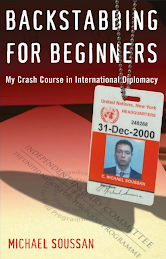
Editor's note: Michael Soussan, a former Program Coordinator for the UN "oil-for-food" operations, resigned from the organization in 2000. His memoir "Backstabbing for Beginners" (Nation Books, 2008) will be adapted to film by award-winning Danish Director Per Fly.

New York (CNN) -- The recently leaked memo from departing chief United Nations corruption investigator, Inga-Britt Ahlenius, to Secretary-General Ban Ki-moon will make it impossible for the White House to support the UN chief's candidacy for a second four-year term next year.

That is, unless the Obama administration itself was only joking when it promised to push for greater transparency and accountability at the United Nations.

In a 50-page "end-of-mission" report, the widely respected former auditor of Sweden -- who was originally brought in to help the UN fix the spectacular accountability gap exposed during the excruciatingly painful "oil-for-food" scandal -- paints a detailed, well-documented tableau of Ban's managerial incompetence.

In a spectacular break from tradition, Ahlenius did what few senior diplomats ever dare to do: She spoke truth to power.

In her report, Ahlenius documents Ban Ki-moon's repeated efforts to undermine his own senior officials, including her own office of internal oversight, by stemming the flow of information, interfering in the appointment of staff, or worse, failing to appoint people to senior management positions altogether. Critical leadership posts were left vacant for as long as possible, thereby strengthening Ban's power over the bureaucracy.

The UN Secretariat, she concludes, is "in a process of decay ... falling apart ... and drifting into irrelevance."

It may be that many member states do not actually want the UN to get in the way of their realpolitik. But when it comes to standing for the principles of its charter in difficult, often dangerous mission areas, the UN cannot succeed unless its staff are led and supported by a better-managed Secretariat in New York.

As it happens, even their very physical security did not appear to be a priority for the Ban Ki-moon administration. It failed to appoint another Under Secretary-General for Safety and Security for a full 11 months after accepting the resignation of David Veness, in June 2008, following the deadly bombing of the UN's Algeria headquarters.

Ban's failures to perform his duties as the UN's chief administrative officer in a timely manner -- the Ahlenius report describes these failures as widespread --have repercussions all the way down the line on staff security and morale. Instead of being empowered to do their job, the staff, including Ahlenius herself, end up feeling undermined by their boss.

Unless Hillary Clinton and her UN ambassador, Susan Rice, are prepared to contradict Ahlenius' assessment, they will have no choice but to withdraw America's support for Ban's re-election (his term expires at the end of 2011). Unfortunately for Ban's administration, few people were better placed than its own auditor to draw such conclusions.

And she is not alone in her assessment. Ahlenius has managed the rather undiplomatic feat of saying out loud what a lot of UN officials, including some at the highest levels, have been murmuring for several years.

While it is not altogether unheard of for former UN bureaucrats to blow their top after they leave office, it is without doubt the first time such a senior official has done so with as much competence, and credibility, as Ahlenius.

As a former employee of the UN's "oil-for-food" operation -- the organization's fraud-ridden $64 billion humanitarian operation that saw billions of dollars diverted from needy Iraqi civilians into the pockets of Saddam Hussein and an international clique of corrupt politicians -- I have learned to recognize the elements that go into making large-scale diplomatic fiascos.

After I had contributed to blowing the whistle on that program in 2004, some UN officials spent more time trying to discredit my testimony than to fix the cracks in the system that led to the debacle in the first place. Not so Ms. Ahlenius.

In fact, she invited me to spend an afternoon conducting a "lessons learned" discussion with her entire senior staff. Her approach was so markedly different from what I had experienced that I caught myself feeling hopeful, thereafter, about the chances of seeing real management reforms happen after all.

Unfortunately, it would seem Ahlenius has become a whistleblower herself. If such a senior UN official can't seem to communicate her concerns to her boss and is forced into the very uncomfortable position of having to speak out with such force as she did in her latest report, it is difficult to conclude that all is well at the top echelons of the world body.

If Ban Ki-moon were well advised, he would not seek a second term in office. If he were earnest about pushing for UN reform, he would free himself from the pressure the member states may try to exert upon his office, officially make public those parts of Ahlenius's report that do not affect staff security, and dedicate himself to mending the cracks in the system identified by his departing auditor.

Instead, Ban left it up to his chief of staff to issue a response which, both in form and substance, does a great job of confirming Ahlenius' criticism. In a July 19 letter to Colum Lynch of the Washington Post, who broke the story, Vijay Nambiar says that his boss "is also concerned" that critical senior managerial positions (now including that of Ahlenius) remain unfilled.

The problem is, Ban's job is not just to "be concerned." It is to actually make appointments -- or "to put butts on seats," as one U.S. official once put it to me off the record. In this instance, Ban ignored the best advice of a 15-member independent panel and refused to appoint John Appleton, the former Connecticut attorney, to head Ahlenius's investigation division. In the wake of the oil-for-food meltdown, Appleton had led an unprecedented exercise in accountability (so successfully, in fact, that his office was shut down in 2008).

Perhaps Ban would prefer to appoint someone else who, like he, prefers to show "concern" about the challenges facing the world organization than to take them on -- with deeds, not just words. For the UN's own sake, let's hope the leaders of the world's democracies can do better than that when it comes to electing a new leader for the United Nations in 2011.

The opinions expressed in this commentary are solely those of Michael Soussan.
Monday, 5 July 2010

Ban Ki Moon Refuses Summons in Bertucci Case

By Matthew Russell Lee

UNITED NATIONS, July 1 -- Under fire for seeming tothumb his nose at the rule of law in the UN, Secretary General Ban Ki-moon's top lawyer Patricia O'Brien faced the Press on Thursday, reading a script. She said Ban has the right to appeal. But why, Inner City Press asked, appeal an order that the decision making official appear in the UN Dispute Tribunal?

By appealing such an order -- as took place in March -- Ban appears to align himself for example with Omar al-Bashir, who seeks to argue around the International Criminal Court's indictment without even appearing once before the ICC in The Hague.

Your ICC analogy is interesting,” Ms. O'Brien replied, but noticed that the ICC is criminal while the UNDT is administrative. But to many the principle is no different: by refusing to even appear, the rule of law is harmed. Bashir is fine with that. But why is Ban?

O'Brien deployed words like “suspensatory” impact, and cited one example where a senior UN official appeared by video conference to the Tribunal in Nairobi. But what happened in March, before now-gone Judge Adams? Why has Ban been criticized, first exclusively by Inner City Press in the Shaaban Shaaban case, then by the Post and Times, for undermining the UN's internal justice?


Ms. O'Brien, Angela Kane and Terekhov, Ban's appearance not shown

The director of the Tribunals Andei Terekhov argued that the New York staff like the system, as proved by the SMCC. But the New York Staff Union doesn't participate in the SMCC, as after an Inner City Press follow up he acknowledged. Sitting in the front row was the human resources official who had tried to divide and conquer the union. There was no time to follow up.

The Head of Management tried to dodge the question of whether the closure on two days notice of the UN after-school program had been her decision. The decision was necessary, she said, while it is being reconsidered. But did you make it? The answer appears to be yes.

Footnote: After the UN justice briefing, the chief of staff of the President of the General Assembly told the Press that the Gender Entity is formed. It will be voted on on Friday. We'll be there: Watch this site.

Tuesday, 18 May 2010

Hot Tips on UN Waste, Fraud and Abuse: U.S. Mission Posts Scores of UN Internal Reports

by Claudia Rosett

Hot tip for any reporters interested in newly disclosed documents on waste, fraud and abuse at the United Nations:

Just days after I queried the U.S. Mission to the UN about its commitment to UN transparency (Paging Ambassador Susan Rice), the Mission finally posted on its web site more than 130 previously secret UN internal audit reports. The UN, for all its endless promises about transparency and its ample enjoyment of other people’s money, does not release these reports to the public. It is only thanks to the U.S. that they are now seeing daylight at all — though it takes some trolling through the Mission’s web site to find them.

For anyone who cares about even minimal integrity in UN management and handling of taxpayer money, there’s a trove of bombshell material here. Together, the reports total hundreds of pages, but the typical report runs about 10-20 pages. They date from October, 2008 through August, 2009.

Here’s a link to the U.S. Mission’s web page on UN Oversight and Transparency with the main links, and here are direct links to the newly posted and until-now confidential internal audit reports from 2008 and 2009.

Pick your subject and dive in, whether it’s a summary of the “higher risks” due to “the lack of an appropriate structure” for the UN’s own Ethics Office, or a report on the dire derelictions of reporting and accountability dogging the plump trust funds of the UN’s Office for the Coordination of Humanitarian Affairs (OCHA). Specifically set up to better coordinate aid, OCHA features in a Nov. 2008 audit report as handling trust funds with a throughput of hundreds of millions of dollars, but not bothering to produce any consolidated statement of cash flow. OCHA also had “little discernible linkage” between strategic planning and “the measurement and reporting of actual performance.”

For those interested in the UN’s climate bureaucracy, check out the July, 2009 report on the slop of the UNFCCC Secretariat’s conference management, with its multi-year delays in accounting for funds. Or delve into the Dec., 2008 report on the UNFCCC’s Clean Development Mechanism, where the governance was found “not adequate to mitigate reputational and other risks,” and the executive board “due to lack of time” had neglected to adopt any code of conduct whatsoever to address such corrosive problems as conflicts of interest.

Or, in the realms of UN peacekeeping, with its more than $8 billion annual budget, for which U.S. taxpayers alone fork out roughly $2 billion per year, check out the UN’s nearly $1 billion annual program for peacekeeping air operations. In an August, 2009 report, the UN’s own internal auditors noted that participation by senior management was “inadequate,” current staffing levels were “insufficient,” time of effective bidding on air charter services was “insufficient,” provisions in air charter agreements were “unclear” and some vendor registration was “improper.”

It takes a certain amount of determination to slog through the UN jargon, in which an executive summary of “not adequate” is often code for outright abuse or screaming failure, if you slog on to the details of the report. But in these reports, which cover only a sampling of the UN’s sprawling global system, the problems roll on and on. In corners that rarely receive attention from the media, they range from poorly documented lump-sum handling of noncompetitively-sourced travel arrangements for the UN mission in East Timor (UNMIT), to the UN’s disregard of its own rules in choosing a director for the UN Centre for Regional Development (UNCRD), headquartered in Japan.

It ought to be reassuring that at least the UN’s internal auditors are tracking some of this mess. But at the UN, it is one thing to have internal auditors flag a problem, and quite another to see the UN genuinely fix it. For instance, at the UN Mission to Cyprus (UNFICYP), where a growing web of UN scandals a few years ago led to fervent UN promises of reform, one of the audits just disclosed by the U.S. Mission, dated August, 2009, suggests that oddities lingered in such areas as “no competitive bidding” on commercial travel for contingents of Argentine peacekeepers, and “inefficient accounting of food rations.” (Here’s a look back at questions in 2005, then surrounding UNFICYP food rations).

For Washington to get any traction on pulling the UN out of its own administrative muck takes a lot of backbone and focused effort. But if the U.S. is to rely on the UN in any way, as President Barack Obama wishes to do, then the only course for minimizing chances of being tainted with the next colossal UN management scandal is for the U.S. to push hard, visibly and constantly for the UN to clean up its own house.

Credit Ambassador Susan Rice that the U.S. Mission to the UN has finally released these UN internal audit reports, even if for some reason it took well over a year to get around to it. (I can’t claim credit for prompting these postings with my story last week, though it would be nice to believe the U.S. Mission is that responsive to criticism. Let us assume it was merely glad coincidence that I queried the Mission on the whereabouts of these reports just 72 hours or so before they were suddenly released in bulk on the Mission web site).

A quick bit of history here: When the Oil-for-Food scandal broke big time in 2004, the UN refused to release its internal audits of the program even to governments of member states, including its chief donor, the U.S. After a showdown with congressional investigators, the internal audits were finally tipped out in early 2005, via the UN inquiry led by Paul Volcker. They provided damning insights into UN administrative abuses and derelictions that helped feed the gusher of Oil-for-Food corruption. Those reports might have been useful in heading off the damage of that UN blowout, had they been released to the public as they were produced, instead of being exposed later as an embarrassing piece of the UN’s self-serving coverup.
In the aftermath of those disclosures, the U.S. Mission under the previous administration began obtaining UN internal audit reports and posting them on its UN reform section of its web site. That’s the third link on the Mission’s current main page for Oversight and Transparency, OIOS Reports Archive, which runs up to Sept., 2008, and until the end of last week was the most recent information available.

For any current attempt to patrol the UN administrative habits, the next questions are: Where are the audits so far from 2010? When will the U.S. Mission post those? And when will the White House fill the important post at the U.S. Mission of Ambassador for Management and Reform? Since Obama took office, that slot has been left to an acting envoy, Obama’s nominee last year having flamed out over questions involving his own issues of management.

The Obama administration’s welcome decision to release the massive backlog of 2009 and late 2008 UN internal audits will only help if people actually read them and distill the information within, and U.S. authorities act by strongly pressuring the UN to clean up its endlessly proliferating mess — which in recent times has had virtually no oversight. The jury’s out. Meanwhile, here’s that link again, to scores of windows on UN management — or too often, mismanagement. It’s a start.

Wednesday, 12 May 2010

Another scandal in UN-DESA (Department of Economical and Social Affairs of the United Nations)

After Bruno Bastet (a French National) former Chief of Staff of Guido Bertucci (former Director of DPADM/DESA) was escorted from UN/DSS police out of DC2, another SCANDAL is about to explode in UN-DESA.

Sources inside Human Resources say that on a recent review of the personnel files of staffers of UN-DESA, they found that at least 60% of the Staff Force are missing important information in their respective Personnel Files:

  1. Certified Copies of their BA/Diploma(s) from recognized World Education Institutions;
  2. Certified Copies of their Masters/PhD or post-graduate courses to substantiate their claims in their PhP/CV;
  3. Certified Copies of their continuing education or training(s) either inside/on-the-job at the UN or at outside institutions;
  4. Initial Medical Clearances Certificates (mainly for short-term consultant and/or advisors);
While same sources say that the above "slippage" could be attributed to failure of OHRM to abide by UN Recruitment Rules and processes, still the number of UN-DESA staffers whom files are "not-in-order" or "do not seem to correspond to their claims" is quite high. On the other side OHRM is trying to show that most of these "rush-recruitments" were initiated by high level managers at DESA claiming either "last minute project emergencies" or "higher authority".

Another area for which seem to be "a real mess" is the hiring process of the so-called DESA Advisors or Consultants. Both these groups are the highest with "no evidence in files of their credentials" and many of them only have a simple 2-3 page CV on which the Recruitment has been initiated.

Sources say the "Review will be finalized very soon". Will these turn into another embarrassment for Sha Zukang?

Saturday, 1 May 2010

Well-Paid U.N. Official Took French Welfare Payments in Fraud Case

click here for story

A United Nations official in a department that promotes “ethics, transparency and accountability” falsified his permanent address to illegally obtain what could amount to tens of thousands of dollars in family allowance and housing funds that normally go to poor and moderate-income citizens in his native France, according to investigators there.

The fraud findings against Bruno Bastet, 40, are contained in an investigation report issued on May 20 by France’s Caisse d’Allocations Familiales (CAF), a branch of the French social security system that calls itself “one of the pivots of the French ‘social model’” — in other words, a centerpiece of the French welfare state.

The fraud involves Bastet’s listing himself, his then common-law wife and two children as residents of a city-owned housing complex in Paris designated for those in need of social assistance. Bastet, a program officer in the U.N. Department of Public Administration and Development Management (DPADM), has actually lived in New York City since 2004, while his former companion told FOX News she and the children have lived in the Dominican Republic since 2005.

If you would like to read the rest of this story, go tohttp://www.foxnews.com/story/0,2933,543562,00.html?loomia_ow=t0:s0:a16:g4:r5:c0.000000:b27383522:z0


Thursday, 25 February 2010

CHINA and UN-DESA to build the world largest ICT application database to be managed by the Chinese inside UNDESA

UNDESA and China are undertaking an initiative to collect a broad array of current ICT applications from almost all geographic regions of the world. Through this Knowledge Base, these cases could become a useful tool at the disposal of government at all levels, the private sector and civil society around the world. The primary goal of this initiative is to provide information that will stimulate an even more rapid expansion of electronic government, which will be more tailor-made to citizen’s needs.

Tuesday, 16 February 2010

Rethinking Poverty


12_Rethinking Poverty_bookcover.jpg

UNU-ONY will hold a book launch to discuss issues raised inRethinking Poverty: Report on the World Social Situation 2010,published by the United Nations Department of Economic and Social Affairs. The book focuses on the challenge of achieving poverty reduction, which remains an ethical, political and economic imperative.

The negative economic and social impacts of the recent food and energy crises, combined with the threats posed by climate change, challenges the assumption of the sustainability of poverty reduction. Rethinking Poverty: Report on the World Social Situation 2010 disputes the current technocratic vision of poverty reduction and affirms that eradicating poverty requires actions leading to sustainable economic growth, productive employment creation and social development as part of an integrated framework of economic and social policies for the benefit of all citizens.

The event will feature Dr. Jomo Kwame Sundaram, United Nations Assistant Secretary-General for Economic Development in the UN Department of Economic and Social Affairs (DESA), and (Honorary) Research Coordinator for the G-24 Intergovernmental Group on International Monetary Affairs and Development.

The Q&A session following the presentation will be moderated by UNU's Director Dr. Jean-Marc Coicaud.


Date: Tuesday, February 16, 2010

Time: 3:00 p.m. to 4:30 p.m.

Venue: Conference Room C, Temporary North Lawn Building (TNLB), UN Headquarters


Background Readings:

  • Rethinking Poverty: Report on the World Social Situation 2010 - Executive Summary - PDF
  • Rethinking Poverty: Report on the World Social Situation 2010 - Full Report - PDF
  • The Global Economic Crisis after One Year: Is a New Paradigm for Recovery in Developing Countries Emerging? - UNU Policy Brief - PDF
  • Policy Responses to the Global Economic Crisis in Africa - UNU Policy Brief - PDF
  • Vulnerability in Developing Countries - UNU Research Brief - PDF
  • Fragile States - UNU Research Brief - PDF
  • Poverty Reduction in China: Is High Growth Enough? - UNU Policy Brief - PDF
  • Can We Eradicate Hunger? - UNU Policy Brief - PDF
  • Fiscal Policy for Poverty Reduction, Reconstruction, and Growth - UNU Policy Brief - PDF
  • Resolution 56/177 adopted by the General Assembly. Implementation of the outcome of the World Summit for
    Social Development and of the twenty-fourth special session of the General Assembly - PDF

    Speaker Profile:

    Dr. Jomo Kwame Sundaram, United Nations Assistant Secretary-General for Economic Development in the UN Department of Economic and Social Affairs

    Moderator Profile:

    Jean-Marc Coicaud, Director, UNU-ONY

    ***


    Thumbnail image for JOmo final pic.jpg

    Dr. Jomo KS (Jomo Kwame Sundaram) has been UN Assistant Secretary General for Economic Development in the United Nations' Department of Economic and Social Affairs (DESA) since January 2005, and (Honorary) Research Coordinator for the G24 Intergovernmental Group on International Monetary Affairs and Development since December 2006. During 2008-2009, he serves as adviser to the President of the 63rd United Nations General Assembly, and as a member of the [Stiglitz] Commission of Experts of the President of the United Nations General Assembly on Reforms of the International Monetary and Financial System. Jomo was Professor in the Applied Economics Department, Faculty of Economics and Administration, University of Malaya until November 2004, Founder Director (1978-2004) of the Institute of Social Analysis (INSAN) and Founder Chair (2001-2004) of IDEAs, International Development Economics Associates (www.ideaswebsite.org ) where he now serves on the Advisory Panel. He was also on the Board of the United Nations Research Institute on Social Development (UNRISD), Geneva. Jomo studied at the Penang Free School, Royal Military College, Yale and Harvard. He has taught at Science University of Malaysia, Harvard, Yale, National University of Malaysia, University of Malaya, and Cornell. He has also been a Visiting Fellow at Cambridge University and a Senior Research Fellow at the Asia Research Institute, National University of Singapore. Jomo has authored over 35 monographs, edited over 50 books and translated 12 volumes besides writing many academic papers and articles for the media. He is on the editorial boards of several learned journals. In 2007, he was awarded the Wassily Leontief Prize for Advancing the Frontiers of Economic Thought. Some of his most recent book publications include Malaysia's Political Economy (with E. T. Gomez), Globalization Versus Development: Heterodox Perspectives; Southeast Asia's Industrialization; Behind Miracle and Debacle; After The Storm: Crisis, Recovery and Sustaining Development in East Asia; The Origins of Development Economics (with Erik Reinert); Pioneers of Development Economics; the two volumes of The Long Twentieth Century -- Globalization Under Hegemony: The Changing World Economy and The Great Divergence: Hegemony, Uneven Development and Global Inequality; Policy Matters: Economic And Social Policies To Sustain Equitable Development and Flat World, Big Gaps: Economic Liberalization, Globalization, Poverty and Inequality. His books in press include Servicing Malaysia: Labour Market Segmentation in Services (with H. L. Khong) and Regulating Malaysia: Law, Institutions and Economic Development (with others).


    JMCphoto3.jpg

    Dr. Jean-Marc Coicaud is the Director of the United Nations University (UNU) Office at the United Nations in New York. He was Senior Academic Officer at the UNU in Tokyo from 1996 to 2003. Before joining UNU, he served in the Executive Office of the United Nations Secretary-General as a speechwriter for Dr. Boutros Boutros-Ghali (1992-1996). A former fellow at Harvard University (Center for International Affairs, Department of Philosophy and Harvard Law School, from 1986 to 1992), Coicaud has held appointments such as Cultural Attaché with the French Ministry of Foreign Affairs, Legislative Aide with the European Parliament (Financial Committee), Associate Professor at the University of Paris, Visiting Professor at the Ecole Normale Supérieure-Ulm in Paris and Visiting Professor at Tsinghua University School of Public Policy and Management. He has also taught at the New School for Social Research (New York). He has been a Senior Fellow at the United States Institute of Peace (Washington, D.C.) and a Global Research Fellow at New York University School of Law. Coicaud holds a Ph.D. in political science-law from the Sorbonne and a Doctorat d'Etat in philosophy from the Institut d'Etudes Politiques of Paris. In addition, he holds undergraduate and graduate degrees in literature and linguistics. Jean-Marc Coicaud is a member of the Advisory Board of Carnegie Council's Global Policy Innovations (New York). He also serves as an adviser for the Fondation pour l'Innovation Politique (Paris). Dr. Coicaud has published 14 books in the fields of comparative politics, political and legal theory, international relations and international law. They are available in English, French, Japanese, Chinese, Spanish and Arabic, and include the following single-authored books: Politics and Legitimacy: A Contribution to the Study of Political Right and Political Responsibility (Cambridge University Press, 2002), Beyond the National Interest (United States Institute of Peace Press, 2007), Kokuren no Genkai/Kokuren no Mirai (Future of the UN/Limits of the UN - Fujiwara Shoten, 2007), Mai Xiang Guo Ji Fa Zhi (Towards the International Rule of Law - Sanlian Shudian, 2008). His latest book, co-edited with Hilary Charlesworth, is Fault Lines of International Legitimacy (Cambridge University Press, 2009).


Sunday, 7 February 2010

U.N. Remains Uninterested in Oversight and Accountability

by Brett D. Schaefer

This Associated Press story does a wonderful job of revealing just how uninterested theUnited Nations is in combating U.N.-related mismanagement, fraud, and corruption. As I detailed in a 2009 Heritage Foundation paper, the U.N. has a well-earned reputation for mismanagement and vulnerability to corruption and fraud. The United States tried for years to get the U.N. to take steps to address this problem, with little success. But when the extend of fraud and mismanagement under the Iraqi Oil-for-Food program became clear, the Bush administration was able to get the U.N. to create the United Nations Procurement Task Force (PTF) as an ad hoc group within the U.N.’s quasi–inspector general, the Office of Internal Oversight Services (OIOS), to investigate and pursue allegations of fraud and mismanagement.


The PTF began work in January 2006 and over the next three years uncovered fraud, waste, and mismanagement in U.N. procurement and other activities involving contracts valued at more than $630 million. The evidence unearthed by the PTF led to misconduct findings against 17 U.N. officials and the conviction of a senior U.N. procurement official. Unfortunately, the PTF did its job too well. As punishment for pursuing cases against Singaporean and Russian nationals, those countries led a successful effort to eliminate the PTF in December 2008.

My prediction that the decision to eliminate the PTF would undermine accountability and oversight at the U.N. is, unfortunately, proving true. As detailed in the AP story, U.N. investigations into fraud, corruption, and mismanagement have ground to a halt since the elimination of the PTF:

Since [the elimination of the PTF at the end of 2008], the number of cases opened, pursued or completed has dropped dramatically and the [OIOS's permanent investigation division] division has let go most former task force investigators, the AP found in an examination of U.N. documents, audits and e-mails, along with dozens of interviews with current and former U.N. officials and diplomats.

Over the past year, not a single significant fraud or corruption case has been completed, compared with an average 150 cases a year investigated by the task force. The permanent investigation division decided not to even pursue about 95 cases left over when the task force ceased operation, while another 80 unfinished cases have languished.

It also stopped probes into contractors and cut qualified staff and other resources — and halted five major corruption investigations documented by the task force in the final days of 2008.

Moreover, the U.N. management under Secretary General Ban Ki-moon seems determined to prevent efforts to bolster investigatory capabilities in the existing U.N. Office of Internal Oversight Services (OIOS), which was supposed to pick up the slack following the demise of the PTF. For instance, Ban’s office reportedly twice blocked the appointment of the head of the OIOS permanent investigation division for more than two years because the most qualified candidate — as determined by an independent panel — was an American.

Meanwhile, the acting head of the division, Michael Dudley, has severely curtailed new investigations by barring new inquiries into anyone outside of the U.N. In other words, any U.N. employee can escape investigation or prosecution simply by quitting.

The story reports that, according to U.S. Ambassador to the U.N. Susan Rice, the loss of the PTF and the lack of an OIOS permanent investigation director are each “a source of concern to the United States.” But apparently the concern was not strong enough to lead the U.S. mission to demand reinstatement of the PTF in return for U.S. support of the U.N. budget this past December. The U.S. did not even bother to call for a vote on the budget.

Since the U.S. pays for 22 percent of the U.N. regular budget and 27 percent of the U.N. peacekeeping budget, you would think that the probability of U.S. tax dollars being misused at the U.N. would be more alarming to the person in charge of U.S. relations with the U.N.

Brett D. Schaefer is Jay Kingham Fellow in International Regulatory Affairs in the Margaret Thatcher Center for Freedom, a division of the Kathryn and Shelby Cullom Davis Institute for International Studies, at the Heritage Foundation and editor ofConUNdrum: The Limits of the U.N. and the Search for Alternatives.


Monday, 25 January 2010

Who is duplicating Who?

ANOTHER UN-DESA SCANDAL

DESA's DPADM un-authorized work on eGovernment and Information Technology raises eyebrows and questions with many UN member states - whom have invested so far 170 Million a year to develop UNESCO's eGovernance Programme as well as in development of UNESCO's eGovernance Databases.

UNESCO has now brought the issue to ECOSOC and General Assembly.

DPADM illegal, unauthorized and non-mandated work in eGovernance and Information Technology, but more importantly in "so-called DATABASES", is a total duplication of the already existing first class Databases from UNESCO in the same exact areas.

We call upon USG Sha Zukang and SG Ban Ki Moon to stop throwing down the drain the tax-payers contribution and re-organize UN-DESA based on a detailed assessment of current structure and services and identify the niche for our organization.

This Chinese way of doing business is taking DESA no where but bringing more shame reminding us of the Italians.

UNESCO


E-Governance

E-Governance is the public sector’s use of information and communication technologies with the aim of improving information and service delivery, encouraging citizen participation in the decision-making process and making government more accountable, transparent and effective.
The principal on-going UNESCO activity in the field of e-governance is a cross-cutting project on E-Governance Capacity-Building. This project aims at promoting the use of ICT tools in municipalities to enhance good governance through the development of training modules for local decision-makers in Africa and Latin America.

Past UNESCO activities on e-governance are described in the Documents/Publications under "Resources" section. The "Global survey on on-line governance" and the "Country profiles of e-governance" were undertaken in cooperation with the Commonwealth Network of Information Technology for Development Foundation (COMNET-IT).

Further information on the e-governance survey and the country profiles can be found in the form of a database in the COMNET-IT website.

Friday, 4 December 2009

Al Gore’s Crumbling Credibility Cracked By Climategate

Listen to Alex Jones

Al Gores Crumbling Credibility Cracked By Climategate 041209Gore


“Super cereal” carbon billionaire has about as much integrity left as his South Park caricature

Steve Watson,
Infowars.net
Friday, Dec 4, 2009

It has not been a good month for Al Gore. If I wanted to enter an understatement of the year contest I’m pretty sure that one would win.

Citing “unforeseen circumstances”, Gore has been forced to cancel an event in Copenhagen that he was due to speak at ahead of the climate change talks next week.

Ticket holders who had paid up to $1200 each for the event, ironically titled “Climate Conclusion”, will be forced to seek refunds.

The circumstances that have forced Gore to keep a low profile are almost certainly related to the climategate scandal, which is now the most viral topic on the internet.

Research presented here by Richard North shows that the ratio between the number of general web pages on Google and the number of news reports recorded puts climategate way in front of Afghanistan, Tiger Woods and Obama in terms of general interest.

It is also no coincidence that Gore has been confronted on several occasions in the past few days.

From Portland to Chicago, almost everywhere Gore has made a public appearance lately, he has been booed, protested and challenged by alert Americans who are refusing to go along with his fearmongering assertions:

Wednesday, 2 December 2009

Internet Governance Forum kicks off in Egypt

CLICK HERE FOR STORY ON XINHUANET.COM

Ambassador Sha Zukang, the UN Under-Secretary-General for Economic and Social Affairs, addresses the fourth version of the Internet Governance Forum (IGF) in Egypt's Red Sea resort of Sharm el-Sheikh on Nov. 15. 2009. The fourth version of the IGF, a multi-stakeholder dialogue on public policy related to Internet governance issues, kicked off in Sharm el-Sheikh on Sunday, with the participation of 1,500 delegates from 100 countries and regions around the world. (Xinhua/Chen Gongzheng)

Ambassador Sha Zukang, the UN Under-Secretary-General for Economic and Social Affairs, addresses the fourth version of the Internet Governance Forum (IGF) in Egypt's Red Sea resort of Sharm el-Sheikh on Nov. 15. 2009. The fourth version of the IGF, a multi-stakeholder dialogue on public policy related to Internet governance issues, kicked off in Sharm el-Sheikh on Sunday, with the participation of 1,500 delegates from 100 countries and regions around the world. (Xinhua/Chen Gongzheng)
Photo Gallery>>>

SHARM EL-SHEIKH, Egypt, Nov. 15 (Xinhua) -- The fourth version of the Internet Governance Forum (IGF), a multi-stakeholder dialogue on public policy related to Internet governance issues, kicked off Sunday in Egypt's Red Sea resort of Sharm el-Sheikh.

The UN-sponsored annual forum was attended by some 1,500 delegates from 100 countries, who are divided into 80 workshops.

Internet security, cloud computing, IPv6, social networks, openness and privacy are among the hottest topics of the four-day event, whose overall title is "Internet governance -- creating opportunities for all".

"The overall theme for our forum is timely and appropriate," said Ambassador Sha Zukang, the UN Under-Secretary-General for Economic and Social Affairs, at the opening ceremony, adding that "the voice of developing world must be heard."

Ambassador Sha Zukang (2nd L), the UN Under-Secretary-General for Economic and Social Affairs, and Egyptian Prime Minister Ahmed Nazif (2nd R) attend the fourth version of the Internet Governance Forum (IGF) in Egypt's Red Sea resort of Sharm el-Sheikh on Nov. 15. 2009. (Xinhua/Chen Gongzheng)

Ambassador Sha Zukang (2nd L), the UN Under-Secretary-General for Economic and Social Affairs, and Egyptian Prime Minister Ahmed Nazif (2nd R) attend the fourth version of the Internet Governance Forum (IGF) in Egypt's Red Sea resort of Sharm el-Sheikh on Nov. 15. 2009. (Xinhua/Chen Gongzheng)
Photo Gallery>>>

Stressing the urgent need of managing critical resources for Internet development and increasing the penetration of the tool, he said "democratic Internet governance is a means of achieving development for all."

For his part, Egyptian Prime Minister Ahmed Nazif said in a keynote speech that Egypt has benefited from the Internet in recent years.

For Egypt, "ICT (Information and Communications Technology) has become a vital sector as important as Suez Canal and tourism," Nazif said.

According to Nazif, Egypt registered a growth rate of 4.3 percent in the 2008-2009 fiscal year that ended in June, despite the global financial crisis, thanks to the double-digit growth of ICT sector in this period.

Launched in 2006, the IGF revolves around Internet's sustainability, robustness, security, stability and development through wide-ranging workshop discussions.

It has met annually, with participants from governments, private sector, international organizations, civil society and technical communities. The previous three versions were held in Athens in 2006, in Rio de Janeiro, Brazil, in 2007, and in Hyderabad, India in 2008.

Thursday, 22 October 2009

China and international institutions: alternate paths to global power

How will the global community be affected by the engagement of this massive global power with international institutions?
Author: Marc Lanteigne
ISBN: 978-0-415-45956-3 (paperback) 978-0-415-36584-0 (hardback) 978-0-203-01837-8 (electronic)
No. of pages: 230

Some quotes from the book...

REDUCTION OF THE RISKS AND COSTS OF INFORMATION GATHERING

"...In the area of state-to-state relations, the axiom "information is power" takes on additional relevance in the post-cold war system. Asymmetries in the level of information between countries can be a source of vulnerability and greatly hamper peaceful international relations." page 22

"...As Keohane noted, one of the most significant advantages of participating in international regimes is that they reduce the costs of transactions between actors during legitimate bargaining, but increase the costs of bargaining in bad faith. one reason for this phenomenon is that institutions facilitate the exchange of information amongst members, thus reducing the risks of barganining..." page 22

"...This was certainly as asset to an emerging China being forced to play catch-up in its understanding of the international system. Information gathering was a primary reason for China's post-1970 policy of institutional engagement, and has played an important role in Chinese power acquisition..." page 22

"...China increasingly opts to participate in international institutions rather than relying exclusively on bilateral agreements. In other words, while China ca learn a lot about state A from engaging it alone, engaging state A within an institutional framework also provides added data on how states A, B, C, D, engage each other." page 23