Showing posts with label UNFCCC. Show all posts

Saturday, 5 December 2009

The essentials in Copenhagen


Rather than getting every small detail of a new global climate treaty done in Copenhagen, UN climate chief Yvo de Boer hopes the conference will reach agreements on four political essentials.

The UN climate conference in Copenhagen in December this year may not yield a new global climate treaty with every minor detail in place. But hopefully it will close with agreements on four political essentials, thereby creating a clarity the world – not least the financially struck business world – needs.

The wish for clarity is expressed by Yvo de Boer, executive secretary of the United Nations Framework Convention on Climate Change (UNFCCC), in an interview with Environment & Energy Publishing (E&E). According to Yvo de Boer, the four essentials calling for an international agreement in Copenhagen are:

1. How much are the industrialized countries willing to reduce their emissions of greenhouse gases?

2. How much are major developing countries such as China and India willing to do to limit the growth of their emissions?

3. How is the help needed by developing countries to engage in reducing their emissions and adapting to the impacts of climate change going to be financed?

4. How is that money going to be managed?

“If Copenhagen can deliver on those four points I’d be happy,” says Yvo de Boer.

He sees a need to get something signed and agreed in Copenhagen, but he thinks it will be very difficult to get every final, small detail of a whole new treaty done. The new climate treaty will be replacing the Kyoto Protocol which was adopted in Kyoto, Japan, in December 1997 and entered into force on 16 February 2005.

The Kyoto Protocol which sets binding targets for the reduction of greenhouse gas emissions has been signed and ratified by 184 parties of the UN Climate Convention. One notable exception is the United States, and Yvo de Boer is “really happy” to see the US back in the international climate change process and that the US is also engaging domestically in the process.

“My big lesson from the Kyoto era is that it's really important that the government delegation that represents the United States is in close touch with the Senate, with the elected officials on what's acceptable and what's not,” says de Boer, and he adds:

“I think that a major shortcoming of Kyoto was that the official delegation came back with a treaty they knew was never going to make it through the Senate. And this time I have the feeling that the communication is much stronger, that the Senate Foreign Relations Committee, through John Kerry, is really expressing strongly what they feel needs to be done in Copenhagen.”

Yvo de Boer thinks the Kyoto Protocol was rejected by the US for mainly two reasons. Firstly, because it did not involve action on the part of major developing countries. Secondly, because it was felt by the Bush administration that Kyoto would be harmful to the US economy.

Copenhagen will be a whole different scenario, and de Boer feels confident that President Barack Obama can successfully engage China and India and convince them to sign the next treaty.

“I think that Secretary of State Clinton's visit to Beijing was a really important and encouraging step to get us moving on that road,” says Yvo de Boer.

Asked about the global recession, de Boer thinks it will certainly have an impact on the negotiations in Copenhagen.

“You see already that investments in renewable energy projects are going down, partly because of the oil price going down and partly because of the economic activity going down,” he says.

But even though greenhouse gas emissions are expected to slow down as a result of shrinking industrial activities, de Boer does not believe it will lessen the pressure on countries to act and sign a new treaty.

“I get the impression talking to business people that they still want clarity from Copenhagen. If you're making investments now, for example in the energy sector, in power plants that are going to be around for the next 30 to 50 years, you can't really afford to keep waiting and waiting and waiting for governments to say where they're going to go on this issue.”

UN hits back at climate sceptics amid e-mails row

Laptop keyboard (Image: PA)
The e-mails were posted on the internet last month

BBC

TO READ ARTICLE ON BBC - CLICK HERE

The UN's official panel on climate change has hit back at sceptics' claims that the case for human influence on global warming has been exaggerated.

The Intergovernmental Panel on Climate Change (IPCC) said it was "firmly" standing by findings that a rise in the use of greenhouse gases was a factor.

It was responding to a row over the reliability of data from East Anglia University's Climatic Research Unit

Leaked e-mail exchanges prompted claims that data had been manipulated.

Last month, hundreds of messages between scientists at the unit and their peers around the world were put on the internet along with other documents.

Some observers alleged one of the e-mails suggested head of the unit Professor Phil Jones wanted certain papers excluded from the UN's next major assessment of climate science.

The body of evidence is the result of the careful and painstaking work of hundreds of scientists worldwide
Professor Thomas Stocker and Professor Qin Dahe, IPCC

Professor Jones, who denies this was his intention, has stood down from his post while an independent inquiry takes place.

In a statement, Professor Thomas Stocker and Professor Qin Dahe, co-chairmen of the IPCC's working group 1, condemned the act of posting the private e-mails on the internet, but avoided commenting on their content.

They went on to point to a key finding that states: "The warming in the climate system is unequivocal.

"[It] is based on measurements made by many independent institutions worldwide that demonstrate significant changes on land, in the atmosphere, the ocean and in the ice-covered areas of the Earth.

"Through further independent scientific work involving statistical methods and a range of different climate models, these changes have been detected as significant deviations from natural climate variability and have been attributed to the increase of greenhouse gases."

They added: "The body of evidence is the result of the careful and painstaking work of hundreds of scientists worldwide.

There is an anti-science group, there is a flat Earth group, if I may say so, over the scientific evidence for climate change
Gordon Brown, Prime Minister

"The internal consistency from multiple lines of evidence strongly supports the work of the scientific community, including those individuals singled out in these e-mail exchanges."

The row comes ahead of the Copenhagen climate summit which starts on Monday.

Professor Jean-Pascal van Ypersele, vice-chairman of the IPCC, said it was no coincidence the information was released in the run-up to the summit.

He claimed unnamed conspirators could have paid for Russian hackers to break into the university computers to steal the e-mails.

He said the theft was a scandal and was "probably ordered" to disrupt the confidence negotiators have in the science.

Earlier, Climate Change Secretary Ed Miliband told the BBC he would be "very surprised" if there had been any wrongdoing on the part of the East Anglia University scientists.

"We're in a moment when the world is about to make some big political decisions," he said.

"And there will be people who don't want the world to make those big decisions and they are trying to use this in part to say somehow this is all in doubt and perhaps we should put the whole thing off.

"Well, I just think they're wrong about that."

Prime Minister Gordon Brown said the scientific evidence was "very clear" and called doubters a "flat Earth group".

He said: "There is an anti-change group. There is an anti-reform group. There is an anti-science group, there is a flat Earth group, if I may say so, over the scientific evidence for climate change."

'Open and transparent'

Meanwhile, the Met Office said it would publish all the data from weather stations worldwide, which it said proved climate change was caused by humans.

Its database is a main source of analysis for the IPCC.

It has written to 188 countries for permission to publish the material, dating back 160 years from more than 1,000 weather stations.

John Mitchell, head of climate science at the Met Office, said the evidence for man-made global warming was overwhelming - and the data would show that.

"So this is not an issue of whether we are confident or not in the figures for the trend in global warming, it's more about being open and transparent," he told the BBC.

The Met Office said it had already planned to publish the material long before the row and denied reports that government ministers had tried to block the publication.


THE ECONOMIST: - Climate change e-mails - REPLAY ALL

TO READ ARTICLE ON THE ECONOMIST - CLICK HERE


A row over climate change e-mails grows louder


AFP

AS POLITICIANS, policy wonks, businessmen, NGO types, hacks and hangers-on converge in Copenhagen for the forthcoming climate conference, a row over a set of e-mails from a previously obscure part of Britain's University of East Anglia is becoming ever louder, if no more illuminating. Two weeks ago e-mails and other documents that had been leaked or hacked from the university's Climatic Research Unit (CRU) were sent to various websites. Those with a longstanding opposition to action on climate change, from bloggers to members of the American Senate to the Saudi government, are touting the e-mails as a resource with which to derail the Copenhagen talks.

CRU's researchers use various techniques to reconstruct the temperatures of times past. Some of the reconstructions they have been party to have long been the subject of technical criticism, sometimes in peer-reviewed literature, more frequently on blogs, notably Climate Audit, an award-winning blog by Stephen McIntyre. The critics have made many attempts to get CRU to distribute the raw data and computer codes which its scientists work on. The e-mails and other documents read as though the researchers were obstructive in dealing with some of these requests, that some of the data they used were in poor shape, that they may have indulged in spin when presenting some results and that they really did not care for their critics.

The head of the CRU, Phil Jones, has stepped aside while the university undertakes an enquiry apparently centred on how the files got out and on how they relate to freedom of information requests. On Friday December 4th Rajendra Pachauri, chair of the Intergovernmental Panel on Climate Change, said that the organisation would also hold some sort of an inquiry, perhaps looking at the scientific substance of the issues and the scientists' approach to the IPCC.

The IPCC bases its work on papers that have been published in the peer-reviewed scientific literature. In one e-mail Mr Jones talks of stopping a couple of papers that he holds in low esteem from being discussed in an IPCC report “even if we have to redefine what the peer-review literature is”. This does not look good, though it is worth noting that at least one of those papers was, in fact, included in the report. Other e-mails talk of trying to get editors at specific journals removed.

That the e-mails and documents should be inspected in some sort of systematic way for evidence of poor practice or even chicanery is a fair next step. But it is ludicrous to think that climate science is a house of cards that will collapse if the e-mails were to discredit CRU's work.

Carbon dioxide is a greenhouse gas. It warms the surface and increases the amount of water vapour that the atmosphere can hold, which in turn warms things further. How much warming you get for a given amount of carbon dioxide is hard to say, because there are feedback processes involved, such as the making of clouds, and also other factors at work. It may be that this century's warming will be moderate, staying below 2ºC. It is quite possible, though, that unless something is done the warming will be greater, and there is a real risk that it could be a lot greater, perhaps 4ºC or more.

The inquiries into the “climategate” e-mails and files may find that some of the researchers fell short of the standards of their calling, or that some of the science in question does not stand up as well as its authors would wish. To think that all action on climate change should cease pending such inquiries, though, is foolish, cynical or both.

Climategate reveals 'the most influential tree in the world'

CLICK HERE TO READ STORY ON TELEGRAPH.CO.UK

Leaked emails from the Climatic Research Unit show how the world's weightiest climate data has been distorted, says Christopher Booker

By Christopher Booker
Published: 7:41PM GMT 05 Dec 2009
The magical faraway tree - a larch in the Yamal Peninsula in Siberia, sampled by Dr Keith Briffa, has been called 'the most influential tree in the world'
The magical faraway tree: a larch in the Yamal Peninsula in Siberia, sampled by Dr Keith Briffa, has been called 'the most influential tree in the world' Photo: NATIONAL GEOGRAPHIC CREATIVE

Coming to light in recent days has been one of the most extraordinary scientific detective stories of our time, bizarrely centred on a single tree in Siberia dubbed "the most influential tree in the world". On this astonishing tale, it is no exaggeration to say, could hang in considerable part the future shape of our civilisation. Right at the heart of the sound and fury of "Climategate" – the emails leaked from the Climatic Research Unit (CRU) in East Anglia – is one story of scientific chicanery, overlooked by the media, whose implications dwarf all the rest. If all those thousands of emails and other documents were leaked by an angry whistle-blower, as now seems likely, it was this story more than any other that he or she wanted the world to see.

To appreciate its significance, as I observed last week, it is first necessary to understand that the people these incriminating documents relate to are not just any group of scientists. Professor Philip Jones of the CRU, his colleague Dr Keith Briffa, the US computer modeller Dr Michael Mann, of "hockey stick" fame, and several more make up a tightly-knit group who have been right at the centre of the last two reports of the UN's Intergovernmental Panel on Climate Change (IPCC). On their account, as we shall see at this week's Copenhagen conference, the world faces by far the largest bill proposed by any group of politicians in history, amounting to many trillions of dollars.

It is therefore vitally important that we should trust the methods by which these men have made their case. The supreme prize that they have been working for so long has been to establish that the world is warmer today than ever before in recorded history. To do this it has been necessary to eliminate a wealth of evidence that the world 1,000 years ago was, for entirely natural reasons, warmer than today (the so-called Medieval Warm Period).

The most celebrated attempt to demonstrate this was the "hockey stick" graph produced by Dr Mann in 1999, which instantly became the chief icon of the IPCC and the global warming lobby all over the world. But in 2003 a Canadian statistician, Steve McIntyre, with his colleague Professor Ross McKitrick, showed how the graph had been fabricated by a computer model that produced "hockey stick" graphs whatever random data were fed into it. A wholly unrepresentative sample of tree rings from bristlecone pines in the western USA had been made to stand as "proxies" to show that there was no Medieval Warm Period, and that late 20th-century temperatures had soared to unprecedented levels.

Although McIntyre's exposure of the "hockey stick" was upheld in 2006 by two expert panels commissioned by the US Congress, the small group of scientists at the top of the IPCC brushed this aside by pointing at a hugely influential series of graphs originating from the CRU, from Jones and Briffa. These appeared to confirm the rewriting of climate history in the "hockey stick", by using quite different tree ring data from Siberia. Briffa was put in charge of the key chapter of the IPCC's fourth report, in 2007, which dismissed all McIntyre's criticisms.

At the forefront of those who found suspicious the graphs based on tree rings from the Yamal peninsula in Siberia was McIntyre himself, not least because for years the CRU refused to disclose the data used to construct them. This breached a basic rule of scientific procedure. But last summer the Royal Society insisted on the rule being obeyed, and two months ago Briffa accordingly published on his website some of the data McIntyre had been after.

This was startling enough, as McIntyre demonstrated in an explosive series of posts on his Climate Audit blog, because it showed that the CRU studies were based on cherry-picking hundreds of Siberian samples only to leave those that showed the picture that was wanted. Other studies based on similar data had clearly shown the Medieval Warm Period as hotter than today. Indeed only the evidence from one tree, YADO61, seemed to show a "hockey stick" pattern, and it was this, in light of the extraordinary reverence given to the CRU's studies, which led McIntyre to dub it "the most influential tree in the world".

But more dramatic still has been the new evidence from the CRU's leaked documents, showing just how the evidence was finally rigged. The most quoted remark in those emails has been one from Prof Jones in 1999, reporting that he had used "Mike [Mann]'s Nature trick of adding in the real temps" to "Keith's" graph, in order to "hide the decline". Invariably this has been quoted out of context. Its true significance, we can now see, is that what they intended to hide was the awkward fact that, apart from that one tree, the Yamal data showed temperatures not having risen in the late 20th century but declining. What Jones suggested, emulating Mann's procedure for the "hockey stick" (originally published in Nature), was that tree-ring data after 1960 should be eliminated, and substituted – without explanation – with a line based on the quite different data of measured global temperatures, to convey that temperatures after 1960 had shot up.

A further devastating blow has now been dealt to the CRU graphs by an expert contributor to McIntyre's Climate Audit, known only as "Lucy Skywalker". She has cross-checked with the actual temperature records for that part of Siberia, showing that in the past 50 years temperatures have not risen at all. (For further details see the science blog Watts Up With That.)

In other words, what has become arguably the most influential set of evidence used to support the case that the world faces unprecedented global warming, developed, copied and promoted hundreds of times, has now been as definitively kicked into touch as was Mann's "hockey stick" before it. Yet it is on a blind acceptance of this kind of evidence that 16,500 politicians, officials, scientists and environmental activists will be gathering in Copenhagen to discuss measures which, if adopted, would require us all in the West to cut back on our carbon dioxide emissions by anything up to 80 per cent, utterly transforming the world economy.

Little of this extraordinary story been reported by the BBC or most of our mass-media, so possessed by groupthink that they are unable to see the mountain of evidence now staring them in the face. Not for nothing was Copenhagen the city in which Hans Andersen wrote his story about the Emperor whose people were brainwashed into believing that he was wearing a beautiful suit of clothes. But today there are a great many more than just one little boy ready to point out that this particular Emperor is wearing nothing at all.

I will only add two footnotes to this real-life new version of the old story. One is that, as we can see from the CRU's website, the largest single source of funding for all its projects has been the European Union, which at Copenhagen will be more insistent than anyone that the world should sign up to what amounts to the most costly economic suicide note in history.

The other is that the ugly, drum-like concrete building at the University of East Anglia which houses the CRU is named after its founder, the late Hubert Lamb, the doyen of historical climate experts. It was Professor Lamb whose most famous contribution to climatology was his documenting and naming of what he called the Medieval Warm Epoch, that glaring contradiction of modern global warming theory which his successors have devoted untold efforts to demolishing. If only they had looked at the evidence of those Siberian trees in the spirit of true science, they might have told us that all their efforts to show otherwise were in vain, and that their very much more distinguished predecessor was right after all

Friday, 4 December 2009

Al Gore’s Crumbling Credibility Cracked By Climategate

Listen to Alex Jones

Al Gores Crumbling Credibility Cracked By Climategate 041209Gore


“Super cereal” carbon billionaire has about as much integrity left as his South Park caricature

Steve Watson,
Infowars.net
Friday, Dec 4, 2009

It has not been a good month for Al Gore. If I wanted to enter an understatement of the year contest I’m pretty sure that one would win.

Citing “unforeseen circumstances”, Gore has been forced to cancel an event in Copenhagen that he was due to speak at ahead of the climate change talks next week.

Ticket holders who had paid up to $1200 each for the event, ironically titled “Climate Conclusion”, will be forced to seek refunds.

The circumstances that have forced Gore to keep a low profile are almost certainly related to the climategate scandal, which is now the most viral topic on the internet.

Research presented here by Richard North shows that the ratio between the number of general web pages on Google and the number of news reports recorded puts climategate way in front of Afghanistan, Tiger Woods and Obama in terms of general interest.

It is also no coincidence that Gore has been confronted on several occasions in the past few days.

From Portland to Chicago, almost everywhere Gore has made a public appearance lately, he has been booed, protested and challenged by alert Americans who are refusing to go along with his fearmongering assertions:

Copenhagen Conference Has Massive Carbon Footprint

FRIDAY, 04 DECEMBER 2009 14:21

The veracity of proponents of the theory of man-made climate change is very much in doubt in the days leading up to the UN conference in Copenhagen. However, one thing that will be proven beyond a doubt in the next several weeks is that not all pollution is created equal: Some pollution is apparently sanctified by the context of its generation.

The upcoming UN Climate Change conference is going to have a carbon "footprint" that would not fit in a pair of snowshoes, and the delegates’ alleged contribution to global warming will not be limited to the political hot air of their speechifying.

According to a report at FOXNews.com:

The U.N. estimates the 12-day conference will create 40,584 tons of carbon dioxide equivalents, roughly the same amount as the carbon emissions of Morocco in 2006.

Those greenhouse gas emissions are comprised of two parts: international travel and local emissions from hotels and transportation venues. Organizers will also reportedly lay 900 kilometers of computer cable and 50,000 square miles of carpet, along with more than 200,000 meals to be served and 200,000 cups of coffee.

The one bright spot is that the announcement that former Vice President Al Gore will not be delivering one of his soporific speeches at Copenhagen may result in a statistically significant reduction in the amount of coffee consumed by delegates striving to remain awake.

Given the sudden implosion of what little remained of the credibility of the global-warming theory in the wake of “Climategate,” the destruction of data at the Climate Research Unit of the University of East Anglia, and the embarrassing delays at NASA regarding their own ability to produce the data that allegedly informed that agency’s findings, one might wonder what could remain on the conference agenda. Nevertheless, lacking demonstrable scientific proof to support the radical agenda that was originally advanced for Copenhagen, it may still be expected that the “four essential” questions recently set forth by UN officials remain on track for discussion and action:

1. How much are the industrialized countries willing to reduce their emissions of greenhouse gases?


2. How much are major developing countries such as China and India willing to do to limit the growth of their emissions?


3. How is the help needed by developing countries to engage in reducing their emissions and adapting to the impacts of climate change going to be financed?


4. How is that money going to be managed?

In short, while delegates whose raison d’être for gathering in the first place has been subjected to justified public ridicule, nothing will have changed concerning the fundamental policy goals that will be set forth before the world.

And the United States delegation will apparently be leading the way to accomplishing an agenda that threatens the prosperity of their own nation.

Again, according to FOXNews.com:

President Obama will travel to the Danish capital on Dec. 9 to offer his goal of cutting emissions 17 percent by 2020, in line with a bill passed by the House in June and slightly less than a 20-percent decrease proposed in the Senate.

“The president going to Copenhagen will give positive momentum to the negotiations,” Michael Froman, Obama’s deputy national security adviser for international economies, told reporters last month. “We think it will enhance prospects for success.”

Joined by up to seven cabinet members, Obama will also propose reducing emissions by 83 percent by 2050 and a 30 percent reduction in 2005 levels by 2025. China and India have said industrialized countries like the United States — the biggest greenhouse gas producer among developed nations — must be willing to slash carbon output 40 percent by 2020 from 1990 levels if it expects poorer economies to agree to long-term goals.

Such reductions can only be accomplished at a very great cost. That the rationale for enduring such costs has been undermined, if not eliminated entirely, why proceed? In part because the political elites cannot endure looking foolish, and in part because it is the environmental excuse for the agenda for a radical economic redistribution that will be pushed at Copenhagen, which has been about power and social engineering all along. In advancing their agenda, the internationalists can justify anything — even the pollution they produce while "saving the Earth from pollution."

Tuesday, 1 December 2009

The Climate Science Isn't Settled


Is there a reason to be alarmed by the prospect of global warming? Consider that the measurement used, the globally averaged temperature anomaly (GATA), is always changing. Sometimes it goes up, sometimes down, and occasionally—such as for the last dozen years or so—it does little that can be discerned.

Claims that climate change is accelerating are bizarre. There is general support for the assertion that GATA has increased about 1.5 degrees Fahrenheit since the middle of the 19th century. The quality of the data is poor, though, and because the changes are small, it is easy to nudge such data a few tenths of a degree in any direction. Several of the emails from the University of East Anglia's Climate Research Unit (CRU) that have caused such a public ruckus dealt with how to do this so as to maximize apparent changes.

The general support for warming is based not so much on the quality of the data, but rather on the fact that there was a little ice age from about the 15th to the 19th century. Thus it is not surprising that temperatures should increase as we emerged from this episode. At the same time that we were emerging from the little ice age, the industrial era began, and this was accompanied by increasing emissions of greenhouse gases such as CO2, methane and nitrous oxide. CO2 is the most prominent of these, and it is again generally accepted that it has increased by about 30%.

The defining characteristic of a greenhouse gas is that it is relatively transparent to visible light from the sun but can absorb portions of thermal radiation. In general, the earth balances the incoming solar radiation by emitting thermal radiation, and the presence of greenhouse substances inhibits cooling by thermal radiation and leads to some warming.

That said, the main greenhouse substances in the earth's atmosphere are water vapor and high clouds. Let's refer to these as major greenhouse substances to distinguish them from the anthropogenic minor substances. Even a doubling of CO2 would only upset the original balance between incoming and outgoing radiation by about 2%. This is essentially what is called "climate forcing."

There is general agreement on the above findings. At this point there is no basis for alarm regardless of whether any relation between the observed warming and the observed increase in minor greenhouse gases can be established. Nevertheless, the most publicized claims of the U.N.'s Intergovernmental Panel on Climate Change (IPCC) deal exactly with whether any relation can be discerned. The failure of the attempts to link the two over the past 20 years bespeaks the weakness of any case for concern.

The IPCC's Scientific Assessments generally consist of about 1,000 pages of text. The Summary for Policymakers is 20 pages. It is, of course, impossible to accurately summarize the 1,000-page assessment in just 20 pages; at the very least, nuances and caveats have to be omitted. However, it has been my experience that even the summary is hardly ever looked at. Rather, the whole report tends to be characterized by a single iconic claim.

The main statement publicized after the last IPCC Scientific Assessment two years ago was that it was likely that most of the warming since 1957 (a point of anomalous cold) was due to man. This claim was based on the weak argument that the current models used by the IPCC couldn't reproduce the warming from about 1978 to 1998 without some forcing, and that the only forcing that they could think of was man. Even this argument assumes that these models adequately deal with natural internal variability—that is, such naturally occurring cycles as El Nino, the Pacific Decadal Oscillation, the Atlantic Multidecadal Oscillation, etc.

Yet articles from major modeling centers acknowledged that the failure of these models to anticipate the absence of warming for the past dozen years was due to the failure of these models to account for this natural internal variability. Thus even the basis for the weak IPCC argument for anthropogenic climate change was shown to be false.

Of course, none of the articles stressed this. Rather they emphasized that according to models modified to account for the natural internal variability, warming would resume—in 2009, 2013 and 2030, respectively.

But even if the IPCC's iconic statement were correct, it still would not be cause for alarm. After all we are still talking about tenths of a degree for over 75% of the climate forcing associated with a doubling of CO2. The potential (and only the potential) for alarm enters with the issue of climate sensitivity—which refers to the change that a doubling of CO2 will produce in GATA. It is generally accepted that a doubling of CO2 will only produce a change of about two degrees Fahrenheit if all else is held constant. This is unlikely to be much to worry about.

Yet current climate models predict much higher sensitivities. They do so because in these models, the main greenhouse substances (water vapor and clouds) act to amplify anything that CO2 does. This is referred to as positive feedback. But as the IPCC notes, clouds continue to be a source of major uncertainty in current models. Since clouds and water vapor are intimately related, the IPCC claim that they are more confident about water vapor is quite implausible.

There is some evidence of a positive feedback effect for water vapor in cloud-free regions, but a major part of any water-vapor feedback would have to acknowledge that cloud-free areas are always changing, and this remains an unknown. At this point, few scientists would argue that the science is settled. In particular, the question remains as to whether water vapor and clouds have positive or negative feedbacks.

The notion that the earth's climate is dominated by positive feedbacks is intuitively implausible, and the history of the earth's climate offers some guidance on this matter. About 2.5 billion years ago, the sun was 20%-30% less bright than now (compare this with the 2% perturbation that a doubling of CO2 would produce), and yet the evidence is that the oceans were unfrozen at the time, and that temperatures might not have been very different from today's. Carl Sagan in the 1970s referred to this as the "Early Faint Sun Paradox."

For more than 30 years there have been attempts to resolve the paradox with greenhouse gases. Some have suggested CO2—but the amount needed was thousands of times greater than present levels and incompatible with geological evidence. Methane also proved unlikely. It turns out that increased thin cirrus cloud coverage in the tropics readily resolves the paradox—but only if the clouds constitute a negative feedback. In present terms this means that they would diminish rather than enhance the impact of CO2.

There are quite a few papers in the literature that also point to the absence of positive feedbacks. The implied low sensitivity is entirely compatible with the small warming that has been observed. So how do models with high sensitivity manage to simulate the currently small response to a forcing that is almost as large as a doubling of CO2? Jeff Kiehl notes in a 2007 article from the National Center for Atmospheric Research, the models use another quantity that the IPCC lists as poorly known (namely aerosols) to arbitrarily cancel as much greenhouse warming as needed to match the data, with each model choosing a different degree of cancellation according to the sensitivity of that model.

What does all this have to do with climate catastrophe? The answer brings us to a scandal that is, in my opinion, considerably greater than that implied in the hacked emails from the Climate Research Unit (though perhaps not as bad as their destruction of raw data): namely the suggestion that the very existence of warming or of the greenhouse effect is tantamount to catastrophe. This is the grossest of "bait and switch" scams. It is only such a scam that lends importance to the machinations in the emails designed to nudge temperatures a few tenths of a degree.

The notion that complex climate "catastrophes" are simply a matter of the response of a single number, GATA, to a single forcing, CO2 (or solar forcing for that matter), represents a gigantic step backward in the science of climate. Many disasters associated with warming are simply normal occurrences whose existence is falsely claimed to be evidence of warming. And all these examples involve phenomena that are dependent on the confluence of many factors.

Our perceptions of nature are similarly dragged back centuries so that the normal occasional occurrences of open water in summer over the North Pole, droughts, floods, hurricanes, sea-level variations, etc. are all taken as omens, portending doom due to our sinful ways (as epitomized by our carbon footprint). All of these phenomena depend on the confluence of multiple factors as well.

Consider the following example. Suppose that I leave a box on the floor, and my wife trips on it, falling against my son, who is carrying a carton of eggs, which then fall and break. Our present approach to emissions would be analogous to deciding that the best way to prevent the breakage of eggs would be to outlaw leaving boxes on the floor. The chief difference is that in the case of atmospheric CO2 and climate catastrophe, the chain of inference is longer and less plausible than in my example.


Monday, 30 November 2009

UN/DESA Policy Brief: Reaching a Climate Deal in Copenhagen

A new policy brief by Imran Habib Ahmad of the UN’s Development Policy & Analysis division draws the following conclusions:

* Conservative estimates peg total developing-country financing needs for mitigation and adaptation at about $250 billion per year. This would be on the order of 0.5 to 1 per cent of world gross product by 2030;
* Current available bilateral and multi-lateral aid is in the order of $10-20 billion, with perhaps $5 billion more in the pike from current proposals;
* Funding for adaptation and mitigation programs must not be voluntary but tied to agreed long-term commitments, based e.g. on pro rata mechanisms (such as levied percentages of financial flows, mandatory contributions in relation to GDP). Specific options should be considered include include taxes on capital flows or on international transport, energy use or emissions, or volumes of transactions in carbon markets, and permit auctioning.

Prepared by:


Imran Habib Ahmad (UN-DESA) and

JJohannes (Hans) B. Opschoor

(Institute of Social Studies, the Hague and member of the United Nations Committee for Development Policy)


For further information please contact:


Imran Habib Ahmad,

Senior Economic Affairs Officer

Development Policy and Analysis Division,

Department of Economic and Social Affairs, Rm. DC2-2024

United Nations, New York, NY 10017, U.S.A.

Tel: +1 212 963-4687 Fax: +1 212 963-1061

e-mail: ahmad33@un.org website: http://www.un.org/esa/policy

UNDESA High-Level Meeting on Climate Change, Technology Development and Transfer Develops Final Statement


23 October 2009: The UN Department of Economic and Social Affairs (UNDESA) and the Government of India convened a high-level meeting on climate change, technology development and transfer in New Delhi, India, from 22-23 October 2009.

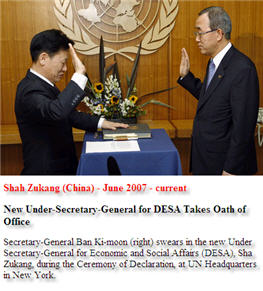
UN Under-Secretary-General for Economic and Social Affairs Sha Zukang opened the meeting, noting that it would build on a similar conference that convened in Beijing, China, in 2008, and suggesting that it could “send a clear message to Copenhagen that there is a way forward on technology cooperation and technology sharing.”

Yvo de Boer, UNFCCC Executive Secretary, outlined five essential components for an agreement in Copenhagen: enhanced action to assist the most vulnerable and the poorest in adapting to the impacts of climate change; ambitious emission reduction targets for all industrialized countries on an individual basis; nationally appropriate mitigation actions by developing countries to limit the growth of their emissions, while safeguarding economic growth and sustainable development, with the necessary support; significantly scaled-up financial and technological resources; and an equitable governance structure to guide financial resources. He said the decision on technology would need to provide clarity on: who pays and how cost is shared; what the funding will be used for; and how the funding will be channeled towards the desired result. He also identified elements that could be included in a mechanism for technology development and transfer under the UNFCCC.

The final statement from the meeting indicates participants “believe that there is an urgent need to accelerate the large scale global deployment of environmentally-sound and climate-friendly technologies and to minimize the time lag between their initial development, transfer and deployment particularly in the developing countries,” and suggests creating centres or networks of centres to stimulate deployment of technologies. [UNFCCC Executive Secretary’s statement] [Meeting website] [Final statement]

Climate change: this is the worst scientific scandal of our generation


TO READ ARTICLE ON TELEGRAPH.CO.UK CLICK HERE

Our hopelessly compromised scientific establishment cannot be allowed to get away with the Climategate whitewash, says Christopher Booker.


By Christopher Booker
Published: 6:10PM GMT 28 Nov 2009


Who's to blame for Climategate?
CO2 emissions will be on top of the agenda at the Copenhagen summit in December Photo: Getty

A week after my colleague James Delingpole , on his Telegraph blog, coined the term "Climategate" to describe the scandal revealed by the leaked emails from the University of East Anglia's Climatic Research Unit, Google was showing that the word now appears across the internet more than nine million times. But in all these acres of electronic coverage, one hugely relevant point about these thousands of documents has largely been missed.

The reason why even the Guardian's George Monbiot has expressed total shock and dismay at the picture revealed by the documents is that their authors are not just any old bunch of academics. Their importance cannot be overestimated, What we are looking at here is the small group of scientists who have for years been more influential in driving the worldwide alarm over global warming than any others, not least through the role they play at the heart of the UN's Intergovernmental Panel on Climate Change (IPCC).

Professor Philip Jones, the CRU's director, is in charge of the two key sets of data used by the IPCC to draw up its reports. Through its link to the Hadley Centre, part of the UK Met Office, which selects most of the IPCC's key scientific contributors, his global temperature record is the most important of the four sets of temperature data on which the IPCC and governments rely – not least for their predictions that the world will warm to catastrophic levels unless trillions of dollars are spent to avert it.

Dr Jones is also a key part of the closely knit group of American and British scientists responsible for promoting that picture of world temperatures conveyed by Michael Mann's "hockey stick" graph which 10 years ago turned climate history on its head by showing that, after 1,000 years of decline, global temperatures have recently shot up to their highest level in recorded history.

Given star billing by the IPCC, not least for the way it appeared to eliminate the long-accepted Mediaeval Warm Period when temperatures were higher they are today, the graph became the central icon of the entire man-made global warming movement.

Since 2003, however, when the statistical methods used to create the "hockey stick" were first exposed as fundamentally flawed by an expert Canadian statistician Steve McIntyre , an increasingly heated battle has been raging between Mann's supporters, calling themselves "the Hockey Team", and McIntyre and his own allies, as they have ever more devastatingly called into question the entire statistical basis on which the IPCC and CRU construct their case.

The senders and recipients of the leaked CRU emails constitute a cast list of the IPCC's scientific elite, including not just the "Hockey Team", such as Dr Mann himself, Dr Jones and his CRU colleague Keith Briffa, but Ben Santer, responsible for a highly controversial rewriting of key passages in the IPCC's 1995 report; Kevin Trenberth, who similarly controversially pushed the IPCC into scaremongering over hurricane activity; and Gavin Schmidt, right-hand man to Al Gore's ally Dr James Hansen, whose own GISS record of surface temperature data is second in importance only to that of the CRU itself.

There are three threads in particular in the leaked documents which have sent a shock wave through informed observers across the world. Perhaps the most obvious, as lucidly put together by Willis Eschenbach (see McIntyre's blog Climate Audit and Anthony Watt's blog Watts Up With That ), is the highly disturbing series of emails which show how Dr Jones and his colleagues have for years been discussing the devious tactics whereby they could avoid releasing their data to outsiders under freedom of information laws.

They have come up with every possible excuse for concealing the background data on which their findings and temperature records were based.

This in itself has become a major scandal, not least Dr Jones's refusal to release the basic data from which the CRU derives its hugely influential temperature record, which culminated last summer in his startling claim that much of the data from all over the world had simply got "lost". Most incriminating of all are the emails in which scientists are advised to delete large chunks of data, which, when this is done after receipt of a freedom of information request, is a criminal offence.

But the question which inevitably arises from this systematic refusal to release their data is – what is it that these scientists seem so anxious to hide? The second and most shocking revelation of the leaked documents is how they show the scientists trying to manipulate data through their tortuous computer programmes, always to point in only the one desired direction – to lower past temperatures and to "adjust" recent temperatures upwards, in order to convey the impression of an accelerated warming. This comes up so often (not least in the documents relating to computer data in the Harry Read Me file) that it becomes the most disturbing single element of the entire story. This is what Mr McIntyre caught Dr Hansen doing with his GISS temperature record last year (after which Hansen was forced to revise his record), and two further shocking examples have now come to light from Australia and New Zealand.

In each of these countries it has been possible for local scientists to compare the official temperature record with the original data on which it was supposedly based. In each case it is clear that the same trick has been played – to turn an essentially flat temperature chart into a graph which shows temperatures steadily rising. And in each case this manipulation was carried out under the influence of the CRU.

What is tragically evident from the Harry Read Me file is the picture it gives of the CRU scientists hopelessly at sea with the complex computer programmes they had devised to contort their data in the approved direction, more than once expressing their own desperation at how difficult it was to get the desired results.

The third shocking revelation of these documents is the ruthless way in which these academics have been determined to silence any expert questioning of the findings they have arrived at by such dubious methods – not just by refusing to disclose their basic data but by discrediting and freezing out any scientific journal which dares to publish their critics' work. It seems they are prepared to stop at nothing to stifle scientific debate in this way, not least by ensuring that no dissenting research should find its way into the pages of IPCC reports.

Back in 2006, when the eminent US statistician Professor Edward Wegman produced an expert report for the US Congress vindicating Steve McIntyre's demolition of the "hockey stick", he excoriated the way in which this same "tightly knit group" of academics seemed only too keen to collaborate with each other and to "peer review" each other's papers in order to dominate the findings of those IPCC reports on which much of the future of the US and world economy may hang. In light of the latest revelations, it now seems even more evident that these men have been failing to uphold those principles which lie at the heart of genuine scientific enquiry and debate. Already one respected US climate scientist, Dr Eduardo Zorita, has called for Dr Mann and Dr Jones to be barred from any further participation in the IPCC. Even our own George Monbiot, horrified at finding how he has been betrayed by the supposed experts he has been revering and citing for so long, has called for Dr Jones to step down as head of the CRU.

The former Chancellor Lord (Nigel) Lawson, last week launching his new think tank, the Global Warming Policy Foundation , rightly called for a proper independent inquiry into the maze of skulduggery revealed by the CRU leaks. But the inquiry mooted on Friday, possibly to be chaired by Lord Rees, President of the Royal Society – itself long a shameless propagandist for the warmist cause – is far from being what Lord Lawson had in mind. Our hopelessly compromised scientific establishment cannot be allowed to get away with a whitewash of what has become the greatest scientific scandal of our age.