Sunday, 22 April 2012
New World Bank chief to focus on 'market-based' growth –VIDEO
Tuesday, 25 January 2011
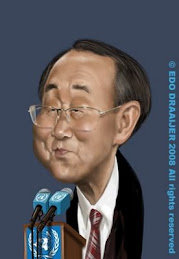
HRW: "Bank Ki moon is a coward ...doesn't deserve a second term" !
CLICK HERE TO VIEW THIS ON BBCNEWS
UN defends Ban Ki-moon against rights 'cowardice' claim
HRW said Mr Ban placed "undue faith" in his persuasion skills
The UN has defended its Secretary General Ban Ki-moon over accusations that he has failed to speak out over human rights issues.
Mr Ban has been singled out for harsh criticism by Human Rights Watch in its annual report.
The group said he had been "notably reluctant to put pressure on abusive governments".
Mr Ban's office denied this, saying he used both quiet diplomacy and public pressure to promote human rights.
But HRW says it wants its annual report to draw attention to "the failure of the expected champions of human rights" to defend those rights and stand up to abusive governments.
While there is "nothing inherently wrong with dialogue and cooperation to promote human rights", the group says, there was a danger that it could become "a charade designed more to appease critics of complacency than to secure change".
"Whether out of calculation or cowardice, many [UN Security] Council members promote dialogue and cooperation as a universal prescription without regard to whether a government has the political will to curtail its abusive behavior."
The BBC's Barbara Plett at the UN says Mr Ban's style has been more discreet than that of his predecessor Kofi Annan. He has often often opted to work behind the scenes to pressure governments on human rights issues.
“Start Quote
Farhan HaqSpokesman for Ban Ki-moonThe record shows he has achieved results through both quiet diplomacy and public pressure”
But HRW says Mr Ban's "disinclination to speak out about serious human rights violators means he is often choosing to fight with one hand tied behind his back".
It says that while Mr Ban has made strong comments on human rights when visiting, for example, Uzbekistan and Turkmenistan, he has failed to do so with Chinese officials.
'Infatuated'HRW also says Mr Ban appeared to have "placed undue faith in his professed ability to convince by private persuasion", citing his discussions with leaders including Sudanese President Omar al-Bashir, Burma's military leader Than Shwe and Sri Lankan President Mahinda Rajapaksa.
Mr Ban's spokesman Farhan Haq defended the secretary general's record, saying he did speak publicly about human rights when he visited some of those countries named by HRW.
"In each case he makes a strategic decision on the most effective to way to secure respect for HR [human rights] and accountability," said Mr Haq.
"The record shows he has achieved results through both quiet diplomacy and public pressure."
Mr Haq cited the freeing of a jailed gay couple in Malawi as one example where quiet diplomacy had proved successful.
The EU also comes under fire in the report - HRW says it has "become particularly infatuated with the idea of dialogue and cooperation" and criticises foreign policy chief Baroness Ashton, "for repeatedly expressing a preference for 'quiet diplomacy' regardless of the circumstances".
Meanwhile US President Barack Obama is accused of lacking his "famed eloquence" when defending human rights in bilateral contexts with China, India and Indonesia, and of failing to ensure other areas of US government "convey strong human rights messages consistently".
Friday, 3 December 2010
Grameen founder Muhammad Yunus in Bangladesh aid probe
By Ethirajan AnbarasanBBC News, Dhaka
Norway says it is examining reports that Nobel Peace Laureate Muhammad Yunus allegedly diverted millions of dollars of aid money from a bank.
International Development Minister Erik Solheim said that it was "totally unacceptable that aid is used for other purposes than intended".
A documentary maker has alleged that cash was diverted from Professor Yunus' Grameen Bank to other parts of Grameen.
In a statement, the bank said that the allegations were false.
It said that a full explanation with more details would be provided at the "earliest convenient time".
The bank was set up by Professor Yunus to provide micro-credit - or small loans - to the poor.
The move by the Norwegians - who insist that no criminal activity has taken place - comes at a time when the reputation of the micro-credit industry has been under attack.
The original aim of the micro-credit concept was poverty reduction, but in recent years some micro-financial institutions have been criticised over exorbitant interest rates and alleged coercive debt collection.
In the south-eastern Indian state of Andhra Pradesh, for example, micro-loans have been blamed for a series of suicides among struggling farmers.
It is estimated some 250 organisations in the state have handed out loans totalling more than £1.65bn (£883m), only a small proportion of which have been paid back.
ObjectionsThe Grameen Bank's denial followed the release of a documentary by Danish filmmaker, Tom Heinemann, who claimed Professor Yunus and his associates diverted nearly $100m of grant money to another company - Grameen Kalyan - which was not involved in micro-credit operations.
Mr Heinemann said he stumbled upon the documents and letters relating to the alleged transfer while doing research for his documentary on micro-credit.
"I got most of the documents from the archives of Norad, the Norwegian aid agency in Oslo," he said.
The Grameen group of more than 30 companies headed by Professor Yunus is divided between those not operating for profit and those which do.
Mr Heinemann's report alleged that after the Norwegian authorities raised objections to the alleged transfer of funds, the Grameen bank returned about $30m. The aid money was from Norway, Sweden and Germany.
Professor Yunus, known as the Banker to the Poor, and the Grameen Bank were awarded the Nobel Peace Prize in 2006 "for their efforts to create economic and social development from below".
Replicated modelThe economist founded the bank, which is one of numerous organisations now providing loans to the poor - especially women - in Bangladesh.
The micro-credit lending model has been replicated in other parts of the world.
Reacting to the latest report, the Norwegian authorities say they have no suspicions of tax fraud or corruption committed by Grameen Bank.
"Having said that, the Government of Norway finds it totally unacceptable that aid is used for other purposes than intended no matter how praiseworthy the causes might be," Norwegian International Development Minister Erik Solheim said in a statement e-mailed to the BBC.
Mr Solheim said that he had asked the Norwegian Agency for Development Co-operation for a full report on the matter.
"At the same time it is important to stress that we are firm believers in micro-finance as a tool in the fight against poverty," he said.
The documentary "Caught in Micro Debt" was shown on Norwegian National Television earlier this week.
"I travelled to Bangladesh, India and Mexico to find out whether micro-credit loans have really helped the poor. But I found out that poor people are getting into more and more debt because of micro-credit loans," Mr Heinemann told the BBC.
He said that he was not accusing Professor Yunus of misusing the money or personally benefiting from the transfer.
Saturday, 5 December 2009
UN hits back at climate sceptics amid e-mails row
The e-mails were posted on the internet last month |
TO READ ARTICLE ON BBC - CLICK HERE
The UN's official panel on climate change has hit back at sceptics' claims that the case for human influence on global warming has been exaggerated.
The Intergovernmental Panel on Climate Change (IPCC) said it was "firmly" standing by findings that a rise in the use of greenhouse gases was a factor.
It was responding to a row over the reliability of data from East Anglia University's Climatic Research Unit
Leaked e-mail exchanges prompted claims that data had been manipulated.
Last month, hundreds of messages between scientists at the unit and their peers around the world were put on the internet along with other documents.
Some observers alleged one of the e-mails suggested head of the unit Professor Phil Jones wanted certain papers excluded from the UN's next major assessment of climate science.
Professor Thomas Stocker and Professor Qin Dahe, IPCC |
Professor Jones, who denies this was his intention, has stood down from his post while an independent inquiry takes place.
In a statement, Professor Thomas Stocker and Professor Qin Dahe, co-chairmen of the IPCC's working group 1, condemned the act of posting the private e-mails on the internet, but avoided commenting on their content.
They went on to point to a key finding that states: "The warming in the climate system is unequivocal.
"[It] is based on measurements made by many independent institutions worldwide that demonstrate significant changes on land, in the atmosphere, the ocean and in the ice-covered areas of the Earth.
"Through further independent scientific work involving statistical methods and a range of different climate models, these changes have been detected as significant deviations from natural climate variability and have been attributed to the increase of greenhouse gases."
They added: "The body of evidence is the result of the careful and painstaking work of hundreds of scientists worldwide.
Gordon Brown, Prime Minister |
"The internal consistency from multiple lines of evidence strongly supports the work of the scientific community, including those individuals singled out in these e-mail exchanges."
The row comes ahead of the Copenhagen climate summit which starts on Monday.
Professor Jean-Pascal van Ypersele, vice-chairman of the IPCC, said it was no coincidence the information was released in the run-up to the summit.
He claimed unnamed conspirators could have paid for Russian hackers to break into the university computers to steal the e-mails.
He said the theft was a scandal and was "probably ordered" to disrupt the confidence negotiators have in the science.
Earlier, Climate Change Secretary Ed Miliband told the BBC he would be "very surprised" if there had been any wrongdoing on the part of the East Anglia University scientists.
"We're in a moment when the world is about to make some big political decisions," he said.
"And there will be people who don't want the world to make those big decisions and they are trying to use this in part to say somehow this is all in doubt and perhaps we should put the whole thing off.
"Well, I just think they're wrong about that."
Prime Minister Gordon Brown said the scientific evidence was "very clear" and called doubters a "flat Earth group".
He said: "There is an anti-change group. There is an anti-reform group. There is an anti-science group, there is a flat Earth group, if I may say so, over the scientific evidence for climate change."
'Open and transparent'
Meanwhile, the Met Office said it would publish all the data from weather stations worldwide, which it said proved climate change was caused by humans.
Its database is a main source of analysis for the IPCC.
It has written to 188 countries for permission to publish the material, dating back 160 years from more than 1,000 weather stations.
John Mitchell, head of climate science at the Met Office, said the evidence for man-made global warming was overwhelming - and the data would show that.
"So this is not an issue of whether we are confident or not in the figures for the trend in global warming, it's more about being open and transparent," he told the BBC.
The Met Office said it had already planned to publish the material long before the row and denied reports that government ministers had tried to block the publication.