Showing posts with label jomo K S. Show all posts

Tuesday, 16 February 2010

Rethinking Poverty


12_Rethinking Poverty_bookcover.jpg

UNU-ONY will hold a book launch to discuss issues raised inRethinking Poverty: Report on the World Social Situation 2010,published by the United Nations Department of Economic and Social Affairs. The book focuses on the challenge of achieving poverty reduction, which remains an ethical, political and economic imperative.

The negative economic and social impacts of the recent food and energy crises, combined with the threats posed by climate change, challenges the assumption of the sustainability of poverty reduction. Rethinking Poverty: Report on the World Social Situation 2010 disputes the current technocratic vision of poverty reduction and affirms that eradicating poverty requires actions leading to sustainable economic growth, productive employment creation and social development as part of an integrated framework of economic and social policies for the benefit of all citizens.

The event will feature Dr. Jomo Kwame Sundaram, United Nations Assistant Secretary-General for Economic Development in the UN Department of Economic and Social Affairs (DESA), and (Honorary) Research Coordinator for the G-24 Intergovernmental Group on International Monetary Affairs and Development.

The Q&A session following the presentation will be moderated by UNU's Director Dr. Jean-Marc Coicaud.


Date: Tuesday, February 16, 2010

Time: 3:00 p.m. to 4:30 p.m.

Venue: Conference Room C, Temporary North Lawn Building (TNLB), UN Headquarters


Background Readings:

  • Rethinking Poverty: Report on the World Social Situation 2010 - Executive Summary - PDF
  • Rethinking Poverty: Report on the World Social Situation 2010 - Full Report - PDF
  • The Global Economic Crisis after One Year: Is a New Paradigm for Recovery in Developing Countries Emerging? - UNU Policy Brief - PDF
  • Policy Responses to the Global Economic Crisis in Africa - UNU Policy Brief - PDF
  • Vulnerability in Developing Countries - UNU Research Brief - PDF
  • Fragile States - UNU Research Brief - PDF
  • Poverty Reduction in China: Is High Growth Enough? - UNU Policy Brief - PDF
  • Can We Eradicate Hunger? - UNU Policy Brief - PDF
  • Fiscal Policy for Poverty Reduction, Reconstruction, and Growth - UNU Policy Brief - PDF
  • Resolution 56/177 adopted by the General Assembly. Implementation of the outcome of the World Summit for
    Social Development and of the twenty-fourth special session of the General Assembly - PDF

    Speaker Profile:

    Dr. Jomo Kwame Sundaram, United Nations Assistant Secretary-General for Economic Development in the UN Department of Economic and Social Affairs

    Moderator Profile:

    Jean-Marc Coicaud, Director, UNU-ONY

    ***


    Thumbnail image for JOmo final pic.jpg

    Dr. Jomo KS (Jomo Kwame Sundaram) has been UN Assistant Secretary General for Economic Development in the United Nations' Department of Economic and Social Affairs (DESA) since January 2005, and (Honorary) Research Coordinator for the G24 Intergovernmental Group on International Monetary Affairs and Development since December 2006. During 2008-2009, he serves as adviser to the President of the 63rd United Nations General Assembly, and as a member of the [Stiglitz] Commission of Experts of the President of the United Nations General Assembly on Reforms of the International Monetary and Financial System. Jomo was Professor in the Applied Economics Department, Faculty of Economics and Administration, University of Malaya until November 2004, Founder Director (1978-2004) of the Institute of Social Analysis (INSAN) and Founder Chair (2001-2004) of IDEAs, International Development Economics Associates (www.ideaswebsite.org ) where he now serves on the Advisory Panel. He was also on the Board of the United Nations Research Institute on Social Development (UNRISD), Geneva. Jomo studied at the Penang Free School, Royal Military College, Yale and Harvard. He has taught at Science University of Malaysia, Harvard, Yale, National University of Malaysia, University of Malaya, and Cornell. He has also been a Visiting Fellow at Cambridge University and a Senior Research Fellow at the Asia Research Institute, National University of Singapore. Jomo has authored over 35 monographs, edited over 50 books and translated 12 volumes besides writing many academic papers and articles for the media. He is on the editorial boards of several learned journals. In 2007, he was awarded the Wassily Leontief Prize for Advancing the Frontiers of Economic Thought. Some of his most recent book publications include Malaysia's Political Economy (with E. T. Gomez), Globalization Versus Development: Heterodox Perspectives; Southeast Asia's Industrialization; Behind Miracle and Debacle; After The Storm: Crisis, Recovery and Sustaining Development in East Asia; The Origins of Development Economics (with Erik Reinert); Pioneers of Development Economics; the two volumes of The Long Twentieth Century -- Globalization Under Hegemony: The Changing World Economy and The Great Divergence: Hegemony, Uneven Development and Global Inequality; Policy Matters: Economic And Social Policies To Sustain Equitable Development and Flat World, Big Gaps: Economic Liberalization, Globalization, Poverty and Inequality. His books in press include Servicing Malaysia: Labour Market Segmentation in Services (with H. L. Khong) and Regulating Malaysia: Law, Institutions and Economic Development (with others).


    JMCphoto3.jpg

    Dr. Jean-Marc Coicaud is the Director of the United Nations University (UNU) Office at the United Nations in New York. He was Senior Academic Officer at the UNU in Tokyo from 1996 to 2003. Before joining UNU, he served in the Executive Office of the United Nations Secretary-General as a speechwriter for Dr. Boutros Boutros-Ghali (1992-1996). A former fellow at Harvard University (Center for International Affairs, Department of Philosophy and Harvard Law School, from 1986 to 1992), Coicaud has held appointments such as Cultural Attaché with the French Ministry of Foreign Affairs, Legislative Aide with the European Parliament (Financial Committee), Associate Professor at the University of Paris, Visiting Professor at the Ecole Normale Supérieure-Ulm in Paris and Visiting Professor at Tsinghua University School of Public Policy and Management. He has also taught at the New School for Social Research (New York). He has been a Senior Fellow at the United States Institute of Peace (Washington, D.C.) and a Global Research Fellow at New York University School of Law. Coicaud holds a Ph.D. in political science-law from the Sorbonne and a Doctorat d'Etat in philosophy from the Institut d'Etudes Politiques of Paris. In addition, he holds undergraduate and graduate degrees in literature and linguistics. Jean-Marc Coicaud is a member of the Advisory Board of Carnegie Council's Global Policy Innovations (New York). He also serves as an adviser for the Fondation pour l'Innovation Politique (Paris). Dr. Coicaud has published 14 books in the fields of comparative politics, political and legal theory, international relations and international law. They are available in English, French, Japanese, Chinese, Spanish and Arabic, and include the following single-authored books: Politics and Legitimacy: A Contribution to the Study of Political Right and Political Responsibility (Cambridge University Press, 2002), Beyond the National Interest (United States Institute of Peace Press, 2007), Kokuren no Genkai/Kokuren no Mirai (Future of the UN/Limits of the UN - Fujiwara Shoten, 2007), Mai Xiang Guo Ji Fa Zhi (Towards the International Rule of Law - Sanlian Shudian, 2008). His latest book, co-edited with Hilary Charlesworth, is Fault Lines of International Legitimacy (Cambridge University Press, 2009).


Thursday, 26 November 2009

The climate-change fraud

Business Mirror

Opinion
Written by John Mangun / Outside the Box
WEDNESDAY, 25 NOVEMBER 2009 20:36

While it may be true that the Philippines is stuck in the middle of the South China Sea, you would think that at least one media outlet would choose to cover one of the biggest stories of the 21st century.

This past week, computer hackers or perhaps a “whistle-blower” insider released thousands of e-mail and other documents obtained from the Climate Research Unit (CRU) at the University of East Anglia in England. The email and internal reports show that data used to support the idea of man-made global warming and climate was falsified, manipulated; and scientific data that went contrary to the climate-change theory was covered up and suppressed.

And while this story is breaking news around the world, certain political leaders in the Philippines are pushing for increased taxpayer funding of the Philippine Climate Change Act, a law based on a fraud. The US Congress is opening investigations about “ClimateGate” and English newspapers are calling it the greatest scandal in modern science.

And not a single newspaper here chooses to cover this story. So I will.

The CRU is widely recognized as a leading institution concerned with the study of climate change. It is the organization that supplied a good portion of the data and analysis used in various UN reports and, of course, Al Gore’s famous movie, An Inconvenient Truth.

In September, a striking revelation was made that the data used to create the “hockey stick” of suddenly increasing global temperatures in the last 20 years was manipulated. The basis of the “hockey stick” of global warming that has made Al Gore a multimillionaire was the growth of trees on the Yamal peninsula in Russia. One of the members of the climate group at CRU, Keith Briffa, is the author of the “hockey stick” data that have been used for 10 years to create the climate-change hysteria. It appears calling him an “author” is appropriate since the “hockey stick” and the hysteria may be based on fiction.

After nearly a decade and hundreds of billions spent on the climate-change panic, the original data were finally released to other scientists. What Briffa did was to use data from a selected sample of tree rings that support the global-warming theory. Tree rings that refuted his claim were ignored. In September, other scientists put all the tree-ring data together and discovered that temperatures have not shown any unusual increase in the last 20 years and there isn’t any hockey stick of temperatures.

In other documents, CRU seems to acknowledge that their climate models are inaccurate, data were falsified or, at the very least, manipulated; scientists have no clue as to future climate trends, and no explanation for the cooling trend since 1998. Further, it also appears that any evidence contrary to the climate-change hysteria was ignored and suppressed.

From an e-mail referring to the fact that temperatures have been dropping since 1998: “I’ve just completed Mike’s nature trick of adding in the real temps to each series for the last 20 years [i.e., from 1981 onward and from 1961 for Keith’s to hide the decline in temperatures].” In other words, data were falsified to fit the climate-change conclusions.

Other e-mail suggest that pro-global warming scientists faked data to get the results they were looking for. Just over a month ago, on September 28, Tom Wigley wrote to Phil Jones of the Hadley Center about his efforts to get the right-sized “blip” in temperatures of the 1940s: “Here are some speculations on correcting SSTs to partly explain the 1940s warming blip. So, if we could reduce the ocean blip by, say, 0.15 deg C, then this would be significant for the global mean. It would be good to remove at least part of the 1940s blip.” Data that did not support global warming and climate change were removed from the studies.

Another problem is that the models just do not work. From an October 2009 e-mail “The fact is that we can’t account for the lack of warming at the moment. Our observing system is inadequate.”

The fact that the models do not accurately work is known to the global-warming scientists, and they will not publicly admit that their theory cannot hold up to investigation. In a 2005 e-mail from Phil Jones, he says, “The scientific community would come down on me in no uncertain terms if I said the world had cooled from 1998. OK it has, but it is only 7 years of data and it isn’t statistically significant.”

Here is the point. The Philippines has limited resources that need to be used wisely. Too often though, local leaders talk and act as if pesos grow on trees. This nation cannot afford to spend money foolishly, and climate-change measures are becoming more foolish with each passing day.

Hopefully, a leader will emerge who has the wisdom and the courage to create a list of priorities that need funding and not just talking for political pogi points. Every centavo spent on the silly climate-change nonsense is money that is not spent on education. Every peso spent on things like nationwide WiFi is money that is not available for improving agricultural production.

Talk is cheap. What we need is a candidate who spells out in black and white what he or she thinks should be the specific spending priorities of government. Not just noble-sounding words, but concrete ideas with numbers to back the ideas up.

This nation is capable of making great strides very quickly if its leaders would only focus resources wisely and specifically, rather than trying to do everything, meet every need, and eventually accomplishing little.

PSE stock-market information and technical analysis tools provided by CitisecOnline.com Inc. E-mail comments to mangun@email.com.

Tuesday, 18 November 2008

Bernard Kliksberg's Beautiful Life !


Today we will discuss the story of another corrupt case in DESA (Department Economic and Social Affairs) of the United Nations. 

His name is Bernard Kligsberg. A so-called leading Argentinean economist, who has made his career in "advising" multiple International institutions at same time. There is nothing wrong with that, as long as you do it in the private sector. But if you work for the UN and you sign the contracts - you have to bide by them and dedicate full time to your work for the respective UN unit who hires you. 

His career at UN-DESA and his personal relation to Guido Bertucci is extremely important because while employed for years as indefinite CONSULTANT at DPADM located at DC-2 - 17 floor, this gentleman was also employed as full time personal advisor to Rebeca Grynspan, Assistant Secretary General of United Nations for Latin America Bureau of UNDP - DC-1, making an astonishing US$429,341 Thousand Dollars a year, respectively from:
1. Full Time Employee of UN Department of Economic and Social Affairs (DESA/DPADM);
2. Full Time Employee of UN Development Programme (UNDP/RBLAC);
3. Full Time Employee of InterAmerican Development Bank in Washington DC (BID);
4. Consultant of UN Development Programme Office in Argentina;
All the above is TAX-FREE, and since this well-known economist is in US with a G4 Visa - thanks to Bertucci and Furio De Tomassi, why not make some extra money aside working for various private and/or semi-private banks in Washington DC. 

Here are all the payment Mr. Kilksberg made at UNDP - at the same very period he was under contract and being paid from Bertucci/De Tomassi with full support of Catherine Pelluso and under "extremely vigilant eyes" of Marie Oveissi.

Another important element of Mr. Kliksberg's career is that while he was employed as CONSULTANT of DPADM/DESA he was also for the past 7 years member of the Committee of Experts in Public Administration, the body who was supposed to exercise oversight functions over DPADM/Bertucci. 

LIFE IS BEAUTIFUL for Mr. Kliksberg - isn't it?

Payments from UNDP Office in ARGENTINA


Payments made by UNDP HQs - Latin America Bureau (RBLAC)


Payments made by UNDP for Travel - While DESA paid for his travel as well


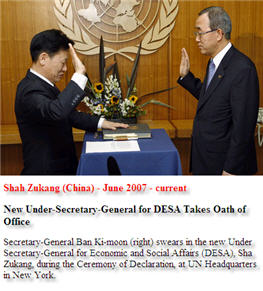
We really wonder at this point if Mr. Sha Zukang or anyother manager of UN-DESA would take any actions to really remove once and for all the corruption which eating-up DESA/DPADM and TCMS like a cancer.