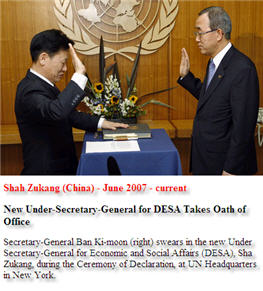
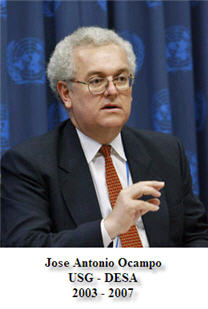
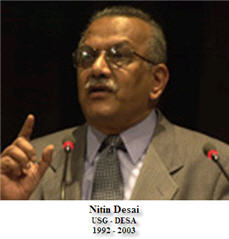
The continuing ear-infection of Sha Zukang and his two ASG's leave honest staff no other options but to contact available member states and inform them on developments inside DESA and provide them with internal documentation in order to open their eyes and allow them to have a transparent look inside DESA's "high society" and it's "pay for play" modus operandi.
Thursday, 29 January 2009
The United States Mission to the UN posts in its website Internal and Confidential Reports on DESA Corruption
Saturday, 24 January 2009
Korean-isation and Chinas-ation of United Nations

maybe the world should finally decide and nominate Kim Won-so in the post of Secretary General, and send the current charlatan and parrot home in Seoul, at least we would have to deal with the real "power man" instead of a fake SG.
DESA's Seoul Center plunged into scandals

John Mary Kauzya and Catherine Pelluso have shortlisted Elia Yi Armstrong as replacement of Adil Khan
a shocking rumor is going thru the halls of UN-DESA. John Mary Kauzya and Catherine Pelluso have shortlisted the candidates that would allegedly take over the post of Head of Economic Branch - (former Adil Khan).is absolutely amazing to even think that a more unqualified, ignorant, corrupt and un-ethical person to be shortlisted for this post. But hey, when UN-DESA has no other but John Mary Kauzya, who is under investigation for fraud, miss-management and gross-negligence conduct, to shortlist the future head of the Economic branch, this is the lowest level DESA has reached in years.
the fact that this korean lady can't stay longer at UNDP, tells a lot about her caliber and qualities.
At UN's DESA, Still No Accountability for Faked Work of Greek Center, New Chief Says
Byline: Matthew Russell Lee of Inner City Press at the UN: News Analysis
UNITED NATIONS, November 28 -- The new head of the UN's Department of Economic and Social Affairs, Sha Zukang, spoke for his first time to the UN press corps on Wednesday. He addressed it head-on, saying he has been called "bad-tempered... aggressive, emotional and tough." It is "all true in a way," he said. "I hope you like me. If not, I don't mind." He added, "I am incapable of not saying what I think." Here's hoping.
Inner City Press asked for an update on the Office of Internal Oversight Services investigations of DESA: Guido Bertucci, the Thessaloniki Center for "Public Service Professionalism," and consultants' contracts. Sha Zukang pulled out a piece of paper and read out from it. "My colleague provided this, anticipating some questions from you," he said. "Don't ask further questions, I don't know the details."
In sum, OIOS released its audit of the Thessaloniki Center on August 2, 2007. While Sha Zukang said that DESA has fully implemented Recommendations 3 and 4, and part of the first recommendation, it is significant to consider the one still unacted upon:
"The Department should establish accountability for the inefficient use of consultants, including the irregular sign-off of a consultant's contract indicating that deliverables had been provided when no such deliverables had actually been received."
This is as good a definition of corruption as any. But where is the accountability? Sha Zukang said to wait for the end of the year. One month remains. The OIOS report, A/62/176, also says that "[i]n its response to the draft audit report, the Department did not accept responsibility for the failure of the project. In addition, the Department rejected three of the four recommendations made by OIOS." Sha Zukang pointed out that the "OIOS investigative taskforce" did reach a finding of "no inappropriate conduct" with regard to one consultant, Catherine Elizabeth Gazzoli. Good for her. As to the rest of the investigation, Sha Zukang said it is still pending, with "no available timeline for completion." Typical OIOS.
Sha Zukang at WEF, Thomas Friedman not shown
DESA's Johan Scholvinck answered Inner City Press' question about the report being launched, on the "World Social Situation 2007." Scholvinck said that DESA is an "analytical" body, without much of an "operational" side (which may be a blessing, see above), and that DESA does not try to overlap with the International Labor Organization. Rather, DESA works with the ILO, as well as with the World Bank, on such issues as youth employment.
DESA has an implicit recommendation for the World Food Program, tucked into the report on page 140:
"the World Food Programme (WFP) has been a major driver of food-for-work schemes... those engaged in what is often onerous labor end up burning more calories than are gained."
How or if WFP chief Josette Sheeran Shiner will respond is not yet clear. She has yet to speak to the UN Headquarters press corps.
Wednesday, Sha Zukang recited the litany of issues on which DESA works, and said that since he assumed his post on July 1, he has been trying to focus more on the central mandate, "development for all." He said, twice, "it is a lot of work," adding ""without much outcome or productivity." Inner City Press welcomed him -- such candor is rare at UN Headquarters. Here's hoping.
* * *
Click here for a Reuters AlertNet piece by this correspondent about Uganda's Lord's Resistance Army. Click here for an earlier Reuters AlertNetpiece about the Somali National Reconciliation Congress, and the UN's $200,000 contribution from an undefined trust fund. Video Analysis here
Because a number of Inner City Press' UN sources go out of their way to express commitment to serving the poor, and while it should be unnecessary, Inner City Press is compelled to conclude this installment in a necessarily-ongoing series by saluting the stated goals of the UN agencies and many of their staff. Keep those cards, letters and emails coming, and phone calls too, we apologize for any phone tag, but please continue trying, and keep the information flowing.
Feedback: Editorial [at] innercitypress.com
UN Office: S-453A, UN, NY 10017 USA Tel: 212-963-1439
Reporter's mobile (and weekends): 718-716-3540
Did Elia Yi Armstrong misrepresented her credential at UN-DESA ?

But let's examine her real CV (see herein attached from UNPAN)
| Experience | Education |
| 1984-1987 English Instructor Yonsei/Jilin Universities, Changchun, China | 1985 - Associate (Piano pedagogy) Royal Conservatory of Music, University of Toronto, Canada |
| 1989-1990 Legislative Aide, State Senator William Maravitz's Office, Chicago, USA | 1989 - Master of Science (social policy and planning in developing countries), London School of economics, UK |
Friday, 23 January 2009
Furio De Tomassi illegally shortlisted and selected Adriana Alberti as Italian Associate Expert
Monday, 19 January 2009
Friday, 16 January 2009
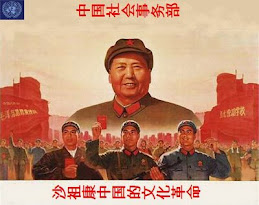
Chinese Department of Economic and Social Affairs

Jian Tan (Chinese)
Wednesday, 14 January 2009
OIOS Risk Assessment Report on UN-DESA
Dagfinn Knutsen, Director of Internal Audit sent the report (Audit File# 08-01411 and Assignment Nr# AN2007/540/01) to DESA's USG asking Mr. Zukang to properly evaluate and take into account the risk assessment of DESA and ensure that appropriate risk mitigation measures are in place.Our blog wanted to post the attached Audit already back in July, but we thought that by giving some times to Sha Zukang he would have done the right thing. Well - as ll know he failed miserably to do the right thing, and his administration has resulted as corrupt and colluded as those of Desai and Ocampo.
We ask DESA staff to read the report, learn from it and ask explanations from your supervisors as to what have they done so far to implement the report.
We will continue to bring to you the entire internal-secret reviews, audits and management decisions on DESA. Only by making it transparent and public our mistakes we will be able to eradicate once and for all the internal corruption of Catherine Pelluso, Marie Oveissi, Furio De Tomassi, Guido Bertucci, Elia Armstrong, and many others (soon to come).
Enjoy it....
Tuesday, 13 January 2009
Bogus project with two fake CTA's in New York and no one working in the center
Within the framework of United Nations’ efforts to promote economic and social development, the Programme for Innovation in Public Administration in the Euro-Mediterranean region has been established to assist interested governments in improving their governance and public administration systems and to provide policy makers, experts and citizens in general with relevant regional knowledge and information on governance.
Who implements the Programme?
The Programme is implemented by the Department of Economic and Social Affairs, through its Division for Public Administration and Development Management (DPADM), with the support of Formez – Training and Research Centre based in Rome, with branches in Naples (Arco Felice) and Cagliari, Italy. It has been launched in mid 2003.
Who funds the Programme?
The Programme is financed by the Ministry of Foreign Affairs of the Government of Italy through Funds in Trust to UNDESA.
Adriana Alberti, Chief Technical Adviser
Programme on Innovation in Public Administration in the Euro-Mediterranean Region
Governance and Public Administration Branch
Division for Public Administration and Development Management
United Nations Department of Economic and Social Affairs (UNDESA)
Email: alberti@un.org
Phone: 212-963-2299
Laila Fala, Governance Specialist
Programme on Innovation in Public Administration in the Euro-Mediterranean Region
Governance and Public Administration Branch
Division for Public Administration and Development Management
United Nations Department of Economic and Social Affairs (UNDESA)
Email: falal@un.org
Phone: 917-367-5012
WHAT'S NEW?Upsss - There is nothing new (Click here)REGIONAL INFORMATION ON GOVERNANCE?Upsss - a blind copy of CIA country profile with UNDP links (Click here)INNOVATORS NETWORKS?Upps - words but there are not networks - the links are bogus and lead you no-where...(Click here)BEST PRACTICES?please don't even go there - is like buying a designer bag in Naples - its so fake and empty and lead to no where.. (click here)PILOT PROJECTS?Uppsss...after 5 years there are not pilot projects....(Click here)
Monday, 12 January 2009
Stelzer lost......
Sunday, 11 January 2009
UN-DESA fails to implement mobility, while 70% of its Managerial force is expected to retire - there is a total lack of succession planning
In closing, let me briefly return to the theme of my address to you last year – a stronger UN for a better world. The foundation of all our work is accountability. The UN Secretariat, including myself, is accountable to you, the Member States. And that is why I push so hard, so strongly for UN reform.
We need to change the UN culture. We need to become faster, more flexible and more effective and more modern. In the coming weeks, I will ask you, the Member States, to support my proposals for a new human resources framework. We need to replace our current system of contracts and conditions of service. It is dysfunctional. It is demoralizing. It discourages mobility between UN departments and the field. It promotes stagnation, rather than creativity. It undercuts our most precious resource – the global, dedicated corps of international civil servants that is the backbone of the United Nations.
But at United Nations Department of Economic and Social Affairs (DESA), our management composed by:
- USG- Sha Zukang - Arm Expert;
- ASG- Jomo Kwame Sundaram - the only Economist;
- ASG- Thomas Stelzer - former President of Klangforum Wien, a leading ensemble for contemporary classical music;
All these three gentlemen have been on the job at minimum one year (Stelzer - Feb 08). They need to initiate immediately an assessment of the age structure of the staff across in DESA, to assess the overall dimensions of the average ageing of staff and its impact on human resources management policies, including succession planning, and its financial implications, with a special emphasis on the Professional staff.
All the reports that come from Catherine Pelluso's office provide only general statistics on gender, geographical distribution and the basic demographic profile of staff. Most reports do not pay sufficient attention to age-related issues, lack analytical details about the consequences of the existing age structure, and do not call the attention of Senior Management in DESA and OHRM at Secretariat to the likely impact of the age structure. Often these reports are submitted either for the purposes of "information" or "taking note of" and rarely contain proposals to address age-related issues which are about to engulf Department of Economic and Social Affairs (DESA).
Both Catherine Pelluso and TCMS's Marie Oveissi are totally ignorant of what a Succession planning tool mean and how that affect the work of the department. For Pelluso and the entire Executive Office at DESA, "succession planning" is done as part of vacancy management, and in most cases it does not go beyond filling vacancies. Instead Sha Zukang should invest in a professional Human Resource Specialist within Executive Office - who should follow professionally the HR strategies and age structure of DESA against the particular mandate and objectives to be accomplished our Department.
Good and fresh example is that of Director of DPADM - instead of being prepared for Guido Bertucci's retirement (and failing to collect the $34,000 as established by OIOS Investigation and requested by Ban Ki-moon), DESA's EO failed to have in place a succession plan and thus being ready to replace both Bertucci (D2) and Khan(D1) right after their departure in July 2008. The lack of such detailed planning led to a leadership gap and a total chaos for the work of the division for the past nine months.
Lack of a coherent HR planning in DESA leads to major implications for a real succession and in endless process of replacing those who retire. While many now believe that such practices are "man maid" - whereby corrupt managers make "deals" with Executive Office (EO) in order to either remain in their positions post-retirement date, or micro-manage the vacancy and replacement process to ensure "continuity".
We will continue to talk about these problems..........
Saturday, 10 January 2009
Eight months to appoint replacements for D2 (DPADM) and D1 (SEGMB)
Friday, 9 January 2009
Anectodes and observations
Accountability? "Ideally the UN, foreshadowing a future world government, ought to be run by a global meritocracy -- rule by the best. In practice, it is the opposite. Any state that can be legally defined as one can join the UN -- it is a club having no rules of probity or morals. … The result is failure and graft. UN officials are not answerable to bodies like Congress or the U.K.'s Parliament, which would be sure to track down, expose and punish gross abuses and manifest failures. No senior UN official has ever gone to jail. It's rare for anyone to be sacked or removed. The top brass resist any kind of investigation, on principle. The oil-for-food inquiry is unique in that it has taken place at all and seems to be garnering results. But will any punishment be meted out? Will any serious reforms be pushed through? Of course not. …"
Paul Johnson, "The UN is for talk, not actions," Forbes (US), March 14, 2005.
Accountability’s importance, then and now “[A free people has] an indisputable, unalienable, indefeasible, divine right to that most dreaded and envied kind of knowledge, I mean, of the character and conduct of its rulers.”
John Adams, second American president, 1797-1801
“Adams had in mind the ministers of the British crown in the reign of King George III, and presumably he knew that the knowledge in question was interactive, moving mostly in the direction of the man being discovered as a thief but also toward the man afraid of finding out that he’s been robbed.”
Lewis Lapham, “Uncle Sam”, Harpers’ Magazine (US), January 2007, pp. 7-9.
Latest rumors on Replacement of Adil Khan (SEGMB)
Thursday, 8 January 2009
A collection of lies from Ban Ki-moon on Reforming the United Nations
Tuesday, 6 January 2009
The guillotine started ...
Monday, 5 January 2009
At UN, Ban's Town Hall Is Stacked with Pre-Screened Questions, on G-to-P Injustice and Permanent Contracts, Few Answers
Byline: Matthew Russell Lee of Inner City Press at the UN: News Analysis
UNITED NATIONS, January 5 -- As Ban Ki-moon kicked off his third year as Secretary General, reviews Monday by UN staff outside Ban's town hall meeting were less than glowing. "It was like a Soviet event," one well-placed staffer quipped to Inner City Press, "complete with pre-selected questions and answers read out of a book." Another marveled how "it's a new day every day in Ban's UN," constant reinvention with no memory of previous new beginnings not followed up on.
Other Headquarters employees grumbled that other duty stations, from Geneva and Vienna to Nairobi, were given questions first. The head of the New York Staff Union, who had been asked to disclose his question in advance, inquired into the elimination last month of the UN's permanent contracts, and whether this violated the UN Charter. Union officials complained that no real answer was given.
Also from New York, a General Service staff member asked Ban why not extend educational benefits to General Services as well as Professional level staff. Ban answered that the limitation comes from the General Assembly, and that American citizens will not get such stipends unless they move and serve in Geneva or elsewhere. At least there was one seemingly unscripted question. The broader unfairness and waste of talent occasioned by the wall between Professional and General Services staff remains unaddressed.
Inner City Press asked Ban's spokesperson at Monday's noon briefing to respond to this Charter-based argument. The Charter doesn't require or provide for permanent contracts, she responded. The new term is "continuing." But what about whistleblower protection? And what about Article 101 of the the Charter's reference to staff being "permanently assigned"?
Inner City Press spoke with a number of senior UN officials on their way in and out of the town hall meeting. One demanded off the record treatment, when discussing Team Ban's crack down on the Press. Others, however, to their credit made no such request.
Peacekeeping chief Alain Leroy, walking in with his colleague Susana Malcorra, replied about the Lord's Resistance Army that the UN Mission in the Congo must focus in the Kivus, and cannot provide protection to the North. Click here for more on that.
The current Special Advisor on Africa may not long retain that title. "I started with Small Islands," he said, adding that he'd prefer not to be too identified with the Continent. So if Ban in fact complies with the stated wish of the General Assembly, expect a new Africa Advisor.
Controller Warren Sach confirmed that for a time he had been officer in charge of the Department of Management, but not on the day for replying to a report of UN retaliation. The resulting letter to the editor was by Catherine Pollard, "that was December 26," Sach said, "she was in charge." And as the Arab League meeting about Gaza droned on the basement, Ms. Pollard held court in the Delegates' Lounge. Every day is a new day.
Footnote: the Town Hall meeting was closed to the press. Even member states were not, at least as of Monday night, able to access the video. Delegates' link to the UN's intra-net had not been undated so far in 2009.
Is this any way to run the so-called World's Body? We may have more on this.
UN System Will Lack Justice Come January 2009
In 2007, the UN General Assembly committed to establishing a new, independent justice system to ensure the due process rights of staff members and hold managers and other employees accountable. It was originally envisioned that this new system would take effect on January 1, 2008, but the General Assembly extended this deadline to January 1, 2009 at the request of the Secretariat.
Now it appears that the Secretariat will also miss the January 2009 deadline. According to the ACABQ’s report:
Since the adoption of General Assembly resolution 62/228 in December 2007, none of the 30 posts authorized for the Office of Administration of Justice (18 new posts and 12 redeployments) have been filled…As a consequence of the lack of staff in the Office, as well as the fact that the statutes of the Dispute and Appeals Tribunals have not yet been adopted, delays have occurred in such areas as the development of procedures for the transition phase, a code of conduct for legal practitioners, terms of reference for the registries and a training and communications plan for the new system of internal justice…The procedures related to the new mechanisms of the disciplinary process, including the reporting of misconduct, investigations, the due process rights of staff, the evaluation of investigation reports and disciplinary proceedings, have not yet been completed. (paragraph 5 and 16(d))
Meanwhile, the Chairperson of the Joint Disciplinary Committee – one of two main bodies in the current UN justice system – has reportedly submitted a resignation letter, effective December 31, the sunset date of the current system. According to this letter, “there is no valid reason to continue, even as a transitional measure, to rely on this obsolete system. Justice will be much better served by focusing all efforts on launching the new system as soon as possible, and bringing all pending cases before it.”
This effectively means that unless the Secretary-General takes immediate action to complete the reform process, there will be no functioning justice system at the United Nations on January 1. In other words, whistleblowers and other employees at the United Nations – the organization charged with promoting human rights – may have no venue whatsoever through which to defend their own rights.
This could not come at a worse time, as the number of people seeking relief through the justice system has recently increased, with an “exceptionally large number of new cases filed in the first half of 2008.” (paragraph 8) The number of disciplinary cases at the United Nations, jumped from 72 in 2006 to 277 thus far in 2008. (paragraph 10)
As the legal cliché "justice delayed is justice denied" suggests, a delay in justice tends to be most harmful to the victim in the case and violates a person’s right to a speedy trial. Therefore, it is critical that the international body meet the January deadline. In doing so, however, the Secretary-General must also adhere to the recommendations made by the Redesign Panel in its original report and address the concerns raised by the UN Staff Union and seconded byGAP.
Saturday, 3 January 2009
UN's Hiring from Permanent Five Grows, China by 8%, US by 134 Jobs, Japan Slower While Others Lose
UNITED NATIONS, -- The number of staffers employed by the UN from the 15 member states on the Security Council continued to rise in 2008, even as the global financial crisis set in and Ban Ki-moon appeared to call for cost-cutting. The just-published List of Staff, supposedly confidential but obtained by Inner City Press, compared to the previous year shows that the number of U.S. nationals employed by the UN rose 134, of six percent, between mid-2007 and mid-2008. France rose by 44 jobs, or 3.8%. The UK gained 27 posts, 3.6%. Russia rose by 11, or 2.4%.
China had the sharpest percentage increase of the Council's Permanent Five member, fully eight percent, but this constituted only 27 jobs, as China began with the fewest of the so-called P-5. UN insiders tied China's eight percent increase to Chinese national Sha Zukang taking the reigns at the Department of Economic and Social Affairs, which the Group of 77 and China is now trying to further expand.
Two non-permanent Security Council members saw their number of staff members decrease, Indonesia and Belgium, while Vietnam and Libya stayed the same, at eight and four posts in both 2007 and 2008, respectively. Italy, on the other hand, rose from 390 to 417 posts, having more jobs in both periods than much more populous China, and larger contributor Japan.
UN's Ban and staff: through often withheld List of Staff, patterns emerge
Japan, the second-largest contributor to the UN budget, rose by 3.4% from 237 to 245 positions. Rising faster were Germany, from 422 to 450, and Canada, from 550 to 598 (8.7%). Australia grew even more rapidly, at an eighteen percent clip, from 245 to 289.
Leaders in the Group of 77 Brazil and Egypt, currently proposing many more jobs for the UN's Department of Economic and Society Affairs, themselves had only 135 and 164 posts, respectively. Incoming Security Council member Turkey declined from 51 posts to 50. Other decliners included Iceland, from 16 to 13, and Greece, from 56 to 52.
The pattern that emerges from the data is that the UN's employment of nationals of the Security Council's Permanent Five members continues to rise, even as posts for some of the Council's non-permanent members declines. Whether this is because the P-5 actively demand the jobs, or those who do the UN's hiring see the value of pleasing the System's most powerful countries, cannot be determined from the data. On that, our inquiries continue, as well as analysis of certain countries not listed in this first report. Watch this site.
Click here from Inner City Press' December 12 debate on UN double standards
Click here for Inner City Press Nov. 7 debate on the war in Congo
Watch this site, and this Oct. 2 debate, on UN, bailout, MDGs
and this October 17 debate, on Security Council and Obama and the UN.
Does Ban Ki-Moon Think It’s His Job to Help Destroy Israel?
by Claudia Rosett at PajamasMedia.Com
Or is he simply a fool, dutifully reciting excerpts from the UN’s Moral Equivalency Manual and Guide to Validating Tyrants and Terrorists of the Middle East. (Seems like they must have one … Maybe Kofi Annan left his dog-eared copy to Ban?)
Or maybe it all amounts to the same thing. Whatever might be going through the Secretary-General’s head as he pops up to opine about Israel and Gaza, he sounds like he’s either pro-Hamas (which, with Iranian backing, is dedicated to destroying Israel) or living on Pluto.
Ban has by now established himself as a knee-jerk subscriber to the UN formulation of “disproportionate force” — the term which is never applied by the UN to Hamas (or Hezbollah) terrorists launching rockets indiscriminately into Israel, or kidnapping Israeli solders, or gunning down and blowing up Israeli civilians. But “disproportionate force” is habitually howled out by the UN when Israel — having negotiated and conceded and warned — finally strikes back, targeting terrorists in its own defense. In practice, this means that terrorists attacking Israel get a ritual and meaningless tut-tut from the UN, usually while UN aid trucks keep rolling in to keep them resupplied. But when Israel attacks terrorists, that warrants emergency Security Council meetings and special press briefings at the highest levels, and repeated, lengthy statements aimed at generating genuine, massive pressure for Israelis to lay down their arms and let the terrorists carry on. Thus Kofi Annan’s histrionics when Israel struck back after Hezbollah, unprovoked, attacked Israel out of Lebanon in 2006.
And so, since Israel launched Operation Cast Lead on December 27th, to stop the attacks out of Gaza, Ban has been preaching full-throated Moral Equivalence from the UN pulpit, demanding an “immediate ceasefire,” calling on “all parties” to “fully uphold humanitarian law,” and insisting that all border crossings into Gaza should be flung open “to ensure the continuous provision of humanitarian supplies.” He got worked up enough about it to make a rare appearance in person at the UN noon press briefing this past Monday.
You can toil through some of his recent effusions here, and here; or for a bit of earlier history, here is Ban’s statement of September 19,2007, in which he pronounced himself “very concerned” that the government of Israel had declared the Gaza Strip an “enemy entity,” and called on Israel not to interupt essential services to Gaza. Ban did allude to the reason for Israel’s action — calling for a stop to “the continued indiscriminate rocket fire from Gaza into Israel.” But how did he propose to make that happen: “I call for it to stop immediately.” (Note: Ban did not mention the word “Hamas,” or call upon any specific actor firing the rockets; he called for “it” to stop. And, thousands of rocket and mortar attacks later, Ban might have noticed that “it” didn’t give a damn).
OK, so what could Ban do? As Secretary-General, he enjoys the opportunity to provide statements and advice to the Security Council, and of course he can order up a press conference and find an instant world audience. And though it might be something of a departure from custom, he could try finding the backbone to speak the truth — that the UN member state of Israel is under relentless attack out of Gaza by a terrorist group, Hamas, dedicated to its destruction. That another terrorist group, Hezbollah, which infests Lebanon is also dedicated to “Death to Israel.” That both are backed and provisioned and trained by Iran, where the president, who is overseen by Supreme Leader Ayatollah Ali Khameini, has called for Israel to be wiped off the map.
Ban could even throw in a few footnotes, about the role of Syria as a cohort and enabler of all this destructive activity and intent, and Saudi wahhabism in all its ruinous manifestations. He might even add a note about a subject which, as a former foreign minister of South Korea, he ought to know very well — the collaboration of Syria and Iran with nuclear-armed, missile vending, totalitarian North Korea.
Ban might also want to mention a name which, as far as I can see on the UN web site, has not passed his lips in any public setting since a September press conference in which he read out a Quartet statement that included a fleeting reference: Gilad Shalit. Actually, it would be fitting for Ban to devote an entire press conference (and then some) to Gilad Shalit, the Israeli soldier kidnapped two-and-a-half years ago into Gaza. If Ban is genuinely concerned about humanitarian traffic through the border crossings, would he care to explain why he has been so publicly insistent on the flow of free goods into terrorist-run Gaza, and so apparently uninterested in whether Gilad Shalit might finally be released to travel back out?
All this would be a great help in clarifying the problems in the Middle East. It would be salutary for the UN as well. True, the organization still has no official definition of terrorism, so Ban might find himself venturing into what is, for UN officials, exotic terrain. But there is nothing to prevent the Secretary-General from saying “terrorist,” if he wants to. It might bother the finely tuned sensitivities of actual terrorists, or states that support them. But there’s not much they could do about it. The UN has no procedure for removing a sitting secretary-general. It would be a move of great integrity were Ban to re-focus the UN debate right now, away from the inane formulations about “disproportionate force,” and toward the genuinely germane issue of terrorism.
So that’s what Ban could do, were he willing to stand up for the actual peace-and-human-dignity charter causes of the UN, or even for simple decency. And if he cannot find it in himself to do that, then the least he could do right now is stop making statements that sound like the utterances of a UN-trained parrot. Give it a rest. Take a holiday, Mr. Ban. It will make for a better world.
Saturday, 20 December 2008
At UN, Korean Staff Rise from 51 to 70 in Ban's Two Years, on Pianos and Lobbyists, An Evolution
UNITED NATIONS, December 20 -- As Ban Ki-moon approaches his third year UN Secretary-General, the tug of his home country South Korea remains in evidence, which some around him seek to change. During a trip last month to Bangladesh, India, Nepal and the Philippines, South Korean business representatives sought repeatedly to meet Ban, and even got themselves listed on his schedule, until a staffer took them off. The just-released List of UN Staff as of July 1, 2008 shows 70 South Korean UN staff, up from 51 two years ago. Of the top five official in the Office of the Secretary-General, three are Korean, including Kim Won-soo, the advisor sometimes called Ban's brain, in a reference to Karl Rove and George W. Bush.
In Ban's first half-year at the UN, questions about whatsome called the Koreanization
We note, however, that for the last name Choi, there were three UN staff in mid-2007, and seven in mid-2008. The new hires include Under Secretary General Choi Young-Jin, head of the UN mission in Cote d'Ivoire, and Assistant Secretary General Choi Soon Hong, Ban's chief technology officer. To be fair, Han Seung-Soo has fallen off the list, as he returned to South Korea to serve as Prime Minister. Some predict more of this eastward migration. More generally, a Ban administration shake-up is predicted for early 2009, on which we will report.
UN's Ban on recent trip, un-scheduling of Korean businessmen not shown
At Ban's December 17 holiday party, he told the press that only the day before, a Korean company had donated a piano for his Sutton Place residence. Some sought to snoop around to see the renovated kitchen used, it has been reported, by Ban's own Korean chef. Inner City Press chose not to look around, and as luck would have it handed Ban a wine glass when he needed one to make a toast. Ban's scheduler, Yoon Yeocheol, joked genially that "you are taking over my job." Ban introduced a pianist, also Korean, who played with energy his own classical composition.
South Korea's contributions to UN Peacekeeping have gone up; statements have been made about the Millennium Development Goals and climate change. Relations between North and South Korea have not meaningfully improved, what with North Korea's recent expulsion of Southerners.
An internal Ban administration memo strategizing how Ban's UN could take a central role in Korean Peninsula matters
Other than on some officials' voluntary public financial disclosure, the UN's transparency has yet to improve under Ban. Only this week, Inner City Press was told that the list of UN envoys should not be publicized or provided, and thateven the terms of Robert Fowler's mandate are confidential
Speaking of letters, at his holiday party Ban told the press of a Korean saying, that if you really love a girl, a potential girlfriend, you should write her ten love letters before getting some answer from her. While his point was not entirely clear -- other than his obvious and endearing love for his wife -- it appeared to concern persistence, which among with independence is needed not only in running but also in covering the United Nations.
In Ban's UN, Withheld List of Staff Shows 51 South Koreans As a Baseline, Series Will Continue
Despite the UN being a public institution, and despite Ban Ki-moon having run for Secretary-General on a platform of transparency, his Spokesperson on May 22 for the third time in five days denied access to a list of UN staff sorted by nationality.
An Associate Spokesperson who came along with Mr. Ban's transition team declined to provide even the nameof another new hire from the transition team but now in the UN Department of Management (DM).
In the face of this stonewalling, Inner City Press has put in a formal freedom of information-type request to the chief of the DM. Inner City Press has also, without the assistance of the UN Department of Public Information, reviewed a copy of the presumptively public data in the List of Staff of the UN Secretariat, and sets forth below, including as a sample to review Mr. Ban's "managed mobility" plan, a list of the 51 South Korean UN staffers in mid-2006. It should be noted that while the Spokesperson began, on May 17, by saying the List is only for member states, "and you are not a member state," the Swiss Ambassador, for example, has been clear that the List should not be kept secret.
Going forward, in the spirit of transparency, this list should be periodically updated, beginning now, specifically with the name of the still-unnamed person brought into the UN along with Mr. Ban's transition team and placed in the Department of Management. Team Ban refuse to provide the name; in five days, the only argument advanced is that since the person is not technically on the 38th floor, unlike the other three the name need not be provided. This argument is inconsistent with the platform Mr. Ban ran on. Practically speaking, given Team Ban's (non) response, it appears that the only way to proceed is by comparing the list below, from mid-2006, to current, real-time information and identifying the new staff members. Consultants, as noted, are in their own gray zone.
Mr. Ban is nearly entirely free to hire nearly whomever he wants. But to decline to provide names of senior appointments and people brought in with the transition team, and to withhold in full this basic information, militates for an ongoing investigative project.
Mr. Ban's Spokesperson on May 17 chided Inner City Press for being interested in names, when "other correspondents here are interested in burning political questions." Inner City Press does cover political questions -- but generally directs its questions in this regard to members of the UN Security Council, which acts on questions of international peace and security. Mr. Ban ran on a platform of managing the UN better, and not speechifying as much as his predecessor.
Half a year in, there are daily statements about far away issues, many of which the UN Secretariat has very little influence over. On political items directly in his control, such as whether toexpand the use of peacekeepers from Fiji despite December's military coup, a question has gone unresponded-to for two days. And basic management information is being withheld. Despite attempts to dissuade, including by holding reporting on UN management and reform to a higher standard than other UN reporting, Inner City Press intends to continue to pursue the Ban management story. The publication today of this baseline list is part of that coverage, but only part. This series will continue.
Mr. Ban and staff in a (data?) warehouse
As a preliminary analysis of the List, the South Korean staffers at the UN in 2006 appear clustered, for example in the Economic and Social Commission for Asia and the Pacific, ESCAP, which is headed by a South Korean, Kim Hak-su. In the following list, the names in bold are new, and did not appear in the 2005 List. There is a separate list of those who appeared in 2005 but not 2006.
While the Spokesperson has not said which of the information is the basis of the withholding, Inner City Press is for now redacting the column on "contractual status," including not only "dollar a year" but also whether "subject to the system of desirable ranges," even though there is no reason such information is private in a public institution. Whether a staff member is P-3 or P-4, etc., cannot be confidential: for example, Mr. Ban has advised journalists not to take their impression of the UN from "P-3s." While Inner City Press disagrees, how does Team Ban expect even compliant journalists to try to follow instructions if P-3 status is withheld? We will be reporting further on this and other lists.
2006 Republic of Korea -- 51
[REDACTED] L-5 x Regional Office for Asia and the Pacific, Senior Program Officer
[REDACTED] P-3 [2005=L-2] Human Rights Officer OHCHR [99]
[REDACTED] P-4 Legal Officer, Counter-Terrorism Committee
[REDACTED] P-4 Economic Affairs Officer, ESCAP
[REDACTED] / Mr. P-4 Economic Affairs Officer, ECA (Africa)
[REDACTED] / Mr P-5 Chief, Health and Dev't Section, ESCAP
[REDACTED] / Mr. P-3 Civil Affairs Officer, UNMIK (Kosovo)
[REDACTED] / Mr. P-3 Accountant
[REDACTED] / Ms. P-2 Associate Program Officer, UNEP
[REDACTED] / Mr. D-1 Chief, Environmental and Sustainable Dev't, ESCAP
[REDACTED] / Mr. P-4 Political Affairs Officer, DDA (Disarmament)
[REDACTED] / Mr. P-5 [2005=P-4] Cartographic, DPKO (Peacekeeping)
[REDACTED] / Mr. P-5 [2005=P-4] Transport Chief, ESCAP
[REDACTED] / Miss P-2 Associate Finance Officer
[REDACTED] / Ms. P-4 Seconded to Int'l Atomic Energy Agency
[REDACTED] / Mr. P-5 Chief, Central Accounts Section
[REDACTED] / Mr. P-3 Economic Affairs Officer, ESCAP
[REDACTED] / Ms. L-2 Associate Expert, DESA
[REDACTED] / Mr. USG Executive Secretary, ESCAP
[REDACTED] / Ms. G-4 General Service, DPKO
[REDACTED] / Ms. P-3 Program Officer, Special Advisor on Africa
[REDACTED] / Ms. L-2 Associate Expert, DESA
[REDACTED] / Mr. P-4 Accounts Chief, UN Pension Fund (Permanent contract)
[REDACTED] / Ms. P-4 Chief Civilian Personnel Officer, UNOCI (Cote D'Ivoire)
[REDACTED] / Mr. P-3 Human Resources, OHRM
[REDACTED] / Mr. L-3 Expert, DESA, Vienna
[REDACTED] / Mr. P-2 Info Systems, DPKO
[REDACTED] / Mrs. P-4 Social Affairs, ESCAP
[REDACTED] / Mrs. P-4 Legal Officer OLA
[REDACTED] / Mr. P-4 Accountant, Peacekeeping
[REDACTED] / Ms. P-3 Librarian DPI
[REDACTED] / Ms. P-4 [2005=P-3] Human Rights Officer, OHCHR
[REDACTED] / Mr. L-5 Senior Program Officer, UNEP, Nairobi
[REDACTED] / Mr. P-4 Auditor ECA
[REDACTED] / Mr. G-4 General Service, DPKO
[REDACTED] / Mr. G-3 General Service, GA
[REDACTED] / Mr. P-4 Environmental Officer, ESCAP
[REDACTED] / Mr. P-3 Engineer, UNOCI, Cote D'Ivoire
[REDACTED] / Mr. P-4 [2005=P-3] Auditor, Internal Audit Unit [2005 was auditor DPKO Haiti]
[REDACTED] / Mr. P-3 Finance Officer, Trust Funds
[REDACTED] / Mr. L-3 Associate Expert, DESA Vienna
[REDACTED] / Ms. P-3 Scientific, UNEP Busan
[REDACTED] / Ms. P-3 Engineer, DPKO
[REDACTED] / Miss P-4 Officer, UNAMA Afghanistan
[REDACTED] / Mr. P-4 First Officer, Special Leave without Pay
[REDACTED] / Mr. P-3 Human Rights Officer, OHCHR
[REDACTED] / Mr. G-4 General Service, ESCAP
[REDACTED] / Mr. G-5 General Service, UNEP Busan
[REDACTED] / Ms. P-4 Program Officer, UNEP Europe
[REDACTED] / Ms. G-3 General Service OCHA
[REDACTED] / Ms. P-5 Chief, ICT, ESCAP
As noted, 10 of the 51 in 2006 were in ESCAP, the Economic and Social Commission for Asia and the Pacific. It was stated that now there are five South Koreans in the Executive Office of the Secretary-General, and that the five names would be provided. However, instead of five names, on May 17 only three were provided, handwritten:
Kim Won-soo ASG
Yoon Yeocheol Chief of scheduling, D1
Lee Sang-hwa P4 - first officer, scheduling
In connection with the provision of these names, Ms. Choi Soung-ah came into the Spokesperson's office. Ms. Choi stated that five people, herself included, had come over with the transition, and she named journalists who she said knew all five. Who then is the fifth, Inner City Press asked. A person in the Department of Management, Ms. Choi said, and declined to provide the name, stating that he has nothing to do with the Executive Office. Staff tell Inner City Press he is working on "mandate review," although the OSSG has refused to name the individual or provide other information. One might infer from this series that withholding information and trying to dissuade inquiry and reporting may not attain the objective that is intended.
Here now the Q&A at the May 22 UN noon briefing, and the (non) follow up thereto:
Question: Just briefly, this public document, the copy from the Secretariat that you referred me to, it seems to not include consultants or dollar-a-year or when-actually-employed people. They're not included in the count.
Spokesperson: Which count? What document are you referring to?
Question: The public composition of the Secretariat document doesn't include in the count consultants, and explicitly excludes dollar-a-year officials and when-actually-employed people. So I was wondering, first of all, if there's some reason why they're excluded but also, how many consultants the Secretariat or Secretary-General has?
Spokesperson: If they're dollar-a-year people, they would not be included here. We're talking about people who are employed on a regular basis with the Secretariat.
Question: Well, I guess with consultants, that's where it seems... It seems that somebody who's a consultant can be working for the UN virtually full time but they're not going to show up in these places. It's just a factual question. I wanted to know how many consultants there are.
Spokesperson: I can check for you but you can always check for yourself.
Question: That's what I’m saying. The public document doesn't have that information. That’s why I can't check.
Spokesperson: Okay, we'll check on that. But you know, we've spent a lot of time on that list.
Correspondent: If it were released, we wouldn't be spending any time on it.
Spokesperson: No, you would spend a lot more time on it because as I mentioned to you, the list you want to see is simply a directory of people with simply, next to them, their nationality and their level...
Question: Okay, final question. To whom should the request be addressed that the list of staff of the United Nations Secretary-General be made a public document? To who should such a request be made, because I'm not going to keep --
Spokesperson: It's not going to be made a public document. If you want to consult it and you need permission to consult it, we'll give you the necessary information.
Question: Ms. [Alicia] Barcena said there's a movement afoot to put in a freedom of information policy at the United Nations. Even in the absence of such a policy, is there a place where one can make a formal request that a document that seems like it contains all public information be released? I don't want to keep doing it here. I agree with you. So to whom is such a request made?
Spokesperson: I’ll find out for you. I think that’s really enough on the list. ...
Correspondent: And I think it should be made public.
Spokesperson: That's your opinion. And it's for reasons of privacy, as I said, that it's not public... it does not circulate publicly, it is for background information only. Okay? Thank you very much.
The statement that the List does not include a code for dollar-a-year and When Actually Employed is not the case. In an attempt to obtain an answer to the questions asked, including how many consultants are employed, and to whom in the UN Secretariat to make a formal request that this List be released to the public, Inner City Press reiterated both in writing to the Office of the Spokesperson early Tuesday afternoon. Despite deadline, no response at all was received by 11 p.m. on Tuesday.
When a public institution like the UN provides no mechanism to challenge the arbitrary withholding of presumptively public information, it appears that the only way to proceed is by moving forward with what information is available.
Provided to date: no information about consultants, not even to whom to make a request. A request has nonetheless been sent, in the style of a freedom of information request. Developing.
Update of May 23, 2007 -- a week after declining to provide the name, on Wednesday evening Associate UN Spokesperson Choi Soung-ah wrote to Inner City Press that
"the Secretary-General brought five Koreans with him to the Secretariat. The five were with him during the transition period as well. Of the five, three are on the 38th floor as you have previously been informed, myself (you know who I am) assigned to the Spokesperson's office, and Mr. Kweon Ki-hwan assigned to the Office of the Under-Secretary General for Management."
Along with thanking Ms. Choi for this response, how ever belated, Inner City Press has asked among other things, "what post in the UN Department of Management was Kweon Ki-hwan put into, and what process was followed to put him in this post?" Developing.
Update of May 25, 2007, explaining the voluntary redactions above:
Ms. Montas wrote:
Subject: Fw: Michele - Noon question(s) in writing as request: who can see The List, S-G/Bashir communications, and Fiji peacekeepers follow-up, thanks
From: Michele Montas [at] un.org
To: matthew.lee [at] innercitypress.com
Sent: Fri, 25 May 2007 1:39 pm
Matthew, One clarification:
The five staff members from the Republic of Korea ,who were appointed by the Secretary-General, were appointed to the Executive Office of the Secretary-General (EOSG). Two of them, Choi Soung-ah and Kweon Ki-hwan, have been assigned to other departments -- the Department of Public Information and the Department of Management respectively. But they remain staff members of EOSG, and perform tasks that are closely related to EOSG work.
While we recognize your right to report, the publication and singling out of UN staffers simply because of the passport they carry is unfair to these international civil servants. It is especially unfair to have targeted nationals of the Republic of Korea who were in the organization before Ban Ki-moon became Secretary-General.
As requested and in accordance with UN policy on staff privacy, we would appreciate it if you removed that list from your website. I specifically told you that the document listing the names of all UN staffers was strictly for background information and could not be published. I am truly disappopinted [sic] that once more you did not respect the journalistic norms on background information. Michele
This "once more" reference is to a briefing given to dozens of UN correspondents by a person who insisted on only being identified as "a senior UN official," and who proceeded to repeatedly state that a white plane used by the Sudanese government in Darfur, with "UN" on its wing, came from Kazakhstan. Later, Inner City Press' research, still not contested by the UN, matched the number on the plane's wing with a Russian airline, and after deliberation, Inner City Press did not name the UN briefer, but stated his nationality, Russian.
Inner City Press was approached by an individual in the UN Department of Public Information -- apparently no one in the UN is supposed to be named -- and had what seemed to be a clarifying conversation. Among other things, Inner City Press advised that particularly in light of the UN's position that as an inter-governmental body they must defer to member states (most recently canceling a human rights film about the Hmong at the request of Vietnam, click here for that), the UN should not be requesting anonymity in order to accuse, as it now appears falsely, a member state. The conversation seemed productive.
Now Ms. Montas bootstraps on the "white plane" situation to claim that Inner City Press' use of the List of Staff of the UN Secretariat, which Inner City Press did not access in Ms. Montas' office in light of her demand that this only be on "background" and could not be used. Inner City Press was provided with the information by a source, without any restriction, just as the Sudan white plane story originated by a leak of a then-confidential UN report to a UN correspondent.
Ms. Montas and DPI did not ask that the white plane information not be published, or be retracted. But now the claim is that since the UN made an offer of the List on background -- an offer that was rejected -- the UN can now state that it is disappointed that information that it characterizes as background was published. Inner City Press -- and the Swiss mission to the UN, as previously reported -- dispute that the List should be withheld, and Inner City Press obtained it from another source, and even then redacted a portion of it, contract status.
It is worth noting, as simply one example, that the U.S. State Department phone book of names and posts is on its Web site. In fact, public UN information lists names, and the definition (by "grade") of posts. So apparently the claim is that nationality is confidential, even though the UN has a hiring system (called "desirable ranges") that is explicitly based on nationality.
To accommodate this request, however, Inner City Press today redacts from its May 22 article the names of the 51 South Koreans employed in the UN Secretariat in mid-2006, pre-Ban. Inner City Press has asked that this number be updated; there has been no response yet to that request. To be clear, the number at December 31, 2006 may have been higher than 51. Inner City Press is told by well placed sources that the Department of Economic and Social Affairs, DESA, noticeably started hiring South Koreans after Mr. Ban's selection as S-G, but before the end of the year.
Questions that should in the interim be answered: what was the number on December 31, 2006; what is the number now, and when and how frequently will updates be provided?
And as to the claim at Friday's noon briefing that there was an interview and evaluation process for the post, the vacancy announcements should be produced.
A statement made at Friday's noon briefing was that "all posts on the 38th floor were staffed through a competitive process." Video here, from Minute 12:35.This has elicited laughter from several of Inner City Press' sources, distilled to a question: was there a competitive process for the posts of Messrs. Kim, Lee and Yoon? But we'll assume that the "all" was mis-spoken. And we'll hope for -- and invest time in -- a better question-and-answer process next week.
Feedback: Editorial [at] innercitypress.com
UN Office: S-453A, UN, NY 10017 USA Tel: 212-963-1439
Reporter's mobile (and weekends): 718-716-3540