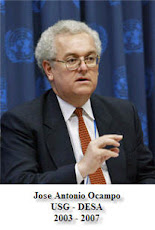
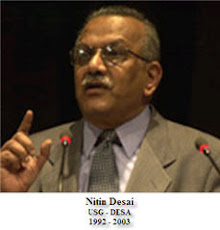
Friday, 22 January 2010

NYPOST: Haiti: Job for the UN

Help still needed after US leaves

Last Updated: 9:49 AM, January 22, 2010

Posted: 2:39 AM, January 22, 2010

The United Nations has elevated Bill Clinton to be its top coordinator for Haiti. It's an excellent move that should help the eventual transition back to UN leadership of world efforts there.

No one is doing more heroic work in Haiti now than the US military. But the 82nd Airborne and the Marines will soon be needed elsewhere, and Haiti is a rare case where the United Nationshas done a good job.

Critics of the UN secretary general have unfairly dubbed this crisis "Ban Ki-moon's Katrina" -- even though the shell-shocked UN, which suffered the largest loss of lives in its history, operated adequately.

Clinton: Great pick to be UN point man.

Of course the UN's efforts couldn't match those of the US military, dispatched to Haiti since last week and now 20,000 troops strong. America's military is best positioned to handle huge emergencies in chaotic field conditions.

The UN's set up for longer-term work -- and it will be needed, when US troops inevitably leave once the immediate emergency is over. Ideally, the tragedy could help pull Haiti out of the multigenerational, self-made crisis that has rendered it the hemisphere's poorest nation.

Happily, the UN's Haiti stabilization force is one of its better operations. With Brazilian troops as its backbone, the mission has met fire with fire since 2004, fighting violent armed gangs in Cite Soleil and other slums, and winning -- or at least achieving enough calm for some outsiders to consider investing in Haiti.

Which brings us back to Clinton, whom Secretary-General Ban last year named as his special envoy for Haiti.

Haiti's ambassador to Washington, Raymond Joseph, tried for years to lure US and international corporations to invest in his country. Though at first no Clinton fan, Joseph told me at the time that the ex-president's involvement prompted many skeptical investors to "get off the fence" and move in.

And so, relative calm in the streets, Clinton's star power and some good moves by the government of PresidentRene Preval created an atmosphere of hope. Haiti wasn't there yet -- but, for the first time in decades, it was moving in the right direction.

Haiti needs more outside help now. President Obama has already pledged $165 million in federal funds, while Americans have donated $40 millions privately, with more sure to come.

Americans should be wary, though, of funneling their money through the UN, which has just launched a $562 million "flash appeal" for donations to Haiti.

Consider what happened to the $13.6 billion, raised in 2005 to help Indonesia after a tsunami killed 2 million there. The Financial Times found that the multiple UN agencies that handled those funds spent a much higher share of the cash for administrative and bureaucratic costs than did aid groups like Oxfam. The UN was also much less transparent when asked to account for the money.

Money and outside help won't suffice, either. For example, earthquake experts can help Haitians devise new construction codes, so fewer buildings collapse next time -- but only Haitians can obey and enforce those codes.

America should help Haiti as much and as long as we can, but (as Obama & Co. are fond of saying) we can't solve all the world's problems alone. Where there's no direct threat, as in Haiti, we should move aside and let other good neighbors (along with our private citizens, our former presidents and the UN) shoulder most of the work.

beavni@gmail.com

Aid makes it to Haiti, but not onto streets

CNN.com


STORY HIGHLIGHTS
  • NEW: Supplies pile up at airport but no distribution system seems to exist, Sanjay Gupta reports
  • Authorities push to clear earthquake-relief bottlenecks, focus on pier
  • Canadian troops work to open an airport in seaside town of Jacmel
  • U.S. officials acknowledge medical supplies haven't been getting through fast enough

On "Hope for Haiti Now," Anderson Cooper joins Wyclef Jean and George Clooney on Friday for a global telethon to air commercial-free across multiple networks and CNN. At 8 p.m. ET/PT Friday.

Port-au-Prince, Haiti (CNN) -- Aid is reaching earthquake-torn Haiti, but getting it to the people who need it remains a challenge.

Large quantities of medications, baby formula and other relief supplies are sitting on the tarmac and in warehouses at the Port-au-Prince airport, but no one is moving it out, according to CNN chief medical correspondent Sanjay Gupta.

"It's like everywhere we go, just walking through the airport, outside the airport even, people are saying, 'We need supplies,' " Gupta said.

Gupta found pallets of formula, pain medication and antibiotics standing unattended next to the runway.

U.S. military personnel in a warehouse tent at the airport gave Gupta a trash bag full of supplies to take back to a hospital he had visited earlier but couldn't explain why there seemed to be no organized system for distribution.

"There is stuff here waiting to be taken out, that's a true statement," said Air Force Col. Ben McMullen, deputy commander of the Joint Special Operations Air Component. "Is it a lot? I can't speak to it. I will tell you the reason you got it is that everyone on this side, specifically the U.S. government side, is dedicated to getting as much stuff outside as they can. ...

"It's a shame, because you would hope that everything could get out there within seconds. But that kind of infrastructure just isn't in place."

Over at the city's port, authorities pushing to clear bottlenecks hope to restore two-way traffic at the south pier sometime Friday.

The magnitude 7.0 quake that rocked the impoverished nation on January 12 damaged its capital's north and south piers. Haitian authorities and the U.S. military had restored one-way traffic to the south pier, which is the smaller of the two, by Thursday.

Port-au-Prince's north pier remains unusable.

The bottlenecks have delayed food and medical aid to the estimated 3 million Haitians who have been affected by the quake.

At least 72,000 people have been confirmed dead in the quake, according to Prime Minister Jean-Max Bellerive.

Canadian troops, meanwhile, were working to open an airport in Jacmel on Thursday, another step that could speed delivery of relief supplies. Jacmel, a seaside town about 25 miles (40 kilometers) from Port-au-Prince, is considered Haiti's cultural capital.

Delayed relief supplies have led to at least five deaths, according to the aid group Doctors Without Borders, also known as Médecins Sans Frontières.

Full coverage | Twitter updates

Working under adverse conditions with limited supplies, medical teams have been forced to improvise.

Renzo Fricke, field coordinator for Doctors Without Borders, said staffers had to buy a saw in the market so surgeons could do amputations. A CNN crew loaned a medic a pocketknife for another operation.

Lacking rubbing alcohol, doctors have used vodka to sterilize equipment and instruments. Surgical patients are receiving over-the-counter pain medicine because doctors lack stronger medication. One nurse used a string of Christmas lights as a makeshift extension cord. CNN's Elizabeth Cohen saw a belt used as a tourniquet. When that broke, a garden hose was used.

U.S. officials have acknowledged that not all aid, particularly medical supplies, has been getting through fast enough. The situation is improving, however, they said.

That offered limited comfort to some Haitians.

iReport: List of missing, found | Are you there?

"I have not eaten for two days," 32-year-old Anderson Bellegarde said Thursday. "I'm only drinking water."

Bellegarde had waited more than six hours outside a money-wiring branch. Businesses such as Western Union are starting to reopen and are attracting the longest and most visible lines in Haiti's capital, as quake survivors scramble for cash.

Sidewalks were crowded with street vendors and kiosks, and many small food stores were open. Dozens of stalls sold fruits and vegetables at a dusty market along a pocked and rut-filled dirt side street.

More than 300 aid distribution sites are up and running, a senior U.S. administration official said. More than 700,000 meals and 1.4 million bottles of water have been delivered, along with 22,000 pounds of medical supplies, said Lt. Gen. Douglas Fraser of the U.S. Southern Command.

About 120 to 140 flights a day are coming into the single-runway Port-au-Prince airport, compared with 25 a day just after the quake struck last week. More than 840 have landed since the airport was reopened, but there is a waiting list of 1,400 to come in, Fraser said.

To improve air traffic, the U.S. military said Wednesday it had obtained landing rights at the Dominican Republic's air base at San Isidro, about 135 miles (220 kilometers) east of Port-au-Prince.

Impact Your World

International aid contributions since the quake have totaled hundreds of millions of dollars. U.S. spending for relief in Haiti has hit $170 million, the federal government announced Thursday.

About 13,100 U.S. troops are in and around Haiti -- nearly 2,700 on the ground and 10,400 more offshore. Many Marines spend time in Haiti during the day but sleep on ships at night. More U.S. troops are to arrive by this weekend, bringing the total to about 4,600 troops on the ground.

CNN's Arthur Brice, Susan Candiotti, Jill Dougherty, Eric Marrapodi, Lisa Desjardins and Elise Labott contributed to this report.

Wednesday, 20 January 2010

Oil-Rich Nations Fall Far Short in Haiti Donations

Wednesday, January 20, 2010

By Joshua Rhett Miller

FC1


What do Alyssa Milano, Sandra Bullock, Lance Armstrong, Gisele Bundchen, the country of Senegal and — very possibly — you have in common?

All — including you — have donated more funds to the Haitian relief effort than oil-rich nations like Saudi Arabia and Iran.

That's right ... if you personally have donated money to help the earthquake-stricken people of Haiti, then you have contributed more money than the governments of Saudi Arabia and Iran, whose combined dollar donation is a big fat zero.

As Haiti slowly recovers from last week's earthquake, nearly $400 million has been donated by countries, individuals and organizations to the devastated nation, accordign to United Nations documents.

But the goodwill has been far from balanced. India, which has one of the world's largest gross domestic products, has donated $1 million, a figure matched or eclipsed by much smaller economies like the Czech Republic ($1.1 million), Botswana ($1.1 million) and Senegal ($1 million).

And those donations have been matched or topped by individuals like Bill Gates, Angelina Jolie and Brad Pitt.

The United States leads the way among developed nations with $114.5 million donated as of Wednesday, according to the U.N. That's more than 28 percent of the $397 million donated to rebuild the impoverished Caribbean nation. The United Kingdom and France are next with more than $30.9 million and $16.8 million donated, respectively. Australia ($13.4 million) and Italy ($8.7 million) round out the top five donating countries.

Another $951 million has been pledged from other nations.

Click here to see how much the world has given.

Other key contributors include the Central Emergency Response Fund (CERF), which donated more than $25 million, and the European Commission, which added nearly $6 million to the relief effort. The European Union has also pledged an additional $400 million-plus.

Private organizations and individuals have contributed more than $110 million — better than one-quarter of the relief funds currently tracked by the U.N. — with another $146 million pledged.

Among private organizations and corporations, the American Red Cross has donated nearly $6 million, including a $5 million cash contribution, followed by Deutsche Bank ($4 million), the Bill and Melinda Gates Foundation ($1.5 million) and Bank of America ($1 million). Wall Street behemoths Goldman Sachs, Morgan Stanley and JP Morgan have donated $1 million each, along with Starbucks and the Hess Corporation. The World Bank has pledged $100 million, according to U.N. documents. Major League Baseball, the National Football League and the National Basketball Association have pledged $1 million apiece.

Not to be outdone by big business, celebrities like Jolie and Pitt have pledged $1 million to the relief fund via the Jolie-Pitt Foundation. Sandra Bullock also has donated $1 million. Brazilian model Gisele Bundchen has added $1.5 million, followed by Madonna ($250,000), seven-time Tour de France winner Lance Armstrong, who has sent $125,000 via his foundation, and actress Alyssa Milano ($50,000).

Actor George Clooney and musician Wyclef Jean have also joined the effort and will host telethons to generate donations to the impoverished nation. Clooney's Not on Our Watch charity gave another $1 million to Haiti, and contributions have been pouring into Jean's Yele Haiti charity.

Top economies like Japan and China, meanwhile, have donated $5.3 million and $4.4 million, respectively, or roughly 1 percent of the nearly $400 million donated. Germany, according to U.N. documents, has donated more than $6 million, easily surpassing donations from the Russian Federation, which provided $700,000 and one cargo aircraft with two helicopters.

Some oil-producing countries might be donating indirectly. On Jan. 15, the Arab Gulf Program for United Nations Development Organizations announced a $100,000 to support relief efforts, and the OPEC Fund for International Development announced a grant of $500,000 for emergency operations. Neither donation has been listed in U.N. documents.

The United Arab Emirates' government hasn't sent any funds, but the UAE's Red Crescent, the federation's chief private humanitarian organization, has donated roughly $430,000 and housing materials.

Venezuela, like Saudi Arabia and Iran, hasn't made a withdrawal at the ATM machine, but it has provided 616 tons of emergency relief materials and 116 tons of special machinery for reconstruction.

And Iran, which has seen its share of cataclysmic earthquakes, has offered 30 tons of food, tents and medicine. (Its Red Crescent has also donated $106,000).

Saudi Arabia stands nearly alone with Kuwait. According to the U.N. document, neither country has donated or pledged so much as a penny or a Band-Aid.

Saturday, 16 January 2010

Put the Pentagon in Charge

CLICK HERE TO READ STORY ON NEWSWEEK

Why the U.S. military is the only organization that can effectively manage the chaos in Haiti. And other hard truths about the disaster

By John Barry Newsweek Web Exclusive
Jan 15, 2010

As the international relief effort descends on Haiti, there are certain truths that nobody wants to acknowledge publicly. The first is that few of those still buried under the rubble can be saved. There will, of course, be stories of miracle rescues. But the reality, says Fred Krimgold, earthquake expert at Virginia Tech, is that "a very, very high percentage of the people who are rescued are found in the first few hours. The drop-off is significant after that. By the time the rescue teams and sniffer dogs and fancy equipment arrive, you're really left with the exceptional situations, the freak survivals." Many of those lucky enough to be pulled from the rubble will die too, succumbing to what disaster-relief experts call "crush injuries" from the rubble that entombed them. The toxins these injuries release in the body typically overwhelm the kidneys. Without dialysis, the injured tend to die—and nobody brings dialysis machines to a disaster zone.

The other truth is that the only entity on the planet with the capacity to bring help to Haiti on the scale needed is the U.S. military. The United Nations will find it impolitic to admit this; the big international relief groups, proud of their noncombatant status, will shy from acknowledging it. But it is the reality.

Journalists in Port-au-Prince ask the persistent question: "Who's in charge?" The answer is a quiet-spoken U.S. Special Forces officer from a tiny township on the Kentucky River. Lt. Gen. P. K. (Ken) Keen is deputy commander of U.S. Southern Command, and the man tapped to run the American relief effort in Haiti. It's a task that will tax Keen's diplomatic as well as organizational skills as he navigates the politics of international disaster relief.

Formally, Keen—who is in Port-au-Prince—will take his orders from the U.S. ambassador to Haiti, Kenneth Merten. Formally, the official with lead responsibility within the Washington bureaucracy is the administrator of the U.S. Agency for International Development (USAID), Rajiv Shah—who's been in the job for all of one week. Formally, the aid from international donors is pulled together by the U.N. Office for the Coordination of Humanitarian Affairs.

But the reality is that what materials and assistance are delivered to Haiti, how much, and when, will depend almost wholly on a network of relationships established on the ground between the U.S. military, a handful of disaster experts from USAID, and five or six of the biggest NGOs already working in Haiti: World Vision, CARE, Save the Children, Oxfam, and one or two others. As experts from Europe arrive, they will be slotted into this network. In practice, these emergency relief workers are a global cadre; they know each other from years' together at one disaster scene after another. And the roles are clear. The relief workers figure out what's needed, and draw up their lists. The AID liaison staffers with the U.S. military prioritize the requests and sign off on them. The military brings the goods into the country. The big NGOs distribute them, with emergency access to U.S. government funds to hire local contractors.

It's a system built up over 20 years; and—belying the chaos on the streets—it works efficiently. There is even a how-to manual: FOG, it's inappropriately called, the Field Operations Guide, which was intended to be a pocket manual, but has now swollen to 378 pages of accumulated know-how.

But none of this can function except on the bedrock of U.S. military capability, as the first days of chaos in Haiti have again demonstrated. Haiti's communications were destroyed in the quake; the U.S. military's first task was to set up a new network. Supplies couldn't be flown into Port-au-Prince airport until the U.S. military had sent in airport repair and cargo-handling teams.

The port is unusable because many of the wharves are rubble and most of the cranes have collapsed. Heavy-lift helicopters flying off the carrier USS Carl Vinson are the only way of getting most supplies ashore. When the USS Bataan, one of the Marines' amphibious assault carriers, arrives off Haiti with the dock landing ship USS Fort McHenry, their hovercraft will take up the cargo-ferrying effort. To distribute relief supplies around the shattered country, only the U.S. military has the transport; many of the NGOs' vehicles were damaged in the quake. To keep order and reassure a frantic populace, a company of the 82nd Airborne is already there, and a 3,500-strong brigade will be in place over the weekend.

On Friday, the U.S. military was stepping up its leadership role. The Chairman of the Joint Chief of Staff, Adm. Mike Mullen, said that up to 10,000 U.S. troops would be operating in or near Haiti by Monday, with the possibility of more being added later. And the State Department said Haitian Prime Minister Jean-Max Bellerive signed a document turning over control of the Port-au-Prince airport to the U.S. government indefinitely. These are crucial steps in the right direction.

The U.S. military won't be welcome in Haiti for long. Ironically, one of the first signs of Haitian revival will, predictably, be protests at the American presence. For now, though, it's the American armed forces that stand between Haiti and utter collapse.


Find this article at http://www.newsweek.com/id/231103

Friday, 15 January 2010

U.N.'s World Health Organization Eyeing Global Tax on Banking, Internet Activity

Friday , January 15, 2010

By George Russell

FC1


The World Health Organization (WHO) is considering a plan to ask governments to impose a global consumer tax on such things as Internet activity or everyday financial transactions like paying bills online.

Such a scheme could raise "tens of billions of dollars" on behalf of the United Nations' public health arm from a broad base of consumers, which would then be used to transfer drug-making research, development and manufacturing capabilities, among other things, to the developing world.

The multibillion-dollar "indirect consumer tax" is only one of a "suite of proposals" for financing the rapid transformation of the global medical industry that will go before WHO's 34-member supervisory Executive Board at its biannual meeting in Geneva.

The idea is the most lucrative — and probably the most controversial — of a number of schemes proposed by a 25-member panel of medical experts, academics and health care bureaucrats who have been working for the past 14 months at WHO's behest on "new and innovative sources of funding" to accomplish major shifts in the production of medical R&D.

WHO's so-called Expert Working Group has also suggested asking rich countries to set aside fixed portions of their gross domestic product to finance the shift in worldwide research and development, as well as asking cash-rich developing nations like China, India or Venezuela to pony up more of the money.

These would also add billions in additional funds to international health care for the future — as much as $7.4 billion yearly from rich countries, and as much as $12.1 billion from low- and middle-income nations.

But the taxation ideas draw the most interest. The expert panel cites a number of possible examples. Among them:

—a 10 per cent tax on the international arms trade, "which might net about $5 billion per annum";

—a "digital tax or 'hit' tax." The report says the levy "could yield tens of billions of U.S. dollars from a broad base of users";

—a financial transaction tax. The report approvingly cites a levy in Brazil that charged 0.38 percent on bills paid online and on unspecified "major withdrawals." The report says the Brazilian tax was raising an estimated $20 billion per year until it was cancelled for unspecified reasons.

The panel concludes that "taxes would provide greater certainty once in place than voluntary contributions," even as the report urges WHO's executive board to promote all of the alternatives, and more, to support creation of a "global health research and innovation coordination and funding mechanism" for the planned revolution in medical research, development and distribution.

Click here to read the executive summary of the report.

The WHO scheme to transfer impressive amounts of money, technology, patents and manufacturing ability to the developing world in a global battle to conquer disease looks similar in many respects to the calls for huge transfers of wealth and technology that were at the heart of the just-failed U.N.-sponsored conference on lowering greenhouse gas emissions at Copenhagen.

Indeed, the volume of revenues that the experts foresee from their global indirect tax — if it should ever be approved by enough national governments — might well come close to the $30 billion annual wealth transfer that rich nations approved at Copenhagen to hand over to poor countries until 2012.

But a global health tax would go one big step further. And, as the experts point out, one trail-blazing version of their global consumer tax for medical research already exists: a germinating program known as UNITAID, which aims to battle against HIV/AIDS, malaria and tuberculosis.

UNITAID, which began in 2006 and is also hosted by WHO, is financed in part by a "solidarity contribution" levy of anywhere from $1.20 to $58 on airline tickets among a group of nations led by France, Brazil, Chile, Norway and Britain. According to the WHO experts report, it has raised around $1 billion since its inception, with 13 countries having already passed the airline tax legislation and "several" others in the process of doing so.

The idea, as with the "indirect" taxes that WHO is about to consider, is that a relatively small consumer levy, once implemented, is a low-profile and relatively painless way to create a global health-care tax system.

UNITAID's board chairman, Philippe Douste-Blazy, a former French Cabinet Minister and currently special advisor to U.N. Secretary General Ban Ki-moon on "innovative financing for development," is also a member of the WHO expert working group.

The global financial mechanism that the experts have been exploring is the keystone to WHO's entire program for the transformation of the world's health industry, which was endorsed as a "global strategy and plan of action" by the health organization's World Assembly in May 2008.

The plan includes more than 100 specific actions across the areas of research and development, technology transfer and intellectual property rights, among others, according to an update that will also be presented to the executive board next week.

Click here for the update.

New regional and national networks for medical innovation and development are being planned in Asia, Latin America and Africa — where, for example, there will be "African-led product research and development innovation," including delivery of drugs based on traditional medicines.

Another major effort is the transfer of technology to poorer countries to produce vaccines. One example: H1N1 flu vaccine, which is being manufactured in China, India and Thailand under licensing arrangements created under WHO auspices.

After WHO issued repeated warnings of a serious H1N1 influenza pandemic over the past two years, countries such as Britain and France ordered hundreds of millions of dollars worth of vaccine, only to decide that they were unnecessary, leading to mass cancellations of orders. WHO is reviewing how it handled the crisis.

According to the WHO update, the U.N. organization is already promoting transfers of new medical products for vaccines against rabies, even though that disease is now something of a rarity in the West.

A significant aim of the WHO effort is expanding production and distribution of remedies for what it calls "neglected diseases," mainly meaning those that are more common in poor, underdeveloped countries than in richer ones. These include a variety of parasitic ailments, including trypanosomiasis, or sleeping sickness.

Behind all of the effort is the "persistent and growing concern," as the expert's paper puts it, that "the benefits of the advances in health technology are not reaching the poor," which the paper calls "one of the more egregious manifestations of inequity."

As with "climate change" at Copenhagen, the WHO's experts see that health inequity as a malady that innovative and permanent forms of global taxation are just the right thing to help cure.

George Russell is executive editor of Fox News.

Wednesday, 13 January 2010

UN should be sidelined in future climate talks, says Obama official

CLICK HERE TO READ STORY AT GUARDIAN.CO.UK


America sees a diminished role for the United Nations in trying to stop global warming after the "chaotic" Copenhagen climate change summit, an Obama administration official said today.

Jonathan Pershing, who helped lead talks at Copenhagen, instead sketched out a future path for negotiations dominated by the world's largest polluters such as China, the US, India, Brazil and South Africa, who signed up to a deal in the final hours of the summit. That would represent a realignment of the way the international community has dealt with climate change over the last two decades.

"It is impossible to imagine a global agreement in place that doesn't essentially have a global buy-in. There aren't other institutions beside the UN that have that," Pershing said. "But it is also impossible to imagine a negotiation of enormous complexity where you have a table of 192 countries involved in all the detail."

Pershing said the flaws in the UN process, which demands consensus among the international community, were exposed at Copenhagen. "The meeting itself was at best chaotic," he said, in a talk at the Centre for Strategic and International Studies in Washington. "We met mostly overnight. It seemed like we didn't sleep for two weeks. It seemed a funny way to do things, and it showed."

The lack of confidence in the UN extends to the $30bn (£18.5bn) global fund, which will be mobilised over the next three years to help poor countries adapt to climate change.

"The UN didn't manage the conference that well," Pershing said. "I am not sure that any of us are particularly confident that the UN managing the near-term financing is the right way to go."

Pershing did not exclude the UN from future negotiations. But he repeatedly credited the group of leading economies headed by America for moving forward on the talks, including on finance and developing green technology. He suggested the larger forum offered by the UN was instead important for countries such as Cuba or the small islands which risk annihilation by climate change to air their grievances.

"We are going to have a very very difficult time moving forward and it will be a combination of small and larger processes," he said.

The first test of the accord agreed by America, China, India, South Africa and Brazil arrives on 31 January, the deadline for countries to commit officially to actions to halt global warming. Here, too, Pershing indicated the focus would be narrower in scope than the UN's all-inclusive approach. "We expect there will be significant actions recorded by major countries," he said. "We are not really worried what Chad does. We are not really worried about what Haiti says it is going to do about greenhouse gas emissions. We just hope they recover from the earthquake."

Key groups of developing countries are to meet this month to try to explore ways to get to agree a binding agreement.

As the dust settles on the stormy Danish meeting, environment ministers from the so-called Basic countries – Brazil, South Africa, India and China – will meet on 24 January in New Delhi. No formal agenda has been set, but observers expect the emerging geopolitical alliance between the four large developing countries who brokered the final "deal" with the US in Denmark will define a common position on emission reductions and climate aid money, and seek ways to convince other countries to sign up to the Copenhagen accord that emerged last month.

Fewer than 30 countries out of the 192 who are signed up to the UN Framework Convention on Climate Change (UNFCCC), which organised Copenhagen, have indicated that they will sign. Many are known to be deeply unhappy with the $100bn pledged for climate aid and the decision not to make deeper cuts in emissions.

Under UN laws, consensus is required. There is confusion over the legal standing of the agreement reached in Copenhagen and many countries may not be in a position to sign up by 31 January because they have yet to consult their parliaments.

Meanwhile, Bolivia, one of a handful of poor countries which openly opposed the deal in Copenhagen, has invited countries and non-governmental groups which want a much stronger climate deal to the World Conference of the People on Climate Change.

Pershing said that he had told some of those leaders that there was no prospect of reaching a stronger deal that would limit warming to 1.5 degrees.

The conference, to be held in Cochabamba in Bolivia from 20-22 April, is expected to attract heads of state from the loose alliance of socialist "Alba" countries, including Venezuela and Cuba. Alba, the Bolivarian Alliance for the Peoples of Our America countries, was set up to provide an alternative to the US-led free trade area of the Americas.

Bolivia this week urged leaders of the world's indigenous ethnic groups and scientists to come. "The invitation is to heads of state but chiefly to civil society. We think that social movements and non government groups, people not at decision level, have an important role in climate talks," said Maria Souviron, the Bolivian ambassador in London.

The meeting, which is intended to cement ties between the seven Alba countries, is also expected to pursue the idea of an international court for environmental crimes, as well as the radical idea of "mother earth rights". This would give all entities, from man to endangered animal species, an equal right to life.

"Our objective is to save humanity and not just half of humanity," said Morales in a speech at Copenhagen. "We are here to save mother earth. Our objective is to reduce climate change to [under] 1C. [Above this] many islands will disappear and Africa will suffer a holocaust. The real cause of climate change is the capitalist system. If we want to save the earth then we must end that economic model."

Tuesday, 12 January 2010

U.N. Cuts Back on Investigating Its Own Fraud

Tuesday , January 12, 2010

AP

UNITED NATIONS -- The United Nations has cut back sharply on investigations into corruption and fraud within its ranks, shelving cases involving the possible theft or misuse of millions of dollars, an Associated Press review has found.

At least five major cases in Afghanistan, Iraq and Africa are among the inquiries halted as the U.N. scaled back on self-policing over the past year.

The world body was rocked earlier in the decade when more than 2,200 companies from some 40 countries colluded with Saddam Hussein's regime to bilk $1.8 billion from a U.N.-administered oil-for-food program for Iraqi humanitarian relief.

In response, it established a special anti-corruption unit, the Procurement Task Force, in 2006 that over the next three years uncovered at least 20 other major schemes affecting more than $1 billion in U.N. contracts and international aid.

But at the beginning of 2009, the United Nations shuttered the agency and diverted its work to the Office of Internal Oversight Services' permanent investigation division.

Since then, the number of cases opened, pursued or completed has dropped dramatically and the division has let go most former task force investigators, the AP found in an examination of U.N. documents, audits and e-mails, along with dozens of interviews with current and former U.N. officials and diplomats.

Over the past year, not a single significant fraud or corruption case has been completed, compared with an average 150 cases a year investigated by the task force. The permanent investigation division decided not to even pursue about 95 cases left over when the task force ceased operation, while another 80 unfinished cases have languished.

It also stopped probes into contractors and cut qualified staff and other resources -- and halted five major corruption investigations documented by the task force in the final days of 2008.

Nancy Boswell, president of anti-corruption watchdog Transparency International-USA, fears the U.N. is greatly diminishing its self-policing capabilities.

"One year after the (Procurement Task Force) was terminated, it is deeply troubling that allegations persist that the (Office of Internal Oversight Services) has not vigorously pursued open cases, that its leadership has not put in place a permanent head of investigations and that it may be narrowing its scope of inquiry," Boswell said.

U.N. officials -- who operate a $5 billion annual budget and whose extended agencies and funds spend at least $20 billion a year more -- say their commitment to rooting out corruption is undiminished.

"The investigations division, I am convinced, is doing a very good job, and is continuing the good work," U.N. management chief Angela Kane said in late October. She repeated the assertion last week.

But the U.N.'s track record over the past year suggests otherwise:

-- Nothing has come of a task force report completed in December 2008 that found $1 million a day flowing out of a safe in a U.N. project office in Kabul -- part of $850 million intended for Afghanistan's rebuilding and elections between 2002 and 2006. A year later, U.N. managers say the case is still under review.

-- Task force staff ran out of time before they could complete two more investigations on Afghanistan. One involved evidence that a U.S. firm padded its charges by $1 million and the other that U.N. staff diverted millions of dollars from Afghan elections, roads, schools and hospitals, according to U.N. documents and officials.

Task force investigators found evidence some of the money went to expand U.N. operations in Africa, Asia and the Middle East without authorization. And they found no documentation to confirm how the Kabul office used tens of millions of dollars meant to promote democratic elections in Afghanistan.

-- No action has been taken on a task force finding that about half of $350,000 in U.N. funds intended to launch a radio station for women in Baghdad was used to pay off personal loans, a mortgage, credit card bills and taxes, as well as for cash withdrawals from a bank in Jordan. The task force recommended disciplining a U.N. staff member and referring the case to national prosecutorial authorities. Neither has happened.

-- A task force investigation of collusion and bid-rigging involving a transport company in Africa found contracts steered to one company and two of its senior officers. The task force recommended the case be prosecuted; nothing has happened. U.N. managers say the case is under review.

-- In another case, task force investigators obtained evidence of major corruption involving more than $200 million in transportation contracts for U.N. peacekeeping throughout Africa. U.N. procurement records show Russian companies held a large proportion -- a quarter of about $400 million in U.N. air transportation contracts in 2009. The case has since been dropped.

At the end of 2008, the U.N. General Assembly refused to fund the task force for another year. Russia and Singapore, in particular, protested findings of wrongdoing involving citizens or companies from their nations, though the U.N. Board of Auditors concluded the task force acted impartially and helped deter fraud and corruption.

The Government Accountability Project, a Washington-based nonprofit law firm that defends whistleblowers, says the U.N. quashed the task force, buried its cases and retaliated against an investigator trying to protect some probes' computer files.

"We did talk to investigators. They were concerned that investigations which were substantial and which had accumulated credible evidence of wrongdoing had not been zealously pursued since the task force was disbanded," said Bea Edwards, the firm's international program director. "It appears there was political pressure brought to bear that may have been instrumental in delaying or stopping (task force) investigations."

The task force had 20 white-collar crime investigators, led by a veteran former U.S. federal prosecutor, Robert Appleton. Its work has led to at least four convictions, millions of dollars in restitution orders, misconduct findings against 17 U.N. officials and the banning of 47 U.N. contractors due to fraud, other illegality or rules violations.

Now, all but two task force investigators are gone from the investigation division, in most cases because the U.N. would not renew their contracts. Some vacancies have been filled, but with staff lacking experience in fraud and corruption cases. U.N. officials told the AP that investigators were instructed to interview witnesses using a standardized form rather than relying on case-specific examination techniques and pointed questioning.

In July, the investigation division quietly let the task force's contract expire with the firm that examined computer data, reconstructed deleted files and provided other expert forensic support services. Investigators were never given a reason.

Edric Selous, a senior legal officer for the U.N.'s Office of Legal Affairs, said the investigation division made "a huge effort" to close out the task force's remaining 175 cases -- but none were sent to his office for review.

"There's been a diminution in the number of cases received since December," said Selous, whose office advises the U.N. secretary-general on referring cases for prosecution outside the United Nations.

Whenever the task force identified suspected criminal activity, it recommended sending the case to a national criminal authority immediately. Legal experts say speedy action is essential to prevent evidence from being destroyed and to provide the best chance of recovering proceeds from fraud.

Several task force reports from December 2008 still await a final decision from Secretary-General Ban Ki-moon more than a year later, including cases involving large sums of money and accusations of major fraud, theft or embezzlement by U.N. staff.

In 2009, the secretary-general referred only one case for prosecution outside the U.N., and only after reports by the AP and The Washington Post. U.S. prosecutors are now pursuing task force allegations that the former American head of the U.N. project office in Kabul, Gary K. Helseth, diverted a half-million dollars to lease luxury cars, fly first-class on private trips, buy expensive meals and install high-end home appliances.

The permanent investigation division's acting head, Michael Dudley, barred new inquiries into anyone outside the U.N., including former staff, contractors and other employees. In a Jan. 30, 2009, memo obtained by the AP, Dudley wrote that "employees of a third party" are outside his division's mandate and cases involving ex-U.N. staff "should be reassessed to determine whether the matter should be closed without further investigation."

The move undercuts oversight of billions of dollars in U.N. spending and more than 6,600 U.N. contractors who receive that money, say U.N. officials, diplomats and legal experts. Additionally, they say, U.N. staff members could avoid scrutiny -- and potentially get away with fraud, embezzlement or theft -- by simply quitting.

The document closed a task force investigation into allegations that an Israeli U.N. staff member steered contracts to Israeli companies for work with the U.N. Economic Commission for Africa in Ethiopia, and that other U.N. officials cut personal deals with bidding companies. The probe was closed on grounds that, under Dudley's new policy, the vendor was beyond the investigation division's responsibility.

Inga Britt-Ahlenius of Sweden, who supervises the Office of Internal Oversight Services, said she asked Dudley whether he wrote such a document and he denied it.

Dudley told the AP he did not recall writing the memo, even though his initials and name were on it, and he denied changing the investigation division's mandate. "Every case that is possible or merits investigation is being investigated," he said.

Edwards, who interviewed top U.N. officials for her whistleblower probe for the Government Accountability Project, said Dudley spoke about changing the mandate, keeping the number of investigators to a minimum and closing cases when the officials involved leave the U.N.

"He told us that he felt that if someone who was charged with misconduct had retired or left the organization, there was no point in investigating since the person was beyond sanction by the U.N.," she recalled. "He told me and my assistant that. There were two of us there. We were absolutely astonished."

Ban Ki-moon says he has seen "steady progress" in U.N. self-policing since the Office of Internal Oversight Services' creation, and he pledged "full support" for the agency.

But the investigation division has not had a permanent director for more than 2 1/2 years in a hiring process bogged down by Ban's office, which twice opposed the selection of an American for the job, say U.N. officials and diplomats.

Kane, the U.N. management chief, said greater diversity is needed among candidates for the top investigative post. But an independent panel unanimously deemed the American the most qualified candidate after two full recruitment rounds, with global advertising, that drew more than 70 applicants globally.

Edwards says the appointment is improperly "bottlenecked" in Ban's office.

Former U.S. Comptroller General David Walker, chairman of the U.N.'s Independent Audit Advisory Committee, said his panel is concerned whether valid cases are still being pursued and insisted a permanent investigations director must be chosen quickly.

In February, the committee, which advises the General Assembly, said it had serious concerns whether the Office of Internal Oversight Services could be effective since more than a quarter of its jobs were vacant. It particularly urged that "strong leadership and management are critical" for the investigation division.

U.S. Ambassador Susan Rice told the AP the loss of the task force "remains a source of concern to the United States," as does the lack of a permanent investigations director.

"The fact that there remains a disagreement within the U.N. as to how to put in place optimal leadership for the investigative division, which we think is an important tool for the U.N., is a problem," she said.
Monday, 4 January 2010

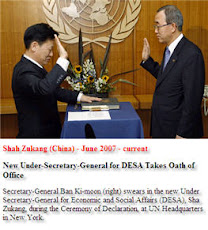
Sha Zukang racks up list of broken promises

After 3 years in office, Sha Zukang have fallen short on a number of his promises.

We want to countdown from 16 July 2008 Town-hall meeting with our USG, in which he promised "quick, responsive policies to restore DESA's reputation".

Broken Promise N#1: Mobility
  • yet no clear rules nor explanation from USG/EO on the mobility exercise;
  • staff still being reassigned before mobility eligibility and swapped with other colleagues while no regard towards individual career growth;
  • no career planning at all level, branch managers or directors continue their feudal ruling;
  • good performers not rewarded because managers not interested in letting them go;
Broken Promise N#2: Career Development
  • lack of branch or division minimum planning for any career development for staff;
  • DESA staff still lack access to regional commissions and/or vice-versa;
  • total lack of strategic management of human resources, no one in DESA knows what their real job is;
  • total disproportional use of consultants or outside "resources" while disregard of internal capacities;
  • lack of empowerment and decentralization or better utilization of junior staff;
Broken Promise N#3: Training
  • still no individual training plans at no level;
  • disregard to planning and incorporating training costs into divisional budgets or projects;
  • lack of training in inter-divisional communication has led to deepen the gap of knowledge of DESA's internal capacities and inter-division cooperation;
Broken Promise N#4: Promotion and Recruitment of Personnel
  • still managers make the rules;
  • no planing nor clear vision as to how to restructure DESA and align personnel to meet its mandates;
  • total disregard of OHR processes;
  • EO continue in its path of disregard of all rules and hiring of unqualified candidates for posts, nepotism and corruption reign in 23rd floor;
Broken Promise N#5: Use of Posts
  • total corruption and disregard of UN rules on assignment or re-allocation of posts;
  • no assessment made yet;
  • many vacant posts (158) still vacant and kept vacant in purpose from managers at various levels in order to justify for hiring of short-term consultants or friends/family;
  • total lack of trust of DESA staff in current Executive Office (EO) seen as main source of favoritism and abuse of power;
Broken Promise N#6: Transparency in recruitment & Promotions
  • a complete lack of transparency in hiring of Hayan Qian;
  • a complete lack of transparency in hiring of Adil Khan's replacement;
  • a complete lack of transparency in hiring of 8 D1/L6-7 and 12 P5 and many more;
  • lack of transparency in filling temporary posts (most of time to accommodate unqualified individual for their leak-ass attitudes)
Broken Promise N#7: Gender and Geographical balance
  • total disregard of gender consideration or better mismanagement of gender to justify EO's decisions;
  • if you are Korean or Chinese you know you have the right ingredients to stay around DESA and Secretariat;
Broken Promise N#8: Leadership
  • since Nitin Desai's days there is no DESA Strategic Plan;
  • Directors continue to reign as if Divisions are their own home backyards and not a UN public institution;
Broken Promise N#9: Managing for efficiency and effectiveness
  • total disregard of programmatic requirements;
  • managers continue to use resources as they see fit, and hire their friends, family or lovers (both straight and gay);
  • abuse of power is the Rule;
Broken Promise N#10: Integrity, Accountability and equality
  • USG, ASG, Director and Branch Chiefs are the Kings and Queens in DESA, whatever they say is the law - no one cares what real direction the organization is going;
  • no one is ever held accountable therefore leading to a total loss of trust from staff towards higher management and their ability to stand for what is right;
  • Current motto for Career Development is : "shut-up or leak-ass or bribe to secure your future in DESA"
Broken Promise N#11: Rules
  • No one knows what Rules are;
  • DESA still lacks a consolidated website or intranet site in which staff can identify and follow the organizational or divisional rules and mandatory requirements;
Broken Promise N#12: Conflict

  • if anyone dares to raise any issue - will face consequences from higher management - that's how managers perceive CONFLICT MANAGEMENT;
  • staff divided in groups / clans - pro or against one manager/director;
Broken Promise N#13: Performance Management
  • ePAS - one should beg or leak ass of respective supervisors who seat in staff ePAS-es for weeks and months without any reason;
  • no responsible career development path - no one knows what to do to achieve a career growth (professionally) inside DESA;
Broken Promise N#14: Contractual issues and consultants
  • thank god not many italians around these days (at least not as in Bertucci's time);
  • despite the fact that the new Knowledge Management Chief will be Italian from "private sector";
  • plenty of chinese or koreans - no one knows how these guys come and go;
  • plenty of temporary staff continue to seat in posts for years without proper contracts;
  • total lack of corporate resource planning allows managers to decide on their own who and when to hire consultants;

Friday, 11 December 2009

UN Personnel Contracts return to normal - 5th Cmtt slap ban in the face ...yet again

ANOTHER FAILURE FOR BAN KI MOON AND HIS KOREAN TEAM

STAFF NEED NOT TO WORRY ....
THIS SECRETARY GENERAL IS A TOTAL FAILURE

Tuesday, 8 December 2009

Audit report alleges corruption at U.N. weather agency

WMO Vote Rigging Scandal

The Associated Press

GENEVA: News allegations of corruption within the United Nations have surfaced in a confidential audit report that claims the 2003 election of the current chief of the U.N. weather agency was manipulated.

The report, obtained by The Associated Press on Friday, centered around payments to government delegates at the Geneva-based World Meteorological Organization, which coordinates the study of the world's weather and climate.

WMO hired Maria Veiga of Portugal, an independent auditor who wrote the report, in 2003 to investigate the financial irregularities, but fired her three years later for what it described as "serious misconduct."

The auditor, however, said she was blocked from pursuing her investigation, received intimidating phone calls and was threatened with legal action by one WMO official before being dismissed.

In a 65-page summary of her findings, Veiga said that Muhammad Hassan of Sudan, a former WMO staffer, skimmed some US$3 million from the agency while he was working in its training department.

The disappearance of the money was made public in 2003 when WMO handed the matter over to Swiss authorities. At the time Hassan, who by then had gone abroad, was suspected of having embezzled the money.

But according to the documents seen by the AP, most of the funds were allegedly used to influence the votes of about 50 WMO member states during the May 2003 election of the agency's new secretary-general.

The misappropriated funds were "used to pay travel, accommodation and pocket money of ... delegates of certain countries with WMO (on the understanding) that the delegates would then vote and act according to Mr. Hassan's and other WMO staff members' ... instructions," the report states.

Hassan's current whereabouts are unknown to Swiss authorities, and the AP was unable to contact him. But Marc Tappolet, the investigating magistrate of Geneva canton, told the AP that the Swiss inquiry against Hassan is continuing.

The purpose of the payments was to support the candidacy of Kenya's Evans Mukolwe, the report said. Veiga told the AP that delegates told her the idea was to draw votes away from France's official candidate, Jean Pierre Beysson, so that senior WMO official Michel Jarraud, also of France, could win the top post.

Mukolwe beat Beysson 85-70 in the first round of voting, but failed to win the required two-thirds majority in three subsequent rounds, and nominations were reopened. Lithuania then nominated Jarraud, who beat Mukolwe by 109 to 50 votes.

Jarraud had served for eight years as deputy to outgoing WMO chief Godwin Obasi of Nigeria.

"I think Mr. Obasi ... wanted his deputy to be elected because he felt that Mr. Jarraud's election would bring a certain continuity of his work," Beysson told the AP late on Friday by telephone from Paris.

Obasi, who allegedly had close ties to Hassan, has since returned to his native Nigeria. AP's calls to Obasi's phone numbers there went unanswered Saturday.

Jarraud said in a statement Saturday he was not involved in any wrongdoing.

"At no time did I attempt to influence the elections and I reject categorically any allegation in connection with this," he said.

WMO spokeswoman Carine Richard-van Maele said Veiga's allegations were "completely unfounded and defamatory." She added that the agency hoped the Swiss investigation would answer all questions in the case.

"WMO is convinced that the principle motive for the misappropriation of its funds was personal enrichment," Richard-van Maele said. "At no time did Mr. Jarraud have knowledge of fraudulent use of WMO funds. As soon as the fraud was discovered, Mr. Jarraud initiated action, as his top priority, to strengthen internal controls and procedures."

Veiga's report also mentions a dozen other high-level WMO staffers who were allegedly involved.

Her lawyer, Edward Flaherty, said the Swiss investigation into senior officials was blocked when Jarraud "refused to lift the immunity of the other persons of interest in the investigation."

The lifting of diplomatic immunity, which has so far occurred only in Hassan's case, is a precondition for a criminal investigation by national authorities against U.N. staff members.

___

Associated Press Writer Frank Jordans contributed to this report.