Showing posts with label unpan. Show all posts

Thursday, 17 February 2011

UNPAN afraid to show the list of its practitioners and experts (hides behind walls)


THIS IS HOW UNDESA's UNPAN
PRACTICES TRANSPARENCY OF ITS OWN ACCOUNTS

if any government or public would like to know the names of practitioners and experts (consultants) of UNDESA's Public Administration Network, they will need to have access thru a firewall or better write about it to Haiyan Qian the Director of DPADM.

The only question is what to do when Haiyan Qian is not around?

How can DPADM preach good governance and openess and citizen access to government data and info, while DESA's accounts are behind secret walls?


UNPAN applauds Canada's open data strategy - the question is when would DESA's UNPAN open itself up to the world on its own project data?

Civil servants forge ahead with open data strategy


OTTAWA— Civil servants are forging ahead with an open-data strategy for the federal government while politicians drag their heels on a formal policy.

A parliamentary committee has been studying the issue since last April and resumes debate this week, but documents obtained under Access to Information show that bureaucrats started drafting a plan in July.

Unlike the United States and Britain, Canada has no formal federal policy of making raw, taxpayer-funded data freely available to the public.

Civil servants have realized that needs to change.

At the July meeting to kick off the strategy, they drafted a five-point plan.

The goal was "to create economic opportunity and promote informed participation by the public by expanding access to federal government data," said a copy of the presentation.

Part of the plan was expected to launch last fall.

It would include a common "front door" to government data, a searchable catalogue and easy downloading, said a report to a set of OECD meetings on public governance, held in Venice in November.

"It will also encourage users to develop applications that re-use and combine government data to make it useful in new and unanticipated ways, creating new value for Canadians," said the Canadian chapter of the OECD report.

But the roll-out has bogged down over issues such as bilingualism, licensing and security.

"We are not able to confirm timing of the launch at this time," said an email from Pierre-Alain Bujold, a spokesperson for Treasury Board, which oversees the project.

Liberal MP Shawn Murphy, chairman of the Commons committee studying open data, said he was unaware of the plan.

"They haven't told us yet," he said.

"But that doesn't surprise me. There is an appetite in the public to get this done."

Part of the committee's work includes seeking submissions from the public.

Advocates for open data have made their positions clear -- two of the top three ideas submitted to the federal government's digital economy consultations were for more access to public sector and data.

Supporters say greater access would save the government money.

"Canadians often pay multiple times for the same data, since each level of government also purchases the same data, federal departments purchase these data from each other," wrote Tracey Lauriault, a researcher at Carleton University who also runs a blog about open government.

The fact that the bureaucracy is moving ahead without clear political direction isn't that unusual, suggested David Eaves, a leading advocate for more transparency in government information.

"We already have a policy infrastructure for dealing with most of the open data that's out there because we already have open data," he said.

The July presentation suggested the strategy begin simply with the data already in the public domain.

At a website called datadotgc.ca, Eaves has set up a clearinghouse for government information that's available online now.

Natural Resources Canada leads the way with 222 sets, but after that it's only dribs and drabs of what's available for free.

But it's not just about creating a portal to what is there, suggested Alberta Senator Elaine McCoy.

"You can find a lot of stuff just using Google," she said.

"What excites me is having the raw data in machine-readable form, so that I could just quickly capture it with my computer in a nanosecond and then be immediately able to mash it up."

McCoy and a group of programmers tried to create such a mashup out of data from the Harper government's Economic Action Plan.

They wanted to track stimulus spending across the country to see how it was being used, but the plan failed when the data wasn't available.

What's holding back the data isn't technology, but the desire of both the political leadership and the civil service to control their messages, McCoy said.

"You can't do that if your databases are wide open, because somebody can come in and take a look at them and say excuse me, I think your interpretation is not the correct one."

At the municipal level, Edmonton, Ottawa, Calgary, Vancouver and London, Ont., are leading the way in opening up databases.

The information released has been used for everything from mapping restaurant inspections to the development of applications that track transit arrival times.

While it's trickier to think of daily uses of federal data, that doesn't mean it shouldn't be available, Eaves said.

"The great thing about this stuff is you don't know what people are going to find that's going to be successful and innovative and adding value," he said.

"If we knew, then we'd be doing it, but we don't and we don't even get a chance."

Wednesday, 12 May 2010

Another scandal in UN-DESA (Department of Economical and Social Affairs of the United Nations)

After Bruno Bastet (a French National) former Chief of Staff of Guido Bertucci (former Director of DPADM/DESA) was escorted from UN/DSS police out of DC2, another SCANDAL is about to explode in UN-DESA.

Sources inside Human Resources say that on a recent review of the personnel files of staffers of UN-DESA, they found that at least 60% of the Staff Force are missing important information in their respective Personnel Files:

  1. Certified Copies of their BA/Diploma(s) from recognized World Education Institutions;
  2. Certified Copies of their Masters/PhD or post-graduate courses to substantiate their claims in their PhP/CV;
  3. Certified Copies of their continuing education or training(s) either inside/on-the-job at the UN or at outside institutions;
  4. Initial Medical Clearances Certificates (mainly for short-term consultant and/or advisors);
While same sources say that the above "slippage" could be attributed to failure of OHRM to abide by UN Recruitment Rules and processes, still the number of UN-DESA staffers whom files are "not-in-order" or "do not seem to correspond to their claims" is quite high. On the other side OHRM is trying to show that most of these "rush-recruitments" were initiated by high level managers at DESA claiming either "last minute project emergencies" or "higher authority".

Another area for which seem to be "a real mess" is the hiring process of the so-called DESA Advisors or Consultants. Both these groups are the highest with "no evidence in files of their credentials" and many of them only have a simple 2-3 page CV on which the Recruitment has been initiated.

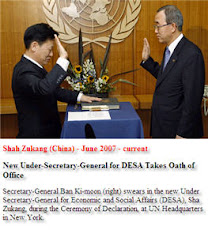
Sources say the "Review will be finalized very soon". Will these turn into another embarrassment for Sha Zukang?

Saturday, 1 May 2010

Well-Paid U.N. Official Took French Welfare Payments in Fraud Case

click here for story

A United Nations official in a department that promotes “ethics, transparency and accountability” falsified his permanent address to illegally obtain what could amount to tens of thousands of dollars in family allowance and housing funds that normally go to poor and moderate-income citizens in his native France, according to investigators there.

The fraud findings against Bruno Bastet, 40, are contained in an investigation report issued on May 20 by France’s Caisse d’Allocations Familiales (CAF), a branch of the French social security system that calls itself “one of the pivots of the French ‘social model’” — in other words, a centerpiece of the French welfare state.

The fraud involves Bastet’s listing himself, his then common-law wife and two children as residents of a city-owned housing complex in Paris designated for those in need of social assistance. Bastet, a program officer in the U.N. Department of Public Administration and Development Management (DPADM), has actually lived in New York City since 2004, while his former companion told FOX News she and the children have lived in the Dominican Republic since 2005.

If you would like to read the rest of this story, go tohttp://www.foxnews.com/story/0,2933,543562,00.html?loomia_ow=t0:s0:a16:g4:r5:c0.000000:b27383522:z0


Thursday, 22 October 2009

China and international institutions: alternate paths to global power

How will the global community be affected by the engagement of this massive global power with international institutions?
Author: Marc Lanteigne
ISBN: 978-0-415-45956-3 (paperback) 978-0-415-36584-0 (hardback) 978-0-203-01837-8 (electronic)
No. of pages: 230

Some quotes from the book...

REDUCTION OF THE RISKS AND COSTS OF INFORMATION GATHERING

"...In the area of state-to-state relations, the axiom "information is power" takes on additional relevance in the post-cold war system. Asymmetries in the level of information between countries can be a source of vulnerability and greatly hamper peaceful international relations." page 22

"...As Keohane noted, one of the most significant advantages of participating in international regimes is that they reduce the costs of transactions between actors during legitimate bargaining, but increase the costs of bargaining in bad faith. one reason for this phenomenon is that institutions facilitate the exchange of information amongst members, thus reducing the risks of barganining..." page 22

"...This was certainly as asset to an emerging China being forced to play catch-up in its understanding of the international system. Information gathering was a primary reason for China's post-1970 policy of institutional engagement, and has played an important role in Chinese power acquisition..." page 22

"...China increasingly opts to participate in international institutions rather than relying exclusively on bilateral agreements. In other words, while China ca learn a lot about state A from engaging it alone, engaging state A within an institutional framework also provides added data on how states A, B, C, D, engage each other." page 23