Wednesday, 11 July 2012

Ban Ki-moon says: "30 percent of aid lost to corruption" (How much of it is from UN's corruption?)


How many times have we heard of corruption undermining development?
 
At the 2012 Economic and Social Council high-level panel on accountability and transparency, which concluded Monday (July 9), U.N. Secretary-General Ban Ki-moon again reiterated the importance of combating corruption. Peace, development nor human rights “can flourish in an atmosphere of corruption,” he said.
 

CAN Indigenous Peoples Council Demands International Climate and Environment Court


22 June 2012: In a formal declaration sent to the UN Conference on Sustainable Development (UNCSD, or Rio+20) in Rio de Janeiro, Brazil, the Consultative Council of Indigenous Peoples of the Andean Community (CCPICAN) demanded the creation of an International Court of Climate and Environmental Justice.
 
The Council, which represents indigenous peoples of Bolivia, Colombia, Ecuador and Peru, sent two "special declarations" adopted on 10 June 2012, to Rio+20. One on some of the themes of the Conference, the other focused on climate change.
 
The Special Declaration to Rio+20 calls for the new Court to be empowered to "prevent, adjudge and sanction" States, enterprises and persons for acts or omissions that provoke climate change "or strong and irreparable damage to nature." The Declaration also calls for, inter alia: the rejection of green economy, geoengineering, transgenic organisms and nanotechnology; the creation of a world tax on international financial transactions, with the revenue earmarked to combating climate change and restoring and preserving Mother Earth; and the approval of a Universal Declaration of the Rights of Mother Earth.
 
The Special Declaration on Climate Change rejects the Cancun Agreements and "the false solutions of carbon markets," condemns and rejects REDD, REDD+ and REDD++, and demands that developed countries reduce their greenhouse gas (GHG) emissions 50% by 2017 and 100% by 2040. The Declaration reiterates the call for a global tax on international financial transactions, and commits themselves to push for a Latin American Referendum on climate change that would require LAC governments to take their demands to "global leadership." [CAN Press Release (in Spanish)] [Declaración Especial a la Conferencia Mundial sobre Desarrollo Sostenible (Rio+20) & Declaracion Especial sobre Cambio Climatico]
 

Tuesday, 10 July 2012

"Agenda 21" The UN-DESA's diabolical plan for the world is explained on the "...

Communist UN Rio+20 Summit Boss Announces Global Deals, Press Applauds


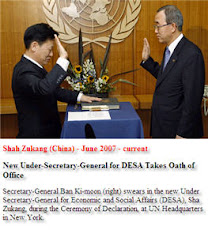
RIO DE JANEIRO - Communist Chinese diplomat Sha Zukang, in his capacity as Secretary General of the United Nations Rio+20 Conference on Sustainable Development, announced hundreds of “commitments” by governments and businesses on so-called “sustainability” worth more than half a trillion dollars. And incredibly, much of the audience — supposedly unbiased members of the media — applauded in delight.
 

What if Russia and China don’t become more liberal?


By Chrystia Freeland
 
Liberal democracy faces a new and decisive challenge – figuring out how to deal with the “post-Communist oligarchies” of Russia and China. These regimes – authoritarian, capitalist and eagerly integrated into the global economy – are without precedent. Figuring out how to deal with them is the greatest strategic and moral question the West faces today. How we answer it will determine the shape of the 21st century, much as the struggle with communism and fascism shaped the 20th.
 
This is the assertion Michael Ignatieff, a Canadian intellectual and a former leader of the Liberal Party, made in a powerful lecture in the Latvian capital, Riga, at the beginning of this month. Ignatieff’s thesis came to mind during the annual St. Petersburg International Economic Forum, held last week as the gracious former imperial capital for which the forum is named glowed in the pure white light of the summer solstice.
 

A bad UN idea on arms deals


The United States is set to foolishly join in a full-court press at the United Nations this week for a new treaty on the global conventional-arms trade.
 
The drive is to hash out a text by month’s end, but readouts of a UN “draft paper” on the accord’s goals suggest the Arms Trade Treaty is something to avoid like the plague.
 

Corruption, Dysfunction & Whistleblower Retaliation at the World Bank


World Bank headquarters in Washington, DCForbes: World Bank Spinning Out of Control – Corruption, Dysfunction Await New Head
 
Summary: With a new World Bank president taking office this coming Saturday, this Forbes cover story looks at how corruption and mismanagement permeates the ranks and programs of the institution. The Bank, as the long-form article details, is plagued by mission-creep from major donor countries, widespread opaqueness in procedures, continual decision-making marked by conflicts of interest, and questionable financial practices. According to a former director interviewed by Forbes, “the inmates are running the asylum.”
 

Friday, 29 June 2012

Even the hardcore left admits Rio+20 was an epic failure of United Nations

Rio+20′s Unheralded Achievements


 by Isobel Coleman
June 28, 2012
U.S. Secretary of State Hillary Clinton attends the U.S.-Africa Clean Energy Finance Initiative at the Rio+20 Conference on June 22, 2012 (Paulo Whitaker/Courtesy Reuters).  
U.S. Secretary of State Hillary Clinton attends the U.S.-Africa Clean Energy Finance Initiative at the Rio+20 Conference on June 22, 2012 (Paulo Whitaker/Courtesy Reuters).

With the conclusion of the United Nations Conference on Sustainable Development (better known as Rio+20) last week, the recriminations have begun. As Reuters put it in a sentence typical of the coverage, “Global leaders on Friday wrap up a United Nations development summit with little to show but a lackluster agreement.”


Indeed, while participating governments agreed on a 283-paragraph outcome document, called “The World We Want,” the Economist reported that the document “was filled with weasel words and compromises.” Such massive summits (Rio had some 50,000 attendees) are rarely conducive to comprehensive, binding agreements. So, in an effort to find something good to say about the conference, I will settle on the fact that at least it gave some visibility to several important issues.
The first is food security. At the Rio conference, UN Secretary-General Ban Ki-moon launched the Zero Hunger Challenge that aims to ensure adequate food for everyone, improve child health through better nutrition, boost the sustainability of food systems, reduce food waste, and raise the income of small farmers. The British government committed £150 million to help farmers adapt to climate change. The challenge has no deadline, but it brings high-level funding and attention to a vital concern.

The U.S.-Africa Clean Energy Finance Initiative spotlights another crucial issue: clean energy. This program, launched by the State Department, the Overseas Private Investment Corporation (OPIC), and the U.S. Trade and Development Agency, will use small U.S. government grants to leverage far larger investments from OPIC and the private sector in clean energy projects in Africa. Initial grants can fund assessments or land surveys, for example, that are needed to unlock private investment. As Secretary of State Hillary Clinton said in announcing the program in Rio, clean and accessible energy sources are essential to “further our sustainability goals while also furthering economic opportunities and better lives for tens of millions of men, women, and children.”

It was also heartening to see some attention to fuel subsidies. As I wrote on the blog in February and March, subsidies for fossil fuel consumption strain government budgets and often benefit those least in need. They also promote the use of dirty fuels instead of encouraging the development of cleaner ones. But lifting subsidies is a vexing political problem. In the Rio outcome document, “countries reaffirm the commitments they have made to phase out harmful and inefficient fossil fuel subsidies” and “invite others to consider rationalizing” their subsidies, “taking fully into account the specific needs and conditions of developing countries.” This highly conditional language is less than inspiring, but the spotlight on the need to lift subsidies is welcome. An anti-subsidy Twitter campaign tied to Rio also gained significant attention, with the “endfossilfuelsubsidies” hashtag reaching second place on the global list of trending topics.

A final topic that got some attention is what will replace the Millennium Development Goals (MDGs) when they come to an end in 2015. The governments of Colombia and Guatemala have proposed Sustainable Development Goals that link environmental and human development concerns. The final declaration of an NGO conference held by the UN last September proposes seventeen such goals. The Rio outcome document says nothing specific about the content of sustainable development goals, but it endorses the idea and establishes a 30-member working group to craft a proposal next year. As scholars and practitioners continue to assess the world’s uneven progress toward the MDGs, questions about the value of this kind of global benchmark will persist.

Above all, Rio’s outcome speaks clearly to the diversity of the twenty-first century development landscape. Governments, international and regional organizations, civil society, the private sector, individual citizens, and many others should—and do—play a vocal role. While this makes sweeping accords harder to reach, it facilitates an array of smaller but potentially valuable collaborations. A New York Times piece notes that on the margins of the conference, attendees reached “hundreds of side agreements… that offer the promise of incremental but real progress.” Participants at Rio ranged from Microsoft to the Maldives. I’m no fan of 50,000-strong global gatherings, but at least Rio provided a platform for action among diverse players who—in the absence of global consensus—can drive development goals forward in incremental ways.

Monday, 25 June 2012

Rio+20 - Sha Zukang says: "This is an outcome that makes nobody happy. My job was to make everyone equally unhappy," (did he mean that is unhappy with Nikhil Seth??)


CLICK HERE TO READ ON CALGARY.CTV.CA


Rio+20, the unhappy environmental summit


From left to right, UN General Assembly President Nassir Abdulaziz Al Nasser, United Nations Secretary General Ban Ki-Moon, Brazil's President Dilma Rousseff, Brazil's Secretary of the Conference Luis Figueiredo Machado, and Rio+20 Secretary-General Sha Zukang attend the closing ceremony of the Rio+20 UN Conference on Sustainable Development in Rio de Janeiro, Brazil, Friday, June 22, 2012. (AP Photo/Andre Penner)


The Associated Press
RIO DE JANEIRO — Nobody is happy in Rio.
Not the legion of bleary-eyed government negotiators from 193 nations who met in a failed attempt to find a breakthrough at the United Nations conference on sustainable development.
Not the thousands of activists who decried the three-day summit as dead on arrival. Not even the top UN official who organized the international organization's largest-ever event.
"This is an outcome that makes nobody happy. My job was to make everyone equally unhappy," said Sha Zukang, Secretary-General of the conference, nicely summing up the mood.
In the end, this conference was a conference to decide to have more conferences.
That result was hailed as a success by the 100 heads of state who attended. Given how environmental summits have fallen off the cliff in recent years as global economic turmoil squashes political will to take on climate and conservation issues, the mere fact of agreeing to talk again in the future constitutes victory.
Faced with the real prospect of complete failure, negotiators who struggled for months to hammer out a more ambitious final document ended up opting for the lowest common denominator. Just hours before the meeting opened Wednesday, they agreed on a proposal that makes virtually no progress beyond what was signed at the original 1992 Earth Summit, removing the kind of contentious proposals activists contend are required to avoid an environmental meltdown.
"We've sunk so low in our expectations that reaffirming what we did 20 years ago is now considered a success," said Martin Khor, executive director of the Geneva-based South Centre and a member of the UN Committee on Development Policy.
Indeed, the word "reaffirm" is used 59 times in the 49-page document titled "The Future We Want." They reaffirm the need to achieve sustainable development (but not mandating how); reaffirm commitment to strengthening international cooperation (just not right now); and reaffirm the need to achieve economic stability (with no new funding for the poorest nations).
Some of the biggest issues activists wanted to see in the document that didn't make it in included a call to end subsidies for fossil fuels, language underscoring the reproductive rights of women, and some words on how nations might mutually agree to protect the high seas, areas that fall outside any national jurisdictions.
"We saw anything of value in the early text getting removed one by one. What is left is the clear sense that the future we want is not one our leaders can actually deliver," said Greenpeace executive director Kumi Naidoo. "We now need to turn the anger people around the world are feeling into creative, thoughtful and meaningful action."
On the "glass half full" side of things, while the effort to make progress on multilateral talks among the entire 193-nation UN body were a disappointment, the big gathering produced numerous promises and advances made by individual countries, companies and other organizations.
The U.S. agreed to partner with more than 400 companies, including Wal-Mart, Coca Cola and Unilever, to support their efforts to eliminate deforestation from their supply chains by 2020.
Andrew Deutz, director of international government relations at the Nature Conservancy, pointed out that Indonesia, Australia and Colombia all made strong commitments to protecting oceans in their national waters, in part to ensure future food security.
"Monday morning, the challenge will be to go back home and hold governments and companies accountable for the commitments they made here and help them get things done," he said.
Despite the shifting global economic order, with the rise of nations like Brazil and China and a host of other "middle-income" countries, critics said negotiators still argued along the lines of old "north-south" arguments that pit richer developed nations against developing nations.
The Group of 77 nations that represents the poorest on the globe maintained their demand that richer nations in Europe and the U.S. recognize their "historic debt" eating up a much greater amount of the globe's resources since the industrial revolution began 250 years ago. They say rich nations should finance environmental improvements in the poorer nations, and also freely transfer technology that would help the developing nations use more renewable energy and build cleaner industrial sectors.
"Everything has been kicked down the lane a few years, we'll have to wait to formalize sustainable development goals and make the transition to a green economy," said Muhammed Chowdhury, a lead negotiator of Group of 77. "It's not a good scenario."
However, a U.S. delegate member said that countries can no longer debate issues with an eye on the past, that once poor nations are becoming rich, and that anybody looking for the Rio+20 summit and its 193 members to somehow reach a magical agreement and solve complicated environmental and development challenges would be sorely disappointed.
"I think the expectation that there is one document or one approach that can solve one of the major questions of our time -- how do you maintain economic growth and protect the environment? -- there's not one paper that can do that," said U.S. Assistant Secretary of State for Oceans and International Environmental and Scientific Affairs Dr. Kerri-Ann Jones.
"This is a process. We have to embrace it as a process, look at the positive things we have done, and keep working, as there is much more to do."

Friday, 22 June 2012

Having trouble meeting people? UN says Canada’s laws on free association ‘harsh’


A Battle for Internet Freedom as UN Meeting Nears (At UN-DESA, about 50 chinese nationals are working night and day in collecting data from UN Member states in databases stored in China)


Secret negotiations involving dozens of countries preparing for a United Nations summit on international telecommunications could lead to changes in a global treaty that would diminish the Internet's role in economic growth and restrict the free flow of information.
 
The U.S. delegation to the World Conference on International Telecommunications to be held in Dubai in December has vowed to block any proposals from Russia and other countries that they believe threaten the Internet's current governing structure or give tacit approval to online censorship.
 

Rio+20 has been a success on one front – rejecting a WEO


The idea to set up a World Environment Organisation was a popular, sexy one – but it would have been a big step back
 

John Kerry and His First Cousin (a UN-DESA employee) : Both Pushing Hard for the U.N. Climate Change Agenda - VIDEO


U.S. Senator John Kerry and Brice Lalonde, the French-born coordinator of the United Nations Rio + 20 summit conference on sustainable development ,which got under way this week, have a lot in common. Among other things, they are first cousins, a fact widely reported when Kerry ran for the U.S. presidency in 2004.
 
And now both of them are involved in pressing for the success of a radical U.N. agenda for climate change that seems to be faltering in the face of global economic crisis.
 

Feel-Good Environmentalism at the U.N. Why do the global glitterati ignore water and air pollution?


By BJORN LOMBORG
 
... It's the height of arrogance to think that Third World countries should use weak and expensive technologies just to make some in the West feel good. In essence, the global elite is telling coughing Third World people sitting in their dark hovels: "Get a solar panel." That's akin to telling people suffering from water pollution to drink Perrier. Or indeed, to suggest that breadless people should eat cake.
 
There are real and often overlooked environmental problems to be tackled. We need to talk less about ineffective, "feel-good" solutions to global warming and more about smart fixes to air and water pollution. We need to take back our environmental summits from the well-meaning glitterati and do what works.
 
Mr. Lomborg is an adjunct professor at the Copenhagen Business School and the author of "The Skeptical Environmentalist" (Cambridge Press, 2001) and "Cool It" (Knopf, 2007).
 

Rio Outcome Bleak With No New Funding* (Sha Zukang last catastrophe PR campaign)


... “If developing countries are not brought on board, the outcome document will remain a pious list of unfulfilled dreams. The future that we all want must be a future that we all can have,” said Kohona, a former chief of the U.N. Treaty Section, who has been closely monitoring negotiations both at Rio+20 and the politically-disastrous 2009 climate change conference in Copenhagen...
 

Insiders: Global Conferences Becoming Obsolete (UN-DESA fails in Rio+20)


... In light of this trend, most National Journal Insiders say that it’s time for negotiators to trade in mammoth environment and climate summits for smaller, focused meetings that might yield more results.
 
Fifty-three percent of Insiders say that the world should forgo the high-profile conferences like Rio+20 and the U.N. climate summit later this year for smaller, more incremental meetings...


FOX NEWS: U.N. investigating Judge Rotenberg Center’s use of shocks (first such investigation in US soil)

BOSTON - 

Powerful video of a Judge Rotenberg Center student shocked and restrained for hours continues to reverberate on Beacon Hill and beyond, with opponents of the treatment stepping up efforts to ban the shocks as the United Nations expert on torture says he's investigating the school.

The video has helped fuel a renewed lobbying effort to ban the long-controversial shocks. Several opponents of the shocks, including the mother of the student in that video, visited lawmakers' offices today to press for the ban.

"We're going to continue to let our children be tortured? I just hope that they come to their senses are realize this is wrong and it's been wrong for the last 27 years," said Cheryl McCollins, mother of former Rotenberg Center student Andre McCollins.

Opponents want the full Legislature to adopt a Senate budget amendment to ban the shocks. The measure is being considered by a joint House-Senate conference committee that is hashing out the state budget for the fiscal year beginning July 1. Word on whether it's included in the Legislature's final budget could come any day.

The Judge Rotenberg Center is the only place in the country to use this kind of shock treatment, and now scrutiny is also coming from Juan Mendez, the United Nations' Special Rapporteur on Torture.

Read more: http://www.myfoxboston.com/story/18840703/2012/06/20/un-investigating-judge-rotenberg-centers-use-of-shocks#ixzz1yWKERIfG

Wednesday, 20 June 2012

New low for UN-DESA: Nikhil Seth blows it in Rio (GreenPeace calls it an epic failure)


​ Greenpeace International Executive Director has released a statement on his views of Rio+20. "The future we want has gotten a little further away today. Rio+20 has turned into an epic failure, It has failed on equity, failed on ecology and failed on economy" were Kumi Naidoo frank comments after the text for the outcome document was adopted. Please click here for the full statement.

Rio+20: Is this Sha Zukang and Nikhil Seth's last failure ?

Is the Rio+20 Environmental Summit a Failure?

CLICK HERE FOR STORY ON DAILY BEAST

Obama and Cameron missing, economies crashing, a conference document that managed to displease everyone—Rio+20, marking the 20th anniversary of the famed Earth Summit, looks like a bust as world leaders arrive. Mac Margolis reports.


But add a war party of Amazonian tribesmen painted for battle and a roadblock of topless feminists protesting the “commoditization” of nature, and the makings of an urban meltdown are complete. Welcome to green gridlock, the traffic jam to save the planet...

RIO+20 a FAILURE: Nikhil Seth and Sha Zukang force an "ad-referendum" agreement after $219 Million spent on a conference

F A I L U R E

RIO+20 = AD-REFERENDUM AGREEMENT !!!!


Nikhil Seth and Sha Zukang drafting the "ad-referendum agreement" 
as if they were the member states (what a shame)!!

USA and Europe speechless about the process...will see who will blame who? 


Tuesday, 19 June 2012

The FP Twitterati 100 A who’s who of the foreign-policy Twitterverse in 2012.


... TURTLE BAY
 
Lou Charbonneau (@lou_reuters) -- Reuters reporter at the United Nations.
 
Mark Leon Goldberg (@MarkLGoldberg) -- Blogger for the United Nations Foundation's UN Dispatch, which covers the inner workings of Turtle Bay and Foggy Bottom.
 
Matthew Lee (@innercitypress) -- Eccentric but comprehensive U.N. coverage...
 

How should development workers live?


Ravi Kanbur has written an interesting paper (pdf) about how he feels as someone who makes a good living from analysing and writing about poverty. Here is an extract, but it is worth reading the whole, thoughtful piece: [http://kanbur.dyson.cornell.edu/contact.htm]
 

Chinese and Haiyan Qian's role in "UN's internet power grab" role - (why is UN-DESA/DPADM building databases with info from every country - when is NOT mandated to do so?) Who is the final recipient of these data ...?


The U.N.'s Internet Power Grab
Leaked documents show a real threat to the international flow of information.
 
... These are weak responses even by Obama administration standards. Ever since the pre-Internet era of the 1970s, authoritarian regimes have sought to use the U.N. to establish an "information world order" based on government control, not open flows of information. The U.S. learned during the Cold War that the only way to stop U.N. meddling is to wield a big stick. Washington had to leave Unesco when it played the kind of dangerous game the ITU has now chosen.
 
It may be hard for the billions of Web users or the optimists of Silicon Valley to believe that an obscure agency of the U.N. can threaten their Internet, but authoritarian regimes are busy lobbying a majority of the U.N. members to vote their way. The leaked documents disclose a U.S. side that has hardly begun to fight back. That's no way to win this war.
 

U.N. puts Canada on human rights watchlist over Quebec demo law


Canada will be put in the company of some of the world’s worst abusers of human rights tomorrow when the UN’s highest human rights official expresses “alarm” over Quebec’s new law on demonstrations during her opening address to a meeting of the 47-nation UN Human Rights Council, revealed the Geneva-based monitoring group UN Watch, which obtained an advance copy of her speech. Other states on the UN watchlist include Syria, Pakistan and Zimbabwe.


WallStreetJournal: - The Absurd International Criminal Court After 10 years and hundreds of millions of dollars, it has completed precisely one trial.


By ERIC POSNER
 
... The court has been a failure. Although it has a staff of more than 700 and an annual budget in excess of $100 million, the ICC has so far completed precisely one trial—that of Thomas Lubanga, a commander in the civil war in Congo. It took three years and ended with a conviction on March 14, 2012. The appeals have not begun. A few other trials are ongoing or set to begin.
 
Even by the low standards of international tribunals, this performance should raise an eyebrow. What went wrong?..
 
Mr. Posner, a professor at the University of Chicago Law School, is the author of "The Perils of Global Legalism" (University of Chicago Press, 2009). [www.law.uchicago.edu/faculty/posner-e]
 

The United Nations Won’t Tell the Public Where It Gets Its Money


... A member of the public might desire to learn, for example, where the UN gets its money. How much is each member nation contributing to the UN’s regular budget? To the capital budget? To peacekeeping operations? For a brief period, the UN posted such details monthly. But then at the end of 2010, the UN stopped disclosing its personal financial records. All you can get now is a PowerPoint file. For a somewhat unfair comparison, imagine if President Obama submitted his budget to Congress via PowerPoint...
 

Nikhil Seth's future is hanging on Rio+20 - (with a Pakistani appointed as ASG, and Sha Zukang out in 10 days his future stardom could be less certain)

Fear of failure ...?


Working the crowd ...!

With no agreement on "Draft" - Seth is thinking ...!

Monday, 18 June 2012

Rio+20 Earth summit is too important to fail, says Ban ki-Moon


The UN secretary general said the international community was in danger of squandering a once-in-a-generation opportunity
 

The Rise of UN Derangement Syndrome


Why does a small but dedicated group oppose ratifying the benign Law of the Sea Treaty, which both the U.S. Navy and Sarah Palin support?
 

Will the United Nations' legacy in Haiti be all about scandal?


The accomplishments of the UN peacekeeping mission in Haiti have been overshadowed by scandals, from a cholera outbreak to sexual abuse cases. How will this affect future missions?