Monday, 9 May 2011

U.N. adviser nets $2M in Upper East Side

201 E. 80th St.

click here for story


by Ernest Joseph, published May 5, 2011

Marc Jacquand and Rhona Jacquand bought a three-bedroom, 2.5-bath condo at 201 E. 80th St. in the Upper East Side from Karen Murray for $2 million on April 14.

Murray paid $2.2 million for the condo in June 2008. The 1,723-square-foot condo, Unit #7I is one of the 98 units in The Richmond, a 24-story condo development built in 1926.

Mr. Jacquand is a strategic planning adviser at the United Nations Office for the Middle East Peace Process. He most recently was a policy adviser at United Nations. Prior to that, he was a program manager for the United Nations Capital Development Fund.

He majored in math and philosophy at Ecole Sainte Genevieve and graduated from the HEC School of Management with a master's degree in economics. He also received a master's degree in economic and political development from Columbia University.

According to BlockShopper.com, there have been 264 condo sales in Upper East Side during the past 12 months, with a median sales price of $905,000.

Filed under: Government

Address: Highrise201 E. 80th St, Unit: 7I
Buyer(s): Marc Jacquand and Rhona Jacquand
Seller(s): Karen Murray
Sale date: Apr. 14, 2011

Thursday, 5 May 2011

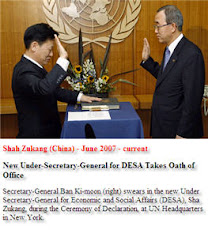
Sha Zukang worried about Waste Management

Waste Management Among the Concerns in U.N. Sustainable Development Agenda


Policies covering the safety of chemical usage, waste management, and transport and mining practices will be among the main concerns at the annual meeting of the United Nation's Commission on Sustainable Development this year.

The commission is a 53-member body reporting directly to the U.N.'s Economic and Social Council. This year, at its 19th session, it is expected to come up with a policy framework that will support countries toward sustainable consumption and production, Sha Zukang, U.N. undersecretary general for Economic and Social Affairs said.

Mr. Sha said such an initiative would send the right message and generate positive momentum towards a successful outcome at next year's annual conference, to be held in Rio de Janeiro, Brazil, also known as "Rio+20." Rio+20 will mark the 20th anniversary of the adoption of Agenda 21, the blueprint for sustainable development that was agreed to at the 1992 Earth Summit in Rio.

"Globally, unsustainable consumption and production threatens to exceed the carrying capacity of life support systems," Mr. Sha said. "This imbalance is obvious - whether measured by greenhouse gas concentrations, by the number of endangered species, by rates of deforestation, or by decreases in fish stocks."

Close to 1,000 representatives from governments, nongovernmental organizations and other parts of civil society are attending the commission's two-week meeting. (EcoSeed Staff)

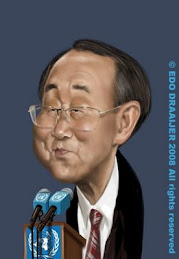
Ban Ki-moon's Statement following the news of Osama Bin Laden's Death

Good morning, ladies and gentlemen.
The death of Osama bin Laden, announced by President [Barack] Obama last night, is a watershed moment in our common global fight against terrorism.
The crimes of Al Qaeda touched most continents, bringing tragedy and loss of life to thousands of men, women and children.
The United Nations condemns in the strongest possible terms terrorism in all its forms, regardless of its purpose and wherever it is committed.
This is a day to remember the victims and families of victims, here in the United States and everywhere in the world.
The United Nations will continue to fight against terrorism and will lead this campaign to fight against terrorism.
I remember, personally, vividly, the day of September 11, 2001. I was in New York on that dark day. The United Nations is committed to continue to lead this campaign with world leaders to fight against international terrorism. I thank you very much.
Personally, I am very much relieved by the news that justice has been done to such a mastermind of international terrorism. I would like to commend the work and the determined and principled commitment of many people in the world who have been struggling to eradicate international terrorism.
The United Nations General Assembly has adopted a global counter-terrorism strategy, and on the basis of that, we will continue to work together with Member States of the United Nations to completely eradicate global terrorism. Thank you very much. I need your support. Thank you.

The 10 Most Powerful Women at the United Nations

In charge of budgets of over $5 billion, capable of mobilizing resources and 100,000 staff worldwide. Responsible for the coordination of thousands of peacekeepers in conflict zones throughout the world, and leading negotiations for the release of child soldiers in Uganda.
Talk about power.
Although there are many actors within the UN system making a positive impact in the international public sector, the 10 women featured here have a level of institutional power that is unprecedented in UN history.
These women are at the head of departments and agencies working to ensure that the right resources get to those who need them as swiftly as possible. They hail from countries all over the world, hold degrees in law, medicine, engineering, political science and military strategy, and have worked in positions as diverse as a senior manager at IBM, a Managing Director on Wall Street and the president of Chile.
Here, are the 10 Most Powerful Women at the United Nations.

WHY DO WE GIVE £650M TO HAVEN FOR TERRORISTS?

FRESH anger erupted yesterday over Britain’s £650million aid gift to Pakistan after it emerged that Osama Bin Laden had been living there.
David Cameron sparked dismay last month when he announced the massive handout on the eve of tax rises and benefit cuts in Britain.
The Prime Minister also promised the Pakistani security services, which are widely blamed for funding and arming the Taliban highly sensitive military technology to combat roadside bombs.
The gesture came after Mr Cameron sparked a diplomatic rift last year when he accused Pakistan of “looking both ways” on terrorism.
But the act of financial goodwill was met with anger last night in the wake of the Al Qaeda leader’s assassination.
Tory MP Philip Davies, who criticised the aid payment when it was announced in April, said: “It is extraordinary to give £650 million of taxpayers’ money to a country that at best is facing both ways and at worst harbouring the world’s worst terrorist.”...

Syria's U.N. Admirers

click here for story

The 'international community' rewards the regime for killing civilians.

Bashar Assad's regime has murdered at least 500 Syrians, and perhaps hundreds more, in putting down its democratic uprising. So what does the United Nations do? Nothing, except hold out the prospect of a seat on its Human Rights Council for the Syrian regime.
Welcome back to the looking glass moral world of Turtle Bay. The Security Council this week couldn't muster the votes to issue a mild press release—the weakest of tools in a meager tool box—about the bloody crackdown in Syria. The Russians, Chinese and Indians blocked the way. Instead we were treated to the sight of the Syrian ambassador, Bashar Jaafari, grandstanding about America's alleged role in arming the obviously unarmed demonstrators being slaughtered by his regime's security forces.
The U.N.'s admirers at the White House consider the Security Council to be the supreme decision-making body in international affairs, and last month U.S. Ambassador Susan Rice hailed the council for "taking swift and meaningful action to try to halt the killing on the ground" in Libya. She should have added that the action, which came barely in time to stop the annihilation of Benghazi, was an aberration. Moammar Gadhafi had lost enough friends in the club of dictators to allow the no fly zone resolution to pass. Mr. Assad remains a rogue in good standing with Moscow and Beijing, and he has nothing to fear from the Security Council.
Meanwhile, Yukiya Amano, chief of the U.N.'s nuclear watchdog agency, admitted for the first time this week that a Syrian site bombed by Israel in 2007 was a secret "nuclear reactor under construction." Syria has long denied any nuclear plans at the site, and it hasn't cooperated with the U.N. nuclear agency since June 2008.
No matter. Syria's stature at the U.N. hasn't suffered. The Arab League last week supported Syria's bid to join the Human Rights Council, following the U.N.'s Asia group. A General Assembly vote is due next month, and on current trend Syria will take its seat on the body that purports to monitor the depredations of the world's rogues. If the regime kills more Syrians, maybe it'll become chairman.

Corruption threatens climate finance

Deutsche Welle
May 2, 2011
Sarah Steffen
Hundreds of billions of dollars will be needed to respond to climate change over the years ahead. Yet corruption threatens to undermine the world's best efforts, Transparency International has warned in a new report.
Fraud risks destabilizing the world's effort to tackle climate change according to a huge 360-page report published by Transparency International in Bangladesh on Saturday.
The "Global Corruption Report: Climate Change," with contributions from some 50 authors from around the world, says corruption poses a special risk to the billions of dollars needed to respond to global warming.
According to the report, up to $700 billion (472 billion euros) will likely be mobilized by 2020. Thereafter, it is widely expected that developing countries alone will need at least $100 billion annually to confront the problem.
Yet Transparency International (TI) warns that a massive strengthening of anti-corruption measures will be needed to prevent much of this money going to waste.
"The 20 countries most affected by climate change score below 3.6 on TI's corruption perception index, indicating that corruption in endemic in these countries," said Lisa Elges, manager of TI's climate governance program.
Zero is the worst level of corruption on TI's 10-point scale, but TI is careful to warn that the risk of corruption is not limited to developing countries.
"Corruption nationally is a problem for all countries. We need to ensure the best accountability, transparency and integrity practices in all countries," Elges said.
Attractive booty
In industrialized Europe, one doesn't have to look far for potential pitfalls.
"The European Union's Emissions Trading Scheme (ETS) has shown that carbon markets are susceptible to undue influence from vested interests, which in the case of the ETS may have contributed to the over-allocation of carbon permits" the report said.
"The result was windfall profits of 6–8 billion euros for Europe's four largest power producers."
Bending rules to suit lobbies is just one problem. Another is vulnerability to outright theft: Millions of dollars have so far been stolen in hacking attacks on Europe's ETS.
"It has been depressingly easy," said Henry Derwent, head of the International Emissions Trading Association (IETA).
"The standard of internet security was just insufficient, in particular a number of registries made really no enquiries at all about the applicants for accounts. We've been warning the European Commission about this for over a year."
In January, hackers cracked into the databases of registries in the Czech Republic, Austria, Estonia, Grerece and Poland, making off with certificates worth 28 million euros.
Derwent is optimistic that reforms to the ETS will make it "a lot easier to supervise" in future, but these kinds of expensive teething problems threaten to permeate the effort to tackle climate change.
Bending the rules
TI's report warns that the trade in emissions certificates - at the heart of the United Nations-backed effort to tackle climate change - is particularly susceptible to conflicts of interest.
There is "no room for any independent oversight of decision-making" in the UN's Clean Development Mechanism (CDM), TI's report laments, suggesting that the system which allows wealthy nations to offset their emissions by investing in reductions in poor countries appears open to abuse from vested interests.
One example involves the industrial gas HFC-23, which is a by-product of manufacturing coolants and a greenhouse gas 11,700 times more potent than carbon dioxide.
"By destroying one ton of HFC-23, you get 11,700 carbon credits. This makes it a very lucrative business, because every carbon credit equals about ten euros," Eva Filzmoser, from the organization CDM Watch, told Deutsche Welle.
Until recently, factories in China were suspected of turning this process into a business model – producing excessive levels of the pollutant in order to claim credit, and money, for destroying it.
"The CDM incentive has a direct impact on the production patterns of those plants. We would actually propose to cut this by 90 percent. We think only ten percent of carbon credits are needed to provide enough incentives to keep destroying this gas," Filzmoser said.
Although the European Union's executive has proposed banning the trade in HFC-23 permits beyond 2013, critics like CDM Watch say the UN system remains insufficiently transparent.
Corruption feeds deforestation
Illegal logging is another area highlighted by TI.
According to the organization's report, up to $23 billion dollars worth of wood is derived from illegal logging operations every year.
TI said that many of the forestry sector's biggest companies are prepared to collude with corrupt governments to log rare and valuable timber, despite marketing campaigns aimed at appealing to more environmentally conscious consumers.
"In many cases these attempts would appear to be a cynical mechanism to maximize profit at taxpayers' expense, as their actual practices belie their commitment to their publicly stated developmental aims," the TI report said.
Other non-government organizations agree.
"Corruption is one of the main reasons why we continue to have such high levels of deforestation," said forestry expert Philipp Göltenboth from the World Wide Fund for Nature (WWF).
"Forests, especially in the tropics, are often difficult to reach and they're often located in countries with a high corruption index. Wood can quickly be turned to money,"
Gavin Hayman from Global Witness, which monitors resource exploitation, said Cambodia provided a striking example of years of corruption in the forestry sector.
"We've been able to show how the prime minister and members of the ruling elite had direct interest in corruption in the forestry sector and actually allowing concessions to loggers which then devastated Cambodia's forests."
"At a stroke of a pen from a government official, a huge area of pristine forest can be handed over to a company…that's a large amount of money which doesn't tend to go to the country, it goes to individual's concerns. So effectively, the government can use its discretionary executive powers to award companies that are friends," Hayman said.
Things to come
The corruption report's chapters on forestry offer a sober warning to one of the few achievements to come out of last year's climate conference in Cancun.
The scheme known as REDD (Reducing Emissions from Deforestation and Forest Degradation) aims to eliminate excessive logging by encouraging rich nations to invest in poor nations' forests.
It could generate up to $28 billion dollars a year once fully operational, but TI warns that it could backfire without much tougher oversight.
"The vast majority of countries participating in (REDD arrangements) are poorly prepared to measure and verify changes in forest carbon emissions and carbon stocks."
Throwing billion of dollars into this atmosphere is a recipe for disaster, the report warns.
"In countries where (accountability) mechanisms are not fully functional or are politically compromised, (REDD) payments may in fact offer incentives for corruption and fraud by government officials and project sponsors seeking to 'game the system.'"
Unless rules are tightened soon, billions of dollars – not to mention public faith – could be thrown out the window
UN human rights boss questions U.S. on legality of bin Laden killing


UNITED NATIONS — The UN's chief human rights official led calls by rights activist organizations on Tuesday for Washington to explain whether U.S. forces lawfully killed Osama bin Laden.
The request by Navi Pillay, the UN High Commissioner for Human Rights, came even as the world body continues to falter over its multi-year bid to define terrorism.
Pillay's bid also appeared to contradict the position held by UN Secretary General Ban Ki-moon, who on Monday described the U.S. action as a "watershed moment in our common global fight against terrorism."
The mixed messages are likely to heighten critics' claims that the UN's human rights apparatus is frequently quick to probe for abuses by Western democracies — even as it appears to limit its criticism of some of the world's established human rights abuser states.
In an example of UN human rights scrutiny involving Canada, the UN's Working Group on People of African Descent announced this week it will visit the country May 16-20 to probe for discrimination against African-Canadians. In recent years the committee has visited the United States, Ecuador and Belgium — but shunned such destinations as Libya, where independent human rights groups such as UN Watch have said black Africans face persecution, and Sudan, where the United States has accused the Arab-led government of committing genocide in Darfur.
On the U.S. action in Pakistan Sunday, Pillay agreed that bin Laden was a "very dangerous man" who had acknowledged having "command responsibility for the most appalling acts of terrorism" — including the Sept. 11, 2001 attacks in the United States that killed almost 3,000. But she also said the United States had always "clearly stated they intended to arrest bin Laden if they could."
Admitting that taking bin Laden alive was "always going to be difficult," Pillay nevertheless signalled the United States needs to explain more about what happened in the compound.
"This was a complex operation and it would be helpful if we knew the precise facts surrounding his killing," Pillay said. "The United Nations has consistently emphasized that all counter-terrorism acts must respect international law."
Amnesty International said it was seeking "greater clarification" about what went on, while New York-based Human Rights Watch said "law enforcement" principles should have applied.
"If he wasn't shooting at the soldiers, the killing should be investigated," Brad Adams, Human Rights Watch Asia director, said in Bangkok at the launch of a report on Thailand.
"People are saying that justice has been done, but justice has not been done. Justice is when you arrest someone and put them on trial."
The White House on Tuesday scrambled to release a so-called "narrative" of the events leading to bin Laden's death after various government sources a day earlier suggested the al-Qaida leader had both been armed and used a woman as a human shield.
While the narrative said bin Laden had not been armed, it recounted a fierce firefight with others as the special operations forces fought their way to the compound's second and third floors, where the al-Qaida leader and family members were located. Bin Laden was also said to have offered resistance, while a woman identified as a wife lunged at the operatives, leading to her being wounded with a shot to the leg.
"There was concern bin Laden would oppose the . . . operation, and indeed he did resist," said Jay Carney, White House spokesman. "Bin Laden's wife rushed the U.S. assaulter, but was not killed. Bin Laden was then shot and killed."
Carney stated that "resistance does not require a firearm" after a reporter pressed him on how bin Laden could have posed a threat.
Speaking earlier, U.S. Attorney General Eric Holder stated that the operation was "lawful, legitimate and appropriate in every way."
"The people who were responsible for that action both in the decision making and in the effecting of that decision, handled themselves, I think, quite well," he told the judiciary committee of the U.S. House of Representatives.
A U.S. executive order signed in 1981 prohibits the United States or anyone acting on its behalf from conducting assassinations, but U.S. officials have argued there is legal latitude to target individuals in an ongoing conflict — including the current one in which bin Laden himself declared war on the United States and other nations.
"The principles of distinction and proportionality that the U.S. applies are . . . implemented rigorously throughout the planning and execution of lethal operations to ensure that operations are conducted in accordance with all applicable law," Harold Koh, legal adviser at the U.S. State Department, told a meeting of the American Society of International Law last year.

UN Economists Disagree With IMF & Geithner on China, Bollinger Blind on US Banks

By Matthew Russell Lee

UNITED NATIONS, May 5 -- While the International Monetary Fund and US officials like Timothy Geithner call for changes in the valuation of China's yuan, the UN on Thursday said that economic problems in the US and countries like it cannot be blamed on China, and defended valuation of currency and capital controls as sovereign rights.

Inner City Press asked UN Deparment of Economic and Social Affairs official Jomo Sundaram about Geithner's and the IMF's charges, and to explain the UN's and IMF's differences on issues ranging from India's economic prospects to the place of capital controls.

Jomo replied that the IMF has been ignoring Article Six of its Articles of Agreement, which he says gives states the right to manage their capital accounts. He said UN bodies like the Economic and Social Commission for Asia and the Pacific, are “closer to governments” that the IMF, which works from Washington.

Certainly, ESCAP chief Noeleen Heyzer has made comments viewed as favorable to the still military dominated government of Myanmar, and Jomo on Thursday tossed seemingly gratuitous praise to Sri Lanka, just after a UN Panel of Experts described 40,000 civilians killed there.


Geithner, Obama & Hillary Clinton & Chinese officials, UN & Bollinger not shown

But ESCAP was not able to report much data about the Democratic People's Republic of Korea -- so they are not able to get close to ALL governments.

Also at the UN this week, Columbia University president Lee Bollinger told the press that there needs to be more journalism in China because “we don't know the condition of Chinese banks.” One wanted to ask him, what about the US banks whose dalliance in predatory mortgages led the whole world into economic meltdown? But the question was not taken. So it goes at the UN.

Friday, 29 April 2011

The OECD should give up control of the aid agenda

New governance structures for aid, and greater input from recipient countries, are required for a very different world

CLICK HERE TO VIEW THIS STORY ON GUARDIAN.CO.UK

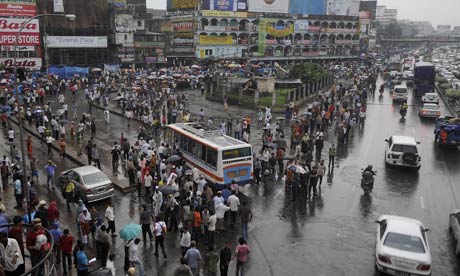
MDG : Bangladesh Infrastructures :  road traffic in Dhaka

Bangladeshi commuters wait for public transport in rush hour during Ramadan. Aid-recipient countries should have more control over the aid agenda. Photograph: Munir Uz Zaman/AFP/Getty Images

The decline of western power does not mean the decline of the west. The former is not only a certainty; it is already a reality. Power is relative, so the rise of power elsewhere automatically diminishes the power of others. But it is how the west reacts to these new realities that will determine whether it suffers actual decline or responds to this geopolitical repositioning in such a way as to enhance its own interests and those of others.

The west has two options. Either it leads the process, whereby power and responsibility in global governance become more democratic, encouraging all countries to be brought in on a more equal footing (the G20 being a step in this direction). Or it resists (for example on the issue of World Bank and IMF governance), thus squandering long-term influence over the kind of changes that are anyway taking place.

One aspect of the west's dominance has been its control of the aidagenda. The Organisation for Economic Co-operation and Development (OECD) was set up in 1961 as a club of rich, mostly western, nations. It soon established a development assistance committee (DAC) to manage aid flows to poor countries, often ex-colonies. Aid is not just charity – it has been and remains an integral part of foreign policy, shoring up political support and economic opportunities in other parts of the world. That is why so far it has sat fairly comfortably in an OECD committee.

The OECD-DAC has been integral in discussions about how aid can be best used to promote development, not just the interests of donors. Arguably the most important role it has played in the last 10 years or so has been to transform pressure from civil society and recipient countries for "better aid" based on recipient-country control (or "ownership") into a fairly successful international bureaucratic agenda. The Paris Declaration on Aid Effectiveness (pdf) is not just a good set of principles, it is also a technocratic process of evaluation and monitoring that is leading to some important (if slow) changes.

The historic imbalances of power remain the same, and will do so as long as countries need aid as a fundamental part of their economies, rather than as an optional and useful extra source of funds. But the declaration and accompanying process have lent power to the countries insisting that donors support national priorities and systems, and to donors and civil society groups pressuring recipient countries to focus more on the poorest. This should mean that aid has been used more effectively for poverty reduction.

So the OECD team responsible for this area of work should be proud of what they have achieved to date. How much harder it will be, then, to relinquish control of this process. But that is the next crucial step if the Paris agenda, and the DAC itself, is to remain useful and legitimate. Why? There are three reasons.

First, non-OECD countries, such as China, India, South Africa, Brazil and Venezuela, are increasing in importance every year as financial supporters of poorer or smaller countries. DAC aid is about $125bn a year compared with non-DAC aid estimated at between $30bn and $60bn. It is nonsensical for a set of principles to cover part of the aid a country receives but not the rest. The OECD's instinct is to try to integrate these countries into the Paris process. But however welcoming the OECD tries to be, these new powers don't want to be part of an old world club – and they don't need to. They will increasingly be setting their own rules.

Second, the OECD's way of giving aid is outdated. That is partly why the Paris process got started in the first place. It is founded on a post-colonial client relationship that is being broken apart not only by the large new donors, but by the proliferation of smaller-scale south-south co-operation that is demonstrating new ways for countries to support one another's development. Not only are the terms "donor" and "recipient" anachronistic, but even the word "aid" itself needs to be shelved – all countries benefit from development co-operation, so a word implying charity is misleading.

And third, the new era of aid effectiveness will be ever more recipient-led. The Paris process has supported attempts begun by civil society in the 1980s to insist that power over aid strategy and spending be increasingly in the hands of recipient countries. The OECD has overseen the growth of a broad-based working party on aid effectiveness that brings countries together in a more or less balanced way to discuss the policy and process.

As we approach the High Level Forum on aid effectiveness in South Korea in November, all the talk is of leadership from recipient countries. Indeed, probably the most important statistic about the Paris agenda to date is that while only 34 recipient countries took part in the initial monitoring survey in 2005, that number rose to 55 for the second survey in 2007, and in the current survey, to be published later this year, 91 countries are expected to return data.

But if the OECD can find me one of those 91 recipient country government that believes the DAC should remain the central cog in this process, I would be surprised. New governance structures are required for a very different world.

The OECD needs to make a bold statement clearly relinquishing overall co-ordination responsibilities of the aid effectiveness agenda and offering to play a different, although still significant, role in a new way of managing aid effectiveness at a global level. By acting against its instincts in this way, it would ironically secure its influence and vital contribution to the gradual evolution of the role of publicly sourced development finance.

Wednesday, 13 April 2011

UN Scandal: InnercityPress publishes French Secret Documents showing France and UN planned since 2005 to destabilize Cote d'Ivoire

French government memos obtained by Inner City Press reflect, as far back as 2005, France and the UN wanted to “put in place a plan of action to destablize Laurent Gbagbo.” See document here, under the rubric “From New York: Departure of Gbagbo.”

The French were monitoring, to say the least, plans for a coup d'etat against Gbagbo, that would result in Gbagbo's “displacement” outside of Cote d'Ivoire. See documenthere.

France's internal reporting on military forces and leaders in Cote d'Ivoire is here.


Magic With U.S. Money for the United Nations

By Claudia Rosett

Click here for story on FORBES.COM

Welcome to the latest Magical Mystery Tour of American funding for theUnited Nations. Today’s featured mystery is, how to explain the missing $2.8 billion?

Thursday morning, President Barack Obama’s ambassador to the U.N., Susan Rice, testified before the House Committee on Foreign Affairs, on “United Nations Budget and Policy.” It was a long and lively session, full of questions about the U.N.’s despot-friendly, anti-American, anti-Semitic and financially opaque culture. But let us focus on the money, which was the core reason for the hearing. The U.S. is by far the biggest donor to the U.N., bankrolling 22% of the U.N.’s core budget, and roughly one-quarter of its far larger and murkier system-wide spending (estimated at somewhere upward of $25 billion). Rice was arguing the Obama line: That while the U.N. may be “far from perfect,” the only ways of improving it depend on an uninterrupted flow of billions in U.S. funding. Some members of congress, including Committee Chair Ileana Ros-Lehtinen (R-FL), were asking if it wouldn’t be better to try to change the U.N.’s entitlement mentality toward those U.S. tax dollars, and pursue a policy of “reform first, pay later.”

Looming behind all this is the question of how much money everyone is actually talking about. A simple question? Not a chance. This is the labyrinthine U.N., meshing with the mega-bureaucracy of hope-and-change America. Where these two meet and engage, details of the landscape tend to get lost in a miasma of cash.

But Rep. Dana Rohrabacher (R-CA) made a valiant attempt to extract some genuine financial specifics from the witness. He asked Ambassador Rice if it’s correct that the U.S. yearly contribution to the U.N. is $6.3 billion. As it happens, that was not a random number. Last June, the Obama administration sent a required report to Congress on U.S. funding for the U.N., covering fiscal year 2009. This report listed total U.S. contributions to the U.N., dispensed not only via the State Department, but via 18 other U.S. departments and agencies, ranging from the Department of Agriculture, to NASA, to the Peace Corps, Postal Service and Treasury. The grand total came to a hefty $6.3 billion. Or, to be more precise, $6,347,415,000.

That is the number that Rohrabacher was asking Rice about — the grand total of U.S. annual largesse to the UN. Since fiscal 2009, with the UN’s soaring budgets and emergency appeals, that number has quite likely gotten even bigger than when Obama’s budget office produced its most recent, 2009 figure. The U.N.’s secretary-general,Ban Ki-Moon, is now talking about “austerity” in the form of 3% cuts in the moving target of some of the U.N.’s escalating spending, but genuine austerity has yet to materialize.

Rice did not have an instant answer for Rohrabacher. She shuffled through her papers and gave a series of partial figures. Rohrabacher asked, “What does that all add up to?” Rice, apparently stalled briefly on the arithmetic, said “I can get you that in a second.” After some more back-and-forth on U.S. policy, Rohrabacher returned to the matter of money, this time asking: “How much has the budget of the United Nations grown over the past 10 years?”

The answer to that question would have to take into account, as theHeritage Foundation’s Brett Schaefer testified to the same House committee in January, that the UN’s regular budget over the past decade has more than doubled, the peacekeeping budget has more than tripled, and U.S. contributions to these, plus a host of other U.N. activities, have grown accordingly. But Rice did not address the question. Instead, she produced a figure for what she said the administration is now requesting for the United Nations.

The number she gave the House committee was $3.539 billion. That’s a lot of money, or at least so it might appear to many of the U.S. taxpayers who earn it and then shell it out to the government. But it is well short of the $6.3 billion that the administration itself reported giving to the U.N. in fiscal 2009. It’s $2.808 billion less, to be exact.

What happened? Did the Obama administration lop $2.8 billion or more off its annual contributions to the UN, and simply forget to tell anybody? Did the UN not notice? Surely this should be news!

Or maybe not. Rice’s lowball $3.539 figure represents specific budget requests for just two U.S. accounts: the Contributions for International Peacekeeping Activities, and the Contributions to International Organizations account (which, as she noted, also includes funding for outfits such as the Organization of American States). This cipher of $3.5 billion is what the news reports picked up on, and it is now circulating as the sum of the Obama administration’s current plans for U.N. funding. That’s just wrong, As last year’s U.N. funding report lays out, the administration dispenses money to the U.N. through a far wider array of spigots. For instance, in fiscal 2009, the State Department dispensed $4.1 billion to the UN; that’s listed separately from the $1.7 billion dispensed via USAID. That in turn was distinct from the $245 million dispensed by the Department of Agriculture, or the $44 million dispensed by the Department of Labor, or the $54 million from the Department of Energy, or the $132 million from Health and Human Services. The list goes on. And though the lucre comes from different sectors of the administration, it’s all U.S. tax money. It all flows into the U.N. A couple of billion here, a couple of hundred million there, and pretty soon — as happened in fiscal 2009 — you’re talking about $6.3 billion. Or these days, possibly more?

Rohrabacher made one last-ditch attempt to pin down the real numbers, as time ran out on the committee clock, asking Rice: “And for all U.N. activities, we’re talking about $3.5 [billion]?

“That’s what I’ve just said,” replied Rice, thus magicking into the debate a subtotal oddly short of the 2009 genuine $6.3 billion that Rohrabacher had initially inquired about.

What’s the real total of U.S. tax dollars the administration is now planning to pour into the U.N.? It’s a very good bet that it’s a figure much larger than the $3.539 that Rice mentioned in her testimony. Culling the real total out of the current budget fracas is something theOffice of Management and Budget should eventually get around to. But Rice never mentioned that. To get the grand total, or even an educated guess, it is apparently not enough that lawmakers ask America’s envoy to the U.N. for the information, though her own legation’s budget includes funding for such responsibilities as keeping an eye on U.N. getting and spending.

If members of Congress want full disclosure, it looks like they either need to summon someone from the trenches of the budget office, and spell out in big letters that they want the real numbers. Or they’ll have to toil through testimony from whatever agglomeration of executive branch departments are now proposing to pour more money into Turtle Bay. These are serious matters, given the UN’s record of spending dollars not only on blankets and bed nets, but on sky-high senior staff salaries, corruption-riddled procurement contracts, racist conferences on “racism,” projects such as the rankly pro-terrorist, anti-Israel Goldstone report, and agency governing boards populated by the likes of Cuba, China and Iran. If Congress is seeking accountability for what the UN does with the American money it gets, one of the big questions that deserves an honest answer is, how much U.S. money is the U.N. actually getting?

Ms. Rosett is a journalist-in-residence with the Foundation for Defense of Democracies, and heads its Investigative Reporting Project.