Saturday, 28 November 2009

Climategate e-mails sweep America, may scuttle Barack Obama's Cap and Trade laws

TO READ ARTICLE ON TELEGRAPH.CO.UK CLICK HERE


Gerald Warner

Gerald Warner is an author, broadcaster, columnist and polemical commentator who writes about politics, religion, history, culture and society in general.

________

Just a few considerations in addition to previous remarks about the explosion of the East Anglia Climategate e-mails in America. The reaction is growing exponentially there. Fox News, Barack Obama’s Nemesis, is now on the case, trampling all over Al Gore’s organic vegetable patch and breaking the White House windows. It has extracted some of the juiciest quotes from the e-mails and displayed them on-screen, with commentaries. Joe Public, coast-to-coast, now knows, thanks to the clowns at East Anglia’s CRU, just how royally he has been screwed.

Senator James Inhofe’s Senate Committee on Environment and Public Works has written to all the relevant US Government agencies, acquainting them with the nature of the e-mails. But the real car crash for Obama is on Capitol Hill where it is now confidently believed his Cap and Trade climate legislation is toast. It was always problematic; but with a growing awakening to the scale of the scientific imposture sweeping the world, as far as the Antipodes, the clever money is on Cap and Trade laws failing to pass, with many legislators sceptical and the mid-term elections looming ever closer.

At the more domestic level, the proposed ban on incandescent light bulbs, so supinely accepted in this servile state of Britain, is now provoking a huge backlash in America. US citizens do not like the government coming into their houses and putting their lights out. Voters may not understand the cut and thrust of climate debate at the technical level, but they know when the Man from Washington has crossed their threshold uninvited.

The term that Fox News is now applying to the Climategate e-mails is “game-changer”. For the first time, Anthropogenic Global Warming cranks are on the defensive, losing their cool and uttering desperate mantras such as “You can be sceptical, not denial.” Gee, thanks, guys. In fact we shall be whatever we want to be, without asking your permission.

At this rate, Copenhagen is going to turn into a comedy convention with the real world laughing at these liars. Now is the time to mount massive resistance to the petty tyrants and hit them where it hurts – in the wallet. Further down the line there may be, in many countries, a question of criminal prosecution of anybody who has falsified data to secure funds and impose potentially disastrous fiscal restraints on the world in deference to a massive hoax. It’s a new world out there, Al, and, as you may have noticed, the climate is very cold indeed.

University of East Anglia emails: the most contentious quotes

TO READ ARTICLE FROM TELEGRAPH.CO.UK CLICK HERE


Here are a selection of quotes from the emails stolen from computers at the University of East Anglia. Many involve Phil Jones, head of the university's Climatic Research Unit.


From: Phil Jones. To: Many. Nov 16, 1999
"I've just completed Mike's Nature [the science journal] trick of adding in the real temps to each series for the last 20 years (ie, from 1981 onwards) and from 1961 for Keith's to hide the decline."

Critics cite this as evidence that data was manipulated to mask the fact that global temperatures are falling. Prof Jones claims the meaning of "trick" has been misinterpreted

From Phil Jones To: Michael Mann (Pennsylvania State University). July 8, 2004
"I can't see either of these papers being in the next IPCC report. Kevin and I will keep them out somehow — even if we have to redefine what the peer-review literature is!"

The IPCC is the UN body charged with monitoring climate change. The scientists did not want it to consider studies that challenge the view that global warming is genuine and man-made.

From: Kevin Trenberth (US National Center for Atmospheric Research). To: Michael Mann. Oct 12, 2009
"The fact is that we can't account for the lack of warming at the moment and it is a travesty that we can't... Our observing system is inadequate"

Prof Trenberth appears to accept a key argument of global warming sceptics - that there is no evidence temperatures have increased over the past 10 years.

From: Phil Jones. To: Many. March 11, 2003
“I will be emailing the journal to tell them I’m having nothing more to do with it until they rid themselves of this troublesome editor.”

Prof Jones appears to be lobbying for the dismissal of the editor of Climate Research, a scientific journal that published papers downplaying climate change.

From Phil Jones. To: Michael Mann. Date: May 29, 2008
"Can you delete any emails you may have had with Keith re AR4? Keith will do likewise."

Climate change sceptics tried to use Freedom of Information laws to obtain raw climate data submitted to an IPCC report known as AR4. The scientists did not want their email exchanges about the data to be made public.

From: Michael Mann. To: Phil Jones and Gabi Hegerl (University of Edinburgh). Date: Aug 10, 2004
"Phil and I are likely to have to respond to more crap criticisms from the idiots in the near future."

The scientists make no attempt to hide their disdain for climate change sceptics who request more information about their work.

Who's to blame for Climategate?


TO READ ARTICLE ON TELEGRAPH.CO.UK CLICK HERE

The publication of damning emails about climate change could literally change the world. Gordon Rayner reports.

By Gordon Rayner
Published: 7:31PM GMT 27 Nov 2009

The drab, drum-shaped home of the University of East Anglia's Climatic Research Unit is an anonymous little outpost, blending seamlessly with its chunky concrete neighbours on a windswept campus just outside Norwich. To the uninitiated, it has the look of a Seventies bus station waiting for the council to pull it down.

Unlikely as it may seem, however, this little corner of East Anglia is now ground zero in a controversy which just might influence the entire future of our planet.

A little over a week ago, hundreds of internal emails written by scientists working at the CRU were obtained by a hacker and posted on the internet, some of which appeared to show that researchers had deliberately faked evidence of global warming by manipulating statistics.

At first, the fallout was restricted to a row between climate change experts, played out in scientific journals and specialist internet blogs, but in the past few days, as the ripples have spread around the globe, "Climategate" has become a white hot political issue which has been seized upon by global warming sceptics and now threatens to overshadow next month's crucial climate change conference in Copenhagen.

In the US, where the CRU emails have been cited as proof of "the greatest act of scientific fraud in history", there are very real fears that hardline Republicans – together with powerful Right-wing media organisations – will use the scandal to scupper President Obama's proposed legislation to cap carbon emissions.

In Australia, the world's worst carbon dioxide polluter per capita, 10 opposition front bench MPs have resigned in protest at a proposed carbon bill, their resolve seemingly strengthened by the emergence of the emails.

And here in the UK, although the main political parties agree that global warming does exist and is man-made, there have been calls for the head of the CRU to resign over the scandal, and demands for a full-scale public inquiry from the former chancellor Lord Lawson who, this week, launched a new think tank, the Global Warming Policy Foundation, to challenge the consensus on global warming policy.

Phil Jones, the 57-year-old director of the CRU, is the man who has suddenly found himself the number one target of climate change conspiracy theorists the world over after he sent the most damaging of all the emails exposed by the anonymous hacker.

In one message, dated November 1999, he wrote: "I've just completed Mike's trick of adding in the real temps to each series for the last 20 years (ie from 1981 onwards) and from 1961 to hide the decline."

Gotcha! say the global warming sceptics who have argued for years that average temperatures on Earth are, in reality, either stable or going down. Professor Jones defended himself by claiming the word "trick" was used out of context and simply referred to a legitimate method of handling data. But there was more.

An email sent by one of Prof Jones's colleagues said: "The fact is that we can't account for the lack of warming at the moment and it is a travesty that we can't."

Prof Jones, whose department has for years refused to release its raw data on temperatures, wrote another email in which he said sceptics "have been after the CRU station data for years. If they ever hear there is a Freedom of Information Act now in the UK, I think I'll delete the file rather than send it to anyone". By chance, he now admits he has "accidentally" deleted some of the raw data.

Another message said the CRU's method of collating data "renders the station counts totally meaningless... so, we can have a proper result, but only by including a load of garbage!"

Prof Jones, who at first refused to confirm even that the emails were genuine, finally issued a statement on Wednesday, in which he said: "My colleagues and I accept that some of the published emails do not read well." On that point, at least, no one is likely to argue with him.

Although Prof Jones is not what you could call a household name (though he soon might be) he is, without doubt, one of the world's most influential proponents of the theory of man-made global warming.

The CRU has the largest archive of global temperature data in the world, and its research formed the basis of the United Nations' key document on global warming, the Intergovernmental Panel on Climate Change report of 2007.

But Prof Jones has been embroiled in controversy before. Three years ago, a report commissioned by the US House of Representatives energy and commerce committee claimed that a clique of just 43 scientists, including Prof Jones and one of his CRU colleagues, was stifling open debate on climate change.

Little wonder, then, that climate change deniers are hailing the emails as final proof that global warming is nothing more than a hoax which is being covered up by governments who have themselves been duped.

Suddenly, Phil Jones is the name on the lips of every Right-wing commentator in the US, some of whom have warned that President Obama is being tricked into making the most expensive mistake in history by backing emission caps and carbon trading legislation that will cost US taxpayers trillions of dollars.

Rupert Murdoch's Fox News has described the emails as a "game-changer" for Obama cap and trade bills. Fox's climate change commentator, John Lott, suggested that Prof Jones was guilty of an "unprecedented co-ordinated campaign to hide scientific information". Meanwhile Matt Drudge, arguably the most influential reporter on the internet and the man who broke the story of President Clinton's affair with Monica Lewinsky, has helped direct millions of hits to websites reporting on the email scandal by featuring it prominently on his Drudge Report website.

Nor are journalists the only ones predicting Climategate will influence US policy. Senator Peter King suggested the emails would "have some impact in slowing down or stopping the cap and trade bill" while fellow Republican senator James Inhofe has called for an investigation into the emails – some of which were sent to government-funded researchers in the US – and alerted the relevant US government agencies to their content.

President Obama's climate tsar Carol Browner has even been forced to make a public statement on the emails, insisting the science on global warming remains sound.

In Australia, meanwhile, the scandal has helped stoke a growing rift in the opposition Liberal Party, which had been poised to back Prime Minister Kevin Rudd's carbon pollution bill, but which is hopelessly split on the issue after 10 of its most senior politicians resigned, threatening to challenge party leader Malcolm Turnbull if he does not oppose the legislation.

Many critics have expressed incredulity that Prof Jones has not been sacked, but his fate is of little consequence compared with the effect the scandal could have on world climate change policy.

Prof Jones is in little doubt that the timing of the leak – two weeks before the start of the Copenhagen conference – was a "concerted attempt to put a question mark over the science of climate change" at the most sensitive possible time. Next month's Copenhagen conference has been billed as the last chance for world leaders to prevent an irreversible change to the planet's climate. Unless they can reach a binding agreement on reducing global emissions, mankind could face a bleak future, according to the majority of the scientific community.

The hacker who exposed the emails no doubt hopes Climategate will tip the scales decisively against an agreement – an outcome which is likely to be supported by a minority of hardliners in the US, such as Bryan Zumwalt, legislative counsel for Republican senator David Vitter, who said earlier this week that the CRU emails were evidence of what "could well be the greatest act of scientific fraud in history" and suggested that "nearly all of the international data and models supporting the theory of global warming would have been influenced by data corruption and fraud".

However Bob Ward, a climate change expert at the London School of Economics and Political Science, believes world leaders will pay little attention to the scandal surrounding the CRU, arguing that politics, not science, will decide the fate of the Copenhagen summit.

"The politicians won't be swayed by this," he said. "It's basic physics that the world is being warmed by greenhouse gases, and politicians can see through the sceptics' arguments. If Copenhagen fails to produce an agreement, it won't be because of these emails. And in the US, President Obama's cap and trade bills will be decided by 12 or 13 Democratic senators who represent states with large coal and oil reserves."

Mr Ward does not believe the emails reveal any evidence of impropriety, but supported Lord Lawson's calls for an independent investigation so the matter can be cleared up.

He said: "I don't believe there is any evidence here of fraud, but it's regrettable that this has happened and I regret the fact that some members of the research community have dismissed out of hand those who have tried to make a counter-argument."

Whether or not Climategate influences the outcome of the Copenhagen summit, it seems that its long-term legacy will be to make the ongoing war of words between "warmists" and "coolists" more poisonous than ever.

Thursday, 26 November 2009

Hacked emails show United Nations Fraud on Climate Change

Ban: - " fast guys bury the emails deep in the arctics...."


Here is a searchable database of the emails hacked from the Climate Research Unit (CRU) at the University of East Anglia.

http://www.eastangliaemails.com/index.php

They sure are interesting emails.

Have fun guys reading the email....

Experts doubt U.N. Population Fund’s claim that population control will help fight climate change

TO READ ARTICLE ON CATHOLIC NEWS AGENCY (CLICK HERE)

.- The United Nations Population Fund (UNFPA) claims that climate change could become “much more extreme and conceivably catastrophic” as population growth “outpaces the Earth’s capacity to adjust.” However, several experts say the claim is alarmist and lacks clear proof.

“We have now reached a point where humanity is approaching the brink of disaster,” UNFPA executive director Thoraya Ahmed Obaid told a Wednesday news conference.

The UNFPA said it had no proof of the effect that population has on climate change, explaining that the connections are “in most cases complex and indirect.”

Saying there is no doubt that people cause “climate change,” it also added that the developing world is responsible for a smaller share of global greenhouse gas emissions than industrialized nations, the Associated Press reports.

According to the AP, policy analyst Caroline Boin of the London-based International Policy Network, said the UNFPA comments were alarmist and unhelpful.

“It requires a major leap of imagination to believe that free condoms will cool down the climate,” she commented.

Two experts in the World Health Organization’s (WHO) “Bulletin” also have criticized linking fertility to climate change.

"Using the need to reduce climate change as a justification for curbing the fertility of individual women at best provokes controversy and at worst provides a mandate to suppress individual freedoms," wrote WHO's Diarmid Campbell-Lendrum and Manjula Lusti-Narasimhan.

In a Friday e-mail to CNA, Colin Mason, Director of Media Production for the Population Research Institute (PRI), said the claims about population growth affecting the climate were “completely unfounded.”

“I find it ironic that, on the one hand, the UNFPA admits that it has no proof of the effect that population control would have on climate change but yet it still has no doubt that ‘people cause climate change.’ Which is it? Is this science, or baseless conjecture? The evidence points toward the latter.”

According to Mason, in 1987 the UNFPA had predicted disaster if the global population reached five billion, but the population is now approaching seven billion.

“Why are we being asked to support something that even they cannot prove?” Mason said. “We believe that it is nothing more than an attempt to attach the obsolete idea of overpopulation to the currently trendy issue of climate change, which is currently the focus of international obsession.”

He said that human ingenuity and attention to justice, not “a forceful lowering of fertility,” would address humanity’s ills. He said his PRI colleague Steven Mosher has said poverty, rather than people, is the environment’s primary enemy.

“Poverty forces people to degrade their surroundings just to survive. Wealth, on the other hand, brings with it the resources to clean up and protect the environment,” Mason argued. “Economic and population growth is not destroying the Earth, it is making it possible to restore much of it to its pristine state.”

Birth control: the most effective way of reducing greenhouse gas emissions

A group of Chinese children

Read Article at Timesonline.co.uk (Click here)

Investing in birth control to reduce population growth could be more effective in cutting greenhouse gas emissions than building wind turbines or nuclear power stations, according to a United Nations report. Taking action to prevent one billion births by 2050 would save as much carbon dioxide as constructing 2 million giant wind turbines.

The UN Population Fund report predicts that the global population could reach 10.5 billion by 2050, up from 6.8 billion today, unless urgent action is taken to reduce fertility rates.

It says that even its medium-growth forecast of 2.3 billion more people by 2050, which assumes a fall in average fertility from 2.56 to 2.02 children per woman, would make it much harder to achieve the cuts in carbon emissions needed to prevent catastrophic climate change.

The report says that reducing population growth would allow the 2050 target for global average emissions per person to be increased significantly above the 2 tonnes recommended by Lord Stern, the author of an influential government report on global warming in 2006. Living standards would be higher because each person would be able to emit more CO2.

The report says: “No human is genuinely carbon neutral. Therefore, everyone is part of the problem, so everyone must be part of the solution in some way.

“Each birth results not only in the emissions attributable to that person in his or her lifetime, but also the emissions of all his or her descendents.”

The report rejects the idea of Chinese-style laws to control population but says that a similar outcome could be achieved by promoting contraception and ensuring that women are better educated.

It says that 215 million women, mainly in developing countries, want contraception but have no access to it. Funding from donor countries for the UN’s birth control programme has fallen from $723 million (£431 million) at its peak in 1995 to $338 million in 2007.

The report also says that the longer women remain in education, the fewer babies they have. Women who have never gone to school have an average of 4.5 children. Those who complete one or two years of university have 1.7.

“Dollar for dollar, investments in voluntary family planning and girls’ education would, in the long run, reduce greenhouse gas emissions at least as much as investments in nuclear or wind energy,” the report says.

It reveals that, contrary to received wisdom, rates of unintended pregnancies are higher in rich countries than in poor ones. In Europe, the US, Australia, Canada, Japan and New Zealand, an average of 41 per cent of pregnancies are unintended, compared with 35 per cent in developing countries.

However, most of the projected increase in population will be in developing countries. The population of Africa is expected to double to 2 billion by 2050. The population of all developed countries is likely to rise only 3 per cent, though this masks big differences, with the US population expected to rise by a third to 400 million and Japan’s expected to decline by a fifth to 100 million.

The Population Fund acknowledges that reducing population growth in developing countries would have little immediate impact on emissions because their inhabitants have relatively small carbon footprints. But it says that the savings would increase as the economies of developing countries grew and levels of consumption — and, therefore, emissions — rose.

The report says that population growth is only beginning to be recognised as an important topic in international negotiations on climate change. It will not be discussed at next month’s UN summit in Copenhagen.

“Fear of appearing supportive of population control has, until recently, held back any mention of ‘population’ in the climate debate.”

A spokeswoman for CAFOD, the Catholic aid agency, said that it did not support the promotion of birth control in poor countries, where the “underlying causes of large families . . . are lack of education of women and unequal power relationships between men and women”.

Children are the cause of climate change says the United Nations


Read Article @Mercatornet.com

Lock up your baby prams and strollers, or at least don't take them out in the daylight hours. Children are, according to one United Nations agency, the new enemy of climate change.

The latest report from the United Nations Population Fund was released on Wednesday at news conferences in Ottawa and other key venues where policy makers could be made aware of the news: more babies will undermine attempts to stop climate change.

Strangely, much of the news conference, like the material put out by the Population Fund, was taken up with detailing the ways the world's leading population control agency works to combat maternal deaths and serious complications from childbirth, both admirable goals. Yet the crux of the report is that, while we need to save those who do give birth, we need fewer of them. In the eyes of the UNFPA, it is the babies of maternity wards present and future that are the culprits in climate change: "Each birth results not only in the emissions attributable to that person in his or her lifetime, but also the emissions of all his or her descendants."

Before world leaders head to Copenhagen to try and hammer out a deal on climate change, UNFPA wants them to consider population growth as a contributing factor to be dealt with. Its report says: "No human is genuinely ‘carbon neutral,' especially when all greenhouse gases are figured into the equation. Therefore, everyone is part of the problem, so everyone must be part of the solution in some way. The world's Governments and peoples will need to work together on every aspect of the factors that increase greenhouse-gas emissions. One such factor is the earth's growing population."

Silly me; I thought that people of the world working together was the cause of population growth.

Seriously, though, the simplicity of the logic behind this report might win you over. If people are causing climate change and we wish to stop it, then we should have fewer people on the planet.

According to a report prepared for Britain's Optimum Population Trust, spending just $7 on basic family planning would reduce carbon dioxide emissions by one tonne, while achieving the same reduction by using alternative low carbon energy sources would cost $32. Again, this makes sense; who wouldn't want to save $25 and avoid having to look at an unsightly wind turbine if all it will take is mailing boxes of Durex to the third world?

It's a theme advanced by some very powerful people, including Jonathon Porritt, an advisor to prime ministers, Prince Charles, and Tim Flannery, the Australian scientist who not only backs reducing Australia's population, but also recently let slip that the Copenhagen negotiations are not really about climate change.

Yet the logic is fundamentally flawed.

The UNFPA study suggesting a greater family planning effort to prevent future children from being born and therefore reduce carbon emissions, actually shows that unplanned pregnancies are higher in Western industrialized countries. It says:

"Rates of unintended pregnancies are actually higher in the industrialized countries than in the developing ones, according to the Guttmacher Institute, which studies the phenomenon in both blocs. In Europe, Australia, Canada, Japan, New Zealand and the United States, an average of 41 per cent of all pregnancies are unintended. In the developing countries, an estimated 35 per cent of pregnancies are unintended."

I can't speak for all of those developing countries, but I can say that in Canada, young people can hardly ride the bus or head out to a bar to meet their friends without being confronted with "family planning" messages and often have access to free contraceptives if they are at university. Yet despite all of this, the rate of unintended pregnancies -- the type the report hopes to reduce in a bid to fight climate change -- is higher where there is greater access to basic family planning. The facts do not support the hypothesis, but the report goes on: "Preventing unintended pregnancies could contribute to population stabilization in the long run and may in turn contribute to a reduction in greenhouse-gas emissions in the future."

Then there is the problem of emission levels. The report admits that the populations a family planning program would target -- the developing nations -- emit far less greenhouse gases than people living in, say, Kansas. So if someone living in a little village outside of Nairobi emits a sliver of a fraction of the amount their cousin in Topeka emits, why would the Population Fund target the Kenyans instead of the Americans with their family planning model? It's an important question, but one the report dances past, simply stating that the carbon footprint of the one billion poorest people in the world is 3 per cent of the global total, and since climate change will impact the poor of the world most severely we should have fewer of them.

Well, okay; the report does not actually say, "Let's have fewer poor Africans", which would be a noble goal if it meant lifting Africans out of poverty; but the report does say the poorest countries who contribute the least to carbon emissions should be the target of the family planning model for dealing with climate change. Ergo, the United Nations thinks one solution to climate change is fewer poor Africans. Not very enlightened now, is it?

There is another problem with the idea that sending condoms and other family planning paraphernalia into the developing world will reduce the population in the way that well-meaning Western researchers think it will. Simply this: it hasn't worked with AIDS.

When Pope Benedict came out against condoms as the way to prevent AIDS in Africa saying their use would only make the situation worse, the reaction was swift. The leader of the Catholic Church was condemned as someone who was out of touch and driven by agenda. Yet who should leap to the pope's defence, but Dr. Edward Green, director of Harvard's HIV Prevention Research Project. Dr. Green's research found that in areas where access to condoms was more prevalent the incidence of HIV infection was also higher.

Not a fan of the condom and AIDS example? Consider then how well Britain's aggressive plan to reduce teen pregnancy has fared. Despite having family planning education throughout the school curriculum, teen pregnancy rates in Britain are the highest in Western Europe. According to a report in The Daily Telegraph, teen pregnancy rates in Britain have risen by one-third over the last decade.

The UNFPA report promises solutions that don't work for a problem that doesn't exist. If the organization truly believed that having fewer people was a solution to climate change, it would be advocating getting rid of those pesky people commuting into Topeka, Kansas or Ottawa or any of the many North American towns surrounded by suburbs with massive carbon footprints. That idea however, is not an easy sell to the donor countries that support the UNFPA. If you want to understand why the report puts forth the solutions it does, you need to follow the money. As for those illicit prams and strollers, keep them out of sight lest the climate police coming snooping for surplus children.

Brian Lilley is the Parliamentary Bureau Chief for radio stations Newstalk 1010 in Toronto and CJAD 800 in Montreal, Canada. Follow Brian on Twitter to get the latest as it happens.

New UNFPA Report Goes Green to Promote "Reproductive Rights"

READ ARTICLE AT C-FAM (CLICK HERE)

By Piero A. Tozzi, J.D.

(NEW YORK – C-FAM) The United Nations Population Fund (UNFPA) released its annual State of the World Population Report yesterday, linking efforts to promote "sustainable development" and affect "climate change" to its "reproductive rights" agenda. Critics see the report as a thinly-veiled attempt to harness popular environmental concerns in service of population control.

The report, "Facing a Changing World: Women, Population and Climate," asserts that achieving "universal access to reproductive health" would both contribute to declines in fertility and "help reduce green-house gas emissions in the long run." It calls upon nations to "fully fund family planning services and contraceptive supplies."


Sounding alarmist, UNFPA claims that "The harsh realities of high per capita emissions among industrialized countries and swiftly rising ones among developing countries highlight the urgency of mobilizing all of humanity to stop collectively at the brink of this possible climate disaster zone." In a statement accompanying the report, UNFPA Executive Director Thoraya Obaid avers that "rapid population growth and industrialization have led to a rapid rise in greenhouse gas emissions. We have now reached a point where humanity is approaching the brink of disaster."

Peter C. Smith of the International Right to Life Federation observes that agencies such as the UNFPA always need a "looming disaster" to secure their funding." Smith sees the "true looming disaster" as the "demographic implosion of the developed world" which is being exported to the developing world. The report touts declining birth rates in Japan and the European Union (EU) as positives and criticizes higher fertility in the United States (US).

In places, the report disavows overt population control arguments and acknowledges development specialists such as Bangladesh's Atiq Rahman, who attributes climate change to "consumption patterns" rather than "demographic considerations." Yet it also asserts that "Each birth results not only in the emissions attributable to that person in his or her lifetime, but also the emissions of all his or her descendents. Hence, the emissions savings from intended or planned births multiply with time." 

Further, the report states that "fear of appearing supportive of population control has until recently held back any mention of 'population' in the climate debate. Nonetheless, some participants in the debate are tentatively suggesting the need at least consider the impacts of population growth." It points to an EU proposal "that population trends be among the factors that should be taken into consideration when setting greenhouse-gas mitigation targets."

Critics also point to the report's favorable citation of Obama administration's science czar, John Holdren, as signaling openness to coercive measures. In the 1970s, Holdren called for forced abortionand sterilization in his writings. 

 Concern over UNFPA's role in facilitating China's one-child policy, which is beset by allegations of forced and sex-selective abortion, contributed to a recommendation by the US State Department under then-Secretary of State Colin Powell to suspend funding of the agency. In March of this year, the Obama administration reversed the Bush administration policy and directed that $50 million be given to UNFPA, despite continued concerns over its China role.

The climate-change fraud

Business Mirror

Opinion
Written by John Mangun / Outside the Box
WEDNESDAY, 25 NOVEMBER 2009 20:36

While it may be true that the Philippines is stuck in the middle of the South China Sea, you would think that at least one media outlet would choose to cover one of the biggest stories of the 21st century.

This past week, computer hackers or perhaps a “whistle-blower” insider released thousands of e-mail and other documents obtained from the Climate Research Unit (CRU) at the University of East Anglia in England. The email and internal reports show that data used to support the idea of man-made global warming and climate was falsified, manipulated; and scientific data that went contrary to the climate-change theory was covered up and suppressed.

And while this story is breaking news around the world, certain political leaders in the Philippines are pushing for increased taxpayer funding of the Philippine Climate Change Act, a law based on a fraud. The US Congress is opening investigations about “ClimateGate” and English newspapers are calling it the greatest scandal in modern science.

And not a single newspaper here chooses to cover this story. So I will.

The CRU is widely recognized as a leading institution concerned with the study of climate change. It is the organization that supplied a good portion of the data and analysis used in various UN reports and, of course, Al Gore’s famous movie, An Inconvenient Truth.

In September, a striking revelation was made that the data used to create the “hockey stick” of suddenly increasing global temperatures in the last 20 years was manipulated. The basis of the “hockey stick” of global warming that has made Al Gore a multimillionaire was the growth of trees on the Yamal peninsula in Russia. One of the members of the climate group at CRU, Keith Briffa, is the author of the “hockey stick” data that have been used for 10 years to create the climate-change hysteria. It appears calling him an “author” is appropriate since the “hockey stick” and the hysteria may be based on fiction.

After nearly a decade and hundreds of billions spent on the climate-change panic, the original data were finally released to other scientists. What Briffa did was to use data from a selected sample of tree rings that support the global-warming theory. Tree rings that refuted his claim were ignored. In September, other scientists put all the tree-ring data together and discovered that temperatures have not shown any unusual increase in the last 20 years and there isn’t any hockey stick of temperatures.

In other documents, CRU seems to acknowledge that their climate models are inaccurate, data were falsified or, at the very least, manipulated; scientists have no clue as to future climate trends, and no explanation for the cooling trend since 1998. Further, it also appears that any evidence contrary to the climate-change hysteria was ignored and suppressed.

From an e-mail referring to the fact that temperatures have been dropping since 1998: “I’ve just completed Mike’s nature trick of adding in the real temps to each series for the last 20 years [i.e., from 1981 onward and from 1961 for Keith’s to hide the decline in temperatures].” In other words, data were falsified to fit the climate-change conclusions.

Other e-mail suggest that pro-global warming scientists faked data to get the results they were looking for. Just over a month ago, on September 28, Tom Wigley wrote to Phil Jones of the Hadley Center about his efforts to get the right-sized “blip” in temperatures of the 1940s: “Here are some speculations on correcting SSTs to partly explain the 1940s warming blip. So, if we could reduce the ocean blip by, say, 0.15 deg C, then this would be significant for the global mean. It would be good to remove at least part of the 1940s blip.” Data that did not support global warming and climate change were removed from the studies.

Another problem is that the models just do not work. From an October 2009 e-mail “The fact is that we can’t account for the lack of warming at the moment. Our observing system is inadequate.”

The fact that the models do not accurately work is known to the global-warming scientists, and they will not publicly admit that their theory cannot hold up to investigation. In a 2005 e-mail from Phil Jones, he says, “The scientific community would come down on me in no uncertain terms if I said the world had cooled from 1998. OK it has, but it is only 7 years of data and it isn’t statistically significant.”

Here is the point. The Philippines has limited resources that need to be used wisely. Too often though, local leaders talk and act as if pesos grow on trees. This nation cannot afford to spend money foolishly, and climate-change measures are becoming more foolish with each passing day.

Hopefully, a leader will emerge who has the wisdom and the courage to create a list of priorities that need funding and not just talking for political pogi points. Every centavo spent on the silly climate-change nonsense is money that is not spent on education. Every peso spent on things like nationwide WiFi is money that is not available for improving agricultural production.

Talk is cheap. What we need is a candidate who spells out in black and white what he or she thinks should be the specific spending priorities of government. Not just noble-sounding words, but concrete ideas with numbers to back the ideas up.

This nation is capable of making great strides very quickly if its leaders would only focus resources wisely and specifically, rather than trying to do everything, meet every need, and eventually accomplishing little.

PSE stock-market information and technical analysis tools provided by CitisecOnline.com Inc. E-mail comments to mangun@email.com.

EDITORIAL: Hiding evidence of global cooling

Scientific progress depends on accurate and complete data. It also relies on replication. The past couple of days have uncovered some shocking revelations about the baloney practices that pass as sound science about climate change.

It was announced Thursday afternoon that computer hackers had obtained 160 megabytes of e-mails from the Climate Research Unit (CRU) at the University of East Anglia (UEA) in England. Those e-mails involved communication among many scientific researchers and policy advocates with similar ideological positions all across the world. Those purported authorities were brazenly discussing the destruction and hiding of data that did not support global-warming claims.

Professor Phil Jones, the head of the Climate Research Unit, and professor Michael E. Mann at Pennsylvania State University, who has been an important scientist in the climate debate, have come under particular scrutiny. Among his e-mails, Mr. Jones talked to Mr. Mann about the "trick of adding in the real temps to each series ... to hide the decline [in temperature]."

Mr. Mann admitted that he was party to this conversation and lamely explained to the New York Times that "scientists often used the word 'trick' to refer to a good way to solve a problem 'and not something secret.' " Though the liberal New York newspaper apparently buys this explanation, we have seen no benign explanation that justifies efforts by researchers to skew data on so-called global-warming "to hide the decline." Given the controversies over the accuracy of Mr. Mann's past research, it is surprising his current explanations are accepted so readily.

TWT RELATED STORIES:
• Tea Party react: Conservatives seek litmus test for RNC funding
• S.C. governor faces 37 ethics violations
• Food snobs fork over $225 for taste of heritage turkey

There is a lot of damning evidence about these researchers concealing information that counters their bias. In another exchange, Mr. Jones told Mr. Mann: "If they ever hear there is a Freedom of Information Act now in the UK, I think I'll delete the file rather than send to anyone" and, "We also have a data protection act, which I will hide behind." Mr. Jones further urged Mr. Mann to join him in deleting e-mail exchanges about the Intergovernmental Panel on Climate Change's (IPCC) controversial assessment report (ARA): "Can you delete any emails you may have had with Keith re [the IPCC's Fourth Assessment Report]?"

In another e-mail, Mr. Jones told Mr. Mann, professor Malcolm K. Hughes of the University of Arizona and professor Raymond S. Bradley of the University of Massachusetts at Amherst: "I'm getting hassled by a couple of people to release the CRU station temperature data. Don't any of you three tell anybody that the UK has a Freedom of Information Act!"

At one point, Mr. Jones complained to another academic, "I did get an email from the [Freedom of Information] person here early yesterday to tell me I shouldn't be deleting emails." He also offered up more dubious tricks of his trade, specifically that "IPCC is an international organization, so is above any national FOI. Even if UEA holds anything about IPCC, we are not obliged to pass it on." Another professor at the Climate Research Unit, Tim Osborn, discussed in e-mails how truncating a data series can hide a cooling trend that otherwise would be seen in the results. Mr. Mann sent Mr. Osborn an e-mail saying that the results he was sending shouldn't be shown to others because the data support critics of global warming.

Repeatedly throughout the e-mails that have been made public, proponents of global-warming theories refer to data that has been hidden or destroyed. Only e-mails from Mr. Jones' institution have been made public, and with his obvious approach to deleting sensitive files, it's difficult to determine exactly how much more information has been lost that could be damaging to the global-warming theocracy and its doomsday forecasts.

We don't condone e-mail theft by hackers, though these e-mails were covered by Britain's Freedom of Information Act and should have been released. The content of these e-mails raises extremely serious questions that could end the academic careers of many prominent professors. Academics who have purposely hidden data, destroyed information and doctored their results have committed scientific fraud. We can only hope respected academic institutions such as Pennsylvania State University, the University of Arizona and the University of Massachusetts at Amherst conduct proper investigative inquiries.

Most important, however, these revelations of fudged science should have a cooling effect on global-warming hysteria and the panicked policies that are being pushed forward to address the unproven theory.

Wednesday, 25 November 2009

Climate money 'unaccounted for'

Press Association, Wednesday November 25 2009

Vast sums promised by rich nations including the UK to help developing countries tackle climate change cannot be accounted for, according to a study.

A total of 20 nations pledged up to 410 million dollars (£247 million) a year in 2001, resulting in a pot that should be worth well over 1.6 billion dollars (£963 million).

But only 260 million dollars (£157 million) has been paid into two United Nations funds earmarked for the purpose according to the latest figures, the BBC World Service investigation said.

The EU said the money was collected in "bilateral and multilateral deals", but was unable to provide data to back up the claim.

The sums were pledged in the 2001 Bonn Declaration, which was signed by the 15 countries that then made up the European Union, plus Canada, Iceland, New Zealand, Norway and Switzerland.

As of the end of September this year, the two UN funds - called the Least Developed Countries and Climate Change Funds - contained 155.4 million dollars (£93.4 million) and 104.1 million dollars (£62.5 million) respectively, the BBC said.

Boni Biagini, who runs the funds, told the broadcaster: "These numbers don't match the 410 million per year. Otherwise, we'd be handling billions of dollars by now."

Artur Runge-Metzger, the senior climate change negotiator for the European Union, said the EU had done what it promised to do.

"We can say we met the promise - climate finance has really been stepped up," he told the BBC. But he admitted the EU was unable to provide data to show it did pay the money. "It's sometimes very hard to say what is the climate bit of this financing," Mr Runge-Metzger added.

Finance for developing countries to tackle global warming will be one of the issues discussed at next month's Copenhagen climate change summit.

Sunday, 1 November 2009

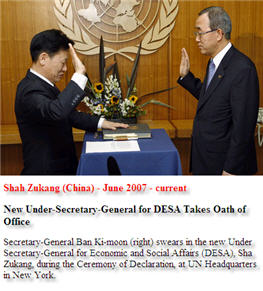
DESA's Brief to Ban Ki Moon/CEB on what intend to do

THIS IS THE VISION OF SHA ZUKANG

in 8 lines to his boss - Ban Ki Moon

at Sep 2009 meeting of CEB


The Committee (CEB) was also updated on the second component of the Monitoring and Analysis initiative – the framework that UN-DESA had started to apply to its work in monitoring the world economic situation and prospects, as part of its broader monitoring work together with UNCTAD and the Regional Commissions. The representative of UN-DESA reported that the Department’s Statistical Division had been exploring ways of changing the questionnaires used for its monthly statistical bulletin to provide mo re real-time data that could be used in monitoring vulnerable situations. The Division was also designing country studies for the poorest countries that typically had the weakest statistical systems, to provide more up-to-date information. It was also working on improved methods for producing statistics on high frequency data, linked to existing data systems such as national accounts, including better monitoring of the financial system and its implications for the real economies.


WHAT THIS MEANS ?


IN SHORT ALL OF US - GET A QUICK GOOGLE SEARCH COURSE OR OTHER LATEST TECHNIQUES IN DATABASE AND DATA-PROCESSING OTHERWISE THERE WILL PLENTY MORE CHINESE TECH GUYS COMING OVER TO "HELP"


UN says don’t expect climate deal at Copenhagen

EURONEWS

CLICK HERE TO GO TO EURONEWS WEBPAGE FOR THE STORY AND A VIDEO

Do not expect any agreements on how to lower climate change at Copenhagen. That is the message coming from the United Nations, as it now admit is has lowered their expectations for the outcome of the summit in December. With all the money spent on organising the meeting, Secretary General Ban Ki Moon had hoped to seal the deal. But an international agreement seems to be a long way off.

Janos Pasztor, Director of the UN Secretary-General’s Climate Change Support Team said: “There are reports of a new poll in the United States that indicates that interest and support for action on climate change may actually be declining. The Secretary-General sees US engagement as vital for a climate change deal. Climate change is not going to be resolved in Copenhagen in the next few weeks. We always knew that. It’s a long term problem that will be with us for many years, if not decades, to come.”

In the UN a new Democratic Senate Committee to tackle global warming has been set up. It is expected to be met with Republican resistance. And the EU cannot agree on financial help for developing countries who want to cut carbon emissions.