Showing posts with label korean. Show all posts

Sunday, 23 October 2011

In Run-Up to Rio+20, United Nations Opens New Office for Sustainable Development Research and Training in Incheon, Republic of Korea

Story @ www.iewy.com (click here)

As the United Nations and the world are gearing up for Rio+20 — a major global conference that aims to accelerate efforts to promote sustainable development — the United Nations opened a new facility today in Incheon, Republic of Korea, that aims to assist developing countries. The new centre was formally launched at a ceremony in Seoul.

The new United Nations Office for Sustainable Development is a joint effort by the United Nations, the Korean Ministry of Environment, the city of Incheon and Yonsei University. The Office will be managed by the United Nations Department of Economic and Social Affairs and will serve as a training and research institution and a centre for pooling together sustainable development knowledge and making it usable and accessible through its knowledge portal.

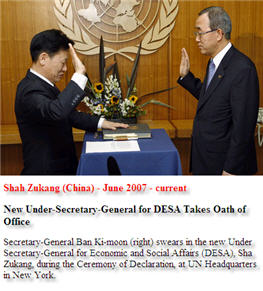
Speaking at the launch of the new Office, the Secretary-General of Rio+20, Sha Zukang, said, “The establishment of the United Nations Office for Sustainable Development twenty years after the United Nations Conference on Environment and Development underscores the fact that the world’s commitment for sustainable development is as strong as ever.”

Mr. Sha said that in the short run the new office will support developing countries and major groups in their preparations for the Rio+20 Conference, while in the longer run, “it will contribute to advancing the implementation of the outcomes of the Rio+20 Conference.”

Housed at Yonsei University in the city of Incheon, the new Sustainable Development Office has already organized a seminar in August on the issue of energy for sustainable development.

The Office will provide a sustainable development knowledge portal uniquely integrating the three pillars of sustainable development — economic growth, improving the quality of life, and protecting the environment. It will also provide a training and capacity-building facility by organizing training programmes for national representatives and major groups from developing countries to advance the sustainable development agenda and implementation of sustainable development goals and targets. In addition, it will undertake policy research and seek synergies through mobilizing sustainable development research institutions and universities.

Rio+20 — the United Nations Conference on Sustainable Development, to be held in Rio de Janeiro, Brazil in June 2012 — aims to galvanize action for sustainable development. Bringing together world leaders and representatives of business and civil society, the Conference will seek to secure renewed political commitment for sustainable development, assessing progress and gaps in implementation of past agreements, and addressing new and emerging challenges. It has two thematic focuses: “a green economy in the context of sustainable development and poverty eradication”, and “the institutional framework for sustainable development”.

For more information, please contact Dan Shepard, Development Section, United Nations Department of Public Information, tel.: +1 212 963 495, e-mail: shepard@un.org.

Friday, 10 December 2010

U.N.'s Message to Whistleblowers: "Kill the Messenger"


By Thalif Deen

UNITED NATIONS, Dec 9, 2010 (IPS) - A rousing battle between former Under-Secretary-General Inga- Britt Ahlenius, who once headed the U.N.'s powerful investigating arm, and her boss Secretary-General Ban Ki-moon is threatening to get ugly.


After she sent a 50-page memo highly critical of Ban last July, Ahlenius says she received phone calls from "a former U.N. staff member and also a South Korean with U.S. citizenship" warning her about "acts of retaliation".

The retaliation, she was told, would come from people in "the circles around the secretary-general" and "they would spare no efforts to hit and hurt me in retaliation for my report."

In a letter to the U.N.'s chief of staff Vijay Nambiar last month, Ahlenius says: "I shared this experience with some people in and outside of the (U.N.) Secretariat and we did not agree on whether this was a friendly warning or whether it was a threat in itself."

"I chose however to interpret this (phone) conversation from the positive side and as a friendly act," she adds.

But Ahlenius stressed that Ban does not tolerate any criticism, including "constructive criticism", of the way he runs the United Nations in his capacity as its chief administrative officer.

The culture and approach is "kill the messenger", she says using, wittingly or unwittingly, an ominous metaphor to drive home her message.

In her original memo which triggered the threat, Ahlenius, a former auditor general of Sweden and until July the head of the U.N.'s Office of Internal Oversight Services (OIOS), accused the secretary-general of being non-cooperative; of exceeding his authority on certain high-level appointments; of double standards on staff dismissals; and of lacking good governance.

IPS was the only news organisation with access to the entire 50-page document which was posted on its website last July.

"I regret to say the (U.N.) Secretariat now is in a process of decay. It is not only falling apart into silos - the Secretariat is drifting, to use the words of one of my senior colleagues," Ahlenius said.

"I am concerned that we are in a process of decline and reduced relevance of the Organisation. In short, we seem to be seen less and less as a relevant partner in the resolution of world problems," she wrote.

Challenging the very leadership of Ban, she said: "You are undermining the authority of your senior advisers both by affording them short - one year - mandates and also by exercising your direct authority over the appointments of their staff."

"There is no transparency (and) there is lack of accountability. Rather than supporting the internal oversight which is the sign of strong leadership and good governance, you have strived to control it which is to undermine its position. I do not see any signs of reform in the Organisation," Ahlenius wrote in her "End of Assignment Report'.

In a seven-page rebuttal to that 50-page memo, and speaking on behalf of the secretary-general, Nambiar makes his own charges against Ahlenius.

She, in turn, counters with her own five-page response sparking a second round of a full-scale war of words.

IPS, which was given access to the two documents, has posted both memos on its website.

In his letter, Nambiar accuses Ahlenius of having chosen "to resort to misrepresentation of the record and distortion of facts".

"Particularly disturbing is the way you have chosen to allow your comments to go public even before they were brought to the notice of your colleagues," the letter says.

Nambiar blames the declining state of the OIOS and its investigative machinery on Ahleinus's "mismanagement that caused serious damage to the accountability and integrity of the Organisation."

The charge of "mismanagement" appears at least three times in the letter, including a reference to "a glaring example of mismanagement".

The letter also points out that "despite your generalized erroneous allegations, you have failed to cite any instance of the secretary-general having tried to block or obstruct any investigation, audit or evaluation activity sought to be undertaken by you."

Nambiar also questions Ahlenius's lines of authority - where they begin and where they end.

In her memo, Ahlenius raised a number of issues related to political agenda and management reform.

"As to the political agenda," rebuffs Nambiar, "I do not feel it is necessary to respond to you since it goes far beyond your audit and investigation mandate."

On issues of management reform, he bluntly tells Ahlenius: "I believe that your comments on the intensive and extensive management reforms measures of the secretary-general are far beyond the purview of your office."

In her response, Ahlenius regrets that she is "deeply disappointed by the content and tone of your letter".

"I was however warned that this would occur, if I dare challenge the secretary-general with a report that would be critical of his performance," she writes. "My first reaction to you letter is not to respond at all. However, finally, I decided to respond."

Ahlenius says that "in order to project a credible message to the world and to constitute a relevant partner for the member states in addressing the world's problems, the Organisation must be professionally managed and must be led through example."

"This administration (of Ban Ki-moon) has hardly done that and your letter is testament to the way in which constructive criticism is viewed by the secretary-general."

She also criticises Ban's efforts "to control OIOS" which she points out "is counter productive and reflects poorly on his image."

The U.N. Secretariat is "in desperate need of different management reforms and the secretary-general must himself take the concrete lead and act to assume responsibility, not to simply talk about such ambitions in his speech," she concludes.

(END)

Thursday, 9 December 2010

Denmark joins Korean green growth institute


Denmark became the first foreign government to join the Global Green Growth Institute, a Seoul-based global think tank on green growth strategies.

On the sidelines of the current U.N. climate talks in Cancun, Mexico, the Danish government agreed Wednesday to participate in the activities of the GGGI, promising to invest $5 million every year in the coming three years.

Established in May, GGGI is a non-profit organization aimed at developing the Korean government’s green growth initiative and helping developing countries adopt their own green growth strategy.

Under the leadership of former Prime Minister Han Seung-soo, domestic and international experts such as Nicholas Stern, professor at the London School of Economics, and Thomas Heller, director of the Climate Policy Initiative, a think tank financed by George Soros, are working as key members of the institute.

Denmark plans to open a local branch of GGGI in Copenhagen and to participate in supporting the green growth efforts of developing countries mainly in the fields of energy and transportation.

“Korea and Denmark are standing together at the starting line for the spread of green growth initiative. That would have a positive effect in the green efforts of developing countries,” said Korea’s Environment Minister Lee Maa-nee, who was attending the Cancun conference.

According to GGGI, the institute has already provided Indonesia, Ethiopia and Brazil with green growth strategies, planning to gradually expand the recipient countries from next year.

Wednesday, 22 September 2010

Not all is well in the house of Ban Ki-moon, but he can still save his job

Sept 22, 2010

OP-ED CONTRIBUTOR

Ominous clouds are gathering over Ban Ki-moon, the beleaguered Secretary General of United Nations, at a time when he must soon announce whether he intends to seek a second, five-year term of office. And Ban’s problems are the U.N.’s problems. The Copenhagen climate change debacle, the devastating recent report of his departing audit watchdog, Inga Britt-Ahlenius, who likened the UN under Ban Ki-moon’s leadership to a ship left rudderless in the wind, and the growth of new organizations, such as the G-20, to manage global economic problems, indicate that the organization is destined for irrelevancy in the emerging global geopolitical order unless strong leadership makes it relevant again.

Within the corridors of the UN, it is well known that Ban Ki Moon works from dawn to dusk and expects the same from his closest associates. However, all this hard work has not silence the growing number of skeptics, who feel that the global influence of the organization under his leadership is eroding day-by-day.

The U.N. Secretary General’s job has one of the most impossible on the planet. It requires intellectual, managerial and spiritual depth, qualities seldom found in one person. Dag Hammarkskjold, the second Secretary General, is generally seen as someone who possessed those attributes, a man of high intelligence and managerial competence but also willing to stand up unflinchingly for his principles. This earned him and the organization much respect. Hammerskjold is also widely seen as a miraculous exception in the history of his post.

Unlike Hammarskjold or even his own immediate predecessor, Kofi Annan, Ban Ki-moon has not been able to forge such a reputation, but is instead generally seen as a follower. This reputation has become Ban Ki-moon’s Achilles heel. He needs to challenge the perception that he is a faceless bureaucrat with no ideas of his own and demonstrate a capacity to stamp his authority in a positive fashion on the world body, if he is to deserve a second term. Ban Ki-moon is in urgent need of reinventing himself through a series of decisive moves.

Firstly, he should undertake across-the-board overhaul of his senior management team. There is a strong sense that the team assembled by Kofi Annan was vastly superior to the one serving Ban Ki-moon. As Inga-Britt Ahlenius pointed out last month in her unprecedented and devastating “end of mission” letter, many members of Ban’s team have little expertise in their respective areas, and with a few exceptions, are widely seen as under-performing.

Ban desperately needs to reverse this impression. This would send a clear message to Member States and staff alike that merit and competence is central to the realization of the organization’s mission.

Secondly, Ban Ki-moon should undertake a rapid capacity assessment of every department in his Secretariat. The inefficiency and underperformance of the U.N. is legendary, as is its resistance to change. It is essential for Ban Ki-moon to strengthen his leadership of the Secretariat by doing an inventory of its weaknesses and fostering greater unity of purpose among the highly decentralized departments.

Thirdly, Ban Ki-moon should establish a high-level panel of eminent person to provide real, concrete recommendations on how to make the organization truly transparent. This is probably the single most important issue affecting the effectiveness of the world body. All such attempts have so far failed. But the desire to finally achieve those goals, especially among the relative handful of states which provide most of the U.N.’s operating funds, is stronger than ever. Ban needs to get in front of this movement in ways that he has so far failed to do.

If not, the U.N. will be made more irrelevant than it already is now. Models of international cooperation at the global and regional level have rapidly changed in the past decade as the pace of economic globalization has accelerated. These processes have not only led to the creation of the G-20, but also significant strengthening of the Organization for Economic Cooperation and Development and the emergence of such increasingly effective regional policy forums as Organization for Security and Cooperation in Europe, ASEAN, and the African Union.

The rising powers of the developing world are gaining increasing stature in those institutions. China, for example, has become a major force in ASEAN, even as it has become the second largest donor to the World Bank.

What this threatens to do, unless Ban takes a stronger hand, is give more radical but less powerful nations, such as Libya, Iran and Venezuela, greater leverage in the ageing and inefficient structures of the U.N., and even newer innovations such are the Human Rights Council or UN Women Organization. This has introduced a new threat to the organization’s existence: most other member states are growing increasingly tired of being held hostage to the extreme views advocated by such outlying countries, and the high cost of coordination associated with maintaining internal dialogues with them.

A strongly led, open and efficient U.N. administration would go a considerable distance toward redressing this balance.

Finally, Ban Ki-moon should drastically reorganize and revitalize his expensive and inefficient communications machinery. At present, most of it is organized around the idea of defending the U.N. from the world’s press, rather than engaging with it to promote the organization’s goals. Ban is notoriously an uninspiring public speaker and all attempts to make his image sexier, in the model of Kofi Annan, have been failures. What he needs instead are talented, widely respected communicators who can speak freely on his behalf, with the knowledge that the Secretary General has their back.

To lay out these sweeping changes is to acknowledge how difficult they are. But difficult is not the same as impossible. A Secretary General who dared to try them would be a Secretary General the world would like to see continue in office.

Tuesday, 16 September 2008

UNPAN changes again the CV of Ms. Elia Yi. Armstrong - adding dates/events and making it even more suspicious than before

Big changes over night in UNPAN webpage !

The korean mafia of 38th floor seem to have contacted and managed to oblige Ms. Haiyan Qian (China), current OIC of DPADM and Chair of UNPAN - to "improve" the Curriculum of the Korean citizen Ms. Elia Armstrong adding into the EDUCATION section the following:

1984 - English Instructor Yonsei/Jilin Universities, Changchun, China (Click here to see in UNPAN) or here (if UNPAN deletes it again)

On the 8th of September when we published our story about the discrepancies of Armstrong's  CV, this element in her EDUCATION section was missing. (click here to see our story of 8th of September 2008)

Cought by panic, the change instead of "improving" the CV, raise even further questions of Ms. Armstrong persona, her real life career and experience.  

This Korean citizen should make up her mind, and chose either she was a Teacher (teaching English) or a Student (studying English) in Yonsei/Jilin Universities in Changchun - China. The question though would be: - why would she go to China to learn how to be an English teacher? 

EDUCATION

EXPERIENCE

1984 - English Instructor Yonsei/Jilin Universities, Changchun, China

1984 - 1987   English Instructor, Yonsei/Jilin Universities, Changchun, China


Meanwhile, sources report that the HR file (consultancy) of korean citizen Ms. Elia Yi Armstrong has disappear from the file cabinet of the office of Mr. Furio De Tomassi. No one seem to know where her personnel folder, with her initial contracts and her initial CV is anymore.

Based on the above DESA staff  have the right to ask: 
  • Who is Elia Yi Armstrong ? 
  • Is she for real ? 
  • Does her past qualifies her as a D1 - Ethical Director at UNDP?