CLICK HERE TO VIEW THIS ON IPSNEWS.NET
THE ENVIRONMENT: RIO+20 MUST SPARK REAL ACTION
By Maurice Strong
NOVEMBER 2011, 2011 (IPS) - The progress made since the 1972 UN Stockholm Conference in our understanding of environmental issues and our capacity to address them effectively is impressive. Unfortunately, the lack of sufficient progress in the implementation of the commitments made by governments at the 1992 Earth Summit have left us on a course that is unsustainable and indeed threatens the future of humankind, writes Maurice Strong, Senior Adviser to the Secretary-General of Rio+20, the United Nations Conference on Sustainable Development.
In this article Strong writes the objective of the Rio+20 Conference (4-6 June 2012) is to secure renewed political commitment for sustainable development, assess the progress made to date and the gaps in the implementation of the outcomes of the major summits, and address new and emerging challenges.
Current economic and political difficulties, however, now pre-empt the attention of governments and the public, undermining the prospects of effective action at Rio+20 to establish the green economy. Rio+20 must produce powerful new momentum towards its realisation at the national, local, and global level. Strong writes that cities are the centres of our civilisation -the principal sources of environmental deterioration but also the principal sources of solutions. The greening of our cities must be at the centre of our efforts.
(*) Maurice Strong is Senior Adviser to the Secretary-General of Rio+20, the United Nations Conference on Sustainable Development. He was the Secretary-General of the 1992 Earth Summit and the first Executive Director of the United Nations Environment Programme (www.mauricestrong.net). (END)
Showing posts with label UNEP. Show all posts
Showing posts with label UNEP. Show all posts
Sunday, 20 November 2011

Thursday, 7 July 2011
POLITICO: Climate talks put heat on Obama
CLICK HERE TO VIEW THIS STORY ON POLITICO
By: Darren Samuelsohn
July 5, 2011 10:35 PM EDT
President Barack Obama faces several big green tests over the next year on the international stage.
Environmentalists and foreign allies are clamoring for U.S. leadership from the Nobel Prize winner on a pair of upcoming summits focused on global warming, sustainable development and biodiversity.
But the White House will need to temper expectations on its foreign policy as it fends off Republicans eager to keep Obama from winning a second term.
U.S. officials say a presidential trip to Rio de Janeiro for the 20th anniversary of the Earth Summit in June 2012 isn’t on his schedule right now, although they can expect the drumbeat to grow for Obama to change those plans as the U.N.-sponsored conference gets closer.
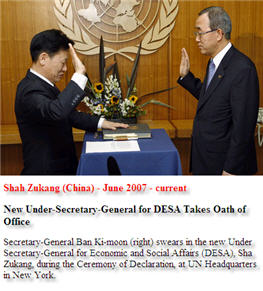
“The United States of America is a country that people around the world admire for its can-do attitude,” Sha Zukang, a Chinese diplomat and the top U.N. official connected with the Rio summit, said last week during a visit to the National Press Club in Washington. “Here, people believe that no problem is too big for human ingenuity to solve. The world has never needed that ingenuity more than it does today. The world needs your leadership.”
On the other hand, conservatives are giddy at the idea of Obama jetting to a South American seaside capital in the middle of his reelection campaign.
Earlier this year, they mocked the president after he praised Brazilian oil drilling efforts while on a visit to Rio, using his remarks in online ads that questioned his commitment to domestic energy exploration.
Republicans also carry big doubts about the climate science at the center of the international talks and question why a debt-strapped United States should spend any money abroad on environmental issues.
“Having some foreign gala with a bunch of rich people flying in private jets and demanding the United States have a lower standard of living is probably not the way, getting into a presidential election, to speak to a country with 9 percent unemployment,” said Grover Norquist, president of Americans for Tax Reform.
Obama won’t be the first president to deal with such an international environmental dilemma.
In 1992, amid his own reelection campaign, President George H.W. Bush agreed to make a last-minute trip to Rio’s first Earth Summit as diplomats neared a major agreement that set up the underlying structure for all future global warming negotiations.
Greens cheered Bush for the move, but there was still criticism that he insisted on inserting language to make the pact voluntary and also didn’t sign a separate treaty on biodiversity. That fall, environmentalists went in large numbers for Bill Clinton.
Ten years later, President George W. Bush skipped the next major global sustainable development summit in Johannesburg, South Africa. A local newspaper there published a cartoon of the U.S. leader mooning the world. Secretary of State Colin Powell attended and was heckled.
Environmentalists cheered Obama’s 2009 decision to attend climate change negotiations in frosty Copenhagen, Denmark, which drew a record number of presidents and prime ministers. They hope the Democrat doesn’t cave to conservative pressure now.
“[Republicans are] a powerful political force in the United States, but the world isn’t going to sit still for the United States to go through another election cycle,” said Jacob Scherr, director of global strategy and advocacy at the Natural Resources Defense Council.
Even if Obama doesn’t go to Rio, the United States will have considerable presence at the conference and in the preliminary legwork leading up to it.
The White House and State Department are already leading an internal working group on the Rio conference with about 15 agencies, including the EPA, the Energy and Commerce departments, the U.S. Trade Representative and the U.S. Agency for International Development.
“We look at Rio as an excellent opportunity to bring the world community together, to give a lot of energy and activity toward promoting sustainable development into the future,” a senior U.S. official said.
Unlike Rio’s 1992 Earth Summit, there will be no treaties or other binding agreements on the docket. Instead, the plan is to produce about three pages of consensus text among the more than 190 countries in attendance.
Roundtable talks will focus on getting individual countries to merge green issues with their economic development. There are also sure to be discussions about ocean acidification, protecting dwindling fisheries and cleaning up manufacturing supply chains.
Private companies, state and local officials, and a large contingent of environmental and nongovernmental organizations are expected at the three-day conference, which U.N. Secretary General Ban Ki-moon has said “will be one of the most important meetings in the history of the United Nations.”
The Rio summit comes as the world population nears 7 billion and global food and water shortages cause repeated bouts of political turmoil. Demand for energy keeps growing, with a billion cars on the road and about 1.4 billion people who still lack access to electricity.
Mounting scientific evidence that fossil-fuel emissions are changing the planet’s climate in irreversible ways also poses a big test for world leaders who must deal with immediate demands to restore fiscal order.
“Our test is to green our economies, … to reduce emissions and seek clean-energy growth,” Ban said in May. “How? By connecting the dots among climate, water, energy, food security and other key challenges of the 21st century … by finding solutions to one problem that are solutions to all.”
With such a sweeping agenda, some greens are nervous that conservatives will have little trouble cherry-picking their own meaning from the summit.
“It’s a welcome objective, but if it goes into resurrecting ideas about creating a new world environmental organization or a comprehensive environmental entity, I think it will be very difficult to make progress,” said Jennifer Haverkamp, international climate director at the Environmental Defense Fund and a former Clinton-era U.S. trade official.
Aside from the Rio conference, Obama faces even more demands over the next year connected to the continued struggle for a way forward on U.N.-led climate negotiations.
Two years after the Copenhagen conference fizzled, talks are set to resume in November in Durban, South Africa.
Calls for a new pact to succeed the 1997 Kyoto Protocol have hit a wall as developed and developing countries square off over how big of a commitment each should make, whether it should be mandatory and how to connect financial aid to the whole package.
Environmentalists aren’t thrilled with the slow pace of the negotiations and on occasion have started showing frustration with an administration that has other priorities to address over the next year and a half.
“The only way to address the climate crisis will be with a global agreement that in one way or another puts a price on carbon,” former Vice President Al Gore wrote last month in a Rolling Stone essay. “And whatever approach is eventually chosen, the U.S. simply must provide leadership by changing our own policy.”
Even without passage of a cap-and-trade bill, U.S. officials say Obama stands by his commitment to reduce emissions 17 percent below 2005 levels by 2020. Obama is also still pledging to help developing countries by contributing to a pair of green technology and adaptation funds, although final figures remain a work in progress.
“It’s always important for us, for the United States, to be seen as taking action,” U.S. climate change envoy Todd Stern told POLITICO. “We’ve done a lot under President Obama. We’ve not done as much as we’d liked to had our legislation succeeded.”
Friday, 4 February 2011
The master minds of Rio +20 get together behind the scenes
In an apartment at Landmark Hotel located nearby the 3rd ring in Beijing, just across the street of UNDP China, a guy from Manitoba/Canada, the so-called mastermind of Rio summit and the creator of UNEP, but also known for his direct involvement in the U.N.'s Oil-for-Food scandals and corruption, Mr. Maurice Strong (82) is planning his last comeback: - the Rio+20.


The questions is where are the WEOG Countries? Where are the Latin Americans? Where are the Africans? How can a major conference like this be an all Chinese/Asian "led initiative"?
This formula shows how transparent the activities that will precede the Rio+20 and the money that will be spent towards the conference will be.
Thursday, 25 February 2010
Bali-Hoo: U.N Still Pushing for Global Environmental Control

Thursday , February 25, 2010
By George Russell
Despite the debacle of the failed Copenhagen climate change conference last December, the United Nations is pressing full speed ahead with a plan for a greatly expanded system of global environmental governance and for a multitrillion-dollar economic transfer scheme to ignite the creation of a "global green economy."
In other words: Copenhagen without the authority — yet — of Copenhagen.
The world body even has chosen a time and a place for the culmination of the process: a World Summit on Sustainable Development to be held in Rio de Janeiro in 2012, the 20th anniversary of the famed "Earth Summit" that gave focus and urgency to the world environmentalist movement.
The 2012 summit date is significant for another reason: It marks the end of the legal term of agreement for the Kyoto Protocol on greenhouse gas emissions, which includes carbon reduction targets, and provided the legal basis for an international cap-and-trade market for carbon, centered in Europe. The U.S. first signed then backed away from the Kyoto deal without ratifying it; until its apparent collapse, the comprehensive Copenhagen deal was intended to include the U.S. and supplant Kyoto with a new, legally binding regime.
The new Rio summit will end, according to U.N. documents obtained by Fox News, with a "focused political document" presumably laying out the framework and international commitments to a new Green World Order.
Just exactly what that environmental order will look like, and the extent of the immense financial commitments needed to produce it, are under discussion this week at a special session in Bali, Indonesia, of the United Nations Environment Program's 58-nation "Governing Council/Global Ministerial Environmental Forum," which oversees UNEP's operations.
The GC/GMEF, as it is known, is made up of environmental ministers and top-level bureaucrats from a roster of supervising nations — the U.S. is one of them — and its meeting is surrounded by a galaxy of environmentalist non-government organizations (NGOs) and environmental journalists from around the world.
Idyllic Bali is a favored venue for U.N. environmental meetings, in part because of its seclusion from too many outside eyes, and because its Pacific location and small size make it a highly congenial hothouse for environmental enthusiasm. In 2007, it served as a launching pad for the Bali Action Plan, which laid the negotiating basis for the Copenhagen treaty process.
The latest Bali session runs from Feb. 24 to 26, and is accompanied by a welter of other UNEP activity ranging from sessions on international waste management and chemical disposal, to the start of a process aimed at a new international treaty covering the storage and disposal of environmental mercury.
But the major topics are a global system of governance and what amounts to the next stage of a radical transformation of the world economic and social order, in the name of saving the planet.
Alongside that, as always, are discussions of vast sums of money that should flow to developing nations to help them make the transition to the new, greener world. As one of the papers written in advance of the meeting to "stimulate discussion" puts it, "the situation ... presents genuine opportunities for a dramatic shift from what can be termed 'business as usual.'"
For the anonymous bureaucrats who wrote the discussion papers, "business as usual" apparently means the current world economy, which the anonymous authors disparagingly term the "brown economy," or the "current dominant economic model." It is, according to the UNEP documents, a model in crisis, "which currently consumes more biomass than the Earth produces on a sustainable basis," and also "depletes natural capital" and "risks perpetuating and exacerbating persistent poverty and distributional disparities."
The new green economy under discussion at Bali will be something very different: For starters, it is much more vague, and as far as the discussion paper authors are concerned, it will stay that way.
The paper paints the coming green order in nebulous and utopian terms. It "implies the decoupling of resource use and environmental impacts from economic growth." It involves "substantially increased investment in green sectors, supported by enabling policy reforms." The investments will "provide the mechanism for the reconfiguration of businesses, infrastructure and institutions, and for adoption of sustainable consumption and production processes." It will lead to "more green and decent jobs, reduced energy and material intensities in production processes, less waste and pollution, and significantly reduced greenhouse-gas emissions."
But when it comes to measuring the achievement of those goals, the paper says, "it is counter-productive to develop generic green economy indicators applicable to all countries given differences in natural, human and economic resources." In the process of turning brown to green, "a green economy in one country may look quite dissimilar to a green economy in another country."
All of which may make judging the value of investment in the ecological transformation difficult to evaluate, except for insiders. But then, the paper suggests that the world may have an additional governing structure composed of exactly those insiders. As the paper puts it:
"Moving towards a green economy would also provide an opportunity to re-examine national and global governance structures and consider whether such structures allow the international community to respond to current and future environmental and development challenges and to capitalize on emerging opportunities."
The discussion paper, published — but not distributed — on Dec. 14, 2009, assumes that the goal of the green economic transformation is the same as that of the ill-fated Copenhagen conference: a 50 percent reduction in global carbon dioxide emissions by 2050. That, the paper says, will require a staggering $45 trillion dollar to accomplish — much of it in transfers from rich nations to poorer ones.
The paper, however, paints that as a bargain — "an average yearly investment of just over $1 trillion." About half of that would go for "replacing conventional technologies with low-carbon, environmentally sound alternatives."
Click here to read the Green Economy paper.
Another major investment target would be "ecosystem-based adaptation and mitigation"—paying people and governments to maintain and expand forests, wetlands, coral reefs and other productive sources of "natural capital," which the current "dominant economic model" — the paper provides no other specifics — abuses.
But that is only the beginning of the transformation. Consumption patterns must change, so that fewer wasteful products are consumed, and more ecologically proper ones are produced — organic food and beverages, for example. The UNEP authors, citing other analytical papers produced by UNEP, claim that "the global market for environmental products and services is projected to double from the present $1.37 trillion per year to $2.74 trillion by 2020."
Beyond the organic food market, however, "environmental products and services" are not defined in much detail. One area would be the management of chemicals and solid and hazardous waste — as the paper puts it, "solid waste management alone consumes on average 20-50 percent of most city budgets."
In social terms, one of the most important goals of the transformation would be jobs, jobs, jobs — all of them green, and many of them, as it happens, already in existence.
The report notes, for example, that the U.S. recycling industry as of 2002 already employed over 1 million people; more investment would thus provide "significant opportunities" for more job creation. The same goes for looking after trees: Citing the U.N. Food and Agriculture Organization, the paper claims that "10 million new green jobs could be created by investing in sustainable forest management."
The report argues that significant amounts of the money developed countries have thrown at the problem of ending their current steep recessions could be counted as the type of green investment it envisages as part of the trillion-a-year future. In the U.S., for example, the document says that 11.6 percent of the economic stimulus as of August 2009 — about $112.8 billion — is the type it sees as vastly increasing in the future.
Where is all the money supposed to come from? The paper is emphatic that government alone doesn't have enough. The paper says that "regulated market mechanisms" are needed to "to promote new and innovative investments in green technology."
But above all, the paper asserts, the focus on ecological transformation must become all-encompassing if it is to succeed. Quoting from UNEP's formal medium-term strategy for 2010 to 2013, it says that "linkages between environmental sustainability and the economy will emerge as a key focus for public policymaking and a determinant of future market opportunities."
In other words, the green economy requires a green-oriented political revolution. As UNEP's medium-term strategy puts it: "The current environmental challenges and opportunities will cause the environment to move from often being considered a marginal issue at the intergovernmental and national levels to the center of political and economic decision-making."
The authors of the UNEP "discussion" papers see that organization — the U.N.'s principal environmental watchdog — and especially its governing "Governing Council/Global Ministerial Environmental Forum," as the central nexus of that new eco-centric regime — and that strengthening its authority at both the national and international levels will be a growing theme as the 2012 Rio Conference looms nearer.
"It is clear that environmental ministers alone cannot meet today's environmental challenges," asserts yet another Bali discussion paper. "One step towards strengthening their standing vis-à-vis other sectors is to strengthen the national [environmental] governance system."
Meantime, UNEP's GC/GMEF "is mandated to bring all environmental aspects together and to formulate broad policy advice and guidance" in the area of "international environmental governance reform" — with the aim of having it all ratified, eventually, by the U.N. General Assembly.
Click here to read the discussion paper on international environmental governance.
In all of this, it appears, the 2012 Rio Conference on Sustainable Development and the preliminary meetings that will determine its agenda is intended to play an important role in focusing attention on the agenda being discussed at Bali, and in creating the suggested frameworks of future "international governance." Above all, the planned Rio summit will be a framework that welds together the UNEP framework of environmentalism with the U.N.'s traditional anti-poverty agenda — which also involves huge investment transfers to poor countries from rich ones.
The two agendas come together in the rubric for Rio: sustainable development. As the paper on governance turgidly puts it: "eradicating poverty, changing unsustainable patterns of production and consumption and protecting and managing the natural resource base of economic and social development [are] overarching objectives of and essential requirements for sustainable development."
Vast international wealth transfers, crash investments in "green" technologies for energy, food, transportation and virtually everything else, with the aim of making enormous cuts in carbon emissions by 2050 — the sum of all the discussions underway at Bali appears indistinguishable from the Copenhagen agenda that was declared dead in December.
Except the U.N. and many nations — including the U.S. — apparently don't think so. Indeed, a series of new Copenhagen process negotiations have just been set for Bonn in April, with another set for late May to early June.
Their official aim is to bring Copenhagen back from the dead by the end of this year at a final negotiating session in Mexico.
In a press release announcing the negotiating round, Yvo de Boer, head of the United Nations Framework Convention on Climate Change (UNFCCC), which manages the Copenhagen negotiating process, declared that "this constitutes a quick return to the negotiations" — and a continuing determination to put a new treaty in place as the capstone of the Green World Order.
But at the same time, he made clear that a deal by the end of the year is unlikely; 2011 is more feasible.
If that happens, de Boer won't be applauding from his current position. He has resigned, effective July 1, to become a consultant.
The first major preparatory meetings for the Rio summit in 2012 will be held at U.N. headquarters in New York City in mid-May.
George Russell is executive editor of Fox News.
Subscribe to:
Posts (Atom)