Showing posts with label UN Secretariat. Show all posts

Monday, 4 October 2010

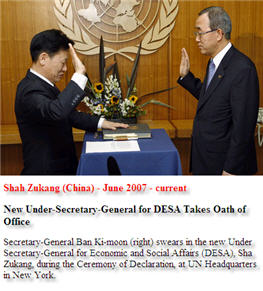
A question to Sha Zukang during last town-hall meeting

On 4th of August 2010, REFORM DESA predicted that the "Russian" will take the P5 at DPADM Despite the show-off at latest town-hall meeting

ENJOY THE MOVIE...AGAIN!


WAY TO GO SHA ZUKANG !!!

Friday, 13 August 2010

Ban Ki Moon furiously lobbying for 2nd term

Ahmadinejad, Chavez, Mugabe to have U.N. platform

General Assembly to get under way in just weeks

Posted: August 11, 2010
12:06 am Eastern

By Stewart Stogel
© 2010 WorldNetDaily

UNITED NATIONS – New York soon will be buzzing again with a collection of anti-American world leaders scheduled to arrive for the 2010 United Nations General Assembly.

The meetings will begin Sept. 23 and run for two weeks.

Among those present from the United States will be President Obama and Secretary of State Hillary Clinton, who will dedicate the new 30-story United States U.N. mission headquarters.

According to the U.N.'s office of protocol, the expected anti-U.S. VIPs will include Iranian President Mahmoud Ahmadinejad, who seems to take delight in coming to New York to thumb his nose at the protests that greet his arrival.

The September visit will mark Ahmadinejad's second U.N. appearance this year and the fifth since he took office in 2005. In May, he attended a nuclear-disarmament conference.

Though he is perhaps the most anti-American leader since the Islamic Revolution, he also is the Iranian president who has paid the most visits to the U.S. since the reign of the late Shah in the 1970s.

The Iranian will be accompanied by Venezuela's Hugo Chavez and Bolivia's Evo Morales, who have sought to counterbalance Washington's influence in Latin America.

Another long-time U.S. antagonist, Nicaragua's Sandinista leader Daniel Ortega, who was noted for his repeated clashes with the Reagan administration, also will make an appearance at the U.N. this year.

In 1986, Ortega taunted Reagan when he told the General Assembly, "President Reagan should remember, Rambo exists only in the movies!" The Ortega slap prompted the U.S. delegation to walk out of the U.N. complex.

Zimbabwe's embattled president, Robert Mugabe, who has survived in office despite crippling U.N.–Commonwealth sanctions, is expected to address the world body Sept. 24.

Georgia, still reeling from the 2008 Russian invasion, will send its president, Mikheil Saakashvili, to speak Sept. 23, just before Russian President Dimitri Medvedev is scheduled to take to the podium.

As the U.S. surge in Afghanistan gains momentum, the General Assembly is providing a venue for Obama to confer with the major players in the region.

Hamid Karzai, Kabul's controversial leader, is expected in New York, along with Pakistani President Asif Ali Zadari and India's Prime Minister Manmohan Singh.

Some newcomers to this year's U.N. forum include British Prime Minister David Cameron, Japanese Prime Minister Nato Kan, South African President Jacob Zuma and Filipino President Benigno Aquino III.

Libya's mercurial Muammar Gadhafi, who "stole" last year's show with his visit to Midtown, has not made a decision on this year's meetings, says the U.N.

U.N. Secretary-General Ban Ki-moon will take the occasion to unofficially circulate his candidacy for a second five-year term as chief of the world body despite the fact that his current term does not expire until December 2011.

Thursday, 17 September 2009

U.N. Budget: Would You Believe $13.9 Billion?


Thursday , September 17, 2009

By George Russell

FC1

http://www.foxnews.com/story/0,2933,551480,00.html

As the United Nations General Assembly reconvenes in New York City this week, Secretary General Ban Ki-moon intends to present its members with a two-year headquarters budget that he claims will be as stingy as these recessionary times demand. It will total just $4.9 billion, a trifling 0.5 percent — or $22.4 million — more than the U.N. spent over the previously two years. The U.S. pays 22 percent of the new budget total, or about $1.08 billion.

“This level of resources,” Ban proclaims in his introduction to the 1,702-page budget document, “is the outcome of the lengthy budget formulation process, reflecting a thorough review and extensive consultations with program managers to ensure the optimal utilization of resources in order to fully, efficiently and effectively implement the objectives and mandates set by Member States.”

Ban’s claim, however, is deeply misleading. In fact, the same budget document shows that Ban is on track to maintain and surpass his previous record as the biggest spender in U.N. history.

And whatever the totals turn out to be, the cost of paying them will weigh most heavily on the United States, which in addition to paying nearly a quarter of the regular U.N. budget, pays up to 26 percent of its peacekeeping costs, and large amounts of the money for a bewildering variety of U.N. cost centers that make up the sprawling U.N. Secretariat budget. In 2007, the top 17 dues-paying countries in the U.N. paid 86.5 percent of the entire U.N. regular budget, while the 128 lowest-paying members paid only 1 percent.

Overall, Ban’s new budget document shows, the U.N. Secretariat is actually planning on an eye-popping $13.9 billion in “regular” and “extra-budgetary” spending in its 2010 and 2011 budget. That is hike of some $968 million over the spending during the previous two-year period, or a 7.5 percent increase.

The increase, however, is likely to grow much bigger as it is adjusted upward during the two year period, as it inevitably is. And the share that the U.S. will pay of that total is very difficult to determine.

The same figures show that the U.N. Secretariat will employ 22,421 people in 2010-2011 — more than double the number Ban lists on his “regular” budget.

Click here to see the overall cost and personnel totals.

The enormous gap between the $4.9 billion “regular” total and the $13.9 billion overall figure is a reflection of the Byzantine, esoteric and — for anyone trying to control U.N. costs — frustrating U.N. budget process, in which the world organization fudges figures, delays revelations about add-on costs, and counts only about a third of the money it spends every biennium as its “regular budget,” even while the bigger total is the real basis for its activities.

Click here for an overview of the 2010-2011 budget.

And the spending totals the Secretary General presents at the beginning of each budget cycle tend to go dramatically up as the cycle progresses. At the same point in the previous two-year U.N. budget cycle, for example, Ban Ki-moon estimated that the combination of “regular” and “extra-budgetary” spending for 2008-2009 would be $10.47 billion. Instead, the U.N. spent $12.97 billion — $2.5 billion, or nearly 24 percent, more than it originally declared.

“It’s easier to work your way through the U.S. budget — which is immensely bigger — than through the U.N. budget,” observes Brent Shaefer, a U.N. expert at the conservative Heritage Foundation, who has just edited a new book on U.N. reform entitled ConUNdrum: The Limits of the United Nations and the Search for Alternatives. “What you see is the U.N. doing a bit of sleight of hand.”

Nor does the sleight of hand end there. Even the $13.9 billion number does not include the cost of some of the U.N.’s biggest and most sprawling organizations, which submit their own budgets to separate panels of U.N. member states, even as their programs increasingly intertwine and overlap.

These include behemoths like the United Nations Development Program (UNDP), which spends in excess of $6 billion annually — the organization has suspended consideration of its next biennial budget until early next year— or the World Food Program (WFP), which wants to spend $6.3 billion in 2010-2011, as well as the World Health Organization (WHO), which spent $4.2 billion in 2008-2009.

Yet even with those exceptions, as a result of the legerdemain of the U.N. budgeting process, the $13.9 billion spending figure in Ban’s proposed budget is a very understated presentation of U.N. spending plans — by significantly more than 100 percent.

To take just a small matter first, the inflation-adjusted total for the $4.9 billion regular budget brings it immediately to $5.06 billion — and that is only a “preliminary” adjustment.

Nor does it include the full impact of what the U.N. calls “special political missions,” which nowadays include the rapidly spiralling U.N. civilian and development deployments in Iran and Afghanistan. Ban’s introduction to the latest budget declares that these special missions are expected to cost $776.3 million. But later on, the document says the total so far is actually $867.4 million.

In fact, the number is still a moving target, that will change throughout the two year period—never in a downward direction. At the same stage in the U.N.’s budget process two years earlier, the cost of special political missions was estimated at $623.5 million. In the end, the U.N. spent $867 million, an increase of 39 percent.

The U.N.’s budgetary committee has asked Ban to prepare an “updated” estimate for the special missions the General Assembly begins its deliberations.

Nor does the budget include all the likely costs of a major overhaul of U.N. business and information technology, dubbed the Umoja project, which is tallied in Ban’s budget as costing anywhere from about $78.5 million to $186 million in 2011-2011. A recent draft report on the project obtained by FOX News, however, proposes a cost of $232.5 million for the same period — with much more to come later.

More importantly, even Ban’s biggest numbers fail to include the rapidly spirally annual cost of U.N. peacekeeping operations — which will amount to about $7.8 billion just for the period from July 2009 to June 2010.

Click here to see the approved peacekeeping estimate.

The U.S. share of the 2009-2010 peacekeeping package is just under 26 percent of the total, or $2.01 billion — up about $120 million from the previous year. The share can grow to 27 percent before it hits a ceiling mandated by the U.S. Congress.

The $7.9 billion for peacekeeping is treated as a separate element in U.N. accounting, and approved separately by the General Assembly.

Only $586 million worth of peacekeeping operations expenses — which are over and above the $7.8 billion — are listed in Ban’s 2010-2011 headquarters budget.

There is not a great deal of likelihood that overall peacekeeping expenses — which have rocketed from a planned $5.3 billion in the 12 months ending in July 2008 to the current total, a 47 percent hike — will shrink in the years ahead.
Even assuming no change in the rate of spending, that means that in the period covered by Ban’s biennial budget, which includes 18 additional months of peacekeeping, U.N. peacekeeping outlays might run to $15 billion all by themselves — and the U.S. share could reach $3.9 billion, or even more.

So, why are the U.N. budget figures heralded by Ban at the beginning of his proposed budgets so low?

The chief reason is a definition of the “core” or “regular” U.N. budget that refers only to spending covered by mandatory payments — in effect, U.N. dues — by the U.N. member states. The “core” budget is the smaller number, and, as Ban’s introduction to this year’s budget shows, much more apparent effort goes into keeping costs down in the “core.”

But even when announcing increases in those “core” budget numbers for the new budget, Ban fudges.

To arrive at his tiny $22 million spending increase, Ban, as is customary at the U.N., compares the final version of the previous “core” biennial budget — what the U.N. actually spent, with only the first version of the next biennial plan — the most expensive version of the past, in effect, with the lowest initial estimate of the future.

For example, when Ban first introduced the budget for 2008-2009, the Secretariat used an initial figure of $4.19 billion — about $620 million less than the U.N. actually spent in that period. In other words, in the last biennium, the U.N. “core” budget actually increased by 15 percent more than what Ban initially said it would be.

As it happens, when he first presented that initial 2008-2009 budget, Ban declared that the initial estimated regular budget number was also just 0.5 percent higher than the previous two-year budget number — using exactly the same apples-to-oranges comparison that he uses this time.

Rather than the 0.5 percent increase that he heralds, Ban’s latest initial estimated “regular” or “core” budget for 2010-2011 starts out $700 million higher than his initial estimate for the 2008-2009 biennium — an increase of 17 percent before taking account of any subsequent inflation adjustment and further cost growth.

The Heritage Foundation’s Schaefer, in fact, estimates that the U.N. regular budget has been growing at an average rate of 17 percent annually since about 2002 During that same period, Schaefer says, the U.S. budget grew by an average of only 7 percent annually.

Ban’s figure-juggling, however, is not over. He adds estimates for cost inflation, currency exchange rates and other factors that bring his low-ball initial estimate for 2010-2011 from $4.9 billion to about $5.03 billion — roughly $634 million, or 14 percent, more than his low-ball cost adjusted estimate for 2008-2009.

The biggest, and most time-honored U.N. device that Ban uses is a distinction between the organization’s “core” and “non-core” budgets. The “non-core” or “extra-budgetary” spending is supplementary spending that is provided voluntarily by contributing states rather than through a dues formula. It amounts to twice as much as the U.N. spends on “core” items.
Yet even though this “extra-budgetary” spending is voluntary, it is remarkably solid — it amounted to $8.7 billion in 2008-2009, according to Ban’s latest spending document — and comes principally from the same countries as the regular budget does.

In 2010-2011, Ban initially foresees this “extrabudgetary” spending on a rise again, to $9.44 billion, up from $8.66 billion spent in the previous two years. Ban’s office calls the 9 percent projected hike “modest,” and “using conservative estimates based on past experience” and donor undertakings. When queried by FOX News as to whether the Secretary General foresaw further growth in that number in the years ahead, Ban’s office replied that instead, they saw the amount of the increase being ratcheted downward — to $9.3 billion.

But once again, Ban’s budget for 2010-2011 is comparing the final number spent in the previous two years with the initial estimate for “extra-budgetary” spending in 2010-2011. The initial extra-budgetary number for 2008-2009 was just $6.59 billion — meaning that his new initial estimate is a huge $2.85 billion, or 43 percent, higher than its true equivalent in the previous biennium.

Among other things, a substantial portion of the extra-budgetary increase, Ban’s report notes, has gone to the Office of the United Nations High Commissioner for Refugees — $282.2 million — and the United Nations Relief and Works Agency for Palestinian Refugees in the Near East (UNWRA) — $186.9 million.

(As it happens, Ban’s initial budget report for 2008-2009 said very similar things, noting that big increases from hikes in extra-budgetary resources went to UNHCR — $423.3 million — and UNWRA — 122.9 million.)

Click here to see a breakdown of U.N. planned spending by regular and extra-budgetary categories.

Ban’s office says it has “no reason to believe that Member States would not honor their commitments” for extra-budgetary funds.

Perhaps the biggest sign of how confident the U.N. is of at least the bulk of this “extra-budgetary” spending is the number of people it employs with it: 12,153 in 2008-2009, vs. about 10,180 by means of the “regular” budget. In 2010-2011, Ban expects to keep 12,271 people employed using “extra-budgetary” resources — a remarkably stable number.

In other words, about 54 percent of Ban’s Secretariat staff is currently not on the “regular” budget books, and he expects the proportion to stay that way.

In his latest budget presentation, Ban makes much of the fact that he has cut 32 jobs, or about 0.3 percent of the “core” U.N. staff, in his initial estimate.

But on the “extra-budgetary” side, Ban has actually added an additional 118 positions. Net gain: 86. Overall, about an 0.4 percent hike.

Rather than unprecedented fiscal discipline, what Ban’s numbers actually show is that hikes in both the U.N.’s “regular” and “extra-budgetary” spending over the past four years represent a dramatic break with past efforts of major donor countries, led by the U.S., to enforce tougher fiscal discipline.

The watershed in that effort came during the last biennium — the first where Ban Ki-Moon was completely responsible for the budget process.

Led by a shock-wave of developing countries, the U.N. General Assembly abandoned a 20-year tradition of adopting its budgets only by consensus — a custom that gave major donor countries like the U.S., which enjoy only one vote, unofficial clout on budgetary matters in keeping with their financial contributions

In 2008, however, the General Assembly took an official vote on the 2008-2009 budget — and approved it, 142-1. The only No vote came from the U.S., in one of the last acts of the outgoing Bush Administration.

That result, according to Heritage’s Schaefer, meant that “the majority of UN member states who contribute very little to the budget no longer feel the need to listen to the concerns of its largest contributor.”

For its part, Ban’s office, in reply to questions from FOX News, declared that “the Secretary General continues to exercise maximum budgetary discipline and has presented a budget proposal in line with the budget outline as approved by the General Assembly. He will be presenting a number of proposals which are either new or respond to earlier mandates of the General Assembly.

“The ultimate level of the budget,” Ban’s spokesman added, “is a decision solely within the purview of Member States.”
Will the Obama Administration, which differs greatly from its predecessor in its avowed intention to rely further on the U.N. for diplomatic purposes, find the continuing U.N. spendfest a problem?

It remains to be seen — most likely in the labyrinthine results of the U.N. budget process.

George Russell is executive editor of FOX News.

Tuesday, 1 September 2009

Mammoth U.N. Tech Overhaul: Over Budget and Behind Schedule

Tuesday , September 01, 2009

By George Russell

FC1


A $286.6 million computer and software system upgrade, described as the "cornerstone of a United Nations-wide effort to bring groundbreaking reform" to the management of the U.N. Secretariat, is already about three to four months behind schedule, and is headed to be tens of millions of dollars over budget, less than a year and a half after being approved.

Those tidings are contained in a 53-page draft report on the project obtained by FOX News, which was prepared on behalf of a steering committee of top U.N. bureaucrats overseeing the information technology overhaul. The head of the committee is Secretary-General Ban Ki-moon's Under Secretary General for Management, Angela Kane.

The technology system described in the report is intended to unify and coordinate — as well as redefine — jobs and functions across the global secretariat, including its fast-expanding peacekeeping efforts, which have grown in cost from $1 billion to $8 billion annually in just the last five or so years.

Yet despite the unappetizing revelations about the cost and timing of the technology project-named Umoja, or "unity" in Swahili — the bureaucrats in charge of the scheme remain relentlessly upbeat about the final outcome.

MAKE YOUR VOICE HEARD -- CAST YOUR VOTE HERE

Should the U.S. bail a U.N. tech project that is tens of millions of dollars over budget?

This is not a scientific poll.

They dub it a "once-in-a-generation chance to equip the Organization with twenty-first century practices, tools, training and technology," in order to "enable a more streamlined, cost effective, agile and accountable United Nations."

"Umoja is more than a project," the report declares. "It is a movement of continuous administrative report and improvement."

The bureaucrats claim that by the time their project is concluded in 2012 it will be back on schedule, and will pay for itself in cost efficiencies and other savings in just two years' time after it is operable and "stabilized." Their report offers little evidence beyond sweeping generalities, however, of how those efficiencies will be achieved.

And by then, the report says, the technology upgrade will have cost a staggering $337 million, or about $50.4 million more than was planned when the scheme was approved about a year and a half ago.

Even that cost-overrun is considerably understated. The original $286.6 million price tag for the Umoja information technology project, known as an enterprise resource system, or ERP, included $37.2 million worth of funding over and above the expected cost, or roughly 15 percent, for "contingencies" In effect, the report projects that the worst-case over-run will be exceeded by 135 percent.

There is a new 15percent budget line for "contingencies" in the $337 million total for Umoja revealed in the latest draft report, which the authors promise that U.N. bureaucrats will flag to the General Assembly as it is spent. But the "contingency" part of the price tag is considerably lower than the high range of 25 percent of the overall cost that the report says was recommended as a possibility by non-U.N. sources.

Ironically enough, the report was prepared, its authors say, in response to a General Assembly request in 2008 to update the business plan for the ERP, and provide options for a reduced ERP package at a lower cost than originally budgeted. The draft report offers up such packages, but only as interim steps toward full rollout of the system.

Click here to read the draft report.

Along the way, the draft report offers some fascinating insights into the process of cost inflation within the U.N., at least on major projects like the ERP — the same cost inflation that has driven up the cost of the U.N.'s headquarters renovation, now underway, from an estimated $800 million in 1999 to the current-and not finalized — $1.88 billion.

The Umoja draft report also pulls back the curtain slightly on the near-Paleolithic state of outdated and chaotic technology and management practices within the sprawling U.N. Secretariat today.

Among other things, the report says in a footnote that the new ERP system will replace "several hundred" of the "existing 1400+" information systems in use at the U.N. — which would leave roughly 1,000 or so still out there.

Elsewhere, the report says many of the existing electronic systems are only used to back up hand-entered paper systems, which employees trust more than their electronic tools. "Paper documents are usually the source of trusted information," the report confides, adding that at the U.N. "we often have several versions of 'the truth.'"

But above all, the draft report shows that the U.N. is continuing to shower fearsome amounts of money on complicated technological fixes for its management problems, which even before the latest ERP effort had reached runaway proportions. The earlier technology fixes apparently have not achieved much U.N. unity or management efficiency.

According to a 2005 report by the Joint Inspection Unit (JIU), a small, independent branch of the General Assembly that looks at issues across the sprawling array of U.N. funds, programs and agencies worldwide, the global organization-even then — had spent more than $1 billion on various information management systems over the previous decade.

"The United Nations system's investment in ICT [Information and Communications Technologies] is growing at a faster rate than the operating budgets of most United Nations organizations, or than worldwide inflation," the JIU observed, while noting that the U.N. system still had not managed to create even a common payroll system for the tens of thousands of employees worldwide.

Umoja is not intended to solve the problems of the entire disparate U.N. system, just of the U.N. Secretariat — and according to the draft report authors, it would result in "efficiency and productivity gains in the order of 4 to 7 percent of the Organization's entire annual spend."

The draft report's description of how it calculated those savings, however, is sometimes puzzling — starting with the fact that, using the table of dollar values for the 4 percent to 7percent savings provided on page 10 of the report, the total "annual spend" of the U.N. they describe would seem to wobble between $11.03 billion and $11.85 billion, an $800 million difference.

Among other things, the report claims that Umoja's automated processes would "drastically reduce the 207-day average time between the creation of a requisition for goods and the creation of a purchase order" in the Secretariat's procurement system — a claim that seems unarguable. The report says that there would be $32 million to $64 million of process efficiency gains" as a result.

But the report also says that "renegotiating contracts for more favorable pricing based on better usage and performance information" will yield cost savings of $76 million to $117 million, without providing hard details about how the reduction in overcharging will be achieved, or whether contracts can successfully be renegotiated on that basis.

"Better forecasting for goods required" could save $56 million to $70 million, the Umoja document claims. But the report also says that a "one-time savings of $18 million to $27 million" would come from a reduction of inventory, followed by "additional benefits of reduced carrying costs" — which sounds like more of the previous $76 million to $117 million saving.

When it comes to U.N. travel, the report describes a horror story, in which simply processing travel claims on expense accounts each year currently takes up the equivalent of 60 full time employees working full-time. Fixing that would save $21 million to $34 million a year, the report says. The same goes for other accounting exercises. Closing the U.N. Secretariat's year-end accounts "currently involves 40,000 working hours and takes three months." The new system would cut that in half, the report says.

Some projected savings, however, appear bizarre. One example: "Umoja would also generate opportunities for the United Nations to generate income with ... sales of publications, postage stamps and gift items." Expected revenue: $11 million to $21 million. No explanation is provided of how that would happen. The U.N. postal system has been a scandal-tainted perennial money loser.

When it comes to Umoja's own ballooning costs, however, the high tech project looks less like a revolutionary reform and more like a return to the U.N.'s bad old days, especially when compared to the original budget for the tech overhaul put forward last year.

The original plan for the project called for 44 "core" or full-time staffers to manage the Umjoa installation and roll-out. The new draft report bluntly declared the project "could not possibly be executed" without 36 additional bodies. Cost: $32.4 million. Another $18.1 million would be required to replace staff brought in from other parts of the U.N. to help out along the way.

Even though the staffing climbs to 80, the revised Umoja budget includes office rental for 236 people ($6.7 million) with "minor alterations" to the office space ($4.2 million).

The original budget for the tech overhaul had a minimal expense line for travel. That's changed: now the budget calls for "a total of 1,285 trips by the ERP team, subject-matter-experts and corporate consultants," at an average air ticket cost of $6,000, plus $202 "terminal expenses," plus $5,000 for per diem expenses, "with each trip is [sic] estimated to cost $11,202/person."

Total cost: $14.4 million.

The draft report authors claim that Umoja's timetable is "slightly off" its previously announced schedule because the General Assembly only provided $20 million in initial funding, when the Secretariat had asked for $43 million in 2008-2009 for the design of the startup, which was supposed to allow building to start on January 15, 2010.

Now that is likely to begin after the first "three or four" months of 2010, though the report authors insist that "excellent progress" on the overall project will have been made by the end of this year.

Among other things, after what it calls a "comprehensive and competitive bidding process," the Umoja team has chosen a software provider for Umoja: SAP. But negotiations on how to proceed with the software contracts have barely begun, the report says.

The draft report ends with a warning that the technical overhaul involved in Umoja must be accompanied by an overhaul of a wide variety of U.N. rules and regulations, amounting to an entire redefinition of how work is done at the U.N., and by a total restructuring, in effect, of the unwieldy organization. There is no cost attached to that full-scale upheaval — and no sense that the extraordinary reorganization of personnel might cause additional delays.

How the General Assembly, and its often skeptical budget committees, will react to the ballooning price tag for Umoja is not known. The Assembly does not convene until mid-September.

George Russell is executive editor of FOX News.