Friday, 4 December 2009

An Inconvenient Truth: Al Gore, Climategate and Copenhagen


Al Gore by World Economic Forum on Flickr

Al Gore has canceled a scheduled event to speak in Copenhagen and promote his new book Our Choice. Attendees who purchased tickets to hear the former US vice president and climate change speaker present his book in Denmark, will have to seek refunds for their ticket purchases.

Reported by the New York Times, Kalee Krieder, a Gore spokesperson, said the event was canceled "...because of all the breaking issues around the treaty talks...”

A looming cloud has hung over the heads of many climate speakers ever since the release of what is popularly being referred to as "Climategate." When emails were leaked from several British climate scientists, it elevated public skepticism about the causes of climate change.

How this directly impacts Al Gore, is difficult to say, but the LA Times reported that Roger L. Simon and Lionel Chetwynd requested the Academy of Motion Picture Arts and Sciences take back the Oscar Al Gore received for his picture, "An Inconvenient Truth."

Update: The New York Times released new information that Al Gore would still attend the Copenhagen summit to give a speech to attendees at the Bella Center, but would not be making a public appearance.

Wednesday, 2 December 2009

Inhofe Asks Boxer to Investigate Possible Scientific ‘Conspiracy’ in ‘Climategate’

Tuesday, December 01, 2009
By Melanie Hunter-Omar


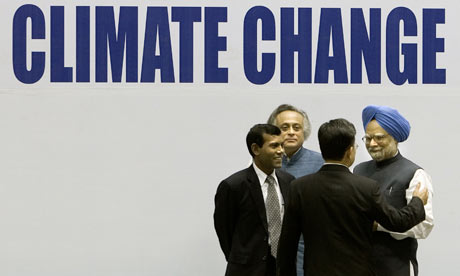
U.N. Undersecretary-General for Economic and Social Affairs, Sha Zukang, back to camera, talks to Indian Prime Minister Manmohan Singh, right, as Maldives President Mohamed Nasheed, left, and Indian Environment Minister Jairam Ramesh, second from left, look on at an international conference on technology and climate change in New Delhi, India, Thursday, Oct. 22, 2009. (AP Photo/Manish Swarup)
(CNSNews.com) – Sen. James Inhofe (R-Okla.), ranking member of the Senate Committee on Environment and Public Works, is calling on Chairman Barbara Boxer (D-Calif.) to conduct hearings on a possible conspiracy between some of the world’s most prominent climatologists to, among other things, manipulate data on so-called global warming.

Inhofe said the recent disclosure of emails between several prominent climatologists reveal “possible deceitful manipulation of important data and research used by the US Global Change Research Program” and the UN’s Intergovernmental Panel on Climate Change.”

He suggested “a possible conspiracy by scientists, some of whom receive or have received US taxpayer funds, to stifle open, transparent debate on the most pressing issues of climate science.”

Inhofe also noted that there appeared to be “a campaign to vilify scientists who question global warming alarmism.”

“For instance,” Inhofe wrote, “one scientist wrote of a ‘trick he employed to ‘hide the decline’ in global temperature trends, as well as discussed attempts to ‘redefine what the peer-review literature is’ to prevent papers raising questions about anthropogenic global warming from appearing in IPCC reports.

“Another scientist stated, ‘The fact is that we can’t account for the lack of warming and it is a travesty that we can’t.’ Still another wrote, “I tried hard to balance the needs of the science and the IPCC, which were not always the same,’” Inhofe added.

The controversy “could have far-reaching policy implications,” Inhofe wrote,” affecting everything from (to name a few) cap-and-trade legislation, state and regional climate change programs,” and the Section 202 (a) of the EPA’s Clean Air Act – policies that “will lead to a torrent of new federal regulations that will destroy thousands of jobs and make electricity and gasoline more expensive for consumers and small businesses.”

Internet Governance Forum kicks off in Egypt

CLICK HERE FOR STORY ON XINHUANET.COM

Ambassador Sha Zukang, the UN Under-Secretary-General for Economic and Social Affairs, addresses the fourth version of the Internet Governance Forum (IGF) in Egypt's Red Sea resort of Sharm el-Sheikh on Nov. 15. 2009. The fourth version of the IGF, a multi-stakeholder dialogue on public policy related to Internet governance issues, kicked off in Sharm el-Sheikh on Sunday, with the participation of 1,500 delegates from 100 countries and regions around the world. (Xinhua/Chen Gongzheng)

Ambassador Sha Zukang, the UN Under-Secretary-General for Economic and Social Affairs, addresses the fourth version of the Internet Governance Forum (IGF) in Egypt's Red Sea resort of Sharm el-Sheikh on Nov. 15. 2009. The fourth version of the IGF, a multi-stakeholder dialogue on public policy related to Internet governance issues, kicked off in Sharm el-Sheikh on Sunday, with the participation of 1,500 delegates from 100 countries and regions around the world. (Xinhua/Chen Gongzheng)
Photo Gallery>>>

SHARM EL-SHEIKH, Egypt, Nov. 15 (Xinhua) -- The fourth version of the Internet Governance Forum (IGF), a multi-stakeholder dialogue on public policy related to Internet governance issues, kicked off Sunday in Egypt's Red Sea resort of Sharm el-Sheikh.

The UN-sponsored annual forum was attended by some 1,500 delegates from 100 countries, who are divided into 80 workshops.

Internet security, cloud computing, IPv6, social networks, openness and privacy are among the hottest topics of the four-day event, whose overall title is "Internet governance -- creating opportunities for all".

"The overall theme for our forum is timely and appropriate," said Ambassador Sha Zukang, the UN Under-Secretary-General for Economic and Social Affairs, at the opening ceremony, adding that "the voice of developing world must be heard."

Ambassador Sha Zukang (2nd L), the UN Under-Secretary-General for Economic and Social Affairs, and Egyptian Prime Minister Ahmed Nazif (2nd R) attend the fourth version of the Internet Governance Forum (IGF) in Egypt's Red Sea resort of Sharm el-Sheikh on Nov. 15. 2009. (Xinhua/Chen Gongzheng)

Ambassador Sha Zukang (2nd L), the UN Under-Secretary-General for Economic and Social Affairs, and Egyptian Prime Minister Ahmed Nazif (2nd R) attend the fourth version of the Internet Governance Forum (IGF) in Egypt's Red Sea resort of Sharm el-Sheikh on Nov. 15. 2009. (Xinhua/Chen Gongzheng)
Photo Gallery>>>

Stressing the urgent need of managing critical resources for Internet development and increasing the penetration of the tool, he said "democratic Internet governance is a means of achieving development for all."

For his part, Egyptian Prime Minister Ahmed Nazif said in a keynote speech that Egypt has benefited from the Internet in recent years.

For Egypt, "ICT (Information and Communications Technology) has become a vital sector as important as Suez Canal and tourism," Nazif said.

According to Nazif, Egypt registered a growth rate of 4.3 percent in the 2008-2009 fiscal year that ended in June, despite the global financial crisis, thanks to the double-digit growth of ICT sector in this period.

Launched in 2006, the IGF revolves around Internet's sustainability, robustness, security, stability and development through wide-ranging workshop discussions.

It has met annually, with participants from governments, private sector, international organizations, civil society and technical communities. The previous three versions were held in Athens in 2006, in Rio de Janeiro, Brazil, in 2007, and in Hyderabad, India in 2008.

Tuesday, 1 December 2009

The Climate Science Isn't Settled


Is there a reason to be alarmed by the prospect of global warming? Consider that the measurement used, the globally averaged temperature anomaly (GATA), is always changing. Sometimes it goes up, sometimes down, and occasionally—such as for the last dozen years or so—it does little that can be discerned.

Claims that climate change is accelerating are bizarre. There is general support for the assertion that GATA has increased about 1.5 degrees Fahrenheit since the middle of the 19th century. The quality of the data is poor, though, and because the changes are small, it is easy to nudge such data a few tenths of a degree in any direction. Several of the emails from the University of East Anglia's Climate Research Unit (CRU) that have caused such a public ruckus dealt with how to do this so as to maximize apparent changes.

The general support for warming is based not so much on the quality of the data, but rather on the fact that there was a little ice age from about the 15th to the 19th century. Thus it is not surprising that temperatures should increase as we emerged from this episode. At the same time that we were emerging from the little ice age, the industrial era began, and this was accompanied by increasing emissions of greenhouse gases such as CO2, methane and nitrous oxide. CO2 is the most prominent of these, and it is again generally accepted that it has increased by about 30%.

The defining characteristic of a greenhouse gas is that it is relatively transparent to visible light from the sun but can absorb portions of thermal radiation. In general, the earth balances the incoming solar radiation by emitting thermal radiation, and the presence of greenhouse substances inhibits cooling by thermal radiation and leads to some warming.

That said, the main greenhouse substances in the earth's atmosphere are water vapor and high clouds. Let's refer to these as major greenhouse substances to distinguish them from the anthropogenic minor substances. Even a doubling of CO2 would only upset the original balance between incoming and outgoing radiation by about 2%. This is essentially what is called "climate forcing."

There is general agreement on the above findings. At this point there is no basis for alarm regardless of whether any relation between the observed warming and the observed increase in minor greenhouse gases can be established. Nevertheless, the most publicized claims of the U.N.'s Intergovernmental Panel on Climate Change (IPCC) deal exactly with whether any relation can be discerned. The failure of the attempts to link the two over the past 20 years bespeaks the weakness of any case for concern.

The IPCC's Scientific Assessments generally consist of about 1,000 pages of text. The Summary for Policymakers is 20 pages. It is, of course, impossible to accurately summarize the 1,000-page assessment in just 20 pages; at the very least, nuances and caveats have to be omitted. However, it has been my experience that even the summary is hardly ever looked at. Rather, the whole report tends to be characterized by a single iconic claim.

The main statement publicized after the last IPCC Scientific Assessment two years ago was that it was likely that most of the warming since 1957 (a point of anomalous cold) was due to man. This claim was based on the weak argument that the current models used by the IPCC couldn't reproduce the warming from about 1978 to 1998 without some forcing, and that the only forcing that they could think of was man. Even this argument assumes that these models adequately deal with natural internal variability—that is, such naturally occurring cycles as El Nino, the Pacific Decadal Oscillation, the Atlantic Multidecadal Oscillation, etc.

Yet articles from major modeling centers acknowledged that the failure of these models to anticipate the absence of warming for the past dozen years was due to the failure of these models to account for this natural internal variability. Thus even the basis for the weak IPCC argument for anthropogenic climate change was shown to be false.

Of course, none of the articles stressed this. Rather they emphasized that according to models modified to account for the natural internal variability, warming would resume—in 2009, 2013 and 2030, respectively.

But even if the IPCC's iconic statement were correct, it still would not be cause for alarm. After all we are still talking about tenths of a degree for over 75% of the climate forcing associated with a doubling of CO2. The potential (and only the potential) for alarm enters with the issue of climate sensitivity—which refers to the change that a doubling of CO2 will produce in GATA. It is generally accepted that a doubling of CO2 will only produce a change of about two degrees Fahrenheit if all else is held constant. This is unlikely to be much to worry about.

Yet current climate models predict much higher sensitivities. They do so because in these models, the main greenhouse substances (water vapor and clouds) act to amplify anything that CO2 does. This is referred to as positive feedback. But as the IPCC notes, clouds continue to be a source of major uncertainty in current models. Since clouds and water vapor are intimately related, the IPCC claim that they are more confident about water vapor is quite implausible.

There is some evidence of a positive feedback effect for water vapor in cloud-free regions, but a major part of any water-vapor feedback would have to acknowledge that cloud-free areas are always changing, and this remains an unknown. At this point, few scientists would argue that the science is settled. In particular, the question remains as to whether water vapor and clouds have positive or negative feedbacks.

The notion that the earth's climate is dominated by positive feedbacks is intuitively implausible, and the history of the earth's climate offers some guidance on this matter. About 2.5 billion years ago, the sun was 20%-30% less bright than now (compare this with the 2% perturbation that a doubling of CO2 would produce), and yet the evidence is that the oceans were unfrozen at the time, and that temperatures might not have been very different from today's. Carl Sagan in the 1970s referred to this as the "Early Faint Sun Paradox."

For more than 30 years there have been attempts to resolve the paradox with greenhouse gases. Some have suggested CO2—but the amount needed was thousands of times greater than present levels and incompatible with geological evidence. Methane also proved unlikely. It turns out that increased thin cirrus cloud coverage in the tropics readily resolves the paradox—but only if the clouds constitute a negative feedback. In present terms this means that they would diminish rather than enhance the impact of CO2.

There are quite a few papers in the literature that also point to the absence of positive feedbacks. The implied low sensitivity is entirely compatible with the small warming that has been observed. So how do models with high sensitivity manage to simulate the currently small response to a forcing that is almost as large as a doubling of CO2? Jeff Kiehl notes in a 2007 article from the National Center for Atmospheric Research, the models use another quantity that the IPCC lists as poorly known (namely aerosols) to arbitrarily cancel as much greenhouse warming as needed to match the data, with each model choosing a different degree of cancellation according to the sensitivity of that model.

What does all this have to do with climate catastrophe? The answer brings us to a scandal that is, in my opinion, considerably greater than that implied in the hacked emails from the Climate Research Unit (though perhaps not as bad as their destruction of raw data): namely the suggestion that the very existence of warming or of the greenhouse effect is tantamount to catastrophe. This is the grossest of "bait and switch" scams. It is only such a scam that lends importance to the machinations in the emails designed to nudge temperatures a few tenths of a degree.

The notion that complex climate "catastrophes" are simply a matter of the response of a single number, GATA, to a single forcing, CO2 (or solar forcing for that matter), represents a gigantic step backward in the science of climate. Many disasters associated with warming are simply normal occurrences whose existence is falsely claimed to be evidence of warming. And all these examples involve phenomena that are dependent on the confluence of many factors.

Our perceptions of nature are similarly dragged back centuries so that the normal occasional occurrences of open water in summer over the North Pole, droughts, floods, hurricanes, sea-level variations, etc. are all taken as omens, portending doom due to our sinful ways (as epitomized by our carbon footprint). All of these phenomena depend on the confluence of multiple factors as well.

Consider the following example. Suppose that I leave a box on the floor, and my wife trips on it, falling against my son, who is carrying a carton of eggs, which then fall and break. Our present approach to emissions would be analogous to deciding that the best way to prevent the breakage of eggs would be to outlaw leaving boxes on the floor. The chief difference is that in the case of atmospheric CO2 and climate catastrophe, the chain of inference is longer and less plausible than in my example.


Monday, 30 November 2009

DESA's Sha Zukang at forefront of CLIMATEGATE

COP15 climate change conference :Sha Zukang, Manmohan Singh, Mohamed Nasheed, Jairam Ramesh

UN under-secretary general for economic and social affairs, Sha Zukang, back to camera, talks to Indian Prime Minister Manmohan Singh, as Maldives President Mohamed Nasheed, left, and Indian environment minister Jairam Ramesh look on. Photograph: Manish Swarup/AP

Lord Monckton: Shut Down The UN, Arrest Al Gore

Listen to Alex Jones


CLICK HERE FOR THE STORY ON PRISONPLANET.COM

Anti-climate cult crusader calls for world to rise up against communistic killers behind global warming fraud

Lord Monckton: Shut Down The UN, Arrest Al Gore 281109top

Paul Joseph Watson
Prison Planet.com
Saturday, November 28, 2009

Appearing on The Alex Jones Show yesterday, Lord Christopher Monckton went further than ever before in his vehement opposition to the elitists running the climate change scam, calling for the UN to be shut down and for fraudulent peddlers of global warming propaganda like Al Gore to be arrested and criminally prosecuted.

Monckton said that those who are threatening to shut down economies, bankrupt nations, and deepen the problems of the third world by implementing draconian policies in the name of global warming should be indicted, prosecuted and imprisoned “for a very long time”.

“The fraudsters and racketeers from Al Gore to the people at the University of East Anglia who have been making their fortune at the expense of taxpayers and the little guy,” should be criminally charged, said Monckton, in response to the climategate scandal.

“We the people have got to rise up worldwide, found a party in every country which stands for freedom and make sure we fight this bureaucratic communistic world government monster to a standstill – they shall not pass,” he added.

Monckton said that the United Nations should be “closed down,” adding that he talked to a senior UN ambassador in Canada who told him that he no longer saw any purpose in the UN and it exists “only to enrich itself at the expense of the nations it claims to serve, it’s time it was brought to an end.”

“We would all save billions if we shut down the UN and just about all of its hideous bureaucracy,” said Monckton.

Lord Monckton emphasized how the emails released as a result of climategate prove that global warming alarmism was still prevalent in public but behind closed doors, warmist scientist are admitting that the “deniers” as they label people like Monckton are correct.

“Publicly they’re saying the science is settled, we’re all doomed unless you close down the economies of the west, whereas privately they’re saying to each other ‘we’ve got it wrong, none of this adds up and it’s a travesty that we can’t explain it’.”

(ARTICLE CONTINUES BELOW)

Monckton also slammed Obama’s science czar John P. Holdren, who in his 1977 book Ecoscience called for draconian population measures to be enforced by a “planetary regime” in the name of saving the earth, as an “openly admitted communist”.

Monckton pointed out how Holdren had been once of the most prominent alarmists in the 70’s warning about the onset of rapid “global cooling”.

“Now with seamless mendacity he says that what we’re now facing is global warming,” said Monckton.

“How can anyone like Holdren stand up with a straight face and expect anyone to believe it,” he added.

Monckton said that the agenda behind the global warming movement was to set up a communistic world government which will be run by people who “do not care how many people they kill with their policies” and that their goal is to “do away with democracy forever by stealth using the excuse to save the planet.”

Monckton said that the people running the scam had a “deliberate desire to control population by killing people in large numbers deliberately if necessary.”

The former advisor to Margaret Thatcher said that the warmists were sounding more and more desperate and knew that they had been rumbled as a result of climategate, which would only make it more urgent for them to try and force through a binding treaty in Copenhagen.

Monckton said that the answer to combating the move towards neo-feudalism and global government was to form a worldwide “freedom party” that would operate nationally in every country in order to defend freedom, democracy and prosperity while routing out every aspect of the communistic takeover.

“Every time these people try to take it away, we in the freedom party will stop them, and I think now is the time,” said Monckton.

Shocking UN Document Divulges Climate Cult Brainwashing

Listen to Alex Jones


Kids coerced into performing global warming song as strategy document reveals plan to greenwash young minds by turning environmentalism into gaia religion

Shocking UN Document Divulges Climate Cult Brainwashing 301109top2

Paul Joseph Watson
Prison Planet.com
Monday, November 30, 2009

With the reverberations of climategate still echoing, it has now emerged that children are being greenwashed in public schools by being forced to sing climate cult ditties and hate their parents as part of a United Nations propaganda program aimed at capturing young minds, as the UN itself officially acknowledges the global warming mantra as a new religion.

A shocking new UN strategy document also reveals how elitists are recruiting members of academia from all over the globe in an effort to hide the “end-run” around national sovereignty that their program represents.

“When did global warming turn into a forced religion?,” asks the New York Post’s Andrea Peyser as she tells the story of how her daughter came home from school singing the words ” . . . You can hear the warning — GLOBAL WARMING . . . “.

“All the kids had been coerced into singing this catchy ditty, which we called “The Warming Song,” at a concert for parents. Further song lyrics scolded selfish adults (that would be us) for polluting our planet and causing a warming scourge that would, in no short order, kill all the polar bears and threaten the birds and bees,” writes Peyser.

That’s right, in the spirit of the Club of Rome’s 1991 resolution to make humanity the enemy in creating the contrived threat of environmental armageddon, children have been turned against their own parents in the service of a new gaia religion.

“In searching for a new enemy to unite us, we came up with the idea that pollution, the threat of global warming, water shortages, famine and the like would fit the bill. All these dangers are caused by human intervention, and it is only through changed attitudes and behavior that they can be overcome. The real enemy then, is humanity itself.,” they wrote in a report entitled “The First Global Revolution”.

“Our children are on the front lines of the warming hysteria, a place where “experts” from Al Gore to the president leave no room for dissent or even the slightest skepticism, despite claims that are no more provable than the Earth is flat.,” says Peyser.

(ARTICLE CONTINUES BELOW)

A newly uncovered document sheds some light on the genesis of how such brainwashing found its way into our schools.

A strategy paper for the United Nations Environmental Program (UNEP), the world’s would-be environmental watchdog, reveals how the global elite in charge of the green takeover resolved that, “Environmentalism should be regarded on the same level with religion “as the only compelling, value-based narrative available to humanity,” according to a Fox News report.

This approach follows a similar tack to the new methods adopted by Al Gore, who in his recent presentations has delivered his message as a kind of religious sermon, acknowledging, “Simply laying out the facts won’t work.”

The UN planning paper outlines a program of implementing a global system of governance based around environmental regulations and laws, stressing the agenda for the “evolutionary nature of strengthening international environmental governance.”

Participants included Janos Pasztor, currently head of the team pushing U.N. Secretary General Ban Ki-moon’s unprecedented Seal the Deal lobbying campaign to pressure U.N. member governments into signing a new environmental agreement at Copenhagen, Dominic Waughray, currently head of environmental initiatives at the World Economic Forum; and Maria Ivanova, and Bulgarian academic Maria Ivanova, director of the Global Economic Governance Project at the Yale Center for Environmental Law and Policy.

A core element of the program includes, “an extensive propagandizing role for UNEP that reaches beyond its member governments and traditional environmental institutions to “children and youth”.

“Civil society, including children and youth, and the private sector will be reached through tailor-made outreach products and campaigns,” states the document.

The document discusses recruiting academia to further the power of UNEP, noteworthy in light of the recent climategate scandal where scientists at major universities were caught hiding evidence of global cooling.

As the Swiss paper puts it, UNEP “should pioneer a new style of work. This requires going beyond a narrow interpretation of UNEP’s stakeholders as comprising its member states — or even the world’s governments — and recruiting a far wider community of support, in civil society, the academic world and the private sector.” At the same time the paper warns that these groups need to be “harnessed to the UNEP mission without appearing to make an end-run around the member governments.”

This passage is fairly damning, as the UN is all but admitting that the program does represent an “end-run around member governments,” and that they have to do their best to hide the fact.

The goals enshrined in the document, a counterpart to the globally binding agreement the UN is seeking to achieve in Copenhagen next month, are “certain to remain a UNEP rallying cry long after the Copenhagen meeting is over — and while the other brainstorming ideas that went into the new four-year strategy, not to mention the strategy itself, go into effect,” writes Fox News’ George Russell.

This document represents yet another smoking gun proving that the climate cult movement is all about expanding the power of a dictatorial, unelected global government, diluting powers of nation states, seizing control of the global economy, eviscerating the middle class with a raft of new regulations and laws, and shutting down industry with impossible CO2 reduction mandates, while erecting environmentalism, which is really a thin veil for global fascism, as the new universal religion.

This has nothing to do with saving the earth and, as the climategate scandal has illustrated, nothing to do with the real science – but everything to do with a relatively small clique of globalists running roughshod over humanity itself in pursuit of their malthusian control freak agenda.

UN/DESA Policy Brief: Reaching a Climate Deal in Copenhagen

A new policy brief by Imran Habib Ahmad of the UN’s Development Policy & Analysis division draws the following conclusions:

* Conservative estimates peg total developing-country financing needs for mitigation and adaptation at about $250 billion per year. This would be on the order of 0.5 to 1 per cent of world gross product by 2030;
* Current available bilateral and multi-lateral aid is in the order of $10-20 billion, with perhaps $5 billion more in the pike from current proposals;
* Funding for adaptation and mitigation programs must not be voluntary but tied to agreed long-term commitments, based e.g. on pro rata mechanisms (such as levied percentages of financial flows, mandatory contributions in relation to GDP). Specific options should be considered include include taxes on capital flows or on international transport, energy use or emissions, or volumes of transactions in carbon markets, and permit auctioning.

Prepared by:


Imran Habib Ahmad (UN-DESA) and

JJohannes (Hans) B. Opschoor

(Institute of Social Studies, the Hague and member of the United Nations Committee for Development Policy)


For further information please contact:


Imran Habib Ahmad,

Senior Economic Affairs Officer

Development Policy and Analysis Division,

Department of Economic and Social Affairs, Rm. DC2-2024

United Nations, New York, NY 10017, U.S.A.

Tel: +1 212 963-4687 • Fax: +1 212 963-1061

e-mail: ahmad33@un.org • website: http://www.un.org/esa/policy

UNDESA High-Level Meeting on Climate Change, Technology Development and Transfer Develops Final Statement


23 October 2009: The UN Department of Economic and Social Affairs (UNDESA) and the Government of India convened a high-level meeting on climate change, technology development and transfer in New Delhi, India, from 22-23 October 2009.

UN Under-Secretary-General for Economic and Social Affairs Sha Zukang opened the meeting, noting that it would build on a similar conference that convened in Beijing, China, in 2008, and suggesting that it could “send a clear message to Copenhagen that there is a way forward on technology cooperation and technology sharing.”

Yvo de Boer, UNFCCC Executive Secretary, outlined five essential components for an agreement in Copenhagen: enhanced action to assist the most vulnerable and the poorest in adapting to the impacts of climate change; ambitious emission reduction targets for all industrialized countries on an individual basis; nationally appropriate mitigation actions by developing countries to limit the growth of their emissions, while safeguarding economic growth and sustainable development, with the necessary support; significantly scaled-up financial and technological resources; and an equitable governance structure to guide financial resources. He said the decision on technology would need to provide clarity on: who pays and how cost is shared; what the funding will be used for; and how the funding will be channeled towards the desired result. He also identified elements that could be included in a mechanism for technology development and transfer under the UNFCCC.

The final statement from the meeting indicates participants “believe that there is an urgent need to accelerate the large scale global deployment of environmentally-sound and climate-friendly technologies and to minimize the time lag between their initial development, transfer and deployment particularly in the developing countries,” and suggests creating centres or networks of centres to stimulate deployment of technologies. [UNFCCC Executive Secretary’s statement] [Meeting website] [Final statement]

UN DESA Climate Change Working Group Prepares Policy Briefs on Forests and Climate Change


© UNDESA22 April 2009: The UN Department of Economic and Social Affairs (UN DESA) Climate Change Working Group has prepared two policy briefs on forests and climate change. Policy Brief 15 addresses finance for forests and climate change, and Policy Brief 16 addresses reducing emissions from deforestation and forest degradation (REDD).


Policy Brief 15, titled “Finance for Forests and Climate Change,” concludes that the “global climate change agreement should include actions on deforestation and forest degradation within the wider context of sustainable forest management.” It also suggests that: funding should be provided from various public and private sources including those mobilized through carbon trading; international action is urgently required to support developing countries in building capacity and preparing for forest carbon programmes; and negotiations on REDD and its financing have to be based on the broader and comprehensive framework of sustainable forest management.

Policy Brief 16, titled “Forests: the Green and REDD of Climate Change,” suggests that financial resources expected to be allocated to forests for climate change programmes, including through REDD, should be mutually supportive of financing sustainable forest management. It suggests that extensive capacity building and training activities should be developed “to enhance the capacity of developing countries for transparent, inclusive and accountable forest governance.” It also highlights monitoring, reporting and verification to enable countries to apply methodologies for estimating and monitoring carbon emissions from deforestation and forest degradation under REDD. [Policy Brief 15] [Policy Brief 16]

Prepared by:


DESA Climate Change Working Group


For further information please contact:


Hossein Moeini-Meybodi

United Nations Forum on Forests

Department of Economic and Social Affairs, Rm. DC1-1248

United Nations, New York, NY 10017, U.S.A.

Tel: +1 212 963-5949 • Fax: +1 917 367-3186

e-mail: moeini-meybodi@un.org • website: http://www. un.org/esa/policy

Climategate Scandal Heats Up, As Researcher "Accidentally" Deleted Data

It would appear that the Climategate scandal, the hacked emails from the Climatic Research Unit at the University of East Anglia in the U.K. revealing that scientists distorted climate changevdata, is not going to cool off anytime soon.

Climate change skeptics are fired up about the "accidental" deletion of temperature data by head of the CRU Phil Jones and the bogus data aggregation procedure used by scientists that "renders the [temperature readings] totally meaningless," but what gets some people's goats the most is the fact that the University of East Anglia is still denying that there was any wrong doing.

The Washington Times: We read and reread these CRU documents in stunned amazement. But rather than investigating all the evidence of so much academic fraud and intellectual wrongdoing, the University of East Anglia is denying there is a problem. Professor Trevor Davies, the school's pro vice chancellor for research, issued a defensive statement on Tuesday claiming: "The publication of a selection of the emails and data stolen from the Climatic Research Unit (CRU) has led to some questioning of the climate science research published by CRU and others. There is nothing in the stolen material which indicates that peer-reviewed publications by CRU, and others, on the nature of global warming and related climate change are not of the highest-quality of scientific investigation and interpretation."...

Read the whole thing here.