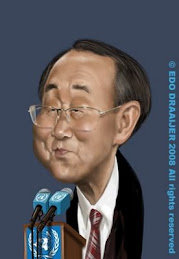
Former U.S. Ambassador to the United Nations John Bolton delivers a clear — and dire — message in a Newsmax magazine special report: Iran's quest for nuclear weapons poses a grave and immediate threat to the United States and world peace.
Showing posts with label united states. Show all posts
Showing posts with label united states. Show all posts
Sunday, 22 April 2012

Monday, 3 October 2011
Globalization’s Government
Jeffrey D. Sachs @ Project-Syndicate.org
NEW YORK – We live in an era in which the most important forces affecting every economy are global, not local. What happens “abroad” – in China, India, and elsewhere – powerfully affects even an economy as large as the United States.
Economic globalization has, of course, produced some large benefits for the world, including the rapid spread of advanced technologies such as the Internet and mobile telephony. It has also reduced poverty sharply in many emerging economies – indeed, for this reason alone, the world economy needs to remain open and interconnected.
Yet globalization has also created major problems that need to be addressed. First, it has increased the scope for tax evasion, owing to a rapid proliferation of tax havens around the world. Multinational companies have many more opportunities than before to dodge their fair and efficient share of taxation.
Moreover, globalization has created losers as well as winners. In high-income countries, notably the US, Europe, and Japan, the biggest losers are workers who lack the education to compete effectively with low-paid workers in developing countries. Hardest hit are workers in rich countries who lack a college education. Such workers have lost jobs by the millions. Those who have kept their jobs have seen their wages stagnate or decline.
Globalization has also fueled contagion. The 2008 financial crisis started on Wall Street, but quickly spread to the entire world, pointing to the need for global cooperation on banking and finance. Climate change, infectious diseases, terrorism, and other ills that can easily cross borders demand a similar global response.
What globalization requires, therefore, are smart government policies. Governments should promote high-quality education, to ensure that young people are prepared to face global competition. They should raise productivity by building modern infrastructure and promoting science and technology. And governments should cooperate globally to regulate those parts of the economy – notably finance and the environment – in which problems in one country can spill over to other parts of the world.
The need for highly effective government in the era of globalization is the key message of my new book, The Price of Civilization. Simply put, we need moregovernment nowadays, not less. Yet the role of government also needs to be modernized, in line with the specific challenges posed by an interconnected world economy.
I wrote The Price of Civilization out of the conviction that the US government has failed to understand and respond to the challenges of globalization ever since it began to impact America’s economy in the 1970’s. Rather than respond to globalization with more government spending on education, infrastructure, and technology, Ronald Reagan won the presidency in 1980 by pledging to slash government spending and cut taxes.
For 30 years, the US has been going in the wrong direction, cutting the role of government in the domestic economy rather than promoting the investments needed to modernize the economy and workforce. The rich have benefited in the short run, by getting massive tax breaks. The poor have suffered from job losses and cuts in government services. Economic inequality has reached a high not seen since the Great Depression.
These adverse trends have been exacerbated by domestic politics. The rich have used their wealth to strengthen their grip on power. They pay for the expensive campaigns of presidents and congressmen, so presidents and congressmen help the rich – often at the expense of the rest of society. The same syndrome – in which the rich have gained control of the political system (or strengthened their control of it) – now afflicts many other countries.
Yet there are some important signs around the world that people are fed up with governments that cater to the rich while ignoring everyone else. Start with the growing calls for greater social justice. The upheavals in Tunis and Cairo were first called the Arab Spring, because they seemed to be contained to the Arab world. But then we saw protests in Tel Aviv, Santiago, London, and now even in the US. These protests have called first and foremost for more inclusive politics, rather than the corrupt politics of oligarchy.
Moreover, US President Barack Obama is gradually shifting toward the left. After three years in which his administration coddled corporate lobbyists, he has finally begun to emphasize the need for the rich to pay more taxes. This has come late in his term, and he might well continue to favor the rich and Wall Street in exchange for campaign contributions in 2012, but there is a glimmer of hope that Obama will defend a fairer budget policy.
Several European governments, including Spain, Denmark, and Greece, also seem to be moving in the same direction. Spain recently imposed a new wealth tax on high-net-worth taxpayers. Denmark elected a center-left government committed to higher government spending financed by new taxes on the rich. And Greece has just voted for a new property tax to help close its yawning fiscal deficit.
The European Commission has also called for a new Financial Transactions Tax (FTT) to raise around $75 billion per year. The Commission has finally agreed that Europe’s financial sector has been under-taxed. The new FTT might still face political opposition in Europe, especially in the United Kingdom, with its large and influential banking sector, but at least the principle of greater tax fairness is high on the European agenda.
The world’s most successful economies today are in Scandinavia. By using high taxes to finance a high level of government services, these countries have balanced high prosperity with social justice and environmental sustainability. This is the key to well-being in today’s globalized economy. Perhaps more parts of the world – and especially the world’s young people – are beginning to recognize this new reality.
Jeffrey D. Sachs is Professor of Economics and Director of the Earth Institute at Columbia University. He is also Special Adviser to United Nations Secretary-General on the Millennium Development Goals.
Thursday, 17 February 2011
UNPAN applauds Canada's open data strategy - the question is when would DESA's UNPAN open itself up to the world on its own project data?
Civil servants forge ahead with open data strategy

OTTAWA— Civil servants are forging ahead with an open-data strategy for the federal government while politicians drag their heels on a formal policy.
A parliamentary committee has been studying the issue since last April and resumes debate this week, but documents obtained under Access to Information show that bureaucrats started drafting a plan in July.
Unlike the United States and Britain, Canada has no formal federal policy of making raw, taxpayer-funded data freely available to the public.
Civil servants have realized that needs to change.
At the July meeting to kick off the strategy, they drafted a five-point plan.
The goal was "to create economic opportunity and promote informed participation by the public by expanding access to federal government data," said a copy of the presentation.
Part of the plan was expected to launch last fall.
It would include a common "front door" to government data, a searchable catalogue and easy downloading, said a report to a set of OECD meetings on public governance, held in Venice in November.
"It will also encourage users to develop applications that re-use and combine government data to make it useful in new and unanticipated ways, creating new value for Canadians," said the Canadian chapter of the OECD report.
But the roll-out has bogged down over issues such as bilingualism, licensing and security.
"We are not able to confirm timing of the launch at this time," said an email from Pierre-Alain Bujold, a spokesperson for Treasury Board, which oversees the project.
Liberal MP Shawn Murphy, chairman of the Commons committee studying open data, said he was unaware of the plan.
"They haven't told us yet," he said.
"But that doesn't surprise me. There is an appetite in the public to get this done."
Part of the committee's work includes seeking submissions from the public.
Advocates for open data have made their positions clear -- two of the top three ideas submitted to the federal government's digital economy consultations were for more access to public sector and data.
Supporters say greater access would save the government money.
"Canadians often pay multiple times for the same data, since each level of government also purchases the same data, federal departments purchase these data from each other," wrote Tracey Lauriault, a researcher at Carleton University who also runs a blog about open government.
The fact that the bureaucracy is moving ahead without clear political direction isn't that unusual, suggested David Eaves, a leading advocate for more transparency in government information.
"We already have a policy infrastructure for dealing with most of the open data that's out there because we already have open data," he said.
The July presentation suggested the strategy begin simply with the data already in the public domain.
At a website called datadotgc.ca, Eaves has set up a clearinghouse for government information that's available online now.
Natural Resources Canada leads the way with 222 sets, but after that it's only dribs and drabs of what's available for free.
But it's not just about creating a portal to what is there, suggested Alberta Senator Elaine McCoy.
"You can find a lot of stuff just using Google," she said.
"What excites me is having the raw data in machine-readable form, so that I could just quickly capture it with my computer in a nanosecond and then be immediately able to mash it up."
McCoy and a group of programmers tried to create such a mashup out of data from the Harper government's Economic Action Plan.
They wanted to track stimulus spending across the country to see how it was being used, but the plan failed when the data wasn't available.
What's holding back the data isn't technology, but the desire of both the political leadership and the civil service to control their messages, McCoy said.
"You can't do that if your databases are wide open, because somebody can come in and take a look at them and say excuse me, I think your interpretation is not the correct one."
At the municipal level, Edmonton, Ottawa, Calgary, Vancouver and London, Ont., are leading the way in opening up databases.
The information released has been used for everything from mapping restaurant inspections to the development of applications that track transit arrival times.
While it's trickier to think of daily uses of federal data, that doesn't mean it shouldn't be available, Eaves said.
"The great thing about this stuff is you don't know what people are going to find that's going to be successful and innovative and adding value," he said.
"If we knew, then we'd be doing it, but we don't and we don't even get a chance."
Monday, 10 January 2011
Dambisa Moyo: without change US will almost certainly become a socialist nation
Click here for story on Telegraph.co.uk

Economist Dambisa Moyo predicts in her new book that the West's economic dominance will collapse unless some very difficult choices are made.
9:30PM GMT 08 Jan 2011
Dambisa Moyo is that rare type of person – an economist who makes waves. Her first book, Dead Aid, angered many in the charity sector by arguing that foreign aid has harmed Africa and should be phased out.
Her second, which is published in London on Thursday, accuses America and other Western powers of squandering their world economic dominance through a sustained catalogue of fundamentally flawed policies.
How the West Was Lost: Fifty Years of Economic Folly – And the Stark Choices Ahead goes so far as to predict that the US will be a “bona fide socialist welfare state” by the latter part of this century.
“Indeed, if nothing else changes it from its current path,” writes Moyo, “it is almost certain that America will move from a fully-fledged capitalist society of entrepreneurs to a socialist nation in just a few decades.
“The trouble is, it won’t be just any socialist welfare state... the US is on a path to creating the worst and most venal form of welfare state [poorly developed and designed] – one born of desperation from many years of flawed economic policies and a society that rapaciously feeds on itself.”
There’s plenty more. If current trends continue unabated, Moyo goes much further than the usual surveys predicting when China will surpass the US in GDP – she suggests China’s new hegemony could include the “redback” renminbi replacing the “greenback” dollar as the world’s favourite currency.
“Think about it,” she urges Americans. “Foreign exchange share prices, the price of copper, the price of oil, all in Chinese renminbi.”
The US and other Western powers will be reduced to second division players and the new global powerhouses will not just be China. Forget East versus West. It’s now the Rest versus the old West.
If Dead Aid was labelled “provocative and incendiary”, How the West Was Lost will likely see reviewers’ lexicons raided for even more emotive language. However, Zambian-born Moyo, 41, is not afraid of being a pioneer. The London-based former Goldman Sachs economist is arguably one of the most powerful women in British business, sitting on the boards of FTSE 100 constituents Barclays and brewing giant SAB Miller.
Last year, she featured in Time magazine’s list of the world’s 100 most influential people and also appeared in Oprah Winfrey’s power list of “20 remarkable visionaries”. She is also one of the World Economic Forum’s “young global leaders” and last year took part in the power-broking Bilderberg Conference, frequented by the world’s movers and shakers.
So what has led her to aim fire at the West’s leaders, struggling as they are with budget deficits and waning economies? The answer, she says, is that she believes the global economy is at an inflexion point in terms of where it goes from here.
“I wanted to write a book that is one-stop shopping for where we are in the world today,” she says. “There’s so much focus on dealing with tactical issues to do with the emergency solution, which are all necessary of course. But people are missing the bigger issues because the way the political structure is set up encourages you to focus on the immediate, rather than what I would say are the important issues, the structural things which have been going on for 50 odd years.
“I hope the book will be picked up by people who are saying: ‘I don’t want to hear all this noise. I just want a clean perspective on what the heck is going on around the world and how is it that we have got to this point.’ ”
So how have we? Apparently with the best of intentions. Moyo says the idea of unintended consequences is a running theme in both Dead Aid and How the West Was Lost, with policies that Western populations have rallied around as great ideas turning out to produce detrimental results.
In this way, she says, Western governments have implemented laudable notions like the idea that everyone should have a roof over their head, receive access to food and be supported in old age
by pensions. These have led to unfortunate outcomes in terms of capital, labour and productivity, the key ingredients for economic growth.
It’s not just the US. “There are tons of examples of UK and European mistakes,” she says. “A classic one is pensions. That’s obviously not an America-specific thing. The British and European economies are suffering under the weight of what is to come. The next great Ponzi scheme after Madoff is probably pensions. Also, it’s not just the United States where performance is declining in a very detrimental and rapid way in maths and science and reading. It’s also very much a problem in the UK.
“And if you compare 1950-1980 with 1980-2000, in terms of GDP growth in the US and many European countries, it’s been exactly the same. Yet between 1950 and 1980, people were living in pretty protectionist regimes and between 1980 and 2000 there was much more capital and trade flows. In addition, real wages have been relatively flat in the US and Europe, so taken together you have a question about whether globalisation, which is another great idea on paper, has actually worked in practice. Has it helped Americans? Has it helped the British people?”
Is there still time to fix these problems? Yes, she says, but the choices are going to be very difficult and may need to be facilitated through political changes, for example in the terms of governments, so they have more incentives to think longer-term.
“We all know what the problems are,” she says. “Which is why I actually think the coalition Government is brilliant because so far they have been able to implement some of the hardest choices of the austerity measures in an environment where it’s much less politicised than if it was just a left-wing or right-wing government in power. You kind of need to strip out the politics.”
It also may require a change of mindset, with Moyo arguing that governments need people who are absolutely focused on long-term structural issues such as education, deficit management, energy, food commodities, longer-term productivity and infrastructure. “The problems have been highlighted but where’s the plan for those issues? There isn’t one.”
It’s these sorts of awkward questions that Moyo seems to most like posing. In Dead Aid she argued that more than $1 trillion of development aid from Western governments to Africa over the past 50 years has not helped Africa but has ruined it, with millions of people poorer because of aid.Destroying the myth that aid works, she said, means making charity history.
Former United Nations Secretary-General Kofi Annan agreed, saying that Moyo made a compelling case for a new approach to Africa, while Rwandan president Paul Kagame bought copies of Dead Aid for his entire cabinet. Some others were not so complimentary, however, with David Roodman, a research fellow at the Centre for Global Development, calling the book “sporadically footnoted, selective in its use of facts, sloppy, simplistic, illogical and stunningly naive”. The pro-aid organisation ONE claimed Dead Aid was “reckless”.
Moyo is unmoved. “I was actually pleasantly surprised,” she says. “I thought it would be much more fractious and that there would be many more NGOs and governments that would be incredibly hostile to the message, but it was actually to the contrary.
“I think there’s clearly a fringe group. I can probably count on one hand the organisations that took a lot of offence and I would argue that many of them have a bigger agenda than trying to help resolve the Africa problem. But a lot of NGOs have approached me. Some asked me to join their boards.
“Many of them just asked for advice because they genuinely want to see a turnaround. I think there’s no doubt in anybody’s mind, whether you love or hate aid, that there’s clearly something wrong. There’s clearly a problem with a system that has not delivered economic growth and reduced poverty for 50 years. Nobody can tell me that things are working swimmingly in Africa. they ain’t.”
Born and raised in Lusaka, Moyo achieved a chemistry degree and MBA at Washington DC’s American University, a doctorate in economics from Oxford University and a masters from Harvard University’s Kennedy School of Government before working as a consultant at the World Bank and then for nearly a decade at Goldman.
“I don’t think my background in Zambia has really affected my lens because my classical training has been Western-style,” she says. “But it’s fantastically fortuitous to have been born African because I don’t feel I have a vested interest to the US or China or wherever.
I feel like I have an impartial perspective on the way the world works. Coming from a continent that’s arguably on the bottom rung, it’s just amazing to see how things operate.”
It certainly hasn’t stopped her from becoming a pronounced free marketeer.
“I think the markets can work in a managed way,” she says. “If they’re left to run rampant it’s obviously problematic, but I think they are the best way of delivering economic benefits and have been shown to be the method to generate the biggest economic benefits to the highest number of people.”
What does she make of the current furore over banker bonuses? “I think some of the proposals coming from Europe are quite interesting,” she says with understatement.
“I’ve seen that they’re going to require vesting schedules on how you get your bonus and there will be caps on what proportion you can earn in cash. There are some interesting things but bonuses are on the whole a red herring. They were an easy target.
“Yes, there might be a need to change things but I think there are more serious things to be addressed. It may be a negative externality of a system but they’re not illegal.
They’re the creation of a system and the only reason that government might be involved in this type of discussion is because they did bail out the banks.
“But beyond that what relevance is there to a broader economy which has some very serious problems in education and health care? I think they are more interesting [than those issues].”
That will please Barclays’ new chief executive, Bob Diamond, but Moyo won’t discuss her non-executive jobs or her time at Goldman, which she clearly doesn’t view as a “great vampire squid”, as Rolling Stone infamously described the investment bank.
She’s already focusing on her next book. Which urban myths does she want to demolish next? “I know what it will be about but I’m not telling,” she smiles.
First, she’ll have to deal with a backlash from proud Americans who don’t agree that the West has been lost.
Thursday, 9 December 2010
UN rapporteur says Assange shouldn't be prosecuted
 CLICK TO VIEW THIS ON ABC AUSTRALIA
Frank La Rue says he doesn't think that the United States Government will be able to make a case against Julian Assange. But he warns it would set a very bad example for free speech if it did take action against him.
He spoke to me earlier today from his home in Guatemala City:
Frank La Rue you monitor freedom of expression and attempts to curtail it around the world. Do you agree with supporters of WikiLeaks that its founder Julian Assange is now a martyr for free speech?
FRANK LA RUE: It certainly is. If there is a responsibility by leaking information it is of, exclusively of the person that made the leak and not of the media that publish it. And this is the way that transparency works and that corruption has been confronted in many cases.
I do believe there's some types of limitations that I actually drafted in my report in Geneva last year and some basic principles. But essentially they have to be in exceptional form.
They have to be established by law. They have to protect a superior goal and imminent danger. And the legislation has to be prior, it has to be clear so people can actually understand perfectly well what will be limited…
ELEANOR HALL: So do you think given that then that the US Government has any grounds to charge the WikiLeaks founder and to seek his extradition?
FRANK LA RUE: I don't think so. I think with the WikiLeaks founder there's two issues at stake. He supposedly is going to be extradited to Sweden for other types of crime not related at all to freedom of expression.
If that is the case I have nothing to say except that I wish that Sweden or any country where he will be tried give him the full guarantees of due process of law and a full possibility of defence.
But in reference to what has been published in WikiLeaks I think there is no criminal responsibility for being the medium. This is one of the big debates in internet and up to now the general doctrine is that there is no responsibility just to transfer information.
There is a responsibility in I would say in this case in two situations. One is that some statements can clearly be a threat to national security. And the second issue is the personal safety of individuals. Those are the cases that really have to be looked at.
But having said that just the fact that the information is embarrassing information to a government does not make it subject to be blocked or filtered or reprisals to the director/founder of the service.
ELEANOR HALL: So have you made representations to the US Government about their attempts to curtail Julian Assange's activities and to prosecute him?
FRANK LA RUE: Up to now the information we have, and I have been asking, is that they have been talking about prosecution of matters not related to the recent information revealed in WikiLeaks. And I have nothing to add because that's beyond my mandate.
ELEANOR HALL: Well at least one company is alleging today that it's coming under pressure from the US Government to stop dealing with WikiLeaks. Do you have concerns about that?
FRANK LA RUE: I do. And that I do understand that is the case and there I have not been required by this company, all the information I would ask them to handle. But I have made it clear that just the fact that the information is leaked should not be the excuse to pressure any of the enterprises that are serving that information.
ELEANOR HALL: Then there's the counter-attack or payback operation they're calling it from WikiLeaks' supporters. Is that retaliation justified?
FRANK LA RUE: I don't believe in retaliation per se. I believe in defending the principles of freedom of expression. My position is that all expression should be allowed.
ELEANOR HALL: What about the freedom of expression of those who express outrage about WikiLeaks? Should people be allowed to call for a person's assassination for example?
FRANK LA RUE: Never. That is incitement to hatred and violence. And that is, that falls under article 20 of ICCPR (International Covenant on Civil and Political Rights).
I think people can express their outrage and people can say that they feel offended by the content of what's being presented in WikiLeaks. But never to call for harassment or direct action against those that are doing that.
ELEANOR HALL: You work for one of the world's biggest diplomatic organisations. Do you have any concerns about WikiLeaks publishing diplomatic cables? I mean do the political players at the UN also have a right to private conversations or does free speech WikiLeaks-style trump that?
FRANK LA RUE: No I believe there's a right to privacy. And I believe there is a criminal responsibility for those that leak it. But I think that is from those functionaries that are actually leaking the information and not from the medium that is making it public.
ELEANOR HALL: Some are suggesting that the WikiLeaks release of secret documents is a game changer. Does the notion of free speech need to be updated to deal with the realities of the modern flow of information?
FRANK LA RUE: I don't think so. My next report to the Human Rights Council in Geneva in June is going to be precisely on freedom of expression and internet.
And I deal with some issues of that nature - blocking, filtering, criminalisation of some speech; but also with issues of privacy, data protection.
And one issue that no-one is really dealing with for me is crucial is the question of access - accessibility to the internet.
ELEANOR HALL: The US Government seems pretty determined to find some way of charging Julian Assange. Who do you think is going to win this battle?
FRANK LA RUE: I will hope certainly that the principle of freedom of expression is the one that prevails because I believe that even if the US feels embarrassed it will be a bad example if anyone is harassed or charged or prosecuted for that.
ELEANOR HALL: Frank La Rue is the United Nations special reporter on freedom of opinion and expression.
And you can listen to a longer version of that interview on our website later this afternoon which includes his reaction to the WikiLeaks cable that suggested the US authorised its diplomats to spy on UN personnel.
Tuesday, 21 September 2010
10 Things Obama Should Do at the United Nations This Week
CLICK HERE TO VIEW THIS STORY ON The Huffington Post
 Richard Grenell
When Barack Obama was campaigning to be president of the United States in 2008, he frequently promised Americans that he would lead the world. In fact, he and his team relentlessly pounded President George W. Bush for "going it alone" and alienating our friends and allies around the globe. His then-campaign foreign policy advisor and current U.S. Ambassador to the UN Susan Rice even joked about how, if elected, they would repair the damage and lead the UN in a way that the Bush team couldn't.
But after almost 2 years on the job, Rice and Obama haven't been able to garner support from the UN to implement U.S. foreign policy priorities as they said they would. In fact, on Iran, North Korea, Sudan and UN reform, Obama and Rice haven't produced the support Bush garnered. While Rice has touted her performance on one Iran sanctions resolution as unique progress at the UN, her final vote count on that one resolution got more "No" votes than did Bush's five Iran resolutions got in total.
Unfortunately, Rice has also been painfully quiet when faced with resistance and hostility from the enemies of democracy and freedom. As President Obama goes back to the UN this week, there are 10 things he should do to more forcefully push for progress on U.S. priorities and more aggressively defend the U.S.:
- Make clear that the Arizona law the UN attacked was written to stop illegal immigration, not prohibit legal immigration.
- Call out the Human Rights Council for yet another disastrous year of Israel bashing and overlooking rights violators.
- Nominate a U.S. Ambassador level person to tackle UN reform and UN budget waste, fraud, abuse and duplicity.
- Ask Secretary-General Ban Ki-moon to investigate the UN's Intergovernmental Panel on Climate Change to ascertain how erroneous scientific claims were added to official UN reports.
- Make clear that the United States will not unilaterally disarm its nuclear weapons and will not support restrictions on private firearm ownership.
- Call for a total review of every UN peace-keeping operation and end those that aren't making progress.
- Ask the African Union to pressure Sudanese President Omar al-Bashir to end the violence and intimidation of southern Sudan and allow international observers for January's referendum.
- Condemn any global airline tax that the UN is thinking of implementing to pay for climate change initiatives.
- Make clear that his Administration will not become a signatory of the International Criminal Court until significant changes are made to satisfy Senate concerns and protect American personnel overseas.
- Correct the record with the UN press corps that First Lady Michelle Obama doesn't think that being first lady is "hell" but that she is actually very proud to represent the greatest country in the world.
These 10 proposals would go a far way in showing the UN that while the Obama Administration is interested in seeking a kinder, gentler world; it will not allow a further retreat of democracy and human rights just to get along with others.
Subscribe to:
Posts (Atom)