Showing posts with label IMF. Show all posts

Wednesday, 8 August 2012

China Daily: - - China's best play a part on international stage (These are the Chinese players)

China's best play a part on international stage

Click here to read this at China Daily: http://www.chinadaily.com.cn/cndy/2012-08/08/content_15651073.htm


More Chinese than ever are holding key positions in international organizations in recent years, broadening developing countries' influence on the world stage.

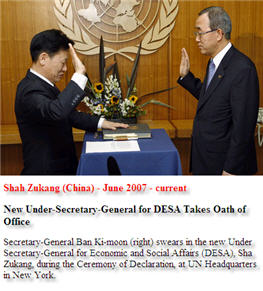
The latest example is Wu Hongbo, former Chinese ambassador to Germany, who was appointed in late May as undersecretary-general for economics and social affairs in the United Nations, replacing Sha Zukang, another Chinese official. Sha had held the position since February 2007.

Before Wu and Sha, Chen Jian was undersecretary-general for General Assembly Affairs and Conference Service of the UN from 2001 to 2007.

Undersecretary-general is the highest position in the UN that can be held by a Chinese citizen, as there is a rule that the UN secretary-general cannot come from the five permanent members of the UN Security Council.

The changes in their areas of responsibility reflect the rise of China's national strength and international influence, said Zhang Yi, deputy director of the Secretariat of the United Nations Association of China.

Chinese officials bring to the table their experience in economic development and addressing the needs of a developing country, adding to the variety and efficiency of international organizations, Zhang said.

In recent years, more Chinese officials have held key positions at international organizations.
In 2011, Zhu Min became the first Chinese to hold the position of deputy managing director of the International Monetary Fund, and Justin Yifu Lin just concluded a four-year term as World Bank chief economist and senior vice-president in June.

Statistics from the UN show that in 2011 China contributed $74.9 million to the organization's annual budget - the eighth most among the 193 UN members.

China currently has less than 500 staff at the UN Secretariat, which is the fewest among the five permanent members of the UN Security Council and fewer than UN members such as Pakistan and Japan, Zhang told China Daily.

The number of UN staff allowed for each member country is determined using a formula that includes demographics and GDP, with budget contributions being a decisive factor.
Holding key positions at international organizations "increases China's voice on the world stage and helps China win more rights in international organizations", said Jin Canrong, deputy dean of the School of International Studies at Renmin University of China.

With the exception of Margaret Chan, director-general of the World Health Organization from Hong Kong, and Wu Jianmin, who was elected president of the International Exhibitions Bureau in 2003, Jin noted that the total number of Chinese officials in decision-making positions at international organizations still lags behind other countries such as India and Japan.

"The increase in the number of high-level Chinese officials in international organizations cannot match the growth of China's national strength, which is likely to harm China's national interests in future, as China contributes an increasing amount of money to these international organizations but still lacks power in decision making," Jin said.

"A country's international position is not only reflected by its own national strength, but also the degree of acceptance by the world," Jin said. "One of the indicators is its participation in international organizations."

The largest difficulty for Chinese citizens working in international organizations is cultural differences, Zhang said. Chinese are used to keeping a low profile and are more concerned with the collective honor of a group, while their Western counterparts are aggressive and highlight personal values, Zhang said. Zhang and Jin said most Chinese staff at international organizations are placed in low-level positions.

The inability to master multiple languages also keeps most Chinese from standing out in the competition to become an international civil servant, Jin said. "Some government departments, which have talents fit for the requirements of international organizations, should let them go instead of hanging on to them," Jin said.

China urgently needs to train more qualified professionals as reserve forces to work in international organizations, Zhang said.

In 2011, the United Nations Association of China and the department of international cooperation at the Ministry of Human Resources and Social Security began co-hosting a training program for international civil servants.

Sponsored by China Ocean Shipping Company, the program has had more than 200 participants in the last two years, mostly university students.

The eight-day program includes an introduction to the UN system, major international issues and lectures by professors and diplomats.

Zhao Liang, 21, participated in the program in 2011. She received an internship with the United Nations Development Programme in China from February to June.

"I hope I can work for the UN in the future, after working at other places and accumulating enough experience to meet the high standards required by the UN," she told China Daily.

Zhao said she will represent China's views and positions when working for an international organization, even though international civil servants are not designated according to a person's home country.

Zhao, who graduated from Renmin University of China this summer, will soon go to the United States to continue her studies in politics.

"I hope this training program will become the starting point of your dreams and a cradle of backup talents for international civil servants from China," Chen, who is president of the UN Association of China, wrote in a foreword for the training program's 2011 student brochure. "It is also expected to help enhance China's capacity in participating in global governance and increase the interest and level of study in international organizations in China," Chen wrote.
chengguangjin@chinadaily.com.cn

Click here to read this at China Daily: http://www.chinadaily.com.cn/cndy/2012-08/08/content_15651073.htm

Tuesday, 31 July 2012

New Assistant Secretary-General for Economic Development takes office

Shamshad Akhtar


photo of desa's asg Shamshad Akhtar

Shamshad Akhtar was appointed by the Secretary-General as Assistant Secretary-General for Economic Development at DESA and took office on 9 July 2012.
Ms. Akhtar has previously served as Governor of the Central Bank of Pakistan and recently also as Vice President of the Middle East and North Africa Region of the World Bank. In her capacity as Governor, Ms. Akhtar served as the Chairperson of the Central Bank Board and its affiliates and as Governor of the IMF. During her term, she was recognized for the conduct of the bank, which was restructured significantly, the introduction of an analytical framework for monetary policy, and the development of a ten-year-vision for the finance industry with a vibrant structure for the banking sector. For these accomplishments, she won two consecutive awards as Asia's Best Central Bank Governor from Emerging Markets and the Banker’s Trust. In 2008, The Asian Wall Street Journal also recognized her as one of the top ten professional women of Asia.
Ms. Akhtar has had a long standing career with the Multilateral Development Banks (MDBs). In her assignment for the World Bank she spearheaded the Bank’s response to the Arab Spring and the Arab regional integration strategy and its implementation. She has served the Asian Development Bank (ADB) for almost 15 years, rising from the ranks as Senior Economist, to attaining the highest professional positions including as Special Senior Advisor to the President of ADB and as the bank’s Director General of the East Asia region. During the Asian Financial crisis she also served as the ADB’s Coordinator to the APEC Finance Minister providing analytical support in a number of economic and social areas for crisis prevention and mitigation, while also leading the engagement with the Bank for International Settlement, and other standard setting bodies.
Ms. Akhtar has worked in several regions/countries dealing with fiscal and taxation policy, decentralization, poverty and inequality, financial and monetary policy, industrial and infrastructure policies and governance development. In the past few months she further served as a member of the Pakistan Economic Advisory Committee and of the Governing Council of Pakistan Statistics Bureau. In addition, Ms. Akhtar advised development agencies on the operationalization of Pakistan’s New Economic Growth Framework and worked on PPP policy frameworks and governance issues.
Ms. Akhtar has earned her post doctorate degree as a US Fullbright Fellow at the University of Harvard and prior, she obtained her PhD in Economics at the Scotland's Paisley College of Technology and a Master in Development Economics at the University of Sussex in the UK. She also has an MSc in Economics from Quaid-e-Azam University in Islamabad.

Sunday, 24 July 2011

China-Based Spies Said to Be Behind Hacking of IMF in Investigators’ View

CLICK HERE TO VIEW THIS ARTICLE ON BLOOMBERG.COM

Investigators probing the recent ransacking of International Monetary Fund computers have concluded the attack was carried out by cyber spies connected to China, according to two people close to the investigation.

Computer specialists have spent several weeks piecing together information about the attack, which the IMF disclosed on June 8. Internal IMF e-mails obtained by Bloomberg News suggest fund officials completed an inventory of stolen documents by the middle of July, and drafted an “operational impact assessment.” The results have not been made public.

Evidence pointing to China includes an analysis of the attack methods, as well as the electronic trail left by hackers as they removed large quantities of documents from the IMF’s computers. The multistaged attack, which used U.S.-based servers as part of their equipment, ended on May 31, people involved in the investigation said on the condition they not be identified because they aren’t authorized to speak about it.

Their conclusion is likely to be a major test for the new IMF chief, Christine Lagarde, who this month appointed Chinese economist Zhu Min as deputy managing director, giving China a much expanded role in the institution.

“There are some very big questions about the role that China wants to play in the global economic system and what role it can play given some of its behavior,” said C. Fred Bergsten, who heads the Washington-based Peterson Institute for International Economics.

The timing of the attack and China’s lobbying for more influence at the Fund appear to overlap, creating a potentially embarrassing situation for China among the IMF’s 186 other members, including the U.S.

Scope of Attack

IMF officials have said little publicly about the scope of the attack or its origins, citing the on-going nature of the investigation, which involves outside forensics experts and the fund’s own information-technology team.

“We are not prepared to finger point at this time,” the IMF said today in a statement. “We also may never know who perpetrated this cyber attack. However, our effort to assess the impact and extent of the attack is continuing.”

Wang Baodong, a spokesman for the Chinese embassy in Washington, said in an e-mail that hacking is “an international issue” affecting dozens of countries and “willfully relating such cases with China is irresponsible.”

People familiar with the incident said that the hackers were able to download a large quantity of documents from dozens of computers on the IMF’s network, which was first infected when an employee downloaded a file containing a piece of sophisticated spying software that quickly spread.

IMF Internal E-Mails

In an internal e-mail sent to staff, Patrick Hinderdael, the IMF’s adviser to the chief information officer, said the attack occurred in at least two phases, and that no activity by the hackers has been detected since the end of May. In the first phase, the attackers grabbed “a general sweep” of recent files then returned for a second wave of downloads, Hinderdael said.

Hackers have learned to use sophisticated methods to hide their identities, including hijacking servers in other countries to launch an attack. Forensics specialists have similarly advanced techniques to cut through the fog. Those include analyzing the code left behind in networks and tracing patterns in multiple attacks that may use the same infrastructure.

Dominique Strauss-Kahn, the head of the IMF, was arrested in New York City on sexual assault charges on May 14 and resigned four days later, setting off an international search for a new director including demands by emerging economies that one of their own lead the fund. Lagarde, the former French finance minister, was appointed to fill the position beginning July 5.

Lagarde’s Cyber Experience

Lagarde has had experience with similar cyber attacks. In March, the French finance ministrysaid its computer network had been hacked and that documents related the French presidency of the G-20 were stolen. The magazine Paris Match quoted a French official saying the information was redirected to servers in China.

Google Inc. (GOOG) has said its computers were attacked by Chinese-based hackers in late 2009, along with the networks of at least 20 other companies. According to diplomatic cables posted by the website WikiLeaks, U.S. defense and intelligence officials have documented the operations of sophisticated cyber spies operating from China over several years.

“As an intelligence professional, I stand back in absolute awe and wonderment at the Chinese espionage effort against the United States of America,” Gen. Michael Hayden, the former CIA director, said at cyber security conference last year. “It is magnificent in its breath, its depth and its efficiency.”

China’s Clout

China, which is driving global economic growth, has been gaining clout in international organizations. In 2008 Justin Lin, a Taiwan-born scholar who defected to China, became the first World Bank chief economist from outside Europe and Lagarde created a new position for Zhu at the IMF, giving China access to a top management post for the first time.

A few months earlier, China obtained the third-largest voting share at the fund after the 187 member countries agreed to better reflect the growing weight of emerging markets in the world’s economy.

China needs to decide whether it will be a cooperative global power or pursue national interests that can be disruptive, Bergsten said.

“The cyber security issue is a very big part of that but it’s only part of a broader mosaic,” he said.

Global Cornerstone

The IMF is a cornerstone institution in the global economic system, managing financial crises around the world. Its computers are likely to contain confidential documents on the fiscal health of many countries.

“The IMF holds some of most valuable data anywhere,” said Josh Shaul, chief technology officer with Application Security, Inc., a cyber security firm based in New York City, NY.

The financial status of countries is critical information for major nation-state investors or holders of sovereign debt, he said.

Hinderdael said in an e-mail to IMF staff that the attack was not related to identity theft or commercial fraud, another indication the intruders weren’t ordinary cyber thieves.

‘Experts’ Assessment’

“According to our experts’ assessment, the information contained in our e-mail, document management, human resource, and financial systems has not been compromised,” Hinderdael said in the e-mail.

In a separate e-mail obtained by Bloomberg News, Jonathan Palmer, chief information officer at the IMF, said the fund was instituting new security measures for employees’ SecurID tokens, a product sold by EMC Corp.’s security division, RSA, and used by government agencies and banks to guard against hacking.

RSA said in March that hackers had compromised its networks, and the stolen information was later used to access the secure computer network of defense contractor Lockheed Martin Corp. There is no evidence linking the RSA breach to the incident at the IMF, a person familiar with the investigation said.

Tuesday, 5 July 2011

As IMF Stays French for 5 Years, Contrast With UN's Even Greater Lack of Oversight of Ban Ki-moon

Click here to read this @ InnercityPress.Com

UNITED NATIONS, July 5 -- The disclosure by the International Monetary Fund of Christine Lagarde's terms of appointment for the next five years, on July 5 at 9 am, stand in contrast to those of Ban Ki-moon as Secretary-General of the UN.

First, that Lagarde is getting a full five years represents another loss for the developing world countries which pushed for a non-European to replace Dominique Strauss-Kahn.

When it became clear that Lagarde would beat out Mexico's Carstens, some predicted that there would be an understanding that the next Managing Director would be from the developing world, and in less that five years. The latter, the letter of appointment indicates, is not the case.

But the IMF letter of appointment contains restrictions on conflicts of interest, receiving honors and even travel pay which the UN either doesn't have for Ban, or does not disclosure.

The IMF letter of appointment provides:

you will not accept any honor, decoration or award during your tenure with the Fund without the approval of the Executive Board, which shall only be given in circumstances where the acceptance of an honor, decoration or award would not give rise to an actual or perceived conflict of interest.”

At the IMF, waiver would be need by the Executive Board. At the UN, while the selection of the S-G is ostensibly by the General Assembly, they provide little to no oversight thereafter. Waivers are gotten through the Ethics Officer, who is selected by Ban: a conflict.

It's worth noting that the one slightly more independent overseer of the S-G, the Under Secretary General of the Office of Internal Oversight Services, had an occupant, Inga-Britt Ahlenius, who was sharply critical of Ban when she left. Her successor, selected by Ban, has said little on the topic.

The IMF letter provides that

The Fund will reimburse you per diem at the rate applicable to Executive Directors plus reasonable vouchered expenses not covered by the per diem, including all hotel expenses, incurred by you for travel in the interest of the Fund. Such expenses shall include travel and hotel expenses of your spouse/partner in attending Annual Meetings of the Board of Governors held outside the Washington, D.C. area, and in accompanying you on official travel in circumstances where this is in the interest of the Fund.”

By contrast, how much the UN pays for the travel of Ban, his family and entourage is entirely opaque. When Inner City Press even asked about what happens with the airline travel miles of Ban, who speaks about the environment, no answer was provided.


Lagarde & Ban: 5 years of politics, but 1 can be removed, the other can't

The IMF emailed to accredited media an embargoed copy of Lagarde's appointment letter. The UN won't provide details about Ban's terms of service even when directly asked as its noon briefing.

The IMF Executive Board hold an annual “performance feedback process” with the Managing Director. Ban proceeds for five years with little to no oversight.

Perhaps most significantly, the IMF letter provides

It is our understanding that, although you have been appointed for a term of five years, either you or the Executive Board shall be free to terminate your connection with the Fund at any time.”

At the UN, there appears to be no mechanism at all for removal.

Footnote: The IMF also provides to its Managing Director that “you are expected to observe the highest standards of ethical conduct, consistent with the values of integrity.” Whether this permits what even the New York Post now presents as the purchase of -- but non payment for -- sexual services has not made clear, as DSK resigned, paving the way for five years for his compatriot Lagarde...

* * *